Powder coating and thermal spray coatings represent two fundamentally different branches of surface engineering, each optimized for entirely different performance requirements. Powder coating applies organic polymer films for corrosion protection, aesthetics, and moderate mechanical protection. Thermal spray coatings deposit metallic, ceramic, or cermet (ceramic-metallic composite) materials for extreme wear resistance, thermal protection, and dimensional restoration in the most demanding industrial and aerospace environments.
Comparison
Powder Coating vs Thermal Spray Coatings: Industrial Wear and Aerospace
Sundial Powder Coating·April 22, 2026·14 min
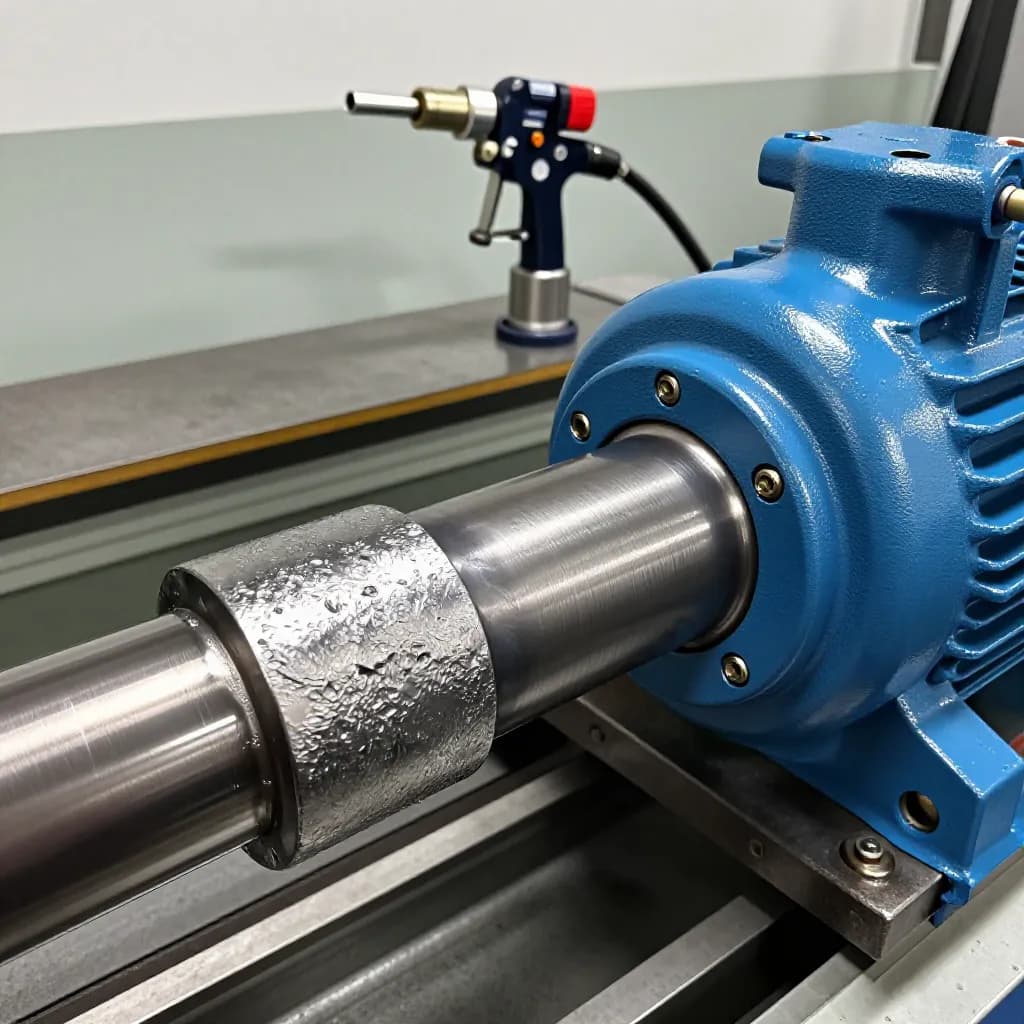
Thermal spray is a family of processes in which coating material — in the form of powder, wire, or rod — is heated to a molten or semi-molten state and propelled at high velocity onto a prepared substrate. The material impacts the surface, flattens into thin splat particles, and builds up layer by layer into a dense coating. The major thermal spray processes include plasma spray (using a plasma arc at 10,000-15,000°C), high-velocity oxy-fuel (HVOF, using combustion gases at 2,500-3,000°C with particle velocities of 600-1,000 m/s), detonation gun (using controlled explosions), flame spray (using an oxy-fuel flame at 2,500-3,000°C), and cold spray (using supersonic gas jets without melting the particles).
Ready to Start Your Project?
From one-off customs to 15,000-part production runs — get precise pricing in 24 hours.
On This Page
Two Coating Worlds: Organic Films vs Metallic and Ceramic Deposits
The materials deposited by thermal spray span a vast range: pure metals (aluminum, zinc, copper, nickel, molybdenum), alloys (stainless steel, Inconel, Hastelloy, MCrAlY), ceramics (alumina, chromia, zirconia, titania), cermets (tungsten carbide-cobalt, chromium carbide-nickel chrome), and polymers (nylon, PEEK). This material versatility allows thermal spray to address applications ranging from corrosion protection of bridges (zinc/aluminum arc spray) to thermal barrier coatings in jet engines (yttria-stabilized zirconia plasma spray) to wear-resistant surfaces on industrial machinery (tungsten carbide HVOF).
Powder coating, while versatile within its domain, is limited to organic polymer materials — polyester, epoxy, hybrid, polyurethane, fluoropolymer, and nylon. These materials provide excellent corrosion protection, aesthetics, and moderate mechanical properties, but they cannot approach the hardness, wear resistance, or thermal capability of metallic and ceramic thermal spray coatings. The comparison between these technologies is therefore not about which is better in absolute terms, but about understanding which technology serves which application requirements.
Hardness, Wear Resistance, and Surface Engineering
Wear resistance is the primary domain where thermal spray coatings dramatically outperform powder coatings, and it is the driving reason for thermal spray's use in industrial and aerospace applications. The hardness values achievable with thermal spray coatings are orders of magnitude higher than organic powder coatings. Tungsten carbide-cobalt (WC-Co) HVOF coatings achieve 1,000-1,400 HV — comparable to the hardest tool steels. Chromium oxide (Cr₂O₃) plasma spray coatings reach 1,200-1,800 HV. Even metallic thermal spray coatings like molybdenum (400-600 HV) and nickel-chromium alloys (300-500 HV) far exceed the hardness of any organic coating.
Powder coatings achieve pencil hardness values of 2H-4H, corresponding to approximately 10-20 HV. This level of hardness provides adequate scratch resistance for decorative and general industrial applications but is wholly insufficient for surfaces subject to abrasive wear, erosive particle impingement, or sliding contact under load. A powder-coated surface in a wear application would be destroyed in hours or days; a thermal spray coating in the same application can last years.
The wear mechanisms that thermal spray coatings address include abrasive wear (hard particles sliding across the surface), adhesive wear (metal-to-metal contact under load), erosive wear (particle impingement at high velocity), fretting wear (small-amplitude oscillatory motion between contacting surfaces), and cavitation erosion (collapse of vapor bubbles in flowing liquids). Each wear mechanism requires specific coating material selection — tungsten carbide for abrasion and erosion, chromium oxide for sliding wear and chemical resistance, nickel-based alloys for high-temperature wear and corrosion.
For industrial applications where wear resistance is the primary requirement — pump shafts, cylinder liners, valve seats, turbine blades, paper mill rolls, textile machinery, and mining equipment — thermal spray coatings are the only viable surface engineering solution. Powder coating has no role in these applications. Conversely, for applications where aesthetics, color, and moderate corrosion protection are the requirements — consumer products, architectural elements, furniture, and general industrial equipment — powder coating is the appropriate technology, and thermal spray would be unnecessarily complex and expensive.
Thermal Protection and Aerospace Applications
Aerospace is the most demanding application domain for thermal spray coatings, and it illustrates capabilities that are entirely beyond the reach of organic powder coatings. Thermal barrier coatings (TBCs) in gas turbine engines — both aircraft engines and industrial power generation turbines — are the flagship application of plasma spray technology. These coatings, typically yttria-stabilized zirconia (YSZ) applied at 200-500 microns over a metallic bond coat (MCrAlY), protect nickel superalloy turbine blades and vanes from combustion gas temperatures that can exceed 1,400°C.
The thermal insulation provided by YSZ TBCs — with thermal conductivity of only 2.0-2.3 W/m·K — allows turbine inlet temperatures to exceed the melting point of the underlying superalloy substrate. This enables higher engine efficiency and power output, directly contributing to fuel savings and reduced emissions. Without thermal spray TBCs, modern high-efficiency gas turbines would not be possible.
Abradable coatings are another critical aerospace thermal spray application. These coatings — typically porous metallic or ceramic materials — are applied to the inner surface of turbine and compressor casings. When rotating blade tips contact the abradable coating, the coating wears preferentially, maintaining tight clearances without damaging the blades. This clearance control improves engine efficiency by reducing gas leakage past the blade tips.
Aerospace also uses thermal spray for dimensional restoration — rebuilding worn surfaces on landing gear, actuator shafts, and bearing journals to original dimensions using hard chrome replacement coatings (typically HVOF tungsten carbide or nickel-based alloys). This extends the service life of expensive aerospace components that would otherwise be scrapped when wear exceeds tolerance limits.
Powder coating's role in aerospace is limited to non-structural, non-critical applications — equipment housings, ground support equipment, and interior furnishings where aesthetics and basic corrosion protection are the requirements. For any application involving extreme temperatures, wear, or structural performance, thermal spray coatings are the only option. The two technologies serve entirely different segments of the aerospace industry.
Bond Strength, Coating Integrity, and Quality Control
Bond strength — the adhesion between the coating and the substrate — is a critical performance metric for both powder coating and thermal spray, but the bonding mechanisms and typical values differ significantly. Powder coating bonds to the substrate through a combination of mechanical adhesion (promoted by surface roughness from pretreatment) and chemical adhesion (promoted by conversion coatings that create chemical bonds between the organic coating and the metal oxide surface). Bond strengths for powder coatings are typically measured by cross-hatch adhesion testing (ASTM D3359) rather than tensile pull-off testing, and well-applied powder coatings achieve the highest rating (5B) consistently.
Thermal spray coatings bond primarily through mechanical interlocking — the molten or semi-molten particles impact the roughened substrate surface, flatten into splats, and mechanically lock into the surface profile. Bond strengths are measured by tensile pull-off testing (ASTM C633) and typically range from 15-40 MPa for plasma spray coatings, 40-80 MPa for HVOF coatings, and 10-30 MPa for flame spray coatings. HVOF coatings achieve the highest bond strengths due to the high particle velocity and dense coating structure.
Coating integrity — the internal cohesion and density of the coating — also differs between the technologies. Powder coatings, once cured, form a continuous, pore-free film with no internal defects. The melt-flow-crosslink process eliminates any porosity or particle boundaries present in the uncured powder layer. Thermal spray coatings, by contrast, have an inherent lamellar (layered) microstructure with inter-splat boundaries, porosity (typically 1-15% depending on the process and material), and oxide inclusions. This microstructure affects the coating's mechanical properties, corrosion resistance, and thermal conductivity.
HVOF coatings achieve the densest microstructure among thermal spray processes — typically less than 1-2% porosity — due to the high particle velocity that produces thorough splat deformation and inter-splat bonding. Plasma spray coatings are typically 3-10% porous, which is acceptable for thermal barrier applications (where porosity actually reduces thermal conductivity, improving insulation) but may require sealing for corrosion protection applications.
Quality control for thermal spray coatings is more complex than for powder coatings. Thermal spray quality is assessed through metallographic cross-section analysis (microstructure, porosity, oxide content), hardness testing, bond strength testing, and non-destructive thickness measurement. Powder coating quality control is simpler — thickness measurement, adhesion testing, gloss measurement, and visual inspection are the standard checks. The greater complexity of thermal spray quality control reflects the more demanding applications and tighter performance requirements these coatings serve.
Process Comparison: Equipment, Cost, and Accessibility
The equipment, expertise, and cost requirements for thermal spray and powder coating differ by orders of magnitude, reflecting the different application domains and performance levels of each technology. Powder coating equipment ranges from entry-level DIY setups costing a few hundred dollars to fully automated industrial lines costing several million dollars. The technology is accessible to small job shops, medium manufacturers, and large OEMs alike. Operator training is straightforward, and the process variables (powder flow, gun distance, cure temperature and time) are well-understood and easily controlled.
Thermal spray equipment is specialized, expensive, and requires significant operator expertise. A plasma spray system — including the plasma gun, power supply (40-80 kW), gas supply, powder feeder, robot or manipulator, spray booth with dust collection, and process control system — represents a capital investment of several hundred thousand to over a million dollars. HVOF systems are similarly expensive, with the additional cost of fuel gas supply and high-pressure gas handling equipment. The operating costs are also higher — plasma spray consumes significant electrical power and process gases (argon, hydrogen, nitrogen), while HVOF consumes oxygen and fuel gas (hydrogen, kerosene, or propylene) at high rates.
Operator expertise requirements are substantially higher for thermal spray. Thermal spray operators must understand the relationships between process parameters (power, gas flow, spray distance, traverse speed, powder feed rate) and coating properties (thickness, porosity, hardness, bond strength). Incorrect parameters can produce coatings with excessive porosity, poor adhesion, residual stress, or inadequate properties. Thermal spray operator certification programs (such as those offered by the International Thermal Spray Association) formalize the training requirements.
The cost per unit area of thermal spray coatings is typically 5-50 times higher than powder coating, depending on the material, process, and application requirements. This cost premium is justified by the extreme performance properties that thermal spray delivers — properties that powder coating cannot approach. For applications that require thermal spray performance, the cost is an investment in component longevity and system reliability. For applications where powder coating's performance is adequate, thermal spray would be an unnecessary and unjustifiable expense.
The thermal spray industry serves a relatively small number of high-value applications — aerospace, power generation, oil and gas, mining, paper and printing, and heavy industry — where the performance requirements justify the cost and complexity. The powder coating industry serves a vastly larger market of general industrial, architectural, automotive, and consumer applications where aesthetics, corrosion protection, and moderate mechanical properties are the requirements.
Corrosion Protection: Different Approaches for Different Scales
Both powder coating and thermal spray can provide corrosion protection, but they do so through different mechanisms and at different scales of application. Powder coating provides barrier corrosion protection — the organic film physically isolates the metal substrate from the corrosive environment. This approach is effective for the vast majority of corrosion protection applications, from architectural aluminum to industrial steel equipment, and is the most cost-effective corrosion protection method for components that can be oven-cured.
Thermal spray corrosion protection uses metallic coatings — typically zinc, aluminum, or zinc-aluminum alloys — applied by arc spray or flame spray. These metallic coatings provide both barrier protection and cathodic (sacrificial) protection, similar to hot-dip galvanizing but applicable to structures too large for immersion in a zinc bath. Arc-sprayed zinc or aluminum coatings are used to protect bridges, offshore platforms, storage tanks, and other large steel structures that cannot be powder coated due to size constraints or the inability to oven-cure.
The cathodic protection mechanism of thermally sprayed zinc and aluminum is a significant advantage over organic powder coatings for large structures. If the coating is damaged — by impact, abrasion, or welding — the exposed steel is cathodically protected by the surrounding zinc or aluminum, preventing corrosion at the damage site. Powder coating provides no cathodic protection — any breach in the organic film exposes the steel to corrosion.
For structures that can be powder coated — components that fit in a curing oven and can withstand cure temperatures — powder coating is generally the more cost-effective and aesthetically superior corrosion protection option. For structures that are too large for oven curing, that require field application, or that need cathodic protection at damage sites, thermally sprayed metallic coatings are the appropriate choice. Some specifications combine both — thermally sprayed zinc or aluminum as a primer, sealed and topcoated with liquid paint for aesthetics and additional barrier protection. This approach is common for bridges and offshore structures where maximum corrosion protection and long service life are critical.
Choosing the Right Technology for Your Application
The choice between powder coating and thermal spray is usually straightforward because the two technologies serve distinctly different performance requirements with minimal overlap. Choose powder coating when the application requires corrosion protection, aesthetics (color, gloss, texture), moderate mechanical protection, and cost-effective finishing for components that can be oven-cured. This encompasses the vast majority of metal finishing applications — consumer products, furniture, architectural elements, automotive components, electrical enclosures, and general industrial equipment.
Choose thermal spray when the application requires extreme wear resistance (abrasion, erosion, sliding wear), thermal protection (temperatures above 200°C), dimensional restoration of worn components, or corrosion protection of structures too large for oven curing. These applications are found in aerospace, power generation, oil and gas, mining, heavy industry, and large-scale infrastructure.
The overlap between the two technologies is small. Thermoplastic powder coatings applied by fluidized bed (nylon, polyethylene) provide moderate wear resistance and thick-film protection that bridges the gap between standard electrostatic powder coating and thermal spray for some applications — conveyor components, food processing equipment, and chemical handling equipment. But for true high-performance wear and thermal applications, thermal spray remains in a class of its own.
For engineers and designers, the key is matching the coating technology to the actual performance requirements of the application. Over-specifying thermal spray for an application that only needs powder coating wastes money and adds unnecessary process complexity. Under-specifying powder coating for an application that needs thermal spray leads to premature failure and costly downtime. Understanding the capabilities and limitations of both technologies enables optimal specification decisions that balance performance, cost, and practicality.
The surface engineering field continues to evolve, with new coating materials, improved process control, and hybrid approaches expanding the capabilities of both powder coating and thermal spray. Cold spray technology, for example, is enabling metallic coating deposition at lower temperatures with reduced oxidation, potentially expanding thermal spray into applications currently served by other technologies. Similarly, advances in powder coating chemistry — including high-temperature and wear-resistant formulations — are pushing the boundaries of what organic coatings can achieve.
Frequently Asked Questions
Is thermal spray harder than powder coating?
Yes, dramatically. Thermal spray coatings achieve 300-1,800 HV depending on the material, while powder coatings reach only 10-20 HV. This extreme hardness makes thermal spray essential for wear-resistant surfaces in industrial machinery, aerospace, and heavy equipment. Powder coating's moderate hardness is adequate for decorative and general protective applications.
Can powder coating replace thermal spray for wear applications?
No. Powder coating's organic polymer film cannot approach the wear resistance of metallic and ceramic thermal spray coatings. For surfaces subject to abrasive wear, erosion, or sliding contact under load, thermal spray is the only viable coating technology. Powder coating serves different applications where aesthetics and corrosion protection are the priorities.
Why is thermal spray so much more expensive than powder coating?
Thermal spray requires specialized equipment (plasma guns, HVOF systems), expensive feedstock materials (tungsten carbide, ceramic powders, superalloys), skilled operators, and complex quality control. The cost is justified by the extreme performance properties delivered. For applications where powder coating's performance is adequate, thermal spray would be unnecessarily expensive.
Is thermal spray used for corrosion protection like powder coating?
Yes, but for different applications. Thermally sprayed zinc and aluminum coatings protect large structures (bridges, offshore platforms) that are too big for powder coating ovens. These metallic coatings provide cathodic protection that powder coating cannot. For components that can be oven-cured, powder coating is more cost-effective and aesthetically superior.
What industries use thermal spray vs powder coating?
Thermal spray serves aerospace, power generation, oil and gas, mining, and heavy industry where extreme wear resistance and thermal protection are required. Powder coating serves a much broader market including architecture, automotive, consumer products, furniture, and general industrial manufacturing where aesthetics and corrosion protection are the primary needs.
Ready to Start Your Project?
From one-off customs to 15,000-part production runs — get precise pricing in 24 hours.