Hard anodizing, also known as Type III anodizing or hardcoat anodizing, is an electrochemical process that produces a thick, extremely hard aluminum oxide layer on aluminum substrates. The process is similar to standard decorative anodizing (Type II) but uses lower temperatures, higher current densities, and longer processing times to produce an oxide layer that is significantly thicker and harder than decorative anodizing. Hard anodized coatings typically range from 25 to 150 microns in thickness, compared to 5 to 25 microns for decorative anodizing.
Comparison
Powder Coating vs Hard Anodizing: Wear Resistance, Hardness, and Aerospace Performance
Sundial Powder Coating·April 22, 2026·11 min
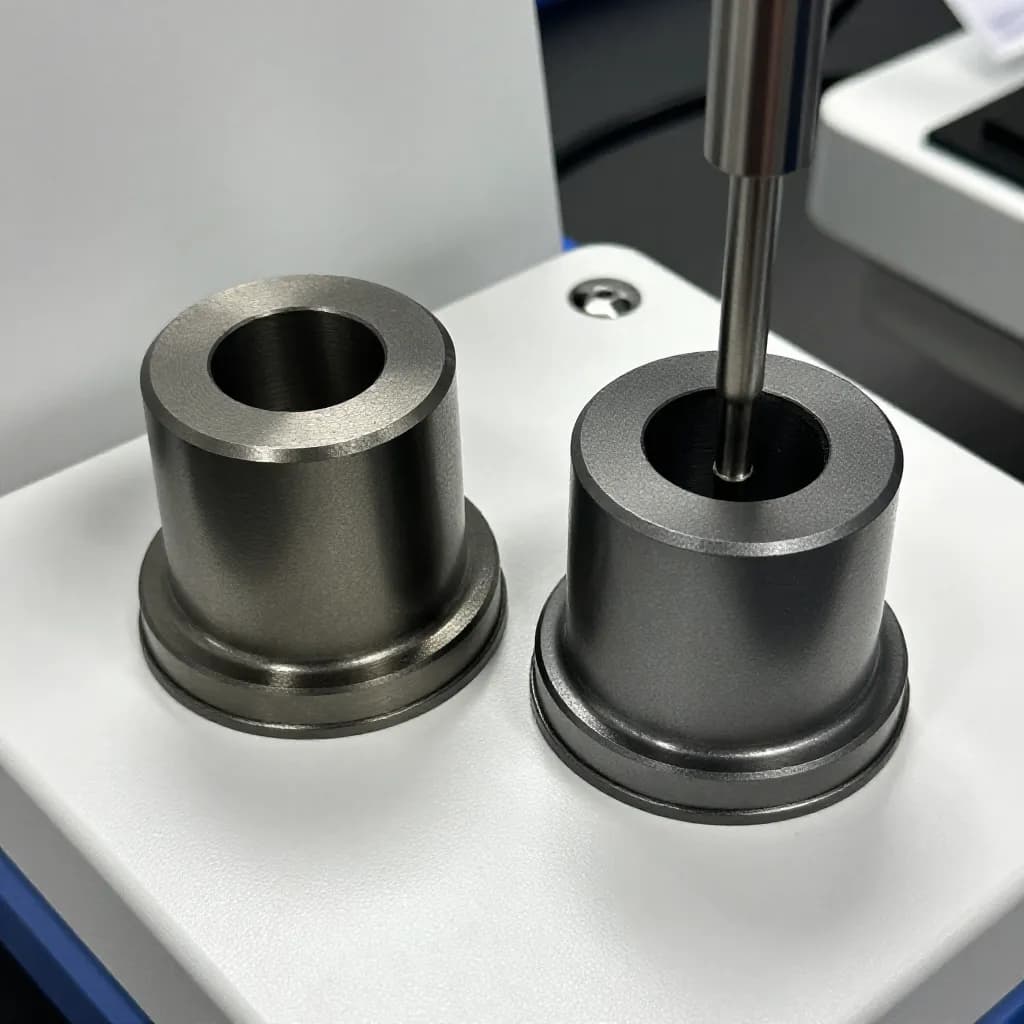
The resulting aluminum oxide layer is one of the hardest coating materials available, with hardness values of 60 to 70 on the Rockwell C scale — comparable to tool steel and approaching the hardness of some ceramic materials. This extreme hardness makes hard anodizing an effective wear-resistant surface treatment for aluminum components that must withstand sliding contact, abrasion, and erosion in demanding service environments.
Ready to Start Your Project?
From one-off customs to 15,000-part production runs — get precise pricing in 24 hours.
On This Page
What Is Hard Anodizing?
Hard anodizing is specified extensively in military, aerospace, and industrial applications. Military weapon systems, aircraft hydraulic components, missile guidance housings, optical equipment, and industrial automation components all use hard anodizing to provide wear resistance, corrosion protection, and electrical insulation on aluminum parts. The process is governed by military specification MIL-A-8625 Type III and is a standard finish in defense and aerospace manufacturing.
Hardness and Wear Resistance Comparison
Hardness is the defining characteristic of hard anodizing and the primary reason it is specified over powder coating for wear-critical applications. The aluminum oxide layer produced by hard anodizing achieves hardness values of 60 to 70 Rockwell C, which is harder than most steels and many tool materials. This hardness translates directly into exceptional abrasion resistance — hard anodized surfaces can withstand thousands of cycles of sliding contact, particle erosion, and mechanical wear that would quickly destroy organic coatings.
Powder coatings are organic polymer films with hardness values in the range of 200 to 300 Vickers (approximately 20 to 30 Rockwell C equivalent), which is adequate for resisting casual scratching and handling damage but far below the hardness needed for engineering wear surfaces. A powder-coated surface subjected to the same sliding contact or abrasive wear that a hard anodized surface withstands would wear through in a fraction of the time.
For applications where the coating must function as a wear-resistant bearing surface — hydraulic cylinder bores, piston surfaces, valve seats, guide rails, and sliding mechanisms — hard anodizing is the appropriate choice. Powder coating cannot serve as an engineering wear surface and should not be specified for applications where the coating must resist sustained mechanical wear. However, for applications where the coating's primary function is corrosion protection, UV resistance, and decorative finish, powder coating provides superior performance in these areas.
Corrosion Protection Approaches
Both hard anodizing and powder coating provide excellent corrosion protection for aluminum, but through different mechanisms. Hard anodizing creates a thick, dense aluminum oxide barrier that is inherently corrosion-resistant. The oxide layer is chemically stable in neutral and mildly acidic environments and provides excellent protection against atmospheric corrosion, salt spray, and many industrial chemicals. When properly sealed, hard anodized coatings can exceed 1000 hours of salt spray resistance.
Powder coating provides corrosion protection through a thick organic polymer barrier combined with a chemical pretreatment on the aluminum substrate. The combination of conversion coating and powder film creates a robust protective system that also exceeds 1000 hours of salt spray resistance when properly applied. Powder coating's organic film provides additional protection against alkaline environments that can attack aluminum oxide, giving it an advantage in environments where alkaline chemicals, wet cement, or strong cleaning agents are present.
The practical difference in corrosion protection between the two finishes is minimal for most applications — both provide excellent long-term protection for aluminum in atmospheric and mildly corrosive environments. The choice between them for corrosion protection alone is less important than the choice based on other performance requirements such as hardness, appearance, or UV resistance.
Military and Aerospace Applications
The military and aerospace sectors use both hard anodizing and powder coating extensively, but for different component types and performance requirements. Hard anodizing is specified for components where wear resistance, dimensional precision, and electrical insulation are critical — weapon system housings, optical equipment mounts, hydraulic actuator components, missile guidance system housings, and aircraft structural fittings. The MIL-A-8625 Type III specification defines the requirements for hard anodizing in military applications.
Powder coating is specified for military and aerospace components where corrosion protection, UV resistance, color coding, and decorative finish are the primary requirements — vehicle body panels, equipment enclosures, ammunition containers, ground support equipment, and exterior aircraft components. Military powder coating specifications such as MIL-PRF-32348 define performance requirements for powder coatings used in defense applications.
Many military and aerospace assemblies use both finishes on different components within the same system. An aircraft landing gear assembly might have hard anodized hydraulic cylinder bores for wear resistance, hard anodized actuator housings for corrosion protection and electrical insulation, and powder-coated external fairings and covers for UV resistance and color identification. This combined approach uses each finish where its specific performance characteristics are most needed.
Thickness, Weight, and Dimensional Considerations
Hard anodizing and powder coating produce coatings of similar thickness ranges but with important dimensional differences. Hard anodizing typically produces coatings of 25 to 150 microns, while powder coating produces coatings of 60 to 120 microns. However, hard anodizing grows both outward from and inward into the aluminum surface — approximately 50 percent of the coating thickness penetrates into the substrate. This means a 50-micron hard anodized coating adds only about 25 microns to the external dimension of the part, while a 50-micron powder coating adds the full 50 microns.
This dimensional characteristic gives hard anodizing an advantage for precision components. Engineers can specify hard anodizing thickness and predict the dimensional change with reasonable accuracy, allowing them to design parts that maintain critical tolerances after finishing. The inward growth of the oxide layer also means that hard anodized parts are dimensionally closer to their original size than powder-coated parts of equivalent coating thickness.
Weight is another consideration in aerospace applications. Hard anodizing converts existing aluminum into aluminum oxide, adding minimal weight to the component. Powder coating adds the full weight of the applied polymer film. For weight-critical aerospace components, hard anodizing's lower weight addition can be a meaningful advantage, particularly on large structural components where even small weight savings are valued.
Color, Appearance, and UV Performance
Appearance and UV resistance are areas where powder coating holds clear advantages over hard anodizing. Hard anodized coatings are typically dark gray to black in color, with the darkness increasing with coating thickness. While the coating can be dyed before sealing, the dark base color limits the achievable color range — light and bright colors are not possible on thick hard anodized coatings. The surface finish is typically matte to semi-matte, with a characteristic hard, industrial appearance.
Powder coating offers virtually unlimited color options — any color from the RAL, NCS, or custom color systems can be matched, and finishes range from high gloss to deep matte, smooth to textured, solid to metallic. This design flexibility makes powder coating the clear choice for applications where specific colors, brand identity, or decorative appeal are important. Consumer products, architectural components, and commercial equipment all benefit from powder coating's aesthetic versatility.
UV resistance is comparable for both finishes in terms of substrate protection, but powder coating maintains its color and gloss through outdoor exposure while hard anodizing's appearance is essentially unchanged by UV because the aluminum oxide is inherently UV-stable. However, dyed hard anodized colors can fade with UV exposure, particularly lighter dye colors. For outdoor applications where color retention is important, powder coating with UV-resistant polyester formulations provides the most reliable long-term color stability.
Choosing Between Hard Anodizing and Powder Coating
Choose hard anodizing when the application requires extreme surface hardness and wear resistance on aluminum components. Hydraulic cylinders, bearing surfaces, sliding mechanisms, valve components, and any aluminum part subject to sustained mechanical wear should be hard anodized. Also choose hard anodizing when electrical insulation, dimensional precision, or minimum weight addition are critical requirements — the aluminum oxide layer provides excellent electrical insulation and adds less dimension and weight than powder coating.
Choose powder coating when the application requires decorative finish, specific colors, UV resistance, or thick-film corrosion protection on aluminum components. Architectural panels, consumer products, automotive accessories, outdoor furniture, and equipment enclosures all benefit from powder coating's combination of protection, appearance, and design flexibility. Powder coating is also the better choice when the aluminum will be exposed to alkaline environments that could attack the aluminum oxide layer of hard anodizing.
For aluminum products that require both wear resistance on functional surfaces and decorative finish on visible surfaces, consider using both finishes on different areas of the same component. This combined approach is common in military, aerospace, and industrial applications where different surfaces of the same part have different performance requirements. Hard anodize the wear surfaces and powder coat the exterior — each finish performing the function it does best.
Frequently Asked Questions
Is hard anodizing harder than powder coating?
Yes, dramatically. Hard anodizing achieves 60-70 Rockwell C hardness, comparable to tool steel. Powder coating achieves approximately 20-30 Rockwell C equivalent. Hard anodizing is an engineering wear surface; powder coating is a protective and decorative finish. They serve fundamentally different functions.
Can powder coating replace hard anodizing for wear resistance?
No. Powder coating is an organic polymer film that cannot match the hardness or abrasion resistance of hard anodized aluminum oxide. For applications requiring wear-resistant surfaces — hydraulic cylinders, bearing surfaces, sliding mechanisms — hard anodizing is the appropriate choice. Powder coating is better suited for corrosion protection and decorative finishing.
Which is better for outdoor aluminum, hard anodizing or powder coating?
For outdoor decorative applications, powder coating is generally better because it offers unlimited color options, excellent UV color retention, and resistance to alkaline environments. Hard anodizing provides excellent outdoor durability but is limited to dark gray/black colors and can be attacked by alkaline substances like wet cement.
Does hard anodizing add as much thickness as powder coating?
Hard anodizing grows approximately 50% outward and 50% inward into the aluminum, so a 50-micron coating adds only about 25 microns to external dimensions. Powder coating adds its full thickness externally. This makes hard anodizing better for precision components with tight dimensional tolerances.
Can you use both hard anodizing and powder coating on the same part?
Yes. Many military and aerospace components use hard anodizing on wear surfaces and powder coating on exterior decorative surfaces. This combined approach leverages the hardness of anodizing where wear resistance is needed and the color and UV resistance of powder coating where appearance matters.
Ready to Start Your Project?
From one-off customs to 15,000-part production runs — get precise pricing in 24 hours.