Electroplating and powder coating are both widely used surface finishing technologies, but they operate through entirely different physical and chemical principles. Electroplating is an electrochemical deposition process in which metal ions dissolved in an electrolyte solution are reduced and deposited onto a conductive substrate by passing an electrical current through the solution. The workpiece serves as the cathode (negative electrode), and a sacrificial anode of the plating metal (or an inert anode with metal salts added to the solution) provides the metal ions. Common electroplated metals include chromium, nickel, zinc, copper, tin, gold, and silver — each offering distinct functional and decorative properties.
Comparison
Powder Coating vs Electroplating: Key Differences Explained
Sundial Powder Coating·April 22, 2026·14 min
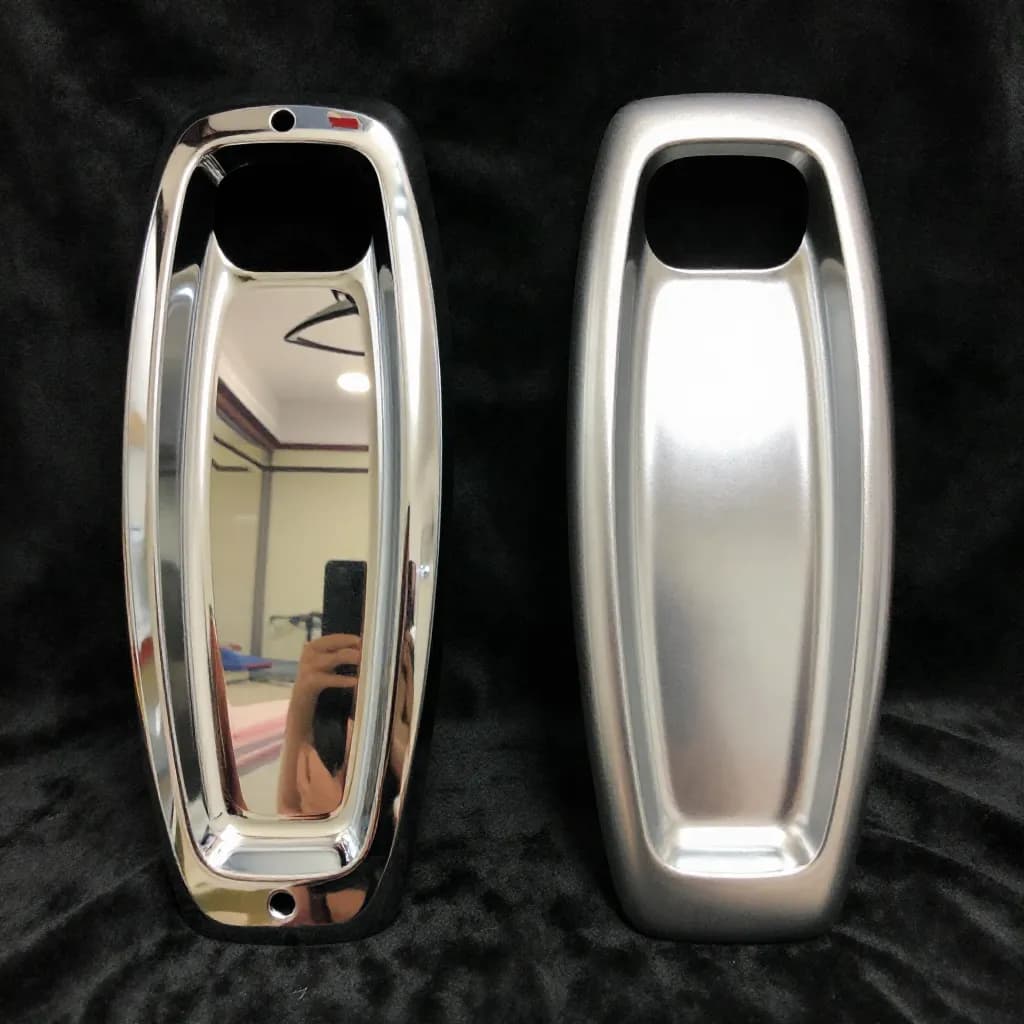
The electroplating process produces extremely thin metallic coatings — typically 0.5-50 microns depending on the metal and application. Decorative chrome plating, for example, is applied at just 0.25-0.5 microns over a much thicker nickel undercoat of 10-40 microns. Zinc plating for corrosion protection is typically 5-25 microns. These thin metallic films provide specific functional properties — hardness, conductivity, solderability, reflectivity, or corrosion resistance — that organic coatings cannot replicate.
Ready to Start Your Project?
From one-off customs to 15,000-part production runs — get precise pricing in 24 hours.
On This Page
Understanding Electroplating and Powder Coating Processes
Powder coating, by contrast, deposits a thick organic polymer film (60-120 microns typical) through electrostatic attraction rather than electrochemical deposition. The dry powder particles are charged by a corona or tribo-charging gun and attracted to the grounded workpiece. After deposition, the powder is cured in an oven where it melts, flows, and crosslinks into a continuous film. The resulting coating is orders of magnitude thicker than most electroplated deposits and provides barrier protection, color, and texture rather than the metallic surface properties that electroplating delivers.
These fundamental differences mean that electroplating and powder coating serve different — though sometimes overlapping — application spaces. The choice between them depends on whether the application requires metallic surface properties (conductivity, reflectivity, hardness) or organic coating properties (color, thickness, barrier protection, flexibility).
Thickness, Hardness, and Mechanical Properties
The mechanical properties of electroplated and powder-coated surfaces differ dramatically due to the fundamental difference between metallic and organic films. Electroplated chromium is one of the hardest commercially applied coatings, achieving 800-1,000 HV (Vickers hardness) for hard chrome and 700-900 HV for decorative chrome. This extreme hardness provides outstanding wear resistance, making hard chrome plating the standard for hydraulic cylinders, piston rings, printing rolls, and other components subject to sliding wear. Electroplated nickel achieves 150-700 HV depending on the bath chemistry and process parameters, with sulfamate nickel at the lower end and electroless nickel-phosphorus at the higher end.
Powder coatings are organic polymer films with hardness values typically in the range of 2H-4H on the pencil hardness scale, which corresponds roughly to 10-20 HV — orders of magnitude softer than electroplated metals. However, powder coatings compensate with properties that electroplated metals lack: flexibility, impact resistance, and thick-film barrier protection. A powder-coated surface can absorb impacts that would crack or chip a hard chrome or nickel deposit, and the thick organic film provides far superior barrier protection against chemical exposure and moisture permeation.
Thickness control differs significantly between the two processes. Electroplating thickness is controlled by current density, plating time, and bath chemistry, and can be precisely specified from sub-micron to several hundred microns for hard chrome. However, achieving uniform thickness on complex geometries is challenging — current density concentrates at edges, corners, and protrusions (the "dog bone" effect), producing thicker deposits at high-current-density areas and thinner deposits in recesses and internal surfaces. This non-uniformity requires careful rack design, auxiliary anodes, and current thieves to manage.
Powder coating achieves more uniform coverage on complex shapes, though it faces its own challenges with Faraday cage effects in deep recesses and internal corners. The electrostatic field lines that guide charged powder particles tend to concentrate on external surfaces and edges, leaving recesses and internal areas with thinner coverage. Tribo-charging guns, which impart charge through friction rather than corona discharge, can improve penetration into recesses. Overall, powder coating provides more consistent coverage on moderately complex geometries than electroplating, though neither process achieves perfect uniformity on highly complex shapes.
Environmental Concerns and Regulatory Compliance
Environmental and regulatory considerations have become one of the most significant factors driving the shift from electroplating to powder coating in many applications. The electroplating industry faces intense regulatory scrutiny due to the hazardous materials inherent in plating processes. Hexavalent chromium — used in decorative chrome plating, hard chrome plating, and chromate conversion coatings — is classified as a Group 1 carcinogen by the International Agency for Research on Cancer (IARC) and is subject to severe restrictions under the European Union's REACH regulation, where it is listed as a Substance of Very High Concern (SVHC) requiring authorization for continued use.
Nickel plating raises concerns about nickel sensitization — nickel is the most common cause of contact dermatitis in the general population, and the EU Nickel Directive restricts nickel release from products intended for prolonged skin contact. Cadmium plating, once widely used in aerospace and military applications, is now heavily restricted due to cadmium's extreme toxicity and carcinogenicity. Cyanide-based plating baths, used for copper, zinc, cadmium, gold, and silver plating, present acute toxicity hazards and require stringent safety controls.
The RoHS (Restriction of Hazardous Substances) Directive restricts hexavalent chromium, cadmium, lead, and mercury in electrical and electronic equipment, directly impacting electroplating specifications for these products. The ELV (End of Life Vehicles) Directive imposes similar restrictions on automotive components. These regulations have driven significant reformulation of plating processes — trivalent chromium plating replacing hexavalent, zinc-nickel and zinc-flake coatings replacing cadmium, and cyanide-free bath chemistries replacing cyanide-based processes.
Powder coating's environmental profile is fundamentally cleaner. The process uses no solvents (zero VOC emissions), no heavy metals in the coating formulation (standard powder coatings are free of hexavalent chromium, cadmium, lead, and mercury), and generates minimal waste thanks to 95-98% material reclaim. Wastewater from pretreatment stages requires treatment, but the volumes and hazard levels are far lower than those from electroplating rinse waters. For manufacturers seeking to simplify environmental compliance and reduce regulatory risk, powder coating offers a significantly more straightforward path than electroplating.
Decorative Applications: Chrome Look vs Color Freedom
In decorative applications, electroplating and powder coating serve different aesthetic objectives. Electroplated chrome and nickel produce a mirror-like metallic finish with a depth and reflectivity that no organic coating can truly replicate. The bright, reflective chrome finish has been a hallmark of automotive trim, bathroom fixtures, furniture hardware, and consumer electronics for decades. Nickel plating provides a warm, slightly yellowish metallic finish that is often used as an undercoat for chrome or as a standalone decorative finish.
However, the aesthetic dominance of chrome plating is being challenged by both regulatory pressure and evolving design trends. As hexavalent chromium restrictions tighten, manufacturers are exploring alternatives including trivalent chrome plating (which produces a slightly different color tone), physical vapor deposition (PVD), and chrome-effect powder coatings. Chrome-look powder coatings use metallic pigments, vacuum metallization, or specialized bonding techniques to approximate the appearance of chrome plating, though they do not achieve the same mirror-like reflectivity. For applications where a bright metallic appearance is desired but true mirror chrome is not essential, these powder coating alternatives offer a compliant, cost-effective solution.
Powder coating's decorative strength lies in its unlimited color palette and finish variety. Where electroplating is limited to the natural colors of deposited metals — silver chrome, warm nickel, yellow gold, copper, brass — powder coating can produce any color imaginable in matte, satin, semi-gloss, gloss, textured, metallic, pearlescent, and special-effect finishes. This makes powder coating the default choice for consumer products, furniture, appliances, and architectural components where brand colors, design themes, or custom aesthetics are required.
The trend in automotive design toward satin, matte, and dark metallic finishes has further expanded powder coating's decorative role. Satin black, gunmetal gray, and dark bronze finishes that were once achieved through specialized plating processes are now routinely produced with powder coatings that offer better durability, easier application, and lower environmental impact. As design preferences continue to evolve away from bright chrome toward more subtle metallic and matte aesthetics, powder coating's share of decorative finishing continues to grow.
Functional Applications: When Electroplating Is Essential
Despite powder coating's advantages in environmental compliance, color range, and barrier protection, there are functional applications where electroplating remains essential and cannot be replaced by organic coatings. Electrical conductivity is the most obvious example — electroplated copper, silver, gold, and tin provide the conductive surfaces required for electrical connectors, circuit board contacts, and electromagnetic shielding. Powder coatings are electrical insulators and cannot serve these functions.
Hard chrome plating remains the standard for wear surfaces in hydraulic and pneumatic cylinders, where the combination of extreme hardness (800-1,000 HV), low friction coefficient, and precise dimensional control is critical. While thermal spray coatings and advanced PVD/CVD coatings are emerging as alternatives, hard chrome's combination of performance, repairability, and cost-effectiveness keeps it dominant in many industrial applications despite environmental pressures.
Solderability is another function that requires metallic plating. Tin and tin-lead plating provide the solderable surfaces needed for electronic component leads and PCB pads. Nickel plating serves as a barrier layer to prevent copper migration in electronic assemblies. Gold plating provides reliable, low-resistance contact surfaces for connectors and switches. These functional requirements are inherent to the metallic nature of electroplated deposits and cannot be met by organic coatings.
Zinc and zinc-alloy electroplating (zinc-nickel, zinc-iron, zinc-cobalt) provides thin-film corrosion protection for fasteners, brackets, and small components where the thickness of powder coating would be impractical. A zinc-nickel plating at 8-15 microns with a trivalent chromate passivation can provide 720-1,000 hours of salt spray resistance in a total coating thickness that is a fraction of what powder coating requires. For threaded fasteners, precision bearings, and close-tolerance assemblies, this thin-film protection is essential.
The key insight is that electroplating and powder coating are not direct competitors across their full application ranges. They overlap in decorative and general corrosion protection applications, where powder coating increasingly wins on environmental, cost, and aesthetic grounds. But for functional metallic properties — conductivity, solderability, extreme hardness, and thin-film precision — electroplating remains indispensable.
Process Economics and Production Considerations
The economics of electroplating versus powder coating differ substantially in terms of capital investment, operating costs, throughput, and waste management. Electroplating lines require significant capital investment in chemical processing tanks, rectifiers, filtration systems, fume extraction, wastewater treatment, and environmental monitoring equipment. A typical decorative nickel-chrome plating line may include 20-40 process tanks for cleaning, activation, copper strike, semi-bright nickel, bright nickel, microporous nickel, decorative chrome, and multiple rinse stages. The chemical inventory is complex and includes hazardous materials requiring specialized storage, handling, and disposal.
Powder coating lines are generally simpler and less capital-intensive for equivalent throughput. A basic powder coating line consists of a pretreatment system (wash tunnel or immersion tanks), dry-off oven, powder spray booth with reclaim system, and curing oven. The chemical inventory is limited to pretreatment chemicals and powder coating material — no hazardous plating solutions, no cyanide, no hexavalent chromium. This simplicity translates to lower operating costs, simpler environmental compliance, and reduced regulatory burden.
Throughput characteristics differ between the two processes. Electroplating is inherently a batch process with cycle times determined by the required deposit thickness and plating rate — decorative nickel-chrome plating may require 30-60 minutes of total immersion time across all process stages. Powder coating can be operated as either a batch or continuous conveyorized process, with typical cycle times of 20-40 minutes including pretreatment, powder application, and curing. For high-volume production, conveyorized powder coating lines achieve higher throughput than batch electroplating lines.
Waste management costs are a significant differentiator. Electroplating generates hazardous wastewater containing dissolved metals (chromium, nickel, copper, zinc) that requires chemical treatment, pH adjustment, and sludge disposal. The sludge is classified as hazardous waste in most jurisdictions and must be disposed of at licensed facilities. Powder coating generates minimal waste — overspray is reclaimed, pretreatment wastewater volumes are lower, and the waste streams contain no heavy metals from the coating process itself.
Making the Right Choice: Decision Framework
Selecting between powder coating and electroplating requires evaluating the specific functional, aesthetic, environmental, and economic requirements of the application. The decision framework begins with functional requirements: if the application requires electrical conductivity, solderability, extreme surface hardness, or thin-film dimensional precision, electroplating is likely necessary. If the application requires color, thick-film barrier protection, impact resistance, or UV stability, powder coating is the appropriate choice.
For decorative applications where both technologies could technically serve, the decision increasingly favors powder coating due to its environmental advantages, broader color palette, and lower regulatory burden. The automotive industry's shift from chrome-plated trim to painted and powder-coated alternatives reflects this trend, driven by both regulatory pressure on hexavalent chromium and design trends favoring matte, satin, and colored finishes over bright chrome.
For corrosion protection of small components and fasteners, zinc and zinc-alloy electroplating remains competitive due to its thin-film efficiency and cathodic protection capability. However, for larger components and assemblies, powder coating's thicker barrier film, aesthetic versatility, and simpler environmental profile make it the preferred choice. The growing availability of zinc-rich powder primers and zinc flake coatings is further expanding powder coating's reach into applications traditionally served by zinc electroplating.
Environmental and regulatory trajectory is an important strategic consideration. Regulations on hexavalent chromium, nickel, cadmium, and other plating chemicals continue to tighten globally. Manufacturers who proactively transition from electroplating to powder coating — where technically feasible — reduce their regulatory risk, simplify their environmental compliance, and position themselves favorably for future restrictions. This strategic dimension, combined with powder coating's technical and economic advantages for most decorative and general protection applications, explains the ongoing shift from electroplating to powder coating across multiple industries.
The most sophisticated approach recognizes that electroplating and powder coating are complementary technologies. A product might use zinc-nickel plating on fasteners, electroless nickel on precision-machined surfaces, and powder coating on housings and covers — each finish optimized for its specific functional and aesthetic role. Understanding the strengths and limitations of both technologies enables engineers to specify the optimal finish for each component.
Frequently Asked Questions
Is powder coating more environmentally friendly than electroplating?
Yes, significantly. Powder coating produces zero VOC emissions, uses no heavy metals in the coating, and achieves 95-98% material utilization. Electroplating involves hazardous chemicals including hexavalent chromium, cyanide, and heavy metals, generating hazardous wastewater and sludge requiring specialized treatment and disposal.
Can powder coating replace chrome plating?
For decorative applications, chrome-effect powder coatings and metallic finishes can approximate chrome's appearance, though they don't achieve true mirror reflectivity. For functional hard chrome applications requiring extreme hardness and wear resistance, powder coating is not a direct replacement. Thermal spray and PVD coatings are emerging alternatives for those applications.
Which is thicker, powder coating or electroplating?
Powder coating is much thicker — typically 60-120 microns versus 0.5-50 microns for most electroplated deposits. This thickness gives powder coating superior barrier protection and impact resistance, while electroplating's thin films are advantageous for precision components where dimensional accuracy is critical.
Is electroplating RoHS compliant?
It depends on the specific plating chemistry. Hexavalent chromium and cadmium plating are restricted under RoHS. Trivalent chromium, zinc-nickel, and other alternative plating processes are RoHS compliant. Powder coating is inherently RoHS compliant as standard formulations contain none of the restricted substances.
Why is electroplating still used if powder coating is cleaner?
Electroplating provides unique functional properties that organic coatings cannot replicate: electrical conductivity, solderability, extreme surface hardness, mirror reflectivity, and thin-film precision. For these specific functions, electroplating remains essential. Powder coating excels in decorative, barrier protection, and general corrosion resistance applications.
Ready to Start Your Project?
From one-off customs to 15,000-part production runs — get precise pricing in 24 hours.