Electroless nickel plating is a chemical deposition process that deposits a uniform layer of nickel-phosphorus alloy onto a substrate without the use of electrical current. Unlike electroplating, which requires the part to be connected to a power supply and immersed in an electrolyte bath with a nickel anode, electroless nickel plating relies on a controlled chemical reduction reaction. The part is immersed in a heated solution containing nickel salts and a reducing agent — typically sodium hypophosphite — which causes nickel to deposit uniformly on all surfaces in contact with the solution.
Comparison
Powder Coating vs Electroless Nickel Plating: Precision, Hardness, and Corrosion Protection
Sundial Powder Coating·April 22, 2026·11 min
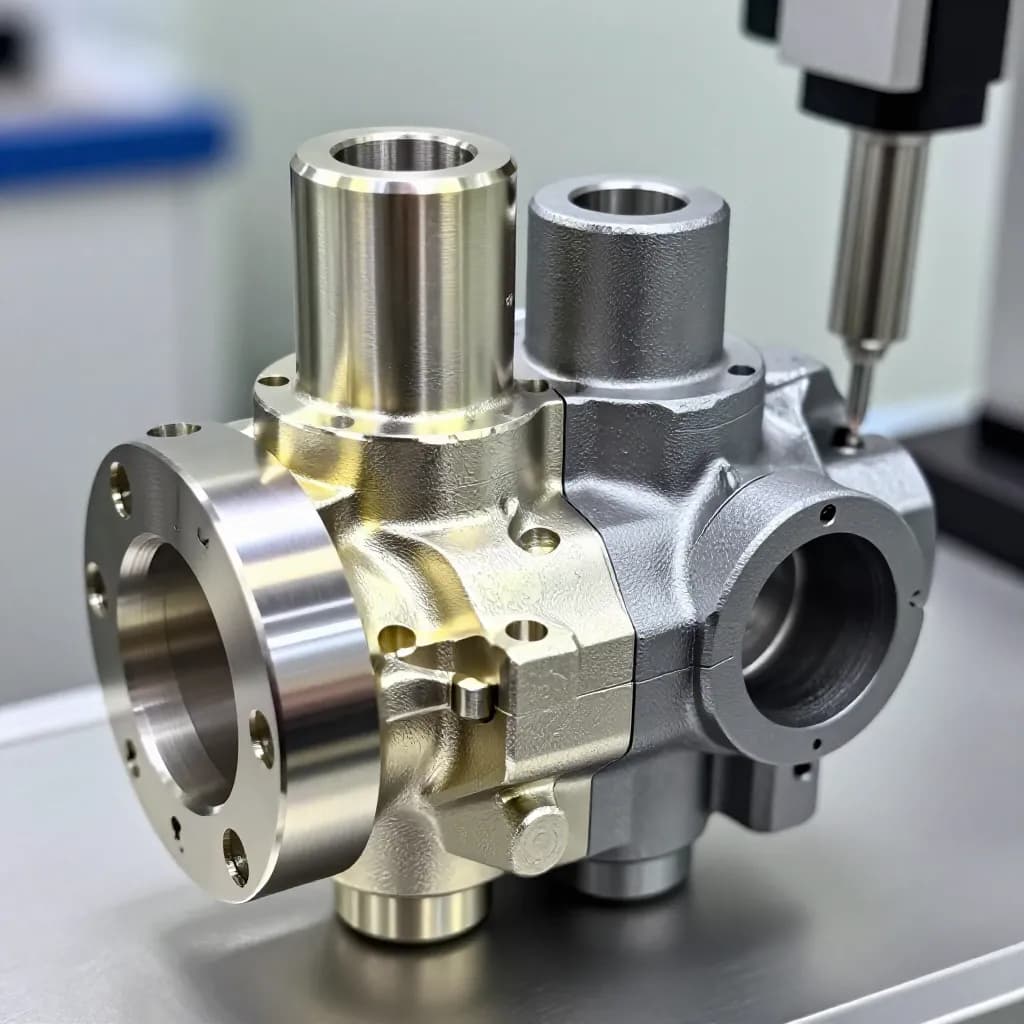
The key advantage of electroless nickel plating is its exceptional uniformity. Because the deposition is chemical rather than electrical, the coating thickness is uniform across the entire part surface, including internal bores, blind holes, threads, and complex recesses. This uniformity is critical for precision components where dimensional tolerances are tight and non-uniform coating thickness would cause functional problems. Electroplating, by contrast, deposits more heavily on edges and high points and less in recesses, requiring careful rack design and current distribution management.
Ready to Start Your Project?
From one-off customs to 15,000-part production runs — get precise pricing in 24 hours.
On This Page
What Is Electroless Nickel Plating?
Electroless nickel coatings are typically applied at thicknesses of 5 to 50 microns, with the phosphorus content ranging from low (2-5 percent) to high (10-13 percent). The phosphorus content determines the coating's properties — low-phosphorus coatings are harder and more wear-resistant, while high-phosphorus coatings offer superior corrosion resistance. Medium-phosphorus coatings (6-9 percent) provide a balance of hardness and corrosion resistance suitable for most applications.
Comparing Protection Mechanisms
Powder coating and electroless nickel plating protect substrates through fundamentally different mechanisms, and understanding these differences is essential for choosing the right finish. Powder coating provides barrier protection through a thick organic polymer film that physically separates the substrate from the environment. The 60 to 120 micron film is dense, continuous, and resistant to moisture, chemicals, and UV radiation. Its effectiveness depends on film integrity — if the coating is breached, the exposed substrate is vulnerable to corrosion.
Electroless nickel plating provides protection through a thin metallic barrier that is inherently corrosion-resistant. The nickel-phosphorus alloy is noble relative to steel and most aluminum alloys, meaning it does not corrode preferentially. High-phosphorus electroless nickel coatings are amorphous — lacking a crystalline grain structure — which eliminates grain boundary corrosion pathways and provides exceptional resistance to many corrosive environments. The coating also provides a degree of galvanic protection to the substrate in some electrolyte combinations.
The practical difference is that electroless nickel provides corrosion protection in a much thinner layer than powder coating. A 25-micron electroless nickel coating can provide corrosion resistance comparable to a 75-micron powder coating in many environments, while adding far less dimensional change to the part. This makes electroless nickel the preferred choice for precision components where dimensional tolerance is critical, while powder coating is preferred for applications where thicker protection, color, and decorative finish are important.
Hardness and Wear Resistance
Hardness is an area where electroless nickel plating significantly outperforms powder coating. As-deposited electroless nickel coatings have a hardness of approximately 500 to 600 Vickers, which is comparable to many hardened steels. When heat-treated at 400 degrees Celsius for one hour, low-phosphorus electroless nickel coatings can achieve hardness values of 900 to 1000 Vickers — approaching the hardness of hard chrome plating. This exceptional hardness makes electroless nickel an effective wear-resistant surface for components subject to sliding contact, abrasion, and erosion.
Powder coatings are organic polymer films with hardness values typically in the range of 200 to 300 Vickers, depending on the formulation. While this is adequate for resisting casual scratching and handling damage, it is far below the hardness needed for wear-resistant bearing surfaces, sliding contacts, or abrasion-resistant applications. Powder coating is not a wear-resistant coating in the engineering sense — it is a protective and decorative finish.
For applications requiring both wear resistance and corrosion protection — valve components, pump shafts, hydraulic cylinders, mold surfaces, and precision mechanical parts — electroless nickel plating is the clear choice. For applications requiring decorative finish, color, UV resistance, and general corrosion protection — architectural components, consumer products, furniture, and automotive accessories — powder coating is the appropriate technology. The two coatings serve different engineering functions and are rarely in direct competition for the same application.
Precision and Dimensional Control
Dimensional control is perhaps the most critical differentiator between electroless nickel plating and powder coating. Electroless nickel deposits uniformly at a controlled rate, allowing precise specification of coating thickness to within plus or minus 2 to 3 microns across the entire part surface. A specification of 25 microns of electroless nickel means that every surface — external, internal, threaded, and recessed — receives 25 microns of coating. This predictability allows engineers to account for the coating thickness in their dimensional tolerances during part design.
Powder coating, while more uniform than most liquid paint systems, cannot achieve the dimensional precision of electroless nickel. Film thickness variation of plus or minus 15 to 25 microns is typical for powder coating, with thicker buildup on edges and thinner coverage in deep recesses. The total film thickness of 60 to 120 microns also represents a significant dimensional addition that must be accounted for in part design. For precision assemblies with tight tolerances, this variation and thickness can be problematic.
This dimensional precision makes electroless nickel plating essential for components such as electronic connectors, precision bearings, optical components, aerospace actuators, and medical devices where coating thickness must be controlled to micron-level precision. Powder coating is appropriate for components where dimensional tolerances are more generous and the coating thickness does not interfere with function — housings, enclosures, frames, panels, and structural components.
Electronics and Aerospace Applications
The electronics industry relies heavily on electroless nickel plating for its combination of solderability, corrosion resistance, electrical conductivity, and dimensional precision. Electroless nickel is used as a barrier layer and solderable surface on printed circuit boards, electronic connectors, semiconductor packages, and RF shielding enclosures. The coating's uniform thickness ensures consistent electrical performance, and its corrosion resistance protects sensitive electronic components from environmental degradation.
In aerospace applications, electroless nickel plating is specified for landing gear components, hydraulic actuators, fuel system parts, and engine accessories where the combination of corrosion resistance, wear resistance, and dimensional precision is critical. The coating's ability to protect complex internal geometries — such as the internal surfaces of hydraulic cylinders and valve bodies — without masking or selective application is a significant advantage in aerospace manufacturing.
Powder coating also serves the aerospace industry, but in different applications. Powder-coated components in aerospace include exterior panels, access doors, equipment housings, and structural members where decorative finish, UV resistance, and general corrosion protection are the primary requirements. The two coatings complement each other within the aerospace sector — electroless nickel for precision functional surfaces and powder coating for exterior decorative and protective applications.
Environmental and Process Factors
The environmental profiles of powder coating and electroless nickel plating differ significantly. Powder coating is one of the most environmentally friendly finishing processes available — zero VOC emissions, near-complete material utilization, and minimal non-hazardous waste. The process uses no liquid chemicals in the coating application step, and the energy consumption is limited to the curing oven.
Electroless nickel plating is a wet chemical process that uses heated solutions containing nickel salts, reducing agents, complexing agents, and stabilizers. The process generates wastewater containing nickel and phosphorus that must be treated before discharge, and spent plating solutions require disposal as hazardous waste. Nickel is classified as a potential carcinogen by some regulatory agencies, and workplace exposure to nickel compounds must be controlled through engineering controls and personal protective equipment.
The environmental burden of electroless nickel plating is significantly lower than that of hexavalent chrome plating or cadmium plating, but it is substantially higher than powder coating. For applications where either technology could meet the performance requirements, powder coating is the environmentally preferable choice. However, for applications requiring the precision, hardness, and conductivity that only electroless nickel can provide, the environmental impact is an accepted trade-off for the unique performance characteristics.
Choosing Between the Two Technologies
The choice between powder coating and electroless nickel plating is usually straightforward because the two technologies serve different application requirements with minimal overlap. Choose electroless nickel plating when the application requires precision dimensional control, high surface hardness, wear resistance, electrical conductivity, solderability, or uniform coating of complex internal geometries. These requirements are typical of precision mechanical components, electronic assemblies, aerospace parts, and medical devices.
Choose powder coating when the application requires decorative finish, color, UV resistance, thick-film corrosion protection, and cost-effective coverage of large surface areas. These requirements are typical of architectural components, consumer products, automotive accessories, furniture, industrial equipment housings, and any product where visual appearance and general environmental protection are the primary coating functions.
In some products, both coatings may be used on different components or even on the same component in sequence. An electronic enclosure might have electroless nickel plating on internal connector surfaces for solderability and EMI shielding, with powder coating on the exterior for decorative finish and corrosion protection. A hydraulic actuator might have electroless nickel on the precision bore and rod surfaces, with powder coating on the external housing. Using each technology where it performs best produces the optimal result for complex products with diverse coating requirements.
Frequently Asked Questions
Is electroless nickel harder than powder coating?
Yes, significantly. Electroless nickel achieves 500-600 Vickers hardness as-deposited and up to 900-1000 Vickers after heat treatment. Powder coatings typically achieve 200-300 Vickers. Electroless nickel is a wear-resistant engineering coating, while powder coating is a protective and decorative finish.
Which provides better corrosion resistance?
Both provide excellent corrosion resistance through different mechanisms. High-phosphorus electroless nickel provides exceptional chemical resistance in a thin (5-50 micron) layer. Powder coating provides robust barrier protection in a thicker (60-120 micron) layer. The best choice depends on whether dimensional precision or thick-film protection is more important.
Can powder coating replace electroless nickel on electronic components?
No. Electroless nickel provides electrical conductivity, solderability, and micron-level dimensional precision that powder coating cannot match. Powder coating is an insulating organic film that is too thick and imprecise for electronic component finishing. The two technologies serve fundamentally different functions.
Is electroless nickel plating environmentally friendly?
Electroless nickel plating is a wet chemical process that generates wastewater containing nickel and phosphorus requiring treatment. It is more environmentally friendly than chrome or cadmium plating but significantly less so than powder coating, which produces zero VOC emissions and minimal waste.
When would you use both electroless nickel and powder coating on the same product?
Products with diverse coating requirements often use both — electroless nickel on precision functional surfaces (connectors, bearing surfaces, internal bores) and powder coating on exterior surfaces for decorative finish and corrosion protection. Electronic enclosures and hydraulic equipment are common examples.
Ready to Start Your Project?
From one-off customs to 15,000-part production runs — get precise pricing in 24 hours.