Titanium and its alloys occupy a unique position among engineering metals — combining exceptional strength-to-weight ratio, outstanding corrosion resistance, and biocompatibility in a single material system. Grade 2 commercially pure (CP) titanium and Ti-6Al-4V (Grade 5) are the most commonly encountered alloys, used extensively in aerospace structures, medical implants, chemical processing equipment, marine hardware, and high-performance sporting goods. Titanium's density of 4.51 g/cm³ is roughly 57% that of steel, while its yield strength in alloy form can exceed 900 MPa, making it the material of choice where weight and strength are both critical.
Technical
Powder Coating Titanium: Aerospace, Medical, and Specialized Applications
Sundial Powder Coating·April 22, 2026·14 min
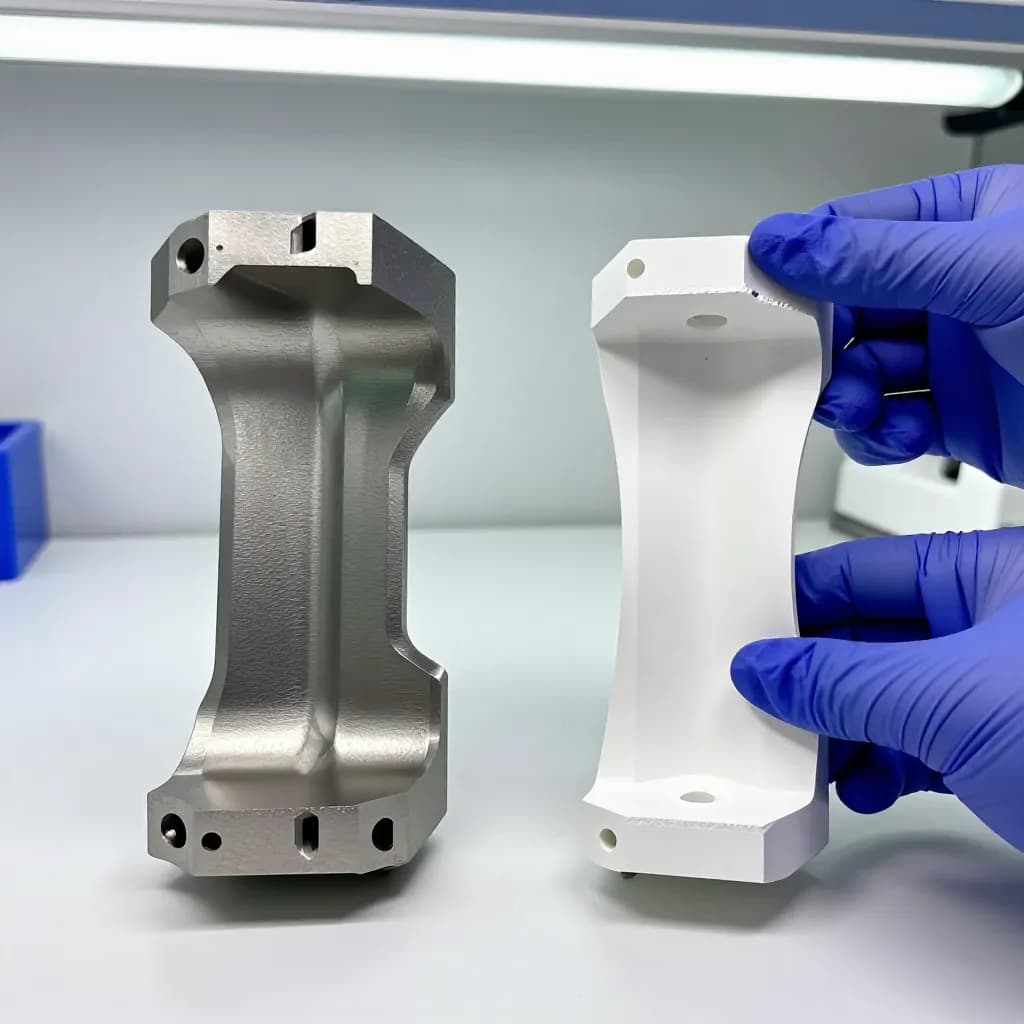
Despite titanium's inherent corrosion resistance — it is virtually immune to atmospheric corrosion, seawater attack, and many chemical environments — there are compelling reasons to apply powder coatings. Color customization for architectural and consumer products, thermal barrier coatings for aerospace components, electrical insulation for medical devices, and wear-resistant coatings for industrial equipment all drive the demand for coated titanium. In some applications, the coating serves as a sacrificial wear layer that protects the expensive titanium substrate from surface damage during handling and assembly.
Ready to Start Your Project?
From one-off customs to 15,000-part production runs — get precise pricing in 24 hours.
On This Page
Titanium as a Coating Substrate: Properties and Challenges
The primary challenge in powder coating titanium is achieving durable adhesion to a surface protected by one of the most stable and tenacious oxide layers found on any engineering metal. Titanium dioxide (TiO₂) forms spontaneously on titanium surfaces and is extraordinarily resistant to chemical attack, mechanical disruption, and thermal decomposition. This oxide layer — typically 3-10 nanometers thick under ambient conditions — is the source of titanium's corrosion resistance but also the principal barrier to coating adhesion. Overcoming this barrier requires aggressive pretreatment methods that go beyond what is needed for steel or aluminum substrates.
The Titanium Oxide Layer: Understanding the Adhesion Barrier
The titanium dioxide layer that forms on titanium surfaces is fundamentally different from the oxide layers on other metals. It is thermodynamically extremely stable, with a free energy of formation of -889 kJ/mol — significantly more negative than aluminum oxide (-1582 kJ/mol for Al₂O₃ but spread across two aluminum atoms) or chromium oxide on stainless steel. This stability means that the oxide layer resists dissolution in most acids and alkalis, does not reduce or decompose at temperatures encountered in powder coating, and reforms almost instantaneously when mechanically removed.
The oxide layer grows thicker with temperature exposure. At room temperature, the native oxide is 3-10 nanometers thick. At 200°C (typical powder cure temperature), it can grow to 20-50 nanometers during a standard cure cycle. At 400-600°C, the oxide thickens to several hundred nanometers and develops interference colors — gold, purple, blue — that indicate increasing thickness. This oxide growth during cure can actually improve adhesion in some cases by creating a rougher, more reactive interface, but it can also cause discoloration beneath clear coatings and alter the surface chemistry in ways that affect long-term adhesion stability.
The practical consequence is that standard pretreatment methods effective on steel and aluminum — iron phosphate, zinc phosphate, and most commercial conversion coatings — are ineffective on titanium because they cannot react with or penetrate the TiO₂ layer. Successful pretreatment must either mechanically disrupt the oxide layer and create sufficient surface roughness for mechanical interlocking before it reforms, or chemically modify the oxide surface to create reactive sites that bond with the organic coating. Both approaches have been developed and validated for production use, but they require more aggressive parameters and tighter process control than pretreatment of conventional substrates.
Pretreatment Methods for Titanium
Grit blasting is the most reliable pretreatment method for titanium prior to powder coating. Aluminum oxide grit in the 60-120 mesh range, propelled at 4-7 bar (60-100 psi), produces a surface profile of 30-75 micrometers that provides excellent mechanical keying for the powder coating. The blast process fractures and partially removes the oxide layer, exposing fresh titanium metal that is highly reactive and bonds readily with organic coatings. However, the oxide layer begins reforming immediately — within seconds in ambient air — so the time between blasting and coating application must be minimized, ideally to less than two hours.
Silicon carbide media is an alternative to aluminum oxide for blasting titanium, producing a slightly more angular profile that some applicators prefer. Steel grit must be avoided because iron contamination of the titanium surface creates galvanic cells that promote corrosion and coating failure. Glass bead blasting produces an insufficient profile for reliable adhesion on titanium and is not recommended for powder coating pretreatment.
Chemical pretreatment of titanium typically involves acid etching in hydrofluoric acid (HF) or hydrofluoric-nitric acid mixtures, which are among the few chemical systems capable of dissolving the TiO₂ layer. A typical etch solution contains 2-5% HF and 15-30% HNO₃ at room temperature, with immersion times of 1-5 minutes depending on the desired surface roughness. The nitric acid serves as an oxidizer that controls the etch rate and prevents hydrogen embrittlement. Hydrofluoric acid is extremely hazardous — it causes severe burns and systemic fluoride poisoning — and requires specialized handling equipment, training, and emergency protocols. For this reason, many facilities prefer mechanical pretreatment despite its limitations. Alkaline permanganate etching and proprietary titanium-specific conversion coatings offer less hazardous chemical alternatives, though they generally produce less aggressive surface activation than HF-based systems.
Aerospace Titanium Coating Applications
Aerospace is the largest market for powder-coated titanium components, driven by the extensive use of titanium alloys in airframe structures, engine components, landing gear, and fasteners. Powder coatings on aerospace titanium serve multiple functions: corrosion protection at dissimilar metal interfaces (titanium-aluminum or titanium-steel joints), thermal barrier protection on engine-adjacent structures, electrical insulation for avionics housings, and color coding for identification and inspection purposes.
The most demanding aerospace application for powder-coated titanium is in the engine environment, where components may experience sustained temperatures of 200-350°C with excursions to 400°C or higher. Standard polyester and epoxy powders cannot withstand these temperatures — specialized high-temperature powder coatings based on silicone-modified polyester, polyphenylene sulfide (PPS), or fluoropolymer (PTFE/PFA) chemistries are required. These coatings maintain their protective and functional properties at temperatures that would destroy conventional organic coatings, though they require higher cure temperatures (250-400°C) that must be validated against the titanium alloy's heat treatment condition.
Aerospace qualification of powder coatings on titanium follows rigorous protocols defined by specifications such as AMS 2530 (Cleaning of Titanium Alloys), AMS 2486 (Anodic Treatment of Titanium), and OEM-specific coating specifications from Boeing, Airbus, Lockheed Martin, and other manufacturers. Qualification testing includes adhesion (tape pull and scribe tests), flexibility (mandrel bend), impact resistance, fluid resistance (hydraulic fluid, fuel, de-icing fluid), salt spray corrosion, and thermal cycling. The qualification process typically requires 6-18 months of testing and documentation, and any subsequent change to materials or process parameters triggers partial or full requalification.
Medical Device and Implant Coating
Titanium's biocompatibility makes it the material of choice for orthopedic implants, dental implants, surgical instruments, and medical device housings. Powder coating of medical titanium components serves purposes distinct from industrial applications — color coding for instrument identification, electrical insulation for electronic medical devices, and specialized functional coatings that promote or inhibit biological responses at the implant-tissue interface.
For non-implantable medical devices — instrument housings, equipment enclosures, and surgical tool handles — standard powder coating processes can be applied with appropriate pretreatment and quality control. The coating must withstand repeated sterilization cycles (autoclave at 134°C, ethylene oxide gas, or hydrogen peroxide plasma) without adhesion loss, discoloration, or degradation. Epoxy and epoxy-polyester powders generally provide the best sterilization resistance, while polyester powders may degrade under repeated autoclave exposure. Biocompatibility testing per ISO 10993 is required for any coating that may contact patients or biological materials, even indirectly.
For implantable applications, powder coating in the traditional sense is rarely used — instead, specialized coating technologies such as plasma-sprayed hydroxyapatite, titanium plasma spray for osseointegration, and drug-eluting polymer coatings are employed. However, powder-based thermal spray processes that deposit titanium or ceramic coatings onto titanium substrates share many process principles with conventional powder coating. The pretreatment requirements — surface cleanliness, oxide management, and contamination control — are even more stringent for implantable devices, with cleanroom processing, validated cleaning protocols, and 100% inspection being standard practice. Any coating process for implantable titanium must be validated per FDA 21 CFR Part 820 quality system requirements and may require premarket notification (510(k)) or premarket approval (PMA) depending on the device classification.
Chemical Processing and Marine Applications
Titanium's exceptional resistance to chloride corrosion, seawater attack, and many aggressive chemicals makes it a preferred material for chemical processing equipment, desalination plants, offshore platforms, and marine hardware. In these environments, powder coating serves primarily as a supplementary barrier, color coding system, or anti-fouling surface rather than as the primary corrosion protection — the titanium substrate itself provides the corrosion resistance.
In chemical processing, powder-coated titanium is used for equipment exteriors, piping supports, valve actuator housings, and control panel enclosures where color coding identifies process streams, safety zones, or equipment status. The coating must resist splash exposure to the process chemicals — acids, alkalis, solvents, and oxidizers — without degradation. Epoxy powders provide the broadest chemical resistance, while novolac epoxy formulations offer enhanced resistance to solvents and elevated-temperature chemical exposure. Chemical resistance testing per ISO 2812 or ASTM D1308 should be performed with the specific chemicals present in the service environment.
Marine applications for powder-coated titanium include deck hardware, railing systems, propeller shafts, and underwater sensor housings. The coating provides UV protection (titanium itself is UV-resistant, but color coatings may fade), anti-fouling properties to reduce marine growth, and aesthetic customization. Marine-grade polyester powders with enhanced UV stabilizers and hydrophobic surface properties are specified for above-waterline applications. For submerged components, fusion-bonded epoxy or polyethylene powder coatings provide heavy-duty barrier protection against the combined effects of seawater immersion, biological fouling, and mechanical abrasion from debris and marine organisms.
Process Control and Quality Assurance
Quality assurance for powder-coated titanium demands rigorous process control at every stage, reflecting the high value of titanium components and the critical nature of most applications. Incoming material verification should confirm alloy grade (using XRF or OES), surface condition, and dimensional conformance. Titanium alloy mix-ups can have catastrophic consequences — coating a CP Grade 2 part with parameters validated for Ti-6Al-4V, or vice versa, may result in inadequate adhesion or substrate property degradation.
Pretreatment process control requires monitoring of blast media condition and contamination (for mechanical pretreatment), chemical bath concentration, temperature, and pH (for chemical pretreatment), and surface cleanliness verification after pretreatment. Water break testing — observing whether rinse water sheets uniformly across the surface or breaks into droplets — provides a quick, qualitative assessment of surface cleanliness. Contact angle measurement using a goniometer provides quantitative data, with contact angles below 30 degrees indicating a clean, wettable surface suitable for coating.
Coating application and cure parameters must be documented and controlled within validated ranges. Film thickness measurement per ISO 2360, adhesion testing per ISO 2409 and ISO 4624, and visual inspection under controlled lighting are standard quality checks. For aerospace and medical applications, additional testing may include flexibility (conical mandrel bend per ISO 6860), impact resistance (falling weight per ISO 6272), and chemical or fluid resistance testing specific to the service environment. All quality records should be maintained for traceability, with batch-level documentation linking each coated component to its raw material certificate, pretreatment batch, powder lot, and cure oven record. This traceability is a regulatory requirement for aerospace (AS9100) and medical device (ISO 13485) applications.
Frequently Asked Questions
Why is titanium so hard to powder coat?
Titanium forms an extremely stable titanium dioxide (TiO₂) oxide layer that resists chemical attack and reforms almost instantly when removed. Standard pretreatment methods effective on steel and aluminum cannot penetrate this layer. Successful coating requires aggressive grit blasting with aluminum oxide or chemical etching with hydrofluoric acid solutions, followed by rapid coating application before the oxide reforms.
What pretreatment works best for titanium before powder coating?
Grit blasting with 60-120 mesh aluminum oxide at 4-7 bar is the most reliable method, producing a 30-75 micrometer surface profile. Chemical etching with hydrofluoric-nitric acid mixtures (2-5% HF, 15-30% HNO₃) is an alternative but requires specialized safety equipment. The time between pretreatment and coating should be less than two hours to prevent oxide reformation.
Can powder coating withstand the temperatures titanium components experience?
Standard polyester and epoxy powders are limited to about 200°C continuous service. For higher-temperature aerospace applications (200-400°C), specialized coatings based on silicone-modified polyester, polyphenylene sulfide (PPS), or fluoropolymer chemistries are required. These high-temperature powders need higher cure temperatures (250-400°C) that must be validated against the alloy's heat treatment condition.
Is powder-coated titanium safe for medical devices?
Yes, for non-implantable devices such as instrument housings and equipment enclosures. The coating must pass biocompatibility testing per ISO 10993 and withstand repeated sterilization cycles. Epoxy and epoxy-polyester powders offer the best sterilization resistance. For implantable applications, specialized coating technologies rather than conventional powder coating are typically used.
Does the titanium oxide layer grow during powder coating cure?
Yes, the oxide layer thickens during cure at 180-200°C, growing from 3-10 nanometers to 20-50 nanometers. At higher temperatures (400°C+), it can reach several hundred nanometers and develop visible interference colors. This growth can sometimes improve adhesion by creating a rougher interface, but it may cause discoloration beneath clear coatings.
Ready to Start Your Project?
From one-off customs to 15,000-part production runs — get precise pricing in 24 hours.