Adhesion is the bond between the powder coating and the substrate, and it is the foundation upon which all other coating properties depend. Without adequate adhesion, even the most durable, UV-resistant, and chemically resistant powder coating will fail because it cannot remain attached to the surface it is supposed to protect.
Technical
Powder Coating Adhesion Loss: Testing Methods, Root Cause Analysis, and Prevention
Sundial Powder Coating·April 23, 2026·12 min
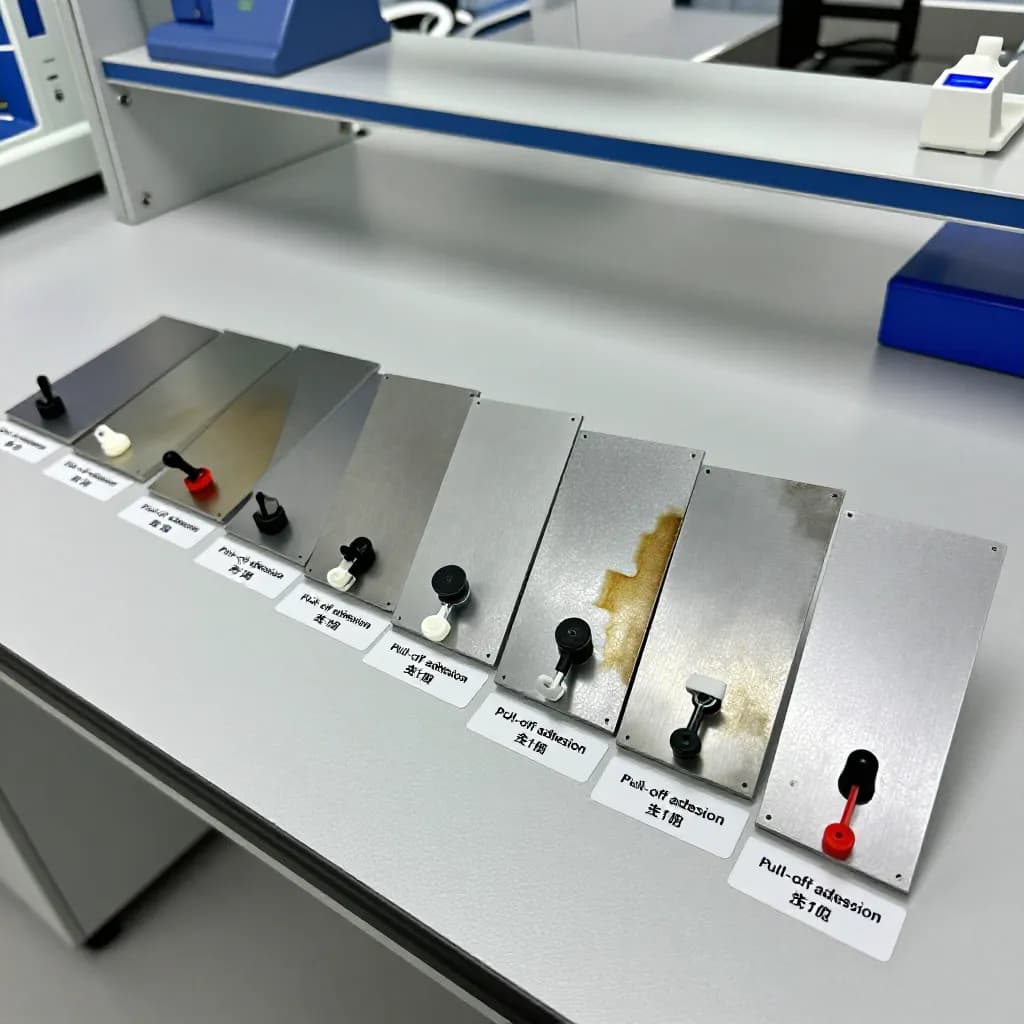
Powder coating adhesion involves multiple bonding mechanisms working together. Mechanical adhesion occurs when the coating flows into the microscopic peaks and valleys of the substrate surface during cure, creating a physical interlock. Chemical adhesion occurs when the coating forms chemical bonds with the pretreatment layer or directly with the substrate surface. The combination of mechanical and chemical adhesion creates a robust bond that resists the stresses of thermal cycling, mechanical impact, and environmental exposure.
Ready to Start Your Project?
From one-off customs to 15,000-part production runs — get precise pricing in 24 hours.
On This Page
Understanding Adhesion and Why It Fails
Adhesion loss occurs when one or more of these bonding mechanisms fail. The failure may be immediate, appearing during or shortly after the coating process, or it may be delayed, developing weeks, months, or years after coating as environmental stresses gradually weaken the bond. Delayed adhesion loss is particularly problematic because it affects coated products that have already been installed or placed in service.
The consequences of adhesion loss range from cosmetic peeling and flaking to complete coating detachment that leaves the substrate unprotected. On structural steel, adhesion loss leads to corrosion that can compromise structural integrity. On architectural facades, it creates an unsightly appearance and potential safety hazard from falling coating fragments. On consumer products, it represents a quality failure that damages brand reputation.
Diagnosing the root cause of adhesion loss is essential for implementing effective corrective action. Simply recoating over a surface with adhesion problems will produce the same failure unless the underlying cause is identified and addressed. This article provides a systematic approach to adhesion testing, root cause analysis, and prevention.
Adhesion Testing Methods
Several standardized testing methods are available for evaluating powder coating adhesion. Each method provides different information, and the choice of test depends on the purpose of the evaluation and the type of adhesion data needed.
The cross-hatch adhesion test, described in ASTM D3359 Method B and ISO 2409, is the most widely used field test for powder coating adhesion. A grid pattern of cuts is made through the coating to the substrate using a multi-blade cutting tool or a sharp blade with a guide. Adhesive tape is pressed firmly over the cut grid and then pulled off rapidly at a 180-degree angle. The amount of coating removed with the tape is compared to a reference scale from 0B, where more than 65 percent of the coating is removed, to 5B, where none of the coating is removed. A rating of 4B or 5B is generally considered acceptable.
The pull-off adhesion test, described in ASTM D4541 and ISO 4624, provides a quantitative measurement of adhesion strength in megapascals or pounds per square inch. A metal dolly is bonded to the coating surface with adhesive, and a calibrated pulling device applies a perpendicular force until the coating detaches. The force at detachment and the failure mode, whether at the coating-substrate interface, within the coating, or within the adhesive, provide detailed information about the adhesion system.
The bend test evaluates adhesion under mechanical deformation. A coated panel is bent over a mandrel of specified diameter, and the coating is examined for cracking, flaking, or detachment at the bend. This test is particularly relevant for coatings on parts that will be formed or flexed in service. ASTM D522 describes the standard procedure.
The impact test, described in ASTM D2794, evaluates adhesion under sudden deformation. A weighted dart is dropped onto the coated surface from a specified height, and the coating is examined for cracking and detachment around the impact site. This test simulates the stresses that coatings experience from impacts during handling, installation, and service.
For field evaluation of existing coatings, the cross-hatch test is the most practical because it requires minimal equipment and can be performed on any accessible surface. The pull-off test provides more detailed data but requires specialized equipment and a flat, accessible surface for dolly bonding.
Root Cause Analysis: Pretreatment Failure
Pretreatment failure is the most common root cause of adhesion loss in powder coatings. The pretreatment process creates the chemical and physical foundation for coating adhesion, and any deficiency in this process directly compromises the bond between coating and substrate.
Inadequate cleaning is the most basic pretreatment failure. If the substrate surface retains oil, grease, shop soils, or other contaminants after the cleaning stage, the pretreatment chemicals cannot react properly with the metal surface. The resulting conversion coating is thin, patchy, or absent, and the powder coating bonds to the contamination layer rather than to a properly prepared surface. This weak bond may hold initially but fails under environmental stress.
Insufficient conversion coating weight indicates that the pretreatment chemical reaction did not proceed to completion. This can result from low chemical concentration, incorrect temperature, insufficient contact time, or exhausted chemical baths. The conversion coating should be verified by coating weight measurement, typically expressed in milligrams per square meter, to confirm that it meets the specification.
Poor rinse quality can undermine an otherwise adequate pretreatment. Contaminated rinse water deposits minerals, chemicals, or biological material on the pretreated surface, creating a barrier between the conversion coating and the powder coating. The final rinse should use clean, low-conductivity water, and rinse water quality should be monitored regularly.
Flash rust formation between pretreatment and coating is a common cause of adhesion failure on steel substrates. If the pretreated surface is not dried quickly and coated promptly, a thin layer of rust forms on the freshly exposed steel. This rust layer prevents the powder coating from bonding to the conversion coating beneath. The time between pretreatment and coating should be minimized, and the drying process should be thorough and prompt.
Pretreatment chemistry that is inappropriate for the substrate can cause adhesion problems. Different metals require different pretreatment processes. Iron phosphate works well on steel but may not provide adequate adhesion on aluminum. Zinc phosphate provides excellent adhesion on both steel and aluminum but requires more complex process control. Using the wrong pretreatment for the substrate is a specification error that results in predictable adhesion failure.
To diagnose pretreatment failure as the root cause, examine the failure interface. If the coating separates cleanly from the substrate with little or no conversion coating visible on either the coating underside or the exposed substrate, pretreatment failure is the likely cause.
Root Cause Analysis: Contamination
Surface contamination that survives the pretreatment process or is introduced after pretreatment but before coating is a frequent cause of adhesion loss. Contamination creates a weak boundary layer between the coating and the substrate that fails under stress.
Oil and grease contamination is the most common type. Sources include machining oils, cutting fluids, hydraulic fluid, fingerprints from handling, and airborne oil mist in the shop environment. Even a monomolecular layer of oil can significantly reduce adhesion. The pretreatment cleaning stage should remove all oil contamination, but if the cleaning process is inadequate or the parts are recontaminated after cleaning, adhesion problems result.
Silicone contamination is particularly insidious because it is extremely difficult to remove and causes severe adhesion failure even in trace amounts. Sources include mold release agents, lubricants, sealants, personal care products, and some cleaning products. Silicone contamination may not be visible and may not be detected by standard cleaning verification tests. If silicone contamination is suspected, specialized cleaning with silicone-removing solvents and verification by contact angle measurement may be needed.
Dust and particulate contamination on the substrate surface before coating creates physical barriers to adhesion. The powder coating bonds to the dust particles rather than to the substrate, and the weak bond between the dust and the substrate becomes the failure point. Maintaining a clean environment between pretreatment and coating application prevents particulate contamination.
Chemical residue from previous processes, including machining, welding, heat treatment, or previous coating removal, can interfere with adhesion. Flux residue from welding is particularly problematic because it is chemically active and hygroscopic. Complete removal of all process residues before pretreatment is essential.
To diagnose contamination as the root cause, examine the failure interface under magnification. Contamination may be visible as a film, particles, or discoloration on the substrate surface or the underside of the detached coating. Chemical analysis of the failure interface using techniques such as FTIR spectroscopy can identify the specific contaminant, which helps trace it to its source in the process.
Root Cause Analysis: Cure and Application Issues
Adhesion problems can also originate from the powder application and curing stages, even when the substrate preparation and pretreatment are adequate. These causes are less common than pretreatment and contamination issues but should be considered when those factors have been ruled out.
Under-curing is a significant cause of adhesion loss. The cross-linking reaction that gives the powder coating its mechanical properties and adhesion strength requires specific time and temperature conditions. If the substrate does not reach the required temperature for the required time, the cross-linking is incomplete. Under-cured coatings may appear normal initially but have reduced adhesion, hardness, and chemical resistance. They are more likely to fail under thermal cycling, mechanical stress, or chemical exposure.
Excessive film thickness can cause adhesion problems, particularly on complex geometries where powder accumulates in recesses and inside corners. Very thick coatings develop higher internal stresses during cure and cooling, and these stresses can exceed the adhesion strength, causing the coating to crack or detach. The Faraday cage effect can cause excessive buildup in recesses while leaving edges and outer surfaces with inadequate coverage.
Incompatible powder layers can cause inter-coat adhesion failure when multiple coats are applied. If the first coat is fully cured before the second coat is applied, the second coat may not bond adequately to the first. Some powder coating systems are designed for two-coat application with specific inter-coat adhesion requirements. Using incompatible products or incorrect application sequences can result in delamination between layers.
Powder contamination from mixed colors, degraded powder, or foreign material in the powder supply can cause localized adhesion problems. Cross-contamination between colors during color changes, powder that has exceeded its shelf life, and moisture absorption by the powder during storage can all affect adhesion. Proper powder handling, storage, and equipment cleaning prevent these issues.
To diagnose cure-related adhesion loss, perform a solvent rub test on the coating. Rub the surface firmly with a cloth dampened with MEK or acetone for a specified number of double rubs. A properly cured coating resists the solvent with minimal softening or color transfer. An under-cured coating softens, becomes tacky, or transfers color to the cloth. This test should be performed on a sacrificial area because it may damage the coating.
Systematic Diagnosis: A Step-by-Step Approach
When adhesion loss is discovered, a systematic diagnostic approach identifies the root cause efficiently and prevents wasted effort on incorrect corrective actions. Follow this sequence to narrow down the cause.
Step one: characterize the failure. Document the location, extent, and pattern of adhesion loss. Is it widespread or localized? Does it follow a pattern related to orientation, position in the oven, or location on the part? Is it at the coating-substrate interface or between coating layers? Photograph the failure from multiple angles and distances.
Step two: examine the failure interface. Carefully remove a section of the detached coating and examine both the underside of the coating and the exposed substrate surface. Look for contamination, corrosion, conversion coating presence or absence, and any unusual discoloration or residue. A magnifying glass or low-power microscope is helpful for this examination.
Step three: test adhesion on unaffected areas. Perform cross-hatch adhesion tests on areas of the coating that appear sound. If adhesion is poor across the entire surface, the cause is likely systemic, such as a pretreatment or cure problem. If adhesion is good everywhere except the failed areas, the cause is likely localized, such as contamination or mechanical damage.
Step four: evaluate the cure. Perform a solvent rub test or DSC analysis to verify that the coating is fully cured. Under-cure is a common and easily correctable cause of adhesion loss that should be ruled out early in the investigation.
Step five: review process records. Examine the pretreatment chemistry logs, oven temperature records, and any quality control data from the time the affected parts were coated. Look for any deviations from normal parameters that coincide with the production of the affected parts.
Step six: consider environmental factors. If the adhesion loss developed in service rather than immediately after coating, evaluate the environmental exposure. Moisture infiltration, chemical exposure, thermal cycling, and UV degradation can all cause delayed adhesion loss. The pattern and location of the failure often point to the specific environmental factor involved.
Step seven: if the cause remains unclear after these steps, submit samples for laboratory analysis. Cross-sectioning, microscopy, and chemical analysis of the failure interface can identify contaminants, measure conversion coating weight, and evaluate cure state with precision that field testing cannot match.
Prevention: Building Reliable Adhesion from the Start
Preventing adhesion loss requires attention to every step of the coating process, from substrate selection through pretreatment, application, cure, and in-service maintenance. Each step contributes to the overall adhesion system, and a weakness at any point can lead to failure.
Substrate preparation sets the foundation. Ensure that all mill scale, rust, weld slag, flux residue, and surface contaminants are removed before pretreatment. For steel substrates, abrasive blasting to a clean surface profile provides the best mechanical adhesion foundation. For aluminum, chemical etching or mechanical abrasion creates the surface texture needed for coating adhesion.
Pretreatment must be appropriate for the substrate, properly controlled, and consistently applied. Monitor pretreatment chemistry concentration, temperature, and contact time at defined intervals. Verify conversion coating weight on production parts regularly. Maintain rinse water quality and replace rinse water before contamination levels affect coating quality.
Minimize the time between pretreatment and coating application. Every minute that a pretreated surface is exposed to the shop environment increases the risk of contamination and flash rust. Ideally, parts should move from pretreatment to powder application within the same production cycle without intermediate storage.
Control the shop environment to prevent contamination. Maintain clean air in the coating area, control humidity to prevent condensation on parts, and enforce handling procedures that prevent fingerprints and contact contamination on pretreated surfaces. Gloves should be worn when handling pretreated parts.
Verify cure conditions through regular oven profiling. Attach data loggers to representative parts and confirm that the substrate reaches the required temperature for the required time. Adjust oven parameters for different part sizes and masses. Document cure verification results for quality records.
Implement adhesion testing as part of production quality control. Perform cross-hatch adhesion tests on production parts at defined intervals, typically at the start of each shift and after any process change. Reject parts that do not meet the adhesion specification and investigate the cause before continuing production.
For in-service adhesion preservation, maintain the coating according to the manufacturer's guidelines. Regular cleaning, prompt repair of damage, and avoidance of chemical exposure all contribute to maintaining the coating's adhesion over its service life. Environmental stresses that are within the coating's design parameters should not cause adhesion loss if the original coating process was performed correctly.
Frequently Asked Questions
What causes powder coating to peel off?
The most common causes are inadequate surface preparation, pretreatment failure, surface contamination, and under-curing. These factors prevent the coating from forming a strong bond with the substrate. Environmental factors such as moisture infiltration and chemical exposure can cause delayed adhesion loss on coatings that initially appeared well-bonded.
How do you test powder coating adhesion?
The cross-hatch test is the most common field method. A grid of cuts is made through the coating, adhesive tape is pressed over the grid and pulled off, and the amount of coating removed is rated on a 0B to 5B scale. Pull-off tests provide quantitative adhesion strength measurements. Both methods are described in ASTM and ISO standards.
Can adhesion loss be repaired without full recoating?
Localized adhesion loss can be repaired by removing the detached coating, preparing the exposed substrate, and applying touch-up paint. However, if adhesion loss is widespread or the root cause is systemic such as pretreatment failure, full stripping and recoating with corrected process parameters is necessary to achieve reliable adhesion.
Why does powder coating adhesion fail after months or years?
Delayed adhesion loss typically results from moisture infiltrating through damage points or areas of weak adhesion, causing corrosion that undermines the coating bond. UV degradation of the coating-substrate interface, thermal cycling stress, and chemical exposure can also cause progressive adhesion loss over time.
How important is pretreatment for powder coating adhesion?
Pretreatment is critical. It creates both the chemical bond and the clean surface needed for reliable adhesion. Studies consistently show that pretreatment quality is the single most important factor in long-term powder coating adhesion. Skipping or inadequately performing pretreatment is the most common cause of adhesion failure.
Ready to Start Your Project?
From one-off customs to 15,000-part production runs — get precise pricing in 24 hours.