Temperature profiling is the definitive method for verifying that powder coatings are properly cured. While visual inspection and simple tests like solvent rub can indicate gross under-cure or over-cure, only a temperature profile — a time-temperature record of the actual part surface temperature throughout the cure cycle — provides the quantitative data needed to confirm that the coating has received the correct thermal exposure for complete crosslinking.
Technical
Powder Coating Temperature Profiling: Data Loggers, Thermocouples, and Cure Window Verification
Sundial Powder Coating·April 23, 2026·13 min
Powder coating cure is a chemical reaction (for thermoset powders) that depends on both temperature and time. The powder manufacturer specifies a cure schedule — typically expressed as a minimum temperature maintained for a minimum time, such as 200°C for 10 minutes at the part surface. This specification defines the cure window — the combination of temperature and time that produces a fully crosslinked coating with the intended physical and chemical properties. Operating below the cure window produces under-cured coatings with reduced hardness, chemical resistance, adhesion, and weathering performance. Operating above the cure window wastes energy and can cause over-cure defects including yellowing, embrittlement, and reduced gloss.
Ready to Start Your Project?
From one-off customs to 15,000-part production runs — get precise pricing in 24 hours.
On This Page
Why Temperature Profiling Is Essential for Powder Coating Quality
Temperature profiling is required during initial system commissioning to establish that the oven delivers adequate thermal exposure to all parts, during routine production to verify ongoing cure compliance, after any process change (line speed, oven temperature, part loading pattern), and as part of troubleshooting when coating performance issues arise. Many customer specifications and quality standards (AAMA 2605, Qualicoat, automotive OEM specifications) require documented temperature profiles as evidence of cure compliance.
Data Logger Systems: Components and Selection
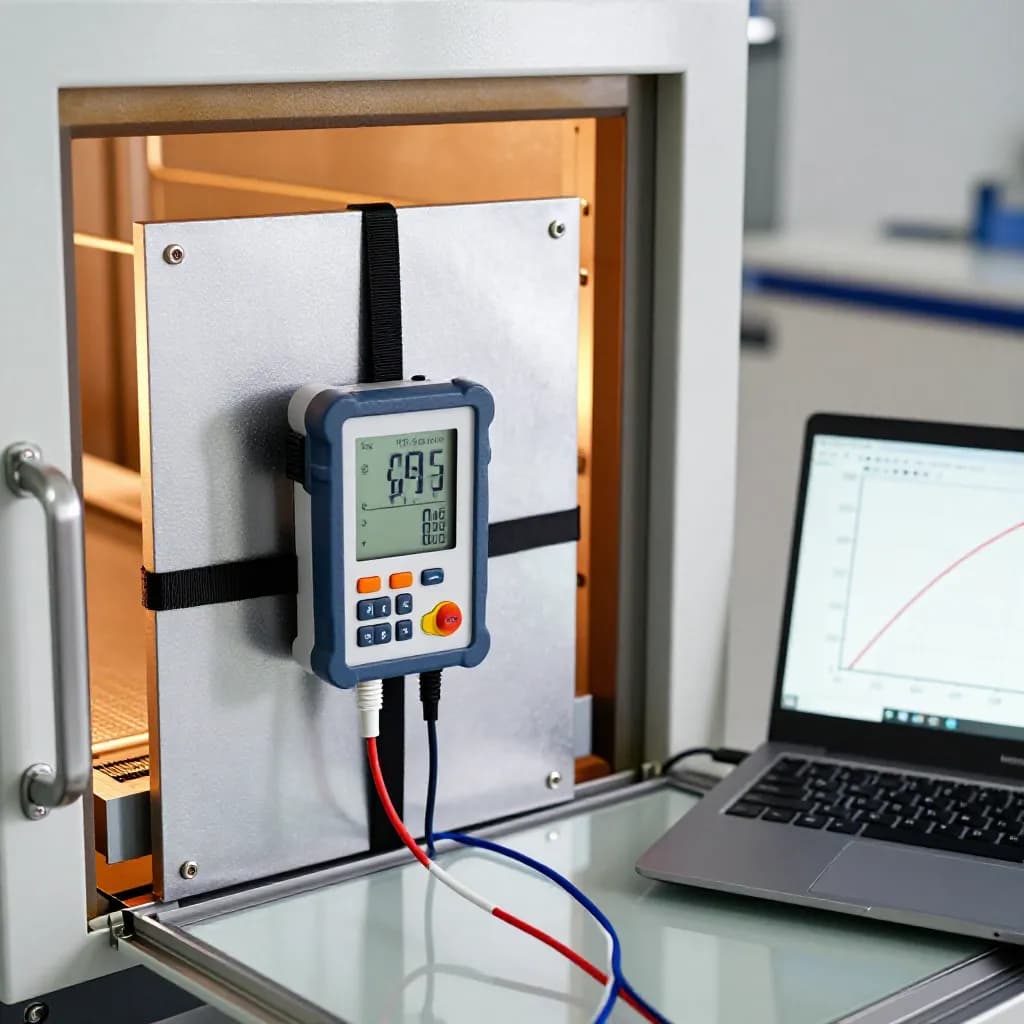
A temperature profiling system consists of three components: a data logger that records temperature measurements, thermocouples that sense temperature at the measurement points, and analysis software that processes the recorded data into a cure profile report. The data logger is the central component — a battery-powered electronic device that samples thermocouple signals at regular intervals (typically every 1–5 seconds) and stores the data in internal memory for later download and analysis.
Data loggers for powder coating oven profiling must withstand the oven environment — temperatures of 180–250°C for 15–30 minutes. This is achieved by housing the logger in a thermal barrier (insulated enclosure) that protects the electronics from the oven heat. The thermal barrier uses insulating materials (ceramic fiber, aerogel, or vacuum panels) to maintain the logger temperature below its maximum operating limit (typically 70–85°C) throughout the oven transit. Barrier design is critical — an undersized barrier allows the logger to overheat and fail, while an oversized barrier is difficult to fit through the oven alongside production parts.
Data loggers are available with 4 to 20 thermocouple input channels, allowing simultaneous temperature measurement at multiple locations on the part and in the oven air. For most powder coating applications, 6–12 channels are sufficient — enough to monitor several part surface locations, the oven air temperature, and the thermal barrier internal temperature. Sampling rate should be at least once per second for accurate capture of temperature transitions. Data resolution of 0.1°C and accuracy of ±1°C are standard specifications that provide adequate measurement quality for cure verification.
Thermocouple Selection, Attachment, and Placement
Thermocouples are the temperature sensors used in powder coating profiling. A thermocouple consists of two dissimilar metal wires joined at one end (the measurement junction) that generate a small voltage proportional to the temperature at the junction. Type K thermocouples (chromel-alumel) are the standard choice for powder coating oven profiling, offering a measurement range of -200 to +1,250°C, accuracy of ±2.2°C or ±0.75% (whichever is greater), and good resistance to the oven environment.
Thermocouple attachment to the part surface is critical for accurate measurement. The thermocouple junction must be in intimate thermal contact with the part surface to measure the actual surface temperature rather than the air temperature near the surface. Common attachment methods include: high-temperature adhesive tape (aluminum tape rated to 300°C), spot welding (for steel substrates — provides the most reliable thermal contact), spring clips or magnets (for temporary attachment to ferromagnetic substrates), and high-temperature epoxy (for permanent attachment on test fixtures).
Thermocouple placement should capture the thermal extremes of the part — the hottest and coldest locations — as well as representative intermediate locations. The coldest location is typically the thickest section of the part (highest thermal mass), the center of a densely loaded rack, or the area farthest from the oven heat source. The hottest location is typically the thinnest section, the part closest to the heat source, or the leading edge of the part as it enters the oven. At minimum, thermocouples should be placed at the coldest point (to verify minimum cure), the hottest point (to verify no over-cure), and one or two intermediate locations. Additional thermocouples monitoring oven air temperature at different heights and positions provide data for oven uniformity assessment.
Oven Temperature Uniformity Surveys
An oven temperature uniformity survey (TUS) maps the temperature distribution throughout the oven volume to identify hot spots, cold spots, and temperature gradients that affect cure consistency. While a temperature profile measures the thermal experience of a specific part, a TUS characterizes the oven itself — providing the data needed to optimize oven settings, identify maintenance issues, and establish the oven's capability to deliver uniform cure across the full range of part sizes and loading patterns.
A TUS is performed by placing thermocouples at defined locations throughout the oven volume — typically a 3D grid with measurement points at the top, middle, and bottom of the oven at multiple positions along the oven length. For a conveyor oven, the data logger and thermocouples travel through the oven on the conveyor, recording the temperature at each grid point throughout the transit. For a batch oven, the thermocouples are fixed in position and the logger records the temperature at each point throughout the entire cure cycle.
The TUS data reveals the oven's temperature uniformity — the difference between the hottest and coldest points in the oven at steady state. Industry standards such as AMS 2750 (Pyrometry) define uniformity classes ranging from ±3°C (Class 1) to ±28°C (Class 6). While AMS 2750 is primarily an aerospace standard, its uniformity classification system is widely referenced in powder coating specifications. For powder coating ovens, a uniformity of ±10°C is considered good, and ±5°C is excellent. Uniformity worse than ±15°C indicates problems — blocked burners, failed recirculation fans, inadequate insulation, or air leaks — that should be corrected before production.
TUS should be performed during initial oven commissioning, annually as part of preventive maintenance, and after any oven modification or repair. The results should be documented and retained as part of the quality management system.
Cure Window Analysis and Profile Interpretation
The cure window is the region on a time-temperature graph that represents the combinations of temperature and time that produce a fully cured coating. The powder manufacturer defines this window based on the cure kinetics of the specific powder chemistry. A typical cure window might specify: minimum 10 minutes at 200°C, or minimum 15 minutes at 190°C, or minimum 20 minutes at 180°C — reflecting the time-temperature reciprocity of the crosslinking reaction (lower temperatures require longer times).
Profile analysis software plots the recorded part surface temperature against time and calculates the time the part spent above the minimum cure temperature — this is the time-at-temperature or dwell time. The profile is compliant if the dwell time equals or exceeds the minimum specified by the powder manufacturer. The software also identifies the peak metal temperature (PMT) — the maximum temperature reached by the part surface — which must not exceed the powder manufacturer's maximum recommended temperature to avoid over-cure.
Some powder manufacturers provide cure schedules in terms of equivalent cure — a calculated value that integrates the total thermal exposure over the entire profile, accounting for the contribution of temperatures below the nominal cure temperature where crosslinking occurs at a slower rate. Equivalent cure analysis uses the Arrhenius equation to weight each temperature-time increment by its contribution to the total crosslinking reaction, providing a more accurate assessment of cure completeness than simple time-at-temperature analysis. This approach is particularly valuable for profiles where the part temperature ramps slowly through the cure range, spending significant time at temperatures below the nominal cure temperature but above the onset of crosslinking (typically 150–170°C for standard polyester powders).
Profiling Best Practices and Common Pitfalls
Effective temperature profiling requires attention to several best practices that ensure the recorded data accurately represents the actual cure conditions. The most common pitfall is poor thermocouple attachment — a thermocouple that lifts off the part surface during the oven transit measures air temperature rather than part temperature, producing a profile that shows higher temperatures and faster heating than the part actually experiences. This can lead to a false conclusion that the part is adequately cured when it is actually under-cured.
To verify thermocouple attachment, check that the thermocouple reading at the start of the profile (before entering the oven) matches the ambient temperature and that the heating rate is consistent with the part's thermal mass. A thermocouple measuring air temperature will show a faster initial heating rate than one measuring a heavy part surface. If the profile shows an unrealistically fast temperature rise, the thermocouple has likely detached.
The data logger thermal barrier must be validated for the specific oven conditions. Before the first production profile, run the barrier through the oven with an internal thermocouple monitoring the logger temperature. If the internal temperature exceeds the logger's maximum operating temperature, a larger or better-insulated barrier is needed. Barrier performance degrades over time as insulation absorbs moisture and compresses — annual validation is recommended.
Profile the actual production parts under actual production conditions — the same line speed, oven temperature, part loading density, and rack configuration used in production. Profiling a single part in an empty oven produces an optimistic result because the part receives more radiant and convective heat than it would in a fully loaded oven. The worst-case cure condition is typically the coldest part in the densest loading pattern at the maximum line speed — this is the condition that should be profiled to verify minimum cure compliance.
Documentation, Frequency, and Regulatory Requirements
Temperature profile documentation is a quality record that demonstrates cure compliance and provides traceability for the finished product. Each profile record should include: the date and time, the part identification (part number, material, dimensions), the powder identification (manufacturer, product code, batch number), the oven identification and setpoint temperature, the line speed, the thermocouple locations (documented on a part sketch or photograph), the complete time-temperature data, the calculated dwell time and peak metal temperature, and the pass/fail determination against the cure specification.
Profiling frequency depends on the application criticality and the applicable quality standard. For general industrial applications, profiling at system commissioning and after any process change may be sufficient. For automotive applications, profiling is typically required at the start of each production run, after any line stoppage exceeding 15 minutes, and at defined intervals during continuous production (every 2–4 hours). Architectural coating standards such as AAMA 2605 and Qualicoat require documented cure verification as part of the quality management system, with profiling frequency defined in the applicator's quality plan.
ISO 9001 and IATF 16949 quality management systems require that special processes — processes whose output cannot be fully verified by subsequent inspection and testing — be validated and controlled through process parameters. Powder coating cure is a special process because under-cure cannot be reliably detected by visual inspection alone. Temperature profiling provides the process parameter documentation that satisfies this requirement. Profile records should be retained for the period specified by the customer specification or quality standard — typically 5–15 years for automotive and architectural applications. Digital profile data stored in quality management databases provides efficient retrieval and analysis for trend monitoring, customer audits, and warranty investigations.
Frequently Asked Questions
What is a cure window in powder coating?
The cure window is the combination of temperature and time that produces a fully crosslinked coating, as specified by the powder manufacturer. For example, 200°C for 10 minutes at the part surface. Temperature profiling verifies that the actual part temperature falls within this window during the cure cycle.
What type of thermocouple is used for powder coating profiling?
Type K thermocouples (chromel-alumel) are the standard choice, offering a range of -200 to +1,250°C and accuracy of ±2.2°C. They are attached to the part surface using high-temperature tape, spot welding, spring clips, or magnets to ensure intimate thermal contact.
How often should temperature profiling be performed?
Frequency depends on application criticality. General industrial: at commissioning and after process changes. Automotive: at the start of each run and every 2–4 hours during production. Architectural (AAMA 2605, Qualicoat): per the applicator's quality plan. Always profile after any oven modification or line speed change.
What is an oven temperature uniformity survey?
A TUS maps temperature distribution throughout the oven volume using thermocouples at multiple positions. It identifies hot spots, cold spots, and gradients that affect cure consistency. Good uniformity is ±10°C; excellent is ±5°C. TUS should be performed at commissioning and annually thereafter.
Why might a temperature profile show false results?
The most common cause is poor thermocouple attachment — a detached thermocouple measures air temperature instead of part temperature, showing faster heating and higher temperatures than the part actually experiences. Always verify attachment and profile under actual production conditions with representative part loading.
Ready to Start Your Project?
From one-off customs to 15,000-part production runs — get precise pricing in 24 hours.