Powder coating plastics and composite materials represents a growing frontier in surface finishing technology, driven by the automotive, aerospace, and consumer electronics industries' desire to extend powder coating's environmental and performance advantages to non-metallic substrates. Plastics and composites are increasingly replacing metals in structural and aesthetic applications — automotive bumpers, fenders, and body panels; aerospace interior components; electronic device housings; and sporting goods — creating demand for finishing technologies that can deliver the durability, consistency, and environmental compliance that powder coating provides on metals.
Technical
Powder Coating Plastics and Composites: Conductive Primers, Low-Cure Solutions, and Automotive Applications
Sundial Powder Coating·April 22, 2026·14 min
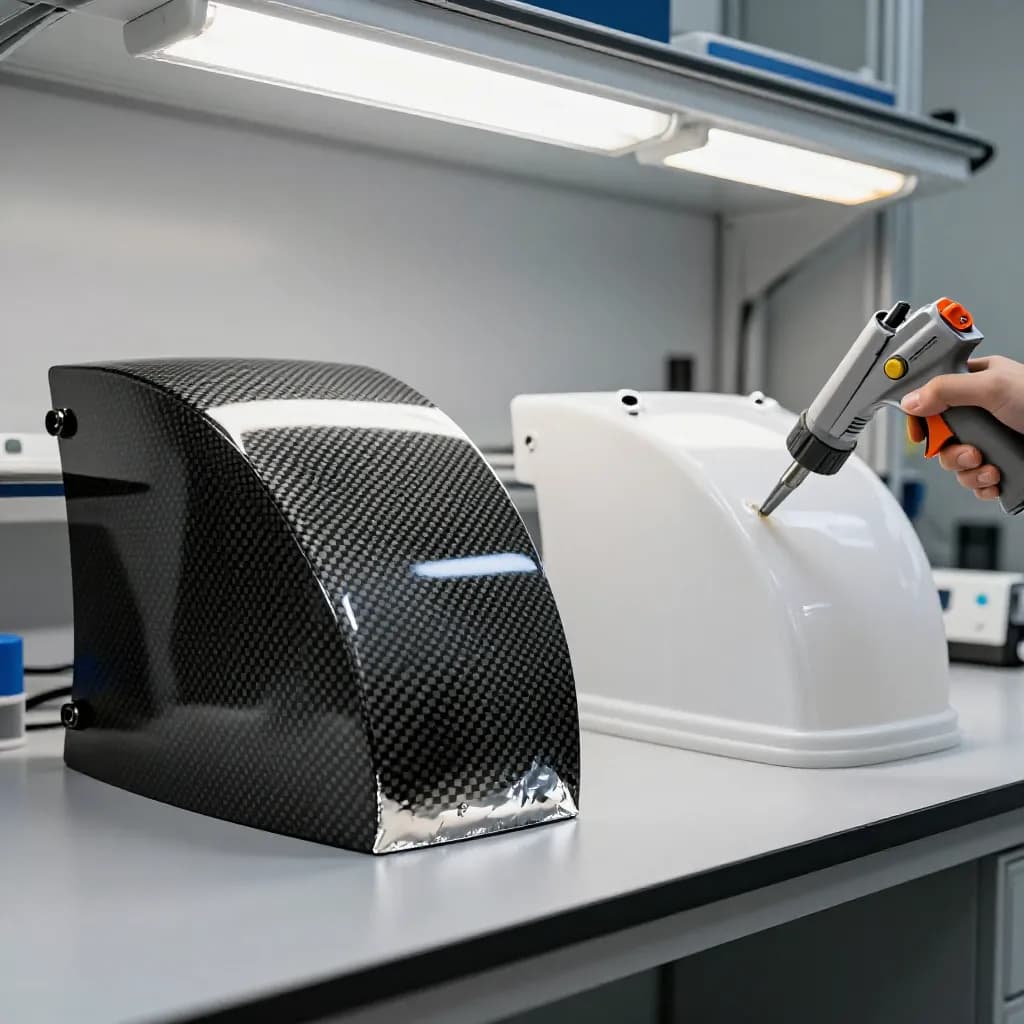
The environmental motivation is compelling. Liquid painting of plastic components generates significant VOC emissions, requires solvent-based primers and basecoats, and produces hazardous waste that must be treated and disposed of. Converting to powder coating eliminates VOC emissions, reduces waste by 90% or more through powder reclaim, and simplifies regulatory compliance. For automotive manufacturers producing millions of painted plastic bumpers and body panels annually, the environmental and economic benefits of powder coating are substantial.
Ready to Start Your Project?
From one-off customs to 15,000-part production runs — get precise pricing in 24 hours.
On This Page
The Case for Powder Coating Plastics and Composites
The technical challenges are equally significant. Most plastics and composites are electrical insulators, preventing conventional electrostatic powder deposition. They have low heat deflection temperatures — typically 80-180°C depending on the polymer — that limit or preclude the use of standard powder coatings curing at 180-200°C. Their surface energy and chemistry differ fundamentally from metals, requiring different adhesion strategies. And their thermal expansion coefficients are typically 3-10 times higher than metals, creating stress at the coating-substrate interface during temperature changes. Overcoming these challenges has required the development of specialized primers, low-cure powder formulations, and application techniques tailored to non-metallic substrates.
Substrate Types and Temperature Limitations
The feasibility of powder coating a specific plastic or composite depends primarily on its heat deflection temperature (HDT) — the temperature at which the material begins to deform under a specified load. This determines the maximum cure temperature that can be applied without distorting the part. Thermoset composites generally tolerate higher temperatures than thermoplastics because their crosslinked molecular structure resists softening.
Sheet molding compound (SMC) and bulk molding compound (BMC) are thermoset polyester composites reinforced with glass fibers, widely used for automotive body panels, electrical enclosures, and industrial housings. With HDTs of 200-260°C, these materials can withstand standard powder cure temperatures of 180-200°C, making them the most straightforward plastics to powder coat. SMC body panels on commercial vehicles and heavy trucks have been powder coated successfully for decades using conventional cure schedules.
Glass-fiber reinforced polyamide (nylon) has an HDT of 200-260°C (depending on glass content and grade) and can tolerate standard cure temperatures. Polyphenylene sulfide (PPS) and polyetherimide (PEI) are high-performance engineering plastics with HDTs above 200°C that are suitable for standard powder coating. At the other end of the spectrum, polypropylene (PP) — the most common automotive bumper material — has an HDT of only 80-110°C, requiring low-cure powders at 120-140°C or UV-cure technology. ABS (acrylonitrile butadiene styrene) and polycarbonate (PC) have intermediate HDTs of 90-130°C, requiring low-cure formulations. Each substrate requires its cure parameters to be validated through systematic testing to determine the maximum temperature and time that can be applied without distortion, discoloration, or property degradation.
Conductive Primers and Surface Preparation
Making plastic and composite surfaces electrically conductive is the first step in enabling electrostatic powder deposition. Conductive primers are the most widely used approach, applied as a liquid basecoat that reduces surface resistivity from 10¹⁰-10¹⁶ ohm/square (typical for plastics) to 10³-10⁶ ohm/square (suitable for electrostatic powder attraction). These primers contain conductive fillers — carbon black, carbon nanotubes, graphite, nickel-coated fibers, or silver-coated particles — dispersed in a resin binder compatible with both the plastic substrate and the powder topcoat.
Water-based conductive primers are preferred for environmental reasons, eliminating the VOC emissions associated with solvent-based alternatives. The primer is applied by spray, dip, or flow-coat at a dry film thickness of 10-25 micrometers and cured at 60-100°C — well within the temperature tolerance of most plastics. The primer serves multiple functions: providing electrical conductivity for powder deposition, promoting adhesion between the plastic surface and the powder coating, and sealing surface porosity in composite substrates that could cause outgassing during cure.
Surface preparation before primer application depends on the plastic type. Non-polar plastics such as polypropylene and polyethylene have very low surface energy (28-31 mN/m) and require surface activation to achieve primer adhesion. Flame treatment, corona discharge treatment, or plasma treatment temporarily increases surface energy to 40-50 mN/m, enabling wetting and adhesion of the conductive primer. Polar plastics such as ABS, polycarbonate, and nylon have higher surface energy (35-45 mN/m) and generally accept primers without activation treatment, though light abrasion with fine sandpaper (320-400 grit) or solvent wiping improves adhesion consistency. SMC and BMC composites require sanding to remove the mold release agent that coats the surface after demolding — this release agent is the primary adhesion barrier on thermoset composites.
Low-Cure and UV-Cure Powder Formulations
Low-cure powder coatings designed for heat-sensitive substrates achieve full crosslinking at temperatures 30-60°C below standard formulations. Current low-cure technology offers polyester, epoxy-polyester, and epoxy powders curing at 120-150°C for 15-30 minutes, with mechanical and chemical properties approaching standard-cure equivalents. These formulations use accelerated crosslinking chemistry — typically modified TGIC, HAA, or blocked isocyanate crosslinkers with catalytic accelerators — that reduce the activation energy required for the curing reaction.
For substrates with HDTs below 120°C — including polypropylene, some ABS grades, and thin-walled polycarbonate — even low-cure thermal powders may exceed the safe temperature limit. UV-cure powder technology provides the solution, using the same two-stage process developed for MDF: infrared melting at 80-120°C followed by UV crosslinking at ambient temperature. UV-cure powders can coat substrates with HDTs as low as 80°C, opening the door to powder coating the full range of automotive and consumer plastics.
The choice between low-cure thermal and UV-cure depends on the substrate's temperature tolerance, part geometry, and production volume. Low-cure thermal powders are simpler to apply — they use conventional electrostatic guns and convection or IR ovens — and work well for flat or gently curved parts where uniform heating is achievable. UV-cure powders require UV lamp arrays positioned to illuminate all coated surfaces, which can be challenging for complex three-dimensional parts with shadowed areas. Dual-cure formulations that combine partial thermal crosslinking with UV final cure offer a compromise, providing some crosslinking during the melt phase and completing the cure with UV exposure. This approach is more tolerant of UV shadowing because the thermal component provides baseline properties even in areas that receive reduced UV exposure.
Automotive Bumper and Body Panel Coating
Automotive bumpers and body panels represent the highest-volume potential application for powder-coated plastics. The global automotive industry produces hundreds of millions of painted plastic bumpers annually, virtually all finished with multi-coat liquid paint systems that generate significant VOC emissions and waste. Converting even a fraction of this volume to powder coating would deliver enormous environmental benefits.
The technical challenges for automotive plastic coating are demanding. Polypropylene bumpers — the dominant material — have an HDT of only 80-110°C, requiring UV-cure or very-low-cure thermal powder technology. The coating must match the color and appearance of adjacent painted metal body panels to within ΔE* < 1.0, requiring precise color control across different substrates and coating technologies. Flexibility is critical — bumpers must absorb low-speed impacts (5-8 km/h) without the coating cracking, chipping, or delaminating. The coating must also withstand car wash chemicals, road salt, fuel splash, UV exposure, and temperature cycling from -40°C to +90°C.
Several automotive OEMs and tier-one suppliers have developed and validated powder coating processes for plastic bumpers and body panels, with some reaching limited production. The typical system consists of a conductive primer (applied by liquid spray), a powder basecoat (color coat), and a powder or liquid clear coat. The conductive primer provides adhesion and electrostatic conductivity, the basecoat provides color and opacity, and the clear coat provides gloss, scratch resistance, and UV protection. Cure is achieved through a combination of low-temperature IR heating and UV exposure, with total process temperatures kept below 100°C for polypropylene substrates. While full-scale production adoption has been slower than initially anticipated, the technology continues to advance and is expected to gain significant market share as environmental regulations tighten.
SMC and BMC Composite Coating
Sheet molding compound (SMC) and bulk molding compound (BMC) composites are the most established substrates for powder coating in the plastics and composites category. These thermoset materials — glass-fiber reinforced polyester with mineral fillers — have been powder coated for commercial vehicle body panels, electrical enclosures, and industrial equipment housings for over two decades. Their high HDT (200-260°C) allows the use of standard powder cure temperatures, simplifying the coating process compared to thermoplastic substrates.
The primary challenge with SMC and BMC is outgassing from the composite matrix. During cure at 180-200°C, residual styrene monomer, moisture, and volatile decomposition products escape from the composite, creating pinholes and bubbles in the curing powder film. The outgassing tendency varies with the composite formulation, molding conditions, and age of the part — freshly molded parts outgas more than aged parts because residual styrene has had less time to diffuse out naturally. A pre-bake degas cycle at 190-210°C for 15-30 minutes before powder application is standard practice for SMC and BMC components.
Surface preparation for SMC and BMC involves removing the mold release agent that transfers from the mold surface to the part during compression molding. This release agent — typically a zinc stearate or silicone-based compound — creates a low-energy surface that prevents coating adhesion. Sanding with 180-320 grit abrasive removes the release agent and creates mechanical keying for the coating. Chemical cleaning with alkaline detergent or solvent wiping supplements sanding for thorough release agent removal. Some SMC formulations incorporate internal mold release agents that migrate to the surface over time, requiring re-cleaning if parts are stored for extended periods before coating. Conductive primers are typically not required for SMC and BMC because the glass fiber and mineral filler content provides sufficient electrical conductivity for electrostatic powder deposition, though a thin conductive primer can improve deposition uniformity on parts with varying filler distribution.
Quality Control and Performance Validation
Quality control for powder-coated plastics and composites must account for the unique failure modes of these substrates — thermal distortion, outgassing, adhesion loss due to substrate flexibility, and coefficient of thermal expansion (CTE) mismatch between the coating and substrate. Standard metal coating quality tests are applicable but may require modified acceptance criteria to reflect the different performance characteristics of plastic substrates.
Adhesion testing per ISO 2409 (cross-hatch) is the primary adhesion quality check, with classification 0-1 required for production acceptance. However, adhesion on plastics should also be evaluated after thermal cycling (-40°C to +80°C, 10-30 cycles) and after humidity exposure (240-1000 hours at 40°C/100% RH per ISO 6270), as these conditions stress the coating-substrate interface through CTE mismatch and moisture absorption. Plastics absorb more moisture than metals, and this moisture can weaken the adhesion bond over time.
Flexibility testing is more critical for plastic substrates than for metals because plastics deform more under load and thermal stress. Mandrel bend testing per ISO 1519 and impact testing per ISO 6272 should be performed at both ambient temperature and at the minimum service temperature (-30°C to -40°C for automotive applications), as powder coatings become more brittle at low temperatures and may crack on flexible substrates. Chip resistance testing per SAE J400 (gravel bombardment) evaluates the coating's ability to withstand stone chip impact on automotive body panels — a critical performance requirement. The test fires standardized gravel at the coated surface at defined velocity and angle, and the resulting chip pattern is rated against photographic standards. Powder coatings on plastic substrates generally achieve good chip resistance because the flexible substrate absorbs impact energy, but the coating formulation must be sufficiently flexible to deform with the substrate without cracking.
Frequently Asked Questions
Can you powder coat plastic parts?
Yes, using conductive primers for electrostatic deposition and low-cure (120-150°C) or UV-cure powder formulations that stay within the plastic's heat deflection temperature. Thermoset composites like SMC and BMC can use standard cure temperatures (180-200°C). Thermoplastics like polypropylene require UV-cure technology to keep substrate temperatures below 100°C.
What plastics can withstand standard powder coating cure temperatures?
Thermoset composites (SMC, BMC) with HDTs of 200-260°C, glass-fiber reinforced polyamide (200-260°C HDT), polyphenylene sulfide (PPS), and polyetherimide (PEI) can all tolerate standard 180-200°C cure temperatures. Polypropylene (80-110°C HDT), ABS (90-130°C HDT), and polycarbonate (120-140°C HDT) require low-cure or UV-cure formulations.
How do you make plastic conductive for powder coating?
Conductive primers containing carbon black, carbon nanotubes, or metallic particles are applied as a liquid basecoat at 10-25 micrometers, reducing surface resistivity from 10¹⁰-10¹⁶ to 10³-10⁶ ohm/square. Non-polar plastics like polypropylene also need surface activation (flame, corona, or plasma treatment) before the primer to achieve adhesion.
Do SMC and BMC composites outgas during powder coating?
Yes, residual styrene monomer, moisture, and volatile decomposition products escape during cure at 180-200°C, causing pinholes and bubbles. A pre-bake degas cycle at 190-210°C for 15-30 minutes before powder application is standard practice. Freshly molded parts outgas more than aged parts because residual styrene has had less time to diffuse out naturally.
Can powder coating match liquid paint appearance on automotive plastics?
Yes, modern powder formulations can achieve color matching within ΔE* < 1.0 of adjacent liquid-painted metal panels. The coating system typically consists of a conductive primer, powder basecoat, and powder or liquid clear coat. Metallic and effect colors require careful formulation and application parameter control to match the flop and sparkle characteristics of liquid metallic paints.
Ready to Start Your Project?
From one-off customs to 15,000-part production runs — get precise pricing in 24 hours.