Springs and clips are among the most mechanically demanding substrates in powder coating. These components operate under continuous or cyclic stress — compression springs store energy through elastic deformation, tension springs resist pulling forces, torsion springs resist rotational loads, and clips maintain clamping force through elastic deflection. The coating applied to these components must withstand the same mechanical stresses without cracking, delaminating, or compromising the component's fatigue life.
Industrial
Powder Coating for Springs and Clips: Protecting High-Stress Components
Sundial Powder Coating·April 23, 2026·11 min
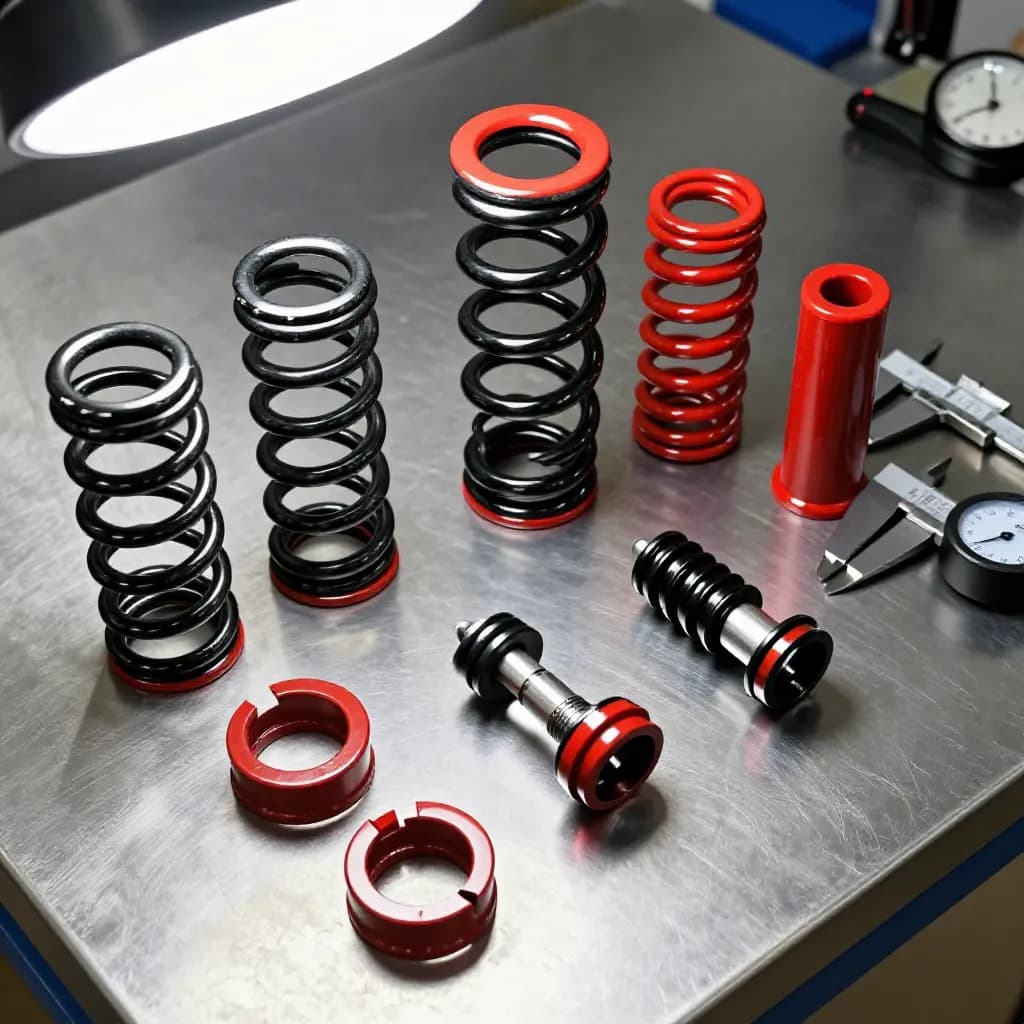
The challenge is multifaceted. The coating must be flexible enough to accommodate the elastic strain that springs and clips experience during normal operation — strains that can reach 1-3% on the outer fiber of a heavily loaded spring. It must maintain adhesion under cyclic loading that may involve millions of stress cycles over the component's service life. And critically, the coating process itself must not introduce defects — particularly hydrogen embrittlement — that could cause catastrophic failure of the high-strength steel substrate.
Ready to Start Your Project?
From one-off customs to 15,000-part production runs — get precise pricing in 24 hours.
On This Page
The Unique Challenges of Coating High-Stress Components
Springs and clips are manufactured from high-strength steel alloys (typically 1500-2000 MPa tensile strength) that are inherently susceptible to hydrogen embrittlement. Any coating process that introduces hydrogen into the steel — including acid pickling, electroplating, and certain cleaning operations — can cause delayed brittle fracture under sustained load. Powder coating, when properly executed, avoids the hydrogen-generating processes that make electroplating hazardous for spring applications.
This article examines the specific requirements, risks, and best practices for powder coating springs, clips, and other high-stress elastic components across automotive, industrial, and consumer applications.
Hydrogen Embrittlement: The Critical Risk Factor
Hydrogen embrittlement is the most serious metallurgical risk associated with finishing high-strength steel springs and clips. When atomic hydrogen diffuses into the steel lattice, it accumulates at grain boundaries and stress concentration points, reducing the steel's ductility and fracture toughness. Under sustained tensile stress, embrittled components can fracture suddenly and without warning — a failure mode that has caused numerous recalls and safety incidents in automotive and aerospace applications.
The susceptibility to hydrogen embrittlement increases with steel strength. Components with tensile strength above 1000 MPa (approximately 31 HRC hardness) are considered susceptible, and those above 1400 MPa are highly susceptible. Most spring steels — including ASTM A228 (music wire), ASTM A229 (oil-tempered wire), ASTM A232 (chrome-vanadium), and ASTM A401 (chrome-silicon) — fall well within the susceptible range.
Hydrogen can be introduced during several stages of the coating process. Acid pickling, which is sometimes used for rust removal or surface activation, generates hydrogen at the steel surface as a byproduct of the acid-metal reaction. Alkaline cleaning at high temperatures can also introduce hydrogen, though at lower rates than acid processes. Electroplating processes (zinc, cadmium, chromium) are particularly hazardous because hydrogen is co-deposited with the metal during electrodeposition.
Powder coating offers a significant advantage over electroplating for spring finishing because the standard pretreatment sequence — alkaline cleaning, mechanical abrasion or blasting, and phosphate conversion coating — does not generate significant quantities of hydrogen. However, if acid pickling is included in the pretreatment sequence (sometimes used to remove heavy rust or scale), a post-pickling bake at 190-220°C for 4-24 hours is mandatory to drive out absorbed hydrogen before the component enters service.
The powder curing cycle itself (typically 180-200°C for 10-20 minutes) provides some hydrogen baking benefit, but the time at temperature may be insufficient for complete hydrogen removal from heavily contaminated parts. When acid processes are unavoidable, a dedicated hydrogen relief bake before powder application is the safest approach.
ASTM F519 provides the standard test method for evaluating the susceptibility of metallic materials to hydrogen embrittlement, and ASTM B849 covers pre-treatments for reducing the risk of hydrogen embrittlement.
Coating Flexibility and Fatigue Performance
The flexibility of the powder coating is critical for springs and clips that undergo repeated elastic deformation during service. A coating that cracks under the strain imposed by normal spring operation not only loses its protective function but can also initiate fatigue cracks in the underlying steel — effectively reducing the component's fatigue life rather than extending it.
Spring steels operate at stress levels of 600-1200 MPa in service, corresponding to elastic strains of 0.3-0.6% for typical spring steel moduli. On the outer surface of a coiled spring, the strain during compression or extension can reach 1-3% depending on the spring index (ratio of coil diameter to wire diameter). The coating must accommodate this strain without cracking.
Standard powder coatings — particularly epoxy and epoxy-polyester hybrids — have elongation at break values of 2-5%, which is marginal for heavily loaded springs. Flexible powder coating formulations, incorporating plasticizers, flexible resin backbones, or rubber-modified epoxies, can achieve elongation values of 5-15%, providing adequate margin for most spring applications.
Polyester powder coatings generally offer better flexibility than epoxies, with elongation values of 3-8% for standard formulations and up to 15% for flexible grades. For springs that will be exposed to outdoor environments where UV resistance is important, flexible polyester formulations provide the best combination of flexibility and weathering performance.
Fatigue testing of coated springs is essential for safety-critical applications. Coated springs are subjected to cyclic loading at the design stress amplitude for the specified number of cycles (typically 10⁵ to 10⁷ cycles depending on the application). The coating is then examined for cracking, and the spring's fatigue life is compared to uncoated control specimens. A properly selected and applied powder coating should not reduce the spring's fatigue life — and in some cases, the coating can slightly improve fatigue performance by reducing surface stress concentrations and preventing corrosion-initiated fatigue cracking.
The coating thickness on springs must be carefully controlled. Excessive thickness increases the coating's stiffness and reduces its ability to conform to the spring's deformation. For most spring applications, film thicknesses of 40-80 microns provide the optimal balance between corrosion protection and mechanical flexibility.
Pretreatment and Surface Preparation for Spring Steel
Surface preparation for spring steel requires a careful balance between achieving adequate cleanliness and surface profile for coating adhesion while avoiding processes that could introduce hydrogen or damage the carefully controlled surface condition of the spring.
Spring steel wire and strip are typically supplied with a clean, oxide-free surface from the wire drawing or rolling process, covered with a thin layer of drawing lubricant or protective oil. The primary pretreatment objective is to remove this oil and any handling contamination without altering the surface metallurgy or introducing hydrogen.
Alkaline cleaning is the preferred degreasing method for spring steel. Immersion or spray cleaning in alkaline solutions at 50-70°C effectively removes oils and lubricants without generating hydrogen. The cleaning solution must be free of chlorides and fluorides, which can cause stress corrosion cracking in high-strength steel. Rinse water quality is also important — deionized or reverse-osmosis water prevents mineral deposits that could interfere with coating adhesion.
Abrasive blasting is used when the spring surface has rust, scale, or heavy contamination that alkaline cleaning cannot remove. For spring steel, the blasting process must be carefully controlled to avoid introducing surface damage that could act as fatigue crack initiation sites. Fine media (100-200 mesh aluminum oxide or glass bead) at moderate blast pressures produce a clean surface with minimal surface roughening. Shot peening — a controlled blasting process that introduces beneficial compressive residual stresses — is often performed on springs before coating and serves the dual purpose of surface preparation and fatigue life enhancement.
Phosphate conversion coating (iron phosphate or zinc phosphate) follows cleaning and provides the adhesion-promoting layer for powder coating. The phosphate crystal layer must be uniform and fine-grained — coarse or uneven phosphate crystals can create stress concentration points under the coating that may initiate fatigue cracks in highly stressed springs.
For clips and flat springs manufactured from pre-coated or galvanized steel, the existing coating or zinc layer must be evaluated for compatibility with the powder coating system. Zinc-coated spring steel can be powder coated, but the zinc surface must be treated with a suitable conversion coating to promote adhesion, and the curing temperature must not exceed the level at which zinc outgassing occurs (typically above 230°C).
Application Methods for Springs and Clips
The geometry of springs and clips creates specific application challenges that require adapted techniques for consistent coating coverage. Coiled springs, leaf springs, torsion bars, and formed clips each present unique geometries that affect powder deposition and curing.
Coiled compression and extension springs are typically coated by hanging them vertically on a conveyor and passing them through an electrostatic spray booth. The helical geometry creates moderate Faraday cage effects between adjacent coils, particularly for springs with a low pitch (closely spaced coils). Reducing gun voltage to 30-50 kV and using tribo-charging guns improves penetration between coils. For springs with very tight coil spacing, rotating the spring during application or spraying from multiple angles ensures coverage on all coil surfaces.
Leaf springs for automotive and truck suspensions are large, heavy components that require robust conveyor systems and extended cure cycles. The flat geometry of individual leaves is well-suited to electrostatic spray, but assembled leaf spring packs present Faraday cage challenges between the stacked leaves. Individual leaves are typically coated before assembly, with the inter-leaf contact surfaces either masked or coated with a friction-modified formulation that maintains the inter-leaf friction coefficient required for proper spring function.
Small clips, retainers, and flat springs are often coated in bulk using tumble or rack coating methods. Tumble coating involves placing parts in a rotating basket within the spray booth, ensuring all surfaces are exposed to the powder spray. This method is efficient for high volumes of small parts but requires careful control to prevent parts from nesting together and creating uncoated contact areas.
Rack coating — hanging individual parts on hooks or fixtures — provides better control over coating thickness and coverage but is more labor-intensive. For automotive clips and retainers produced in high volumes, automated racking systems using custom fixtures that hold multiple parts in optimal orientation for coating provide the best combination of quality and productivity.
Curing temperatures for spring coatings must be carefully controlled. The standard powder curing temperature of 180-200°C is below the tempering temperature of most spring steels (typically 350-500°C), so the curing process does not affect the spring's mechanical properties. However, if curing temperatures exceed 230°C — as may occur with some high-temperature powder formulations — the spring's hardness and fatigue properties should be verified after coating.
Automotive Spring and Clip Applications
The automotive industry is the largest consumer of powder-coated springs and clips, with dozens of coated spring and clip components in every vehicle. From suspension coil springs and valve springs to body clips, trim fasteners, and seat mechanisms, these components must meet stringent automotive durability and corrosion specifications.
Suspension coil springs are among the most demanding automotive powder coating applications. These springs operate under high cyclic stress (typically 700-900 MPa) while exposed to road salt, gravel impacts, and temperature extremes. The coating must withstand stone chip impacts without cracking, resist salt spray corrosion for the vehicle's design life (typically 12-15 years or 200,000+ km), and maintain flexibility through millions of compression cycles.
Automotive OEM specifications for suspension spring coatings typically require 1000+ hours of salt spray resistance per ASTM B117, stone chip resistance per SAE J400 or VDA 621-427, and cyclic corrosion testing per SAE J2334 for 60-80 cycles. The coating must also pass thermal cycling from -40°C to +80°C without cracking or delamination.
Epoxy powder coatings are the traditional choice for suspension springs due to their excellent adhesion, chemical resistance, and flexibility. However, epoxy's poor UV resistance means that springs exposed to sunlight (visible through wheel openings) may chalk and discolor over time. Polyester and acrylic-modified formulations offer better UV resistance for visible spring applications, though their chemical resistance may be slightly lower than pure epoxy.
Body clips, trim fasteners, and interior mechanism springs are typically smaller components coated in high volumes. These parts require consistent coating thickness (typically 40-60 microns), reliable corrosion protection (500-1000 hours salt spray), and specific colors for identification and assembly purposes. Automated coating lines with robotic spray guns and in-line quality monitoring handle the high volumes and tight tolerances required for automotive clip production.
The trend toward electric vehicles is creating new spring and clip coating requirements. EV battery retention clips, high-voltage connector springs, and thermal management system fasteners must meet electrical insulation requirements in addition to conventional corrosion and mechanical specifications.
Quality Assurance and Testing Protocols
Quality assurance for powder-coated springs and clips must address both the coating performance and the potential impact of the coating process on the substrate's mechanical properties. A comprehensive QA program includes incoming material verification, in-process monitoring, and finished product testing.
Coating thickness measurement on springs requires adaptation of standard techniques. For coiled springs, measurements are taken on the outer diameter of the coil where the gauge can make flat contact. Inner coil surfaces and the areas between closely spaced coils are more difficult to measure and may require destructive cross-sectional analysis for verification. Typical acceptance ranges are 50-100 microns for automotive springs and 40-80 microns for industrial clips.
Adhesion testing per ASTM D3359 (cross-cut tape test) or ISO 2409 is performed on flat test panels coated alongside the production parts. For springs, adhesion can also be evaluated by bending a coated wire sample around a mandrel and examining the coating for cracking and delamination. The mandrel diameter is typically 2-3 times the wire diameter for standard flexibility requirements.
Hydrogen embrittlement testing is mandatory for high-strength steel springs (above 1000 MPa tensile strength) that have undergone any acid cleaning or pickling process. The sustained load test per ASTM F519 subjects notched test specimens to a sustained tensile load equal to 75% of the notched tensile strength for 200 hours. Any specimen that fractures during the test period indicates hydrogen embrittlement, requiring process review and corrective action.
Corrosion testing per ASTM B117 (salt spray) or cyclic corrosion protocols provides accelerated evaluation of coating durability. Test springs are loaded to their design stress during salt spray exposure to evaluate coating performance under realistic mechanical conditions — an important distinction from testing unloaded flat panels, as the coating on a stressed spring may crack at defects that would remain benign on an unstressed surface.
Fatigue testing compares the fatigue life of coated springs to uncoated control specimens at the design stress amplitude. The coating should not reduce fatigue life by more than 10% compared to uncoated springs — any greater reduction indicates a coating process issue (excessive thickness, poor adhesion, or hydrogen contamination) that must be resolved.
Process validation for new spring coating applications typically requires a first-article inspection including all of the above tests, followed by ongoing production monitoring with reduced sampling frequency. Statistical process control (SPC) of coating thickness, adhesion, and cure verification ensures consistent quality across production runs.
Frequently Asked Questions
Does powder coating cause hydrogen embrittlement in springs?
The standard powder coating process (alkaline cleaning, phosphate conversion, electrostatic application, thermal cure) does not generate significant hydrogen and is considered safe for high-strength spring steel. However, if acid pickling is used during pretreatment, a hydrogen relief bake at 190-220°C for 4-24 hours is mandatory before the component enters service.
How flexible does powder coating need to be for springs?
Spring coatings must accommodate elastic strains of 1-3% on heavily loaded springs. Standard powder coatings offer 2-5% elongation, which is marginal. Flexible formulations using plasticizers, flexible resin backbones, or rubber-modified epoxies achieve 5-15% elongation, providing adequate margin for most spring applications.
What coating thickness is recommended for springs?
Film thicknesses of 40-80 microns are optimal for most spring applications, balancing corrosion protection with mechanical flexibility. Excessive thickness increases coating stiffness and reduces conformability to spring deformation. Automotive suspension springs typically specify 50-100 microns depending on the OEM requirement.
Does powder coating affect spring fatigue life?
A properly selected and applied powder coating should not reduce fatigue life — and may slightly improve it by reducing surface stress concentrations and preventing corrosion-initiated fatigue cracking. Fatigue testing of coated springs against uncoated controls verifies that the coating process does not degrade mechanical performance.
What powder chemistry is best for automotive suspension springs?
Epoxy powder coatings are the traditional choice for suspension springs due to excellent adhesion, chemical resistance, and flexibility. For springs visible through wheel openings, polyester or acrylic-modified formulations offer better UV resistance. Automotive OEM specifications typically require 1000+ hours salt spray resistance and stone chip testing.
Ready to Start Your Project?
From one-off customs to 15,000-part production runs — get precise pricing in 24 hours.