Cable tray systems are the structural pathways that support and route electrical power cables, data cables, and communication wiring throughout commercial buildings, industrial facilities, data centers, and infrastructure installations. These systems must provide decades of reliable service while protecting the cables they carry from physical damage, supporting their weight, and maintaining the fire safety and electrical grounding requirements of the installation.
Industrial
Powder Coating for Cable Tray Systems: Data Centers, Industrial, and Fire-Rated Applications
Sundial Powder Coating·April 23, 2026·11 min
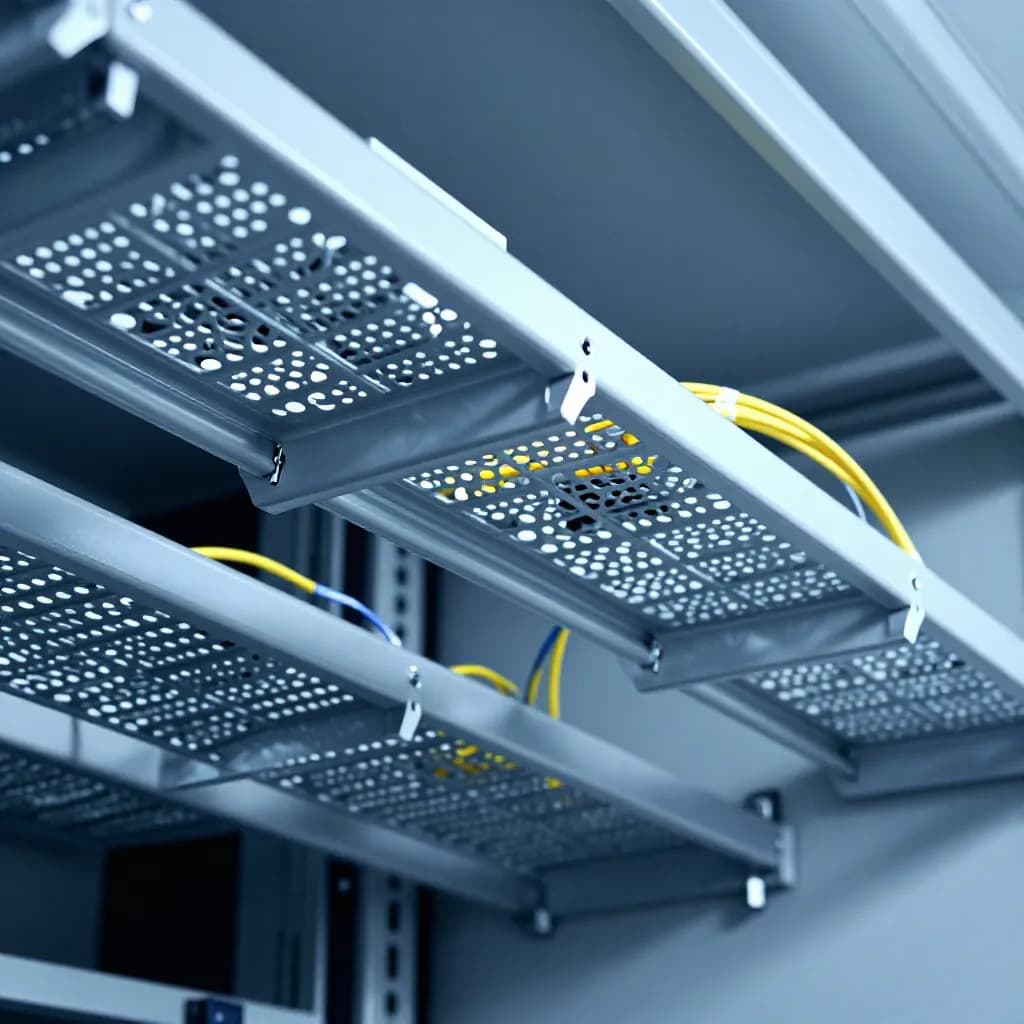
The choice of cable tray finish directly affects the system's corrosion resistance, fire performance, electrical continuity, appearance, and lifecycle cost. Historically, hot-dip galvanizing has been the default finish for cable tray in industrial and commercial applications, but powder coating has emerged as a compelling alternative that offers advantages in appearance, color coding, environmental compliance, and performance in specific corrosive environments.
Ready to Start Your Project?
From one-off customs to 15,000-part production runs — get precise pricing in 24 hours.
On This Page
Cable Tray Systems: The Backbone of Electrical Infrastructure
Powder-coated cable tray systems are now specified for data centers (where appearance and cleanliness matter), commercial buildings (where color coordination with architectural finishes is desired), food processing facilities (where smooth, cleanable surfaces are required), and corrosive industrial environments (where specific chemical resistance is needed beyond what galvanizing provides).
This article examines the technical requirements, standards, and application considerations for powder-coated cable tray systems across their major application sectors, including a detailed comparison with hot-dip galvanized alternatives.
Powder Coating vs. Hot-Dip Galvanizing for Cable Tray
The choice between powder coating and hot-dip galvanizing for cable tray involves trade-offs in corrosion protection mechanism, appearance, chemical resistance, fire performance, and environmental impact. Understanding these trade-offs enables engineers to specify the optimal finish for each application.
Hot-dip galvanizing provides sacrificial cathodic protection — the zinc coating corrodes preferentially to protect the steel substrate at any coating damage or cut edge. This self-healing property is galvanizing's greatest advantage, as it provides corrosion protection even at field-cut ends, drilled holes, and mechanical damage sites without requiring touch-up. However, galvanizing provides limited chemical resistance (zinc is attacked by both acids and strong alkalis), has a utilitarian appearance that may not suit architectural environments, and the galvanizing process generates significant environmental emissions.
Powder coating provides barrier protection — the organic coating physically isolates the steel from the corrosive environment. This barrier is effective against a wide range of chemicals that would attack zinc, including acids, alkalis, and chlorinated compounds. Powder coating offers unlimited color options, a smooth and cleanable surface, and zero VOC emissions during application. However, powder coating does not provide sacrificial protection at damage sites — any breach in the coating exposes bare steel to corrosion.
For many applications, the optimal solution is a duplex system combining galvanizing with powder coating, as discussed in the galvanized structures article. The duplex approach provides both sacrificial and barrier protection, with the powder coating extending the life of the zinc layer while the zinc provides backup protection at coating defects.
In practice, the choice often depends on the installation environment. For outdoor industrial installations with high risk of mechanical damage, galvanizing's self-healing property is valuable. For indoor data center and commercial installations where appearance matters and mechanical damage risk is low, powder coating provides a superior finish. For aggressive chemical environments, powder coating's chemical resistance advantage may be decisive.
NACE SP0169 and NEMA VE 1 provide guidance on cable tray finish selection based on environmental corrosivity, and consulting these standards helps engineers make informed specification decisions.
Data Center Cable Tray Requirements
Data centers represent one of the fastest-growing markets for powder-coated cable tray, driven by the industry's emphasis on cleanliness, organization, and professional appearance in these high-value facilities. The cable tray system in a large data center may extend for kilometers, supporting thousands of power and data cables that are the facility's operational lifeline.
Appearance and cleanliness are primary drivers for powder coating in data centers. The smooth, non-porous surface of powder-coated cable tray resists dust accumulation and is easy to clean — important in environments where particulate contamination can affect sensitive electronic equipment. The matte or satin finish options available with powder coating reduce glare from overhead lighting, improving visual comfort for technicians working in the cable tray area.
Color coding is a significant advantage of powder-coated cable tray in data centers. Different colors can identify different cable types or circuits — for example, orange for fiber optic pathways, blue for data cables, red for emergency power, and gray for general power distribution. This color coding simplifies cable management, reduces installation errors, and facilitates troubleshooting and maintenance. Hot-dip galvanizing cannot provide this color differentiation.
Electrical grounding continuity is a critical requirement for cable tray systems, and the powder coating must not interfere with the grounding path. NFPA 70 (National Electrical Code) and UL 2277 (Standard for Cable Tray Systems) require that cable tray sections maintain electrical continuity for equipment grounding. Powder-coated cable tray achieves this through bare metal contact at splice plates and grounding lugs — areas that are masked during the coating process to maintain conductive contact.
The data center environment is relatively benign from a corrosion perspective — indoor, climate-controlled, and free of aggressive chemicals. Standard polyester or epoxy-polyester powder coatings at 60-80 microns provide more than adequate corrosion protection for this environment. The coating specification for data center cable tray focuses more on appearance consistency, color accuracy, and surface smoothness than on extreme corrosion resistance.
Hot aisle/cold aisle temperature differentials in data centers can cause condensation on cable tray surfaces, particularly in facilities with high cooling loads. The powder coating provides a barrier against condensation-induced corrosion and prevents the rust staining that can occur on uncoated or galvanized tray in humid conditions.
Fire Ratings and Code Compliance
Fire safety is a critical consideration for cable tray systems, and the coating finish can affect the system's fire performance rating. Building codes and electrical codes impose specific requirements on cable tray fire resistance that must be satisfied regardless of the finish type.
UL 2277 (Standard for Cable Tray Systems) is the primary product safety standard for cable tray in North America. This standard evaluates the structural performance of cable tray under fire conditions, including flame spread, structural integrity during fire exposure, and the cable tray's contribution to fire load. Powder-coated cable tray must be tested and listed under UL 2277 with the specific coating system applied — a listing with galvanized finish does not automatically extend to powder-coated versions.
The organic powder coating adds a small amount of combustible material to the cable tray system. For standard polyester or epoxy powder coatings at 60-80 microns on steel cable tray, the fuel load contribution is minimal — typically less than 0.5 MJ/m² — and does not significantly affect the system's fire performance. However, the coating must not propagate flame along the tray length or generate excessive smoke during a fire event.
Flame-retardant powder coatings are available for cable tray applications where enhanced fire performance is required. These formulations incorporate halogen-free flame retardants (aluminum trihydrate, magnesium hydroxide, or intumescent additives) that suppress combustion and reduce smoke generation. Flame-retardant coatings can achieve UL 94 V-0 ratings and meet the flame spread and smoke development requirements of ASTM E84 for building interior finish materials.
In Europe, cable tray fire performance is evaluated under EN 61537 (Cable management — Cable tray systems and cable ladder systems) and the Construction Products Regulation (CPR) requirements for reaction to fire. Powder-coated steel cable tray typically achieves Euroclass A1 or A2 fire classification when the coating contribution is assessed as part of the complete system.
For installations requiring fire-rated cable tray enclosures — where the tray must maintain circuit integrity during a fire for a specified period (typically 30, 60, or 120 minutes) — the coating is part of the fire-rated assembly and must be included in the fire test. Intumescent powder coatings that expand during fire exposure can contribute to the fire resistance of the enclosure by providing additional insulation to the steel structure.
NFPA 70 (National Electrical Code) Article 392 governs cable tray installation requirements, including fire stop provisions where cable tray penetrates fire-rated walls and floors. The coating finish does not affect fire stop requirements, but the coating must be compatible with the fire stop materials (intumescent sealants, mineral wool, etc.) used at penetrations.
Industrial and Corrosive Environment Applications
Industrial facilities present the most demanding corrosion environments for cable tray systems. Chemical plants, pulp and paper mills, wastewater treatment facilities, and offshore platforms expose cable tray to aggressive chemicals, high humidity, and salt-laden atmospheres that can rapidly degrade inadequately protected systems.
In chemical processing environments, cable tray may be exposed to acid fumes, caustic splashes, solvent vapors, and chlorine gas. Hot-dip galvanizing provides limited protection in these environments because zinc is attacked by both acids (pH below 6) and strong alkalis (pH above 12.5). Powder coating with chemical-resistant epoxy or novolac epoxy formulations provides superior protection in the pH 2-13 range, making it the preferred finish for cable tray in chemical plants.
Pulp and paper mills combine high humidity, sulfur compounds (from the kraft pulping process), and chlorine-based bleaching chemicals in an environment that is particularly aggressive to zinc coatings. Epoxy powder coating at 80-120 microns provides effective protection for cable tray in pulp mill environments, with the thicker film compensating for the aggressive chemical exposure.
Wastewater treatment facilities expose cable tray to hydrogen sulfide gas, which converts to sulfuric acid on moist surfaces. This acid attacks both zinc and bare steel, making corrosion protection essential. Epoxy powder coating provides good resistance to dilute sulfuric acid, and the smooth coating surface resists the accumulation of corrosive deposits that accelerate attack on rough galvanized surfaces.
Offshore and coastal installations subject cable tray to continuous salt spray exposure. While hot-dip galvanizing performs well in marine atmospheres (zinc corrodes slowly and uniformly in salt air), powder coating provides additional barrier protection that extends the system's service life. Duplex systems (galvanizing plus powder coating) are the standard specification for offshore cable tray, providing 30-50 year service life in marine environments.
Food processing facilities require cable tray with smooth, cleanable surfaces that resist the aggressive cleaning chemicals (caustic soda, nitric acid, peracetic acid) used in food plant sanitation. Powder-coated cable tray with epoxy or polyester coating provides the smooth surface and chemical resistance needed for food processing environments, and the ability to specify white or light colors facilitates visual cleanliness inspection.
For all industrial applications, the cable tray coating specification should reference the environmental corrosivity category per ISO 12944 and specify the coating system accordingly. Category C3 (medium) environments may be adequately served by standard polyester coating, while C4 (high) and C5 (very high) environments require epoxy or duplex systems.
Application Process and Manufacturing Considerations
Cable tray components — straight sections, fittings, covers, and accessories — are manufactured from sheet steel or aluminum by roll forming, press braking, and welding. The coating process must handle the variety of shapes and sizes in a cable tray product range while maintaining consistent quality across all components.
Straight tray sections are the highest-volume components and are typically coated on continuous conveyor lines. The tray sections are hung from the side rails or bottom, oriented to allow complete powder coverage on all surfaces including the interior of the tray channel. The U-shaped cross-section of ladder and trough-type cable tray creates a moderate Faraday cage effect that requires attention to gun positioning and voltage settings to ensure adequate coverage on the interior bottom surface.
Fittings — elbows, tees, crosses, and reducers — have more complex geometries than straight sections and may require manual spray touch-up in addition to automatic gun application. The junction points where fitting segments are welded together require particular attention, as weld spatter and heat-affected zones can cause coating defects if not properly prepared.
Cut edges on cable tray components — where the sheet steel has been sheared, punched, or laser cut — are the most vulnerable areas for corrosion initiation. Edge coverage strategies (edge radiusing, high-viscosity powder, increased film thickness) are important for cable tray longevity, particularly on field-cut ends where the factory coating is absent.
Field touch-up of cut ends and drilled holes is an important consideration for powder-coated cable tray. Unlike galvanized tray where cut edges receive some cathodic protection from adjacent zinc, powder-coated tray has no self-healing mechanism at cut edges. Touch-up paint (typically a two-component epoxy in the matching color) must be applied to all field-cut ends and drilled holes to maintain corrosion protection. This requirement should be clearly communicated in the installation instructions.
The coating must maintain electrical continuity requirements for equipment grounding. Splice plates, bonding jumpers, and grounding lug attachment points are masked during coating to provide bare metal contact. The masking locations must align with the tray manufacturer's grounding provisions and comply with NEC Article 392 requirements for cable tray grounding.
Powder reclaim efficiency is important for cable tray coating economics. The open geometry of ladder-type cable tray results in significant overspray that passes through the tray without depositing. Efficient booth design with directional airflow and high-capacity reclaim systems maximizes powder recovery and minimizes waste.
Specification, Testing, and Installation Considerations
Specifying powder-coated cable tray requires attention to both the coating performance requirements and the system-level requirements for electrical safety, fire performance, and structural adequacy.
The coating specification should define the powder type (polyester, epoxy, or epoxy-polyester), color (RAL number or custom match), minimum film thickness (typically 60-80 microns for indoor applications, 80-120 microns for outdoor or corrosive environments), and performance requirements (salt spray hours, adhesion, flexibility). Reference to NEMA VE 1 (Metal Cable Tray Systems) environmental classification helps align the coating specification with the installation environment.
UL listing is essential for cable tray sold in North America. The powder-coated cable tray system must be tested and listed under UL 2277 with the specific coating system applied. The UL listing covers structural performance, fire performance, and electrical continuity with the coating in place. Specifiers should verify that the cable tray manufacturer's UL listing includes the powder-coated finish option.
Corrosion testing per ASTM B117 (salt spray) provides baseline performance data. Typical requirements are 500 hours for indoor commercial applications, 1000 hours for outdoor or light industrial, and 1500+ hours for aggressive industrial or coastal environments. Cyclic corrosion testing per ASTM G85 or ISO 12944-6 provides more realistic performance prediction than continuous salt spray.
Adhesion testing per ASTM D3359 (cross-cut) should achieve Class 4B or 5B (less than 5% or 0% removal). Flexibility testing per ASTM D522 (mandrel bend) verifies that the coating can withstand the bending that occurs during cable tray installation without cracking.
Installation practices for powder-coated cable tray differ from galvanized tray in several respects. Field cutting should use methods that minimize heat input to the coating — cold cutting with a hacksaw or reciprocating saw is preferred over abrasive cutting wheels that generate heat and sparks that can damage the coating. All field-cut ends must be touched up with compatible repair coating. Cable pulling lubricants must be compatible with the powder coating — some petroleum-based lubricants can soften or stain certain powder coatings.
Maintenance of powder-coated cable tray is minimal — periodic visual inspection for coating damage and prompt touch-up of any damaged areas maintains the system's corrosion protection. In corrosive environments, annual inspection is recommended, while indoor commercial installations may require inspection only every 3-5 years. Cleaning with mild detergent and water removes accumulated dust and deposits that could trap moisture against the coating surface.
Frequently Asked Questions
Is powder-coated cable tray better than galvanized?
It depends on the application. Powder coating offers superior appearance, color coding capability, chemical resistance, and cleanability. Galvanizing provides self-healing cathodic protection at damage sites. For data centers and commercial buildings, powder coating is preferred. For outdoor industrial with high damage risk, galvanizing may be better. Duplex systems provide both benefits.
Does powder coating affect cable tray fire ratings?
Powder-coated cable tray must be separately tested and listed under UL 2277 with the specific coating applied. The thin organic coating adds minimal fuel load (less than 0.5 MJ/m²) and typically does not significantly affect fire performance. Flame-retardant powder formulations are available for enhanced fire performance requirements.
How is electrical grounding maintained on powder-coated cable tray?
Splice plate contact areas, bonding jumper attachment points, and grounding lug locations are masked during powder coating to maintain bare metal contact for electrical continuity. These grounding provisions comply with NEC Article 392 requirements and are verified during UL 2277 testing.
What coating is best for cable tray in chemical plants?
Epoxy or novolac epoxy powder coatings at 80-120 microns provide superior chemical resistance in the pH 2-13 range, outperforming galvanizing which is attacked by both acids and strong alkalis. For the most aggressive environments, duplex systems combining galvanizing with epoxy powder coating provide maximum protection.
Do field-cut ends of powder-coated cable tray need touch-up?
Yes. Unlike galvanized tray where cut edges receive cathodic protection from adjacent zinc, powder-coated tray has no self-healing mechanism. All field-cut ends and drilled holes must be touched up with compatible two-component epoxy repair coating to maintain corrosion protection.
Ready to Start Your Project?
From one-off customs to 15,000-part production runs — get precise pricing in 24 hours.