The global robotics industry has expanded far beyond traditional automotive welding cells into logistics, food processing, electronics assembly, healthcare, and collaborative human-robot workspaces. Each of these environments places distinct demands on the protective coatings applied to robot enclosures, housings, and structural components. A powder coating specification that works for a welding robot in an automotive plant may be entirely inappropriate for a collaborative robot operating alongside workers in a pharmaceutical cleanroom.
Industrial
Powder Coating for Robot Enclosures: Industrial, Collaborative, Cleanroom, and ESD Applications
Sundial Powder Coating·April 23, 2026·13 min
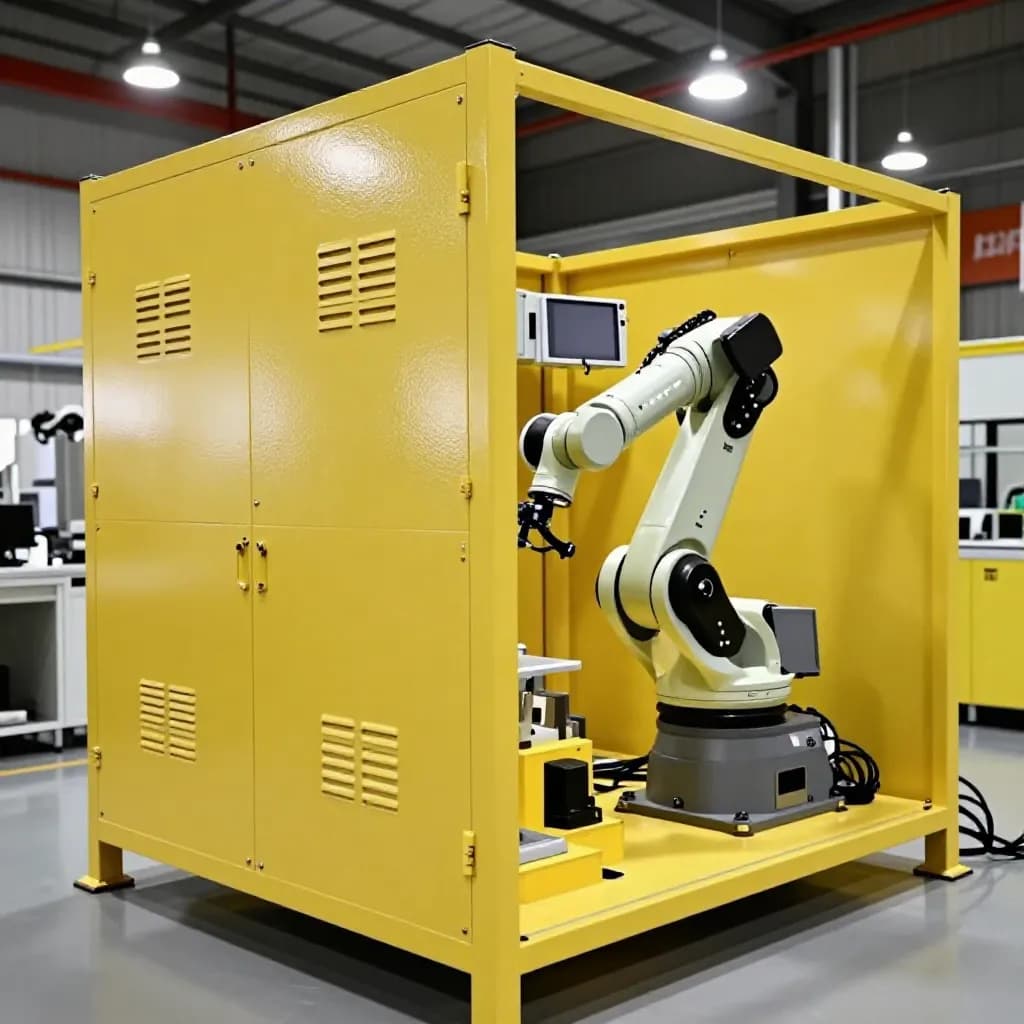
Robot enclosures serve multiple functions beyond simple aesthetics. They protect internal electronics, motors, and wiring from environmental contamination. They provide safety barriers between moving mechanical components and human operators. They dissipate or manage heat generated by motors and controllers. And in many applications, they must meet specific requirements for electrostatic discharge protection, cleanroom particle generation, chemical resistance, or food-contact safety.
Ready to Start Your Project?
From one-off customs to 15,000-part production runs — get precise pricing in 24 hours.
On This Page
Why Robot Enclosures Demand Specialized Powder Coating
Powder coating is the predominant finishing technology for robot enclosures because it delivers a dense, uniform, chemically resistant film that can be formulated to meet all of these functional requirements. The thermoset chemistry of cured powder coatings provides inherent advantages over liquid paints — better chemical resistance, higher film build in a single coat, zero VOC emissions during application, and superior edge coverage on the complex sheet metal geometries typical of robot housings.
The diversity of robotic applications means that no single powder coating specification covers all use cases. This article examines the specific coating requirements for industrial robots, collaborative robots, cleanroom applications, and ESD-sensitive environments, providing technical guidance for specifying the right coating system for each application.
Industrial Robot Enclosures: Harsh Environment Protection
Traditional industrial robots operate in some of the most demanding environments in manufacturing — welding cells with spatter and UV radiation, foundries with extreme heat and abrasive particulates, painting booths with solvent exposure, and machining centers with coolant spray and metal chip impact. The powder coating on industrial robot enclosures must withstand these aggressive conditions while maintaining the safety colors and markings that protect workers.
Welding robot enclosures face the combined assault of weld spatter, UV radiation from the arc, and heat radiation from the workpiece. Anti-spatter powder coatings formulated with silicone-modified surfaces allow weld spatter to be easily removed without damaging the underlying finish. These coatings have low surface energy that prevents molten metal droplets from bonding to the surface, similar to the non-stick principle. Standard film builds of 80-100 microns provide adequate thickness to absorb spatter impact without penetration to the substrate.
Foundry and forging environments expose robot enclosures to radiant heat that can reach 200-300 degrees Celsius at the enclosure surface during close-proximity operations. Standard polyester powder coatings are rated for continuous service at 120-150 degrees Celsius, which may be insufficient for these applications. High-temperature powder coatings based on silicone-modified polyester or pure silicone chemistry can withstand continuous temperatures of 250-350 degrees Celsius, though they sacrifice some color range and mechanical properties compared to standard formulations.
Machining environment robots encounter coolant spray, cutting oil mist, and metal chip impact. The powder coating must resist the chemical attack of water-soluble coolants, which are typically alkaline with pH values of 8.5-9.5, as well as neat cutting oils that can soften some polymer coatings over prolonged contact. Epoxy-polyester hybrid coatings offer the best combination of chemical resistance and mechanical toughness for machining environments, though their UV resistance is limited — acceptable for indoor industrial settings but not for robots operating outdoors.
Impact resistance is critical in all industrial robot environments. Flying debris, tool drops, and collision events can chip or crack the coating, creating corrosion initiation sites. Industrial robot enclosure coatings should achieve a minimum of 100 inch-pounds direct impact resistance per ASTM D2794, with 160 inch-pounds preferred for high-risk environments.
Collaborative Robot Coatings: Safety and Human Interaction
Collaborative robots — cobots — operate in direct proximity to human workers without the safety fencing that separates traditional industrial robots from personnel. This close human interaction creates coating requirements that go beyond environmental protection to include safety signaling, surface comfort, and cleanability for shared workspace hygiene.
Safety color coding is a primary function of cobot enclosure coatings. International standards including ISO 10218 and ISO/TS 15066 establish safety requirements for collaborative robot operation, and while they do not mandate specific colors, industry convention has established clear visual language. Moving parts and pinch points are typically highlighted in safety yellow or orange, emergency stop buttons are red on yellow backgrounds, and the main body is often finished in neutral colors — white, light gray, or the manufacturer's brand color — that provide visual contrast against typical factory backgrounds.
Surface finish characteristics matter for cobots because workers may touch, lean against, or brush past the robot during normal operations. The coating surface should be smooth enough to prevent skin abrasion but not so glossy that it shows every fingerprint and requires constant cleaning. Satin finishes in the 30-50 gloss unit range at 60 degrees provide an optimal balance — smooth to the touch, easy to clean, and forgiving of casual contact marks.
Cleanability is increasingly important as cobots move into food processing, pharmaceutical, and healthcare environments where hygiene standards require regular surface decontamination. The powder coating must withstand repeated cleaning with industrial sanitizers, alcohol-based disinfectants, and in some cases hydrogen peroxide or quaternary ammonium compounds. Smooth, non-porous powder coatings resist bacterial adhesion and biofilm formation more effectively than rough or textured surfaces, making them suitable for environments where microbial control is important.
The coating must also be free of substances that could transfer to products or workers during contact. For food-processing cobots, the coating should comply with FDA 21 CFR 175.300 for food-contact coatings or equivalent regulations in other jurisdictions. This limits the pigments, additives, and base resins that can be used in the formulation.
Cleanroom-Compatible Powder Coatings
Robots operating in cleanroom environments — semiconductor fabrication, pharmaceutical manufacturing, optical assembly, and aerospace component production — must not contribute to airborne particle contamination. The powder coating on cleanroom robot enclosures must be formulated and applied to minimize particle generation from the coated surface during robot operation.
Particle generation from coated surfaces occurs through several mechanisms: mechanical abrasion where surfaces contact each other or external objects, outgassing of volatile compounds from the coating matrix, and degradation of the coating surface due to chemical exposure or UV radiation. A cleanroom-compatible powder coating must minimize all of these particle sources to maintain the required cleanliness classification.
For ISO Class 5 and cleaner environments, powder coatings must undergo particle emission testing that measures both airborne particle generation and surface particle shedding under simulated operating conditions. The coating surface should be smooth with minimal texture — surface roughness values of Ra 0.4-0.8 micrometers are typical for cleanroom applications. Textured or rough finishes that trap and release particles are not acceptable in cleanroom environments.
Outgassing is a particular concern in semiconductor cleanrooms where molecular contamination can affect wafer processing. The powder coating must have low total outgassing rates, typically measured by thermogravimetric analysis or dynamic headspace gas chromatography. Fully cured polyester and epoxy-polyester coatings generally have acceptable outgassing characteristics, but formulations containing volatile plasticizers, flow agents, or degassing additives may exceed cleanroom limits. Coating suppliers should provide outgassing test data for formulations intended for cleanroom use.
Chemical resistance in cleanroom applications extends to the aggressive cleaning agents used for contamination control. Isopropyl alcohol, acetone, and various proprietary cleanroom wipes and solutions are used frequently, and the coating must resist these chemicals without softening, swelling, or generating particles. Epoxy-based powder coatings offer the best chemical resistance for cleanroom applications, and their limited UV resistance is not a concern in the controlled lighting environment of a cleanroom.
Color selection for cleanroom robot enclosures is typically limited to white, light gray, or light blue — colors that make particle contamination visible on the surface and maintain the bright, clean aesthetic expected in controlled environments.
ESD-Dissipative Powder Coatings for Electronics Manufacturing
Robots handling electronic components, circuit boards, and semiconductor wafers must be finished with coatings that prevent electrostatic charge accumulation and uncontrolled discharge. A standard powder coating is an excellent electrical insulator — exactly the wrong property for an ESD-sensitive environment where static discharge can destroy sensitive components worth thousands of dollars.
ESD-dissipative powder coatings are formulated with conductive additives that reduce the surface resistivity of the cured film to the dissipative range of 10^6 to 10^9 ohms per square. This resistivity range allows static charges to dissipate slowly and safely to ground without the rapid discharge that damages electronic components. The conductive additives are typically carbon-based — carbon black, carbon fiber, or carbon nanotube fillers — dispersed uniformly throughout the powder coating matrix.
The challenge with ESD-dissipative powder coatings is achieving consistent resistivity across the entire coated surface. Conductive filler distribution can vary with film thickness, application method, and cure conditions, creating hot spots of higher or lower resistivity. Quality control requires surface resistivity measurement at multiple points on each coated component using a concentric ring probe per ANSI/ESD STM11.11 or equivalent standard. Acceptable variation is typically within one order of magnitude across the surface.
Color options for ESD-dissipative coatings are more limited than standard powder coatings because the carbon-based conductive fillers impart a dark tint to the formulation. Black and dark gray are the most common ESD-dissipative colors, though medium grays and some darker colors are achievable with careful formulation. Light colors and whites are generally not available in dissipative formulations because the carbon loading required for conductivity overwhelms light-colored pigments.
Grounding of ESD-dissipative coated surfaces is essential for the system to function. The coating must make electrical contact with the grounded metal substrate at mounting points, and the robot's grounding system must provide a continuous path to earth ground. Masking strategy must ensure that grounding contact points are left uncoated or that conductive gaskets are used at assembly interfaces to maintain the ground path through the dissipative coating.
For environments requiring both cleanroom compatibility and ESD protection, specialized formulations that combine low particle generation with dissipative resistivity are available, though the selection is more limited and lead times may be longer than standard products.
Heat Management and Thermal Design Considerations
Robot enclosures must manage the heat generated by internal motors, drives, and controllers while maintaining safe external surface temperatures. The powder coating plays a role in this thermal management, and its thermal properties should be considered as part of the overall enclosure thermal design.
Standard powder coatings have thermal conductivity values of approximately 0.2-0.3 watts per meter-kelvin, making them moderate thermal insulators. At typical film builds of 60-100 microns, the coating adds a small but measurable thermal resistance between the enclosure wall and the ambient air. For robots with high internal heat generation, this insulating effect can raise internal temperatures by 2-5 degrees Celsius compared to an uncoated enclosure, which may be significant for temperature-sensitive electronics.
Color selection affects thermal performance through radiative heat transfer. Dark-colored coatings have higher thermal emissivity — typically 0.85-0.95 — meaning they radiate heat more effectively than light-colored coatings with emissivity values of 0.70-0.85. For robot enclosures that rely on passive radiative cooling, dark colors can improve heat dissipation by 10-15 percent compared to white or light gray. However, dark colors also absorb more solar radiation on outdoor robots, which can offset the emissivity advantage.
Ventilation openings and cooling fin areas on robot enclosures require careful coating application to avoid blocking airflow paths. Powder coating can bridge small ventilation slots if film build is excessive, reducing effective open area and airflow. For enclosures with perforated ventilation panels, the powder coating specification should include maximum film build limits on perforated areas and post-coating inspection to verify that ventilation openings remain clear.
Some robot manufacturers use thermally conductive powder coatings on specific enclosure areas to enhance heat transfer. These specialized formulations incorporate thermally conductive fillers — typically aluminum oxide, boron nitride, or aluminum nitride — that increase the coating's thermal conductivity to 1-5 watts per meter-kelvin. While still far less conductive than bare metal, these coatings reduce the thermal resistance of the coating layer and can lower hot-spot temperatures on enclosure surfaces adjacent to high-heat components.
Safety Color Standards and Visual Communication
Robot enclosures use color as a critical safety communication tool, and the powder coating must deliver precise, durable colors that maintain their safety signaling function throughout the robot's service life. International standards define specific colors for safety functions, and deviation from these standards can create confusion and increase the risk of workplace accidents.
ISO 3864 and ANSI Z535 establish the color vocabulary for safety communication in industrial environments. Red indicates prohibition, danger, and emergency stop functions. Yellow signals caution and warns of potential hazards. Orange identifies warning-level hazards. Green indicates safe conditions and first aid. Blue conveys mandatory actions or information. These colors must be applied within defined chromaticity coordinates to ensure consistent recognition across different lighting conditions and viewing angles.
For robot enclosures, the most commonly specified safety colors are safety yellow for hazard zones and pinch points, red for emergency stop buttons and their surrounding areas, and blue or green for status indicators. The main body color is typically a neutral shade — RAL 7035 light gray is the most popular choice for industrial robots — that provides visual contrast for safety markings and integrates well with factory environments.
Color durability is essential for safety function. A safety yellow marking that fades to pale cream after two years of UV exposure no longer communicates its intended warning. Powder coatings for safety-critical colors should use lightfast pigments with Blue Wool Scale ratings of 7 or higher, and the coating formulation should be a super-durable or fluoropolymer-modified polyester for outdoor applications. Indoor robots face less UV challenge but may be exposed to chemical cleaning agents that can alter color appearance.
Retroreflective powder coatings and markings are used on some robot installations to enhance visibility in low-light conditions. While true retroreflection requires applied reflective elements rather than the powder coating itself, high-visibility fluorescent powder coatings in yellow-green or orange provide enhanced conspicuity under both natural and artificial lighting. These fluorescent coatings are particularly valuable for mobile robots and automated guided vehicles that move through shared human-robot workspaces.
Specification and Procurement for Robot OEMs
Robot manufacturers specifying powder coatings for their enclosures must develop comprehensive coating specifications that address all functional requirements while remaining practical for their supply chain. A well-structured specification reduces quality issues, simplifies supplier qualification, and ensures consistent coating performance across production volumes.
The specification should define requirements in several categories. Material requirements specify the coating chemistry, color, gloss level, and any special properties such as ESD dissipation or antimicrobial function. Application requirements define film thickness ranges, coverage requirements, and any areas requiring special attention or masking. Performance requirements establish minimum values for adhesion, hardness, impact resistance, chemical resistance, salt spray endurance, and accelerated weathering. Testing requirements specify the test methods, sample sizes, and acceptance criteria for incoming material inspection and production quality control.
Supplier qualification for robot enclosure coating involves evaluating both the powder manufacturer and the coating applicator. The powder manufacturer should demonstrate formulation consistency through batch-to-batch testing data, provide material safety data sheets and regulatory compliance documentation, and maintain quality certifications appropriate to the robot's end-use market. The coating applicator should demonstrate process capability through statistical analysis of film thickness and adhesion data, maintain calibrated equipment, and operate under a quality management system — ISO 9001 at minimum, with ISO 13485 for medical robots or IATF 16949 for automotive applications.
First article inspection is a critical step in qualifying a new coating supplier or specification. A representative sample of coated enclosures is subjected to the full battery of specification tests, and results are documented in a first article inspection report. This report becomes the baseline against which ongoing production quality is measured. Any specification changes — including powder lot changes, pretreatment chemistry modifications, or cure parameter adjustments — should trigger a partial or full requalification depending on the significance of the change.
For robot OEMs with global manufacturing operations, coating specification harmonization across facilities ensures that robots produced in different locations have consistent appearance and performance. This requires specifying powder coatings by performance requirements rather than brand names, allowing each facility to source locally while meeting the same functional standards.
Frequently Asked Questions
What is ESD-dissipative powder coating for robots?
ESD-dissipative powder coating contains conductive additives — typically carbon-based fillers — that reduce surface resistivity to 10^6 to 10^9 ohms per square. This allows static charges to dissipate safely to ground, preventing electrostatic discharge that could damage sensitive electronic components handled by the robot.
Can powder-coated robots be used in cleanrooms?
Yes, with appropriate coating selection. Cleanroom-compatible powder coatings are formulated for low particle generation and minimal outgassing. Smooth finishes with surface roughness below Ra 0.8 micrometers minimize particle trapping. The coating must also withstand aggressive cleanroom cleaning agents like isopropyl alcohol and acetone.
What safety colors are required on robot enclosures?
ISO 3864 and ANSI Z535 define safety colors: red for danger and emergency stops, yellow for caution and hazard zones, orange for warnings, green for safe conditions, and blue for mandatory actions. Robot enclosures typically use safety yellow for pinch points and red for emergency stop areas, with neutral gray for the main body.
How does powder coating handle heat from robot motors?
Standard powder coatings tolerate continuous temperatures of 120-150 degrees Celsius, adequate for most robot applications. For high-heat environments like foundries, silicone-modified coatings withstand 250-350 degrees Celsius. Dark-colored coatings radiate heat more effectively than light colors, which can improve passive cooling by 10-15 percent.
What powder coating is best for welding robot enclosures?
Anti-spatter powder coatings with silicone-modified surfaces are recommended for welding robots. These low-surface-energy coatings prevent weld spatter from bonding to the enclosure, allowing easy removal without damaging the finish. Film builds of 80-100 microns provide adequate thickness to absorb spatter impact.
Ready to Start Your Project?
From one-off customs to 15,000-part production runs — get precise pricing in 24 hours.