Laboratory furniture operates in one of the most chemically aggressive environments encountered in any industry. Research benches, fume hood interiors, storage cabinets, and shelving systems are routinely exposed to concentrated acids, bases, organic solvents, and oxidizing agents that would destroy conventional paint finishes within weeks. The coating on laboratory furniture is not merely cosmetic — it is a critical functional barrier that protects the steel substrate from corrosion and prevents chemical contamination of the work surface.
Technical
Powder Coating for Laboratory Furniture: Chemical-Resistant Finishes for Research Environments
Sundial Powder Coating·April 22, 2026·12 min
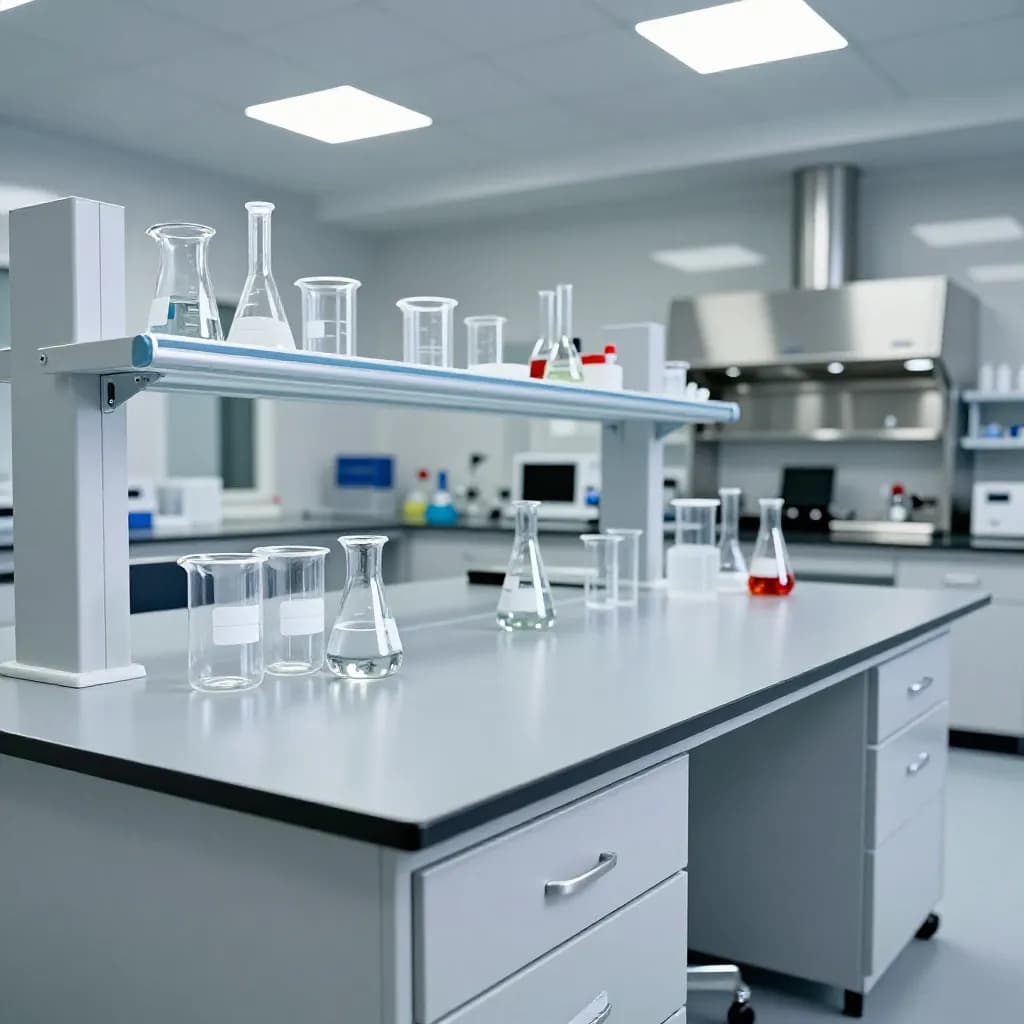
Powder coating has become the standard finish for steel laboratory furniture because it provides the chemical resistance, film integrity, and surface cleanability that this environment demands. The thermoset cross-linked film formed during powder coating cure creates a dense polymer matrix with minimal porosity, preventing chemical penetration to the substrate even under prolonged exposure. This is a fundamental advantage over liquid paint, which typically has higher porosity and lower cross-link density.
Ready to Start Your Project?
From one-off customs to 15,000-part production runs — get precise pricing in 24 hours.
On This Page
Laboratory Furniture Coating Requirements
The laboratory furniture market is served by specialized manufacturers including Fisher Hamilton, Kewaunee Scientific, Thermo Fisher Scientific, and Waldner, all of whom specify powder coating as their primary finishing technology. These manufacturers have developed detailed coating specifications that address the specific chemical, mechanical, and aesthetic requirements of different laboratory types — from general chemistry teaching labs to pharmaceutical cleanrooms and semiconductor fabrication facilities.
Chemical Resistance Testing and Performance Standards
Laboratory furniture coatings are evaluated against a comprehensive panel of chemicals that represent real-world laboratory exposure. SEFA (Scientific Equipment and Furniture Association) Standard 8 is the primary industry benchmark, defining test methods and performance criteria for laboratory furniture surfaces including powder-coated steel.
SEFA 8 chemical resistance testing involves applying reagent-grade chemicals to the coated surface under standardized conditions and evaluating the result after a defined exposure period. The test panel includes sulfuric acid (33% and 98%), hydrochloric acid (37%), nitric acid (30%), sodium hydroxide (40%), acetone, toluene, methylene chloride, dimethylformamide, and numerous other reagents. Coatings are rated on a scale from 0 (no effect) to 4 (severe damage), with laboratory-grade powder coatings expected to achieve ratings of 0-1 for the majority of common laboratory chemicals.
Beyond SEFA 8, European standard EN 13150 specifies requirements for laboratory furniture including chemical resistance, mechanical strength, and dimensional stability. The chemical resistance test method in EN 13150 differs from SEFA 8 in exposure time and evaluation criteria but covers a similar range of reagents. Manufacturers selling globally must ensure their powder coating specifications meet both standards.
For pharmaceutical and biotechnology laboratories, additional requirements may include resistance to cleaning validation agents (typically 1-2% sodium hydroxide at 60-80°C), compatibility with vaporized hydrogen peroxide (VHP) decontamination cycles, and resistance to common cell culture media and biological stains. These application-specific requirements often exceed standard SEFA 8 criteria and require custom testing protocols.
Epoxy Powder Coatings: The Chemistry of Choice for Laboratories
Epoxy powder coatings are the dominant chemistry for laboratory furniture finishing, and for good reason. The epoxy resin system provides the highest chemical resistance of any single-chemistry powder coating, with particular strength against acids, bases, and organic solvents. The bisphenol-A based epoxy resins used in laboratory-grade formulations form a highly cross-linked network with excellent barrier properties and chemical inertness.
Standard laboratory-grade epoxy powder coatings are formulated with high-molecular-weight solid epoxy resins (typically Type 3 or Type 4 with epoxy equivalent weights of 730-1000 g/eq) cured with dicyandiamide (DICY) hardeners. This combination produces a coating with pencil hardness of 3H-4H, excellent adhesion to phosphated steel, and outstanding resistance to a broad spectrum of laboratory chemicals. Film thickness is typically specified at 60-80 microns for single-coat applications.
Novolac epoxy powder coatings represent the premium tier for laboratory applications requiring maximum chemical resistance. Novolac resins have higher cross-link density than standard bisphenol-A epoxies, resulting in superior resistance to concentrated acids, strong solvents, and elevated temperatures. Novolac epoxy coatings can withstand continuous exposure to temperatures up to 150°C and resist chemicals that would penetrate standard epoxy formulations. The trade-off is reduced flexibility and higher material cost.
The primary limitation of epoxy powder coatings is UV sensitivity. Epoxy coatings chalk and yellow when exposed to sunlight or fluorescent lighting with UV content. For laboratory furniture, this is generally acceptable because most components are used indoors under controlled lighting. However, for furniture near windows or under UV-emitting light sources, a two-coat system with an epoxy primer and UV-stable polyester topcoat may be specified.
Electrostatic Dissipative and Conductive Powder Coatings
Laboratories handling sensitive electronics, flammable solvents, or explosive powders require electrostatic dissipative (ESD) or conductive powder coatings on furniture and equipment surfaces. Static discharge can damage sensitive instruments, ignite flammable vapors, or trigger dust explosions — all scenarios that proper ESD coating prevents.
ESD powder coatings are formulated with conductive additives that reduce surface resistivity to the dissipative range of 10⁶ to 10⁹ ohms per square, as defined by ANSI/ESD S20.20 and IEC 61340-5-1. Common conductive additives include carbon black, carbon fiber, conductive mica, and antimony-doped tin oxide (ATO). The additive type and loading level determine the final surface resistivity, which must be verified on production parts using a surface resistance meter per ASTM D257.
Conductive powder coatings achieve surface resistivity below 10⁶ ohms per square and are specified for applications requiring rapid charge dissipation, such as explosive handling facilities and certain semiconductor manufacturing environments. These coatings use higher loadings of conductive additives, typically carbon-based, which limits the available color range to dark shades — primarily black and dark grey.
The grounding system is as important as the coating itself. ESD powder-coated furniture must be electrically connected to the facility ground through dedicated grounding straps or conductive casters. The total resistance from the work surface to ground must not exceed 10⁹ ohms for dissipative applications or 10⁶ ohms for conductive applications. This end-to-end resistance includes the coating, substrate, grounding hardware, and facility ground connection.
For cleanroom laboratories, ESD coatings must also meet particle generation requirements. Standard ESD coatings with carbon black additives can shed conductive particles that contaminate cleanroom environments. Cleanroom-compatible ESD formulations use non-shedding conductive additives such as ATO or inherently dissipative polymers that maintain ESD properties without particle generation risk.
Fume Hood and Safety Cabinet Coating Specifications
Fume hoods and biological safety cabinets represent the most demanding coating application in laboratory furniture. The interior surfaces of these enclosures are directly exposed to concentrated chemical vapors, liquid splashes, and aggressive decontamination procedures that test coating performance to its limits.
Fume hood interior coatings must resist the full spectrum of laboratory chemicals in both liquid and vapor form. ASHRAE 110 testing evaluates fume hood containment performance, but the coating specification is equally critical for long-term serviceability. A failed coating inside a fume hood creates corrosion sites that compromise structural integrity and generate particulate contamination. Novolac epoxy powder coatings at 80-100 microns are the standard specification for fume hood interiors, providing maximum chemical resistance and barrier protection.
Biological safety cabinets (BSCs) classified under NSF/ANSI 49 require interior coatings that withstand formaldehyde gas decontamination, vaporized hydrogen peroxide (VHP) cycles, and daily surface disinfection with bleach or peracetic acid. The coating must be non-porous and free of crevices that could harbor microorganisms. Powder coating's seamless, pinhole-free film is inherently advantageous for this application compared to liquid paint, which may have micro-porosity from solvent evaporation.
Flammable storage cabinets meeting NFPA 30 and OSHA 29 CFR 1910.106 requirements use powder coating as both a protective and fire-resistant finish. The coating must maintain structural integrity at elevated temperatures to keep the cabinet functional during a fire event. Intumescent powder coatings, which expand when exposed to heat to form an insulating char layer, are available for this application but are not yet widely adopted. Standard epoxy powder coatings provide adequate performance for cabinets meeting the 10-minute fire resistance requirement of NFPA 30.
Acid storage cabinets require the highest level of chemical resistance, as they contain concentrated mineral acids that generate corrosive vapors even when containers are sealed. Novolac epoxy coatings with additional acid-resistant pigmentation and a minimum film thickness of 100 microns are specified for acid cabinet interiors.
Cleanroom-Compatible Powder Coating Processes
Pharmaceutical, biotechnology, and semiconductor laboratories often operate under cleanroom conditions classified per ISO 14644-1. Laboratory furniture installed in these environments must meet stringent requirements for particle generation, outgassing, and surface cleanliness that standard powder coating processes may not satisfy without modification.
Particle generation from powder-coated surfaces is evaluated by wiping the cured coating with a cleanroom-grade polyester wipe and counting particles using an optical particle counter. Cleanroom-compatible powder coatings must generate fewer than 100 particles per square centimeter greater than 0.5 micrometers in size. Achieving this requires thorough post-cure cleaning, including ultrasonic cleaning in deionized water followed by IPA wipe-down, to remove any loose powder particles or surface contamination from the coating process.
Outgassing is a critical concern for vacuum systems and sensitive analytical instruments. Powder coatings release trace amounts of volatile compounds — unreacted monomers, flow agents, and degassing products — that can contaminate sensitive processes. For cleanroom applications, powder coatings are specified with low outgassing formulations and extended post-cure bake cycles (typically 30-60 minutes beyond the standard cure schedule) to drive off residual volatiles. ASTM E595 testing quantifies total mass loss (TML) and collected volatile condensable materials (CVCM), with cleanroom specifications typically requiring TML below 1.0% and CVCM below 0.1%.
Surface finish requirements for cleanroom furniture favor smooth, high-gloss coatings (70+ GU at 60°) that minimize particle entrapment and facilitate cleaning. Textured finishes, while popular in general laboratory applications, are generally avoided in cleanrooms because the surface irregularities can trap particles and resist cleaning. The powder coating must be free of orange peel, fisheyes, and other surface defects that could harbor contamination.
Color Coding and Visual Safety Systems
Laboratory furniture powder coating colors serve functional as well as aesthetic purposes. Color coding systems help laboratory personnel quickly identify equipment types, hazard zones, and workflow areas, contributing to operational safety and efficiency.
ANSI Z535.1 defines the safety color code used in laboratory environments: red for fire protection and emergency equipment, orange for dangerous parts of machinery, yellow for caution and physical hazards, green for safety equipment and first aid, and blue for information and mandatory actions. Powder-coated laboratory furniture incorporates these colors in specific applications — red for flammable storage cabinets, yellow for corrosive storage cabinets, blue for acid cabinets in some classification systems, and grey or white for general-purpose benches and casework.
RAL 7035 Light Grey is the most widely specified color for general laboratory casework and benching, chosen for its neutral appearance, ability to show contamination for cleaning verification, and compatibility with virtually any laboratory design scheme. RAL 7012 Basalt Grey and RAL 7016 Anthracite Grey are popular alternatives for contemporary laboratory designs seeking a more modern aesthetic.
Color consistency across large laboratory installations is a significant quality concern. A single laboratory fit-out may involve hundreds of cabinets, benches, and shelving units manufactured in multiple production batches over several months. Spectrophotometric color matching with Delta E tolerances of 0.5-1.0 (CIE Lab*) ensures visual consistency across all components. Master color standards are established at project initiation and maintained throughout production, with batch samples measured and approved before full production proceeds.
Custom colors are frequently specified for branded laboratory environments in pharmaceutical and biotechnology companies. Corporate color matching requires careful formulation to achieve the target color within the constraints of powder coating chemistry — some colors that are easily achieved in liquid paint may require specialized pigments or multi-coat approaches in powder coating.
Installation, Maintenance, and Recoating Protocols
Proper installation practices protect the powder coating investment and prevent damage that could compromise chemical resistance. Laboratory furniture should be transported in protective packaging and handled with clean gloves to prevent contamination and scratching. Installation hardware should use nylon or rubber washers at metal-to-metal contact points to prevent galvanic corrosion and coating damage from fastener torque.
Post-installation cleaning removes construction dust, fingerprints, and packaging residues that could interfere with the coating's chemical resistance and cleanability. A thorough wipe-down with isopropyl alcohol followed by deionized water rinse prepares the surfaces for laboratory use. For cleanroom installations, the cleaning protocol is more rigorous and may include ultrasonic cleaning of removable components and particle count verification of installed surfaces.
Routine maintenance involves daily cleaning with mild detergent or approved laboratory surface cleaners. Chemical spills should be cleaned immediately — while powder coatings resist brief chemical exposure, prolonged contact with concentrated reagents can cause surface damage. Spill response procedures should specify maximum allowable contact times for common laboratory chemicals, typically 1-4 hours for dilute acids and bases, and immediate cleanup for concentrated solvents and oxidizing agents.
Annual inspection of powder-coated laboratory furniture should focus on high-wear areas: bench edges, cabinet door edges, drawer slides, and areas around sinks and cup sinks where water exposure is frequent. Any coating damage that exposes the steel substrate should be repaired promptly with a compatible two-component epoxy touch-up system to prevent corrosion initiation.
Recoating of laboratory furniture is feasible but requires careful planning. The existing coating must be evaluated for adhesion and chemical contamination before overcoating. In most cases, light abrasion with 180-220 grit sandpaper followed by solvent cleaning provides adequate surface preparation for recoating. Heavily contaminated or damaged coatings should be stripped to bare metal using chemical strippers or media blasting before reapplication of the full coating system.
Frequently Asked Questions
What powder coating chemistry is best for laboratory furniture?
Epoxy powder coatings are the standard for laboratory furniture due to their superior chemical resistance against acids, bases, and solvents. Novolac epoxy formulations provide the highest chemical resistance for fume hood interiors and acid storage cabinets. For surfaces exposed to UV light, a two-coat system with epoxy primer and polyester topcoat is recommended.
Does powder-coated laboratory furniture meet SEFA 8 standards?
Yes. Laboratory-grade epoxy powder coatings are formulated to meet SEFA 8 chemical resistance requirements, achieving ratings of 0-1 (no effect to slight effect) for the majority of common laboratory chemicals including sulfuric acid, hydrochloric acid, sodium hydroxide, acetone, and toluene.
Can powder coating be used in cleanroom laboratory furniture?
Yes, with modifications. Cleanroom-compatible powder coatings use low-outgassing formulations, extended post-cure bake cycles, and smooth high-gloss finishes that minimize particle entrapment. Post-cure cleaning with ultrasonic deionized water and IPA wipe-down ensures particle generation meets ISO 14644-1 cleanroom requirements.
What is ESD powder coating for laboratory furniture?
Electrostatic dissipative (ESD) powder coatings contain conductive additives that reduce surface resistivity to 10⁶-10⁹ ohms per square, preventing static discharge that could damage sensitive instruments or ignite flammable vapors. ESD coatings are specified per ANSI/ESD S20.20 for electronics and flammable materials laboratories.
How often should powder-coated laboratory furniture be recoated?
Under normal laboratory conditions with proper maintenance, powder-coated laboratory furniture typically lasts 15-20 years before recoating is needed. Fume hood interiors and acid cabinet interiors may require recoating sooner — typically 8-12 years — due to more aggressive chemical exposure.
Why is RAL 7035 the most common color for laboratory furniture?
RAL 7035 Light Grey is preferred because it provides a neutral, clinical appearance, shows contamination for cleaning verification, coordinates with any laboratory design scheme, and hides minor surface imperfections better than white while maintaining a clean, professional look.
Ready to Start Your Project?
From one-off customs to 15,000-part production runs — get precise pricing in 24 hours.