Fasteners — bolts, screws, nuts, washers, rivets, and specialty hardware — are critical components in virtually every assembled product, and their surface finish directly affects corrosion resistance, assembly performance, aesthetic appearance, and long-term reliability. Powder coating has emerged as an important finishing technology for fasteners, competing with electroplating (zinc, zinc-nickel, cadmium), mechanical plating, hot-dip galvanizing, and organic coatings for specific application segments.
Technical
Powder Coating Fasteners and Hardware: Thread Masking, Torque-Tension, and Hydrogen Embrittlement
Sundial Powder Coating·April 22, 2026·14 min
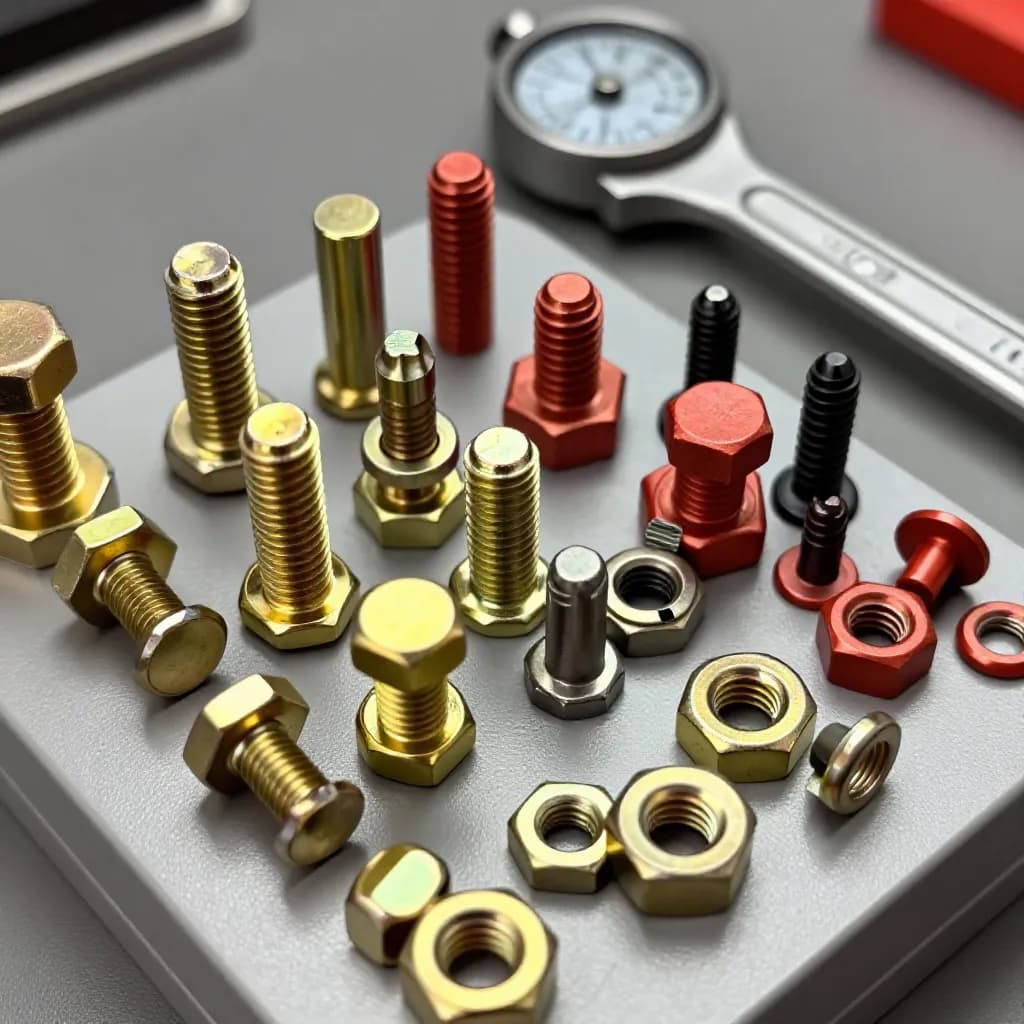
The advantages of powder coating for fasteners include excellent corrosion resistance (500-1500 hours salt spray depending on the system), unlimited color options for identification and aesthetics, zero VOC emissions, and the ability to apply functional coatings (anti-vibration, thread-locking, electrical insulation) in a single operation. Powder-coated fasteners are widely used in outdoor furniture, playground equipment, agricultural machinery, automotive accessories, architectural hardware, and electrical equipment where color matching, corrosion resistance, or electrical insulation is required.
Ready to Start Your Project?
From one-off customs to 15,000-part production runs — get precise pricing in 24 hours.
On This Page
Why Powder Coat Fasteners and Hardware?
The challenges are equally specific to fasteners. Thread dimensions are critical — coating buildup on threads changes the effective thread diameter, affecting fit, torque-tension relationships, and clamp load. Small fastener sizes make individual handling impractical, driving the need for bulk coating methods. High-strength fasteners (Grade 8.8 and above) are susceptible to hydrogen embrittlement from acid-based pretreatment processes. And the sheer variety of fastener types, sizes, and grades means that coating processes must be flexible and adaptable to frequent changeovers.
Thread Masking: Protecting Critical Dimensions
Thread masking is often necessary when powder coating fasteners to prevent coating buildup from altering thread dimensions and compromising assembly performance. A standard powder coating thickness of 60-80 micrometers on a bolt thread increases the major diameter by 120-160 micrometers (coating on both sides), which can prevent the nut from threading onto the bolt or significantly alter the torque-tension relationship. For precision fasteners with tight tolerance classes (6g/6H per ISO 965), even 30-40 micrometers of coating buildup can cause assembly problems.
Masking methods for fastener threads include silicone rubber plugs and caps (available in standard sizes for common thread diameters), high-temperature masking tape wrapped around the thread area, and custom masking fixtures for high-volume production. Silicone plugs are the most common method for low to medium volumes — they are reusable (typically 20-50 cycles before replacement), easy to apply and remove, and available in sizes from M3 to M48 and equivalent imperial sizes. For high-volume production, automated masking systems that apply and remove plugs or caps at line speed are available.
An alternative to masking is to coat the threads and then chase (re-tap or re-die) them after coating to restore the original thread dimensions. Thread chasing removes the coating from the thread flanks while leaving it in the thread roots, providing some corrosion protection in the thread area without affecting fit. This approach is practical for larger fasteners (M10 and above) but becomes difficult and uneconomical for small fasteners. For some applications, the coating on threads is intentional — thread-locking powder coatings (typically nylon-based) are applied to specific thread areas to provide controlled prevailing torque that resists vibration loosening, replacing separate thread-locking adhesives or nylon insert lock nuts.
Torque-Tension Effects of Powder Coating
The torque-tension relationship of a bolted joint — the relationship between the applied tightening torque and the resulting bolt tension (clamp load) — is significantly affected by the surface finish of the fastener. Powder coating changes the friction coefficient of the thread and bearing surfaces, which directly affects the torque required to achieve a given clamp load. Understanding and controlling this effect is essential for safety-critical bolted joints in structural, automotive, and mechanical applications.
Uncoated steel fasteners with oil lubrication typically have a nut factor (K-factor) of 0.15-0.20, meaning that 15-20% of the applied torque is converted to bolt tension, with the remainder consumed by thread friction and bearing friction. Powder-coated fasteners generally have higher friction coefficients than oiled steel, with K-factors of 0.20-0.35 depending on the powder type, film thickness, and surface roughness. This means that a higher torque is required to achieve the same clamp load, or conversely, that the same torque produces less clamp load on a powder-coated fastener than on an oiled steel fastener.
For safety-critical applications, the torque-tension relationship of powder-coated fasteners must be characterized through testing per ISO 16047 or equivalent standards. Test samples representative of production coating conditions are assembled in a torque-tension test fixture that simultaneously measures applied torque and bolt tension. The resulting K-factor data is used to establish the correct tightening torque for the coated fastener. Alternatively, tension-control tightening methods (direct tension indicators, ultrasonic bolt measurement, or turn-of-nut method) that measure or control bolt tension directly, rather than relying on the torque-tension relationship, eliminate the uncertainty introduced by coating friction variation.
Rack vs. Barrel Coating for Fasteners
The choice between rack coating and barrel (tumble) coating depends on the fastener size, quantity, quality requirements, and coating thickness tolerance. Rack coating involves hanging individual fasteners on hooks or fixtures and processing them through a conventional powder coating line — pretreatment, powder application, and cure. This method provides the highest coating quality and most uniform film thickness but is labor-intensive and impractical for small fasteners or large quantities.
Barrel coating (also called tumble coating or spin coating) is the preferred method for high-volume production of small to medium fasteners (M3-M16). The process loads fasteners into a perforated barrel or basket, which is rotated through the pretreatment stages, then transferred to a coating station where powder is applied while the barrel rotates, and finally passed through a cure oven. The tumbling action during coating ensures that all surfaces receive powder, including recessed areas and thread roots that are difficult to reach with directional spray. Film thickness is less uniform than rack coating — typically ±20-30 micrometers versus ±10-15 micrometers for rack coating — but is adequate for most fastener applications.
Spin coating is a variation of barrel coating where fasteners are loaded into a spinning basket and powder is applied by electrostatic spray while the basket rotates at 10-30 RPM. The centrifugal force and tumbling action distribute the powder uniformly, and the electrostatic charge ensures adhesion. After coating, the basket is transferred to a cure oven where the fasteners continue to tumble during cure, preventing them from sticking together as the powder melts. The tumbling during cure also helps to equalize film thickness by redistributing molten powder from thick spots to thin spots. Spin coating achieves better uniformity than static barrel coating and is the preferred method for medium to high-volume fastener coating.
Hydrogen Embrittlement: A Critical Safety Concern
Hydrogen embrittlement is the most serious safety concern in fastener coating operations, capable of causing sudden, catastrophic failure of high-strength bolts under sustained tensile load. The mechanism involves hydrogen atoms — generated during acid pickling, electroplating, or cathodic cleaning — diffusing into the steel microstructure and concentrating at grain boundaries, inclusions, and stress concentration points. The accumulated hydrogen reduces the steel's ductility and fracture toughness, causing delayed brittle fracture that may occur hours, days, or even weeks after the fastener is tightened.
The risk of hydrogen embrittlement increases with fastener strength. Fasteners below Grade 8.8 (approximately 800 MPa tensile strength) are generally considered low risk. Grade 8.8 fasteners are at moderate risk, and Grade 10.9 and 12.9 fasteners (1000-1200 MPa tensile strength) are at high risk. Socket head cap screws, which are typically Grade 12.9, are particularly susceptible. The risk also depends on the steel composition, heat treatment, and surface condition — case-hardened fasteners and those with surface decarburization are more susceptible than through-hardened fasteners with uniform microstructure.
Prevention of hydrogen embrittlement in fastener powder coating requires eliminating or minimizing hydrogen-generating process steps. Mechanical pretreatment (blast cleaning with steel shot or grit) is strongly preferred over acid pickling for high-strength fasteners. If acid cleaning is unavoidable, the exposure time should be minimized (less than 10 minutes), inhibited acid solutions should be used, and a hydrogen relief bake at 190-230°C for a minimum of 4 hours (per ASTM F519 or ISO 9587) must be performed within 4 hours of acid exposure. The powder coating cure cycle at 180-200°C for 10-20 minutes provides some hydrogen relief but is insufficient for heavily embrittled fasteners — the dedicated bake cycle is essential.
Functional Coatings: Thread-Locking and Anti-Vibration
Beyond decorative and protective finishing, powder coating technology enables functional coatings on fasteners that replace separate components or assembly operations. Thread-locking coatings are the most commercially significant functional application — a controlled band of nylon or microencapsulated adhesive powder is applied to specific thread areas, providing prevailing torque that resists vibration loosening without the need for separate lock washers, nylon insert nuts, or liquid thread-locking adhesives.
Nylon patch thread-locking coatings are applied as a stripe or band of nylon powder (typically Nylon 11 or Nylon 12) on 2-4 threads of the bolt or in the nut thread. When the fastener is assembled, the nylon is compressed between the mating threads, creating friction that resists loosening. The prevailing torque — typically 1-15 Nm depending on the fastener size and nylon thickness — is controlled by the width, thickness, and position of the nylon patch. These coatings are reusable for 3-5 assembly cycles and are specified in automotive, aerospace, and industrial applications where vibration loosening is a concern.
Anti-galling coatings for stainless steel fasteners address the tendency of stainless steel threads to seize (gall) during tightening. Galling occurs when the high friction and adhesion between mating stainless steel surfaces causes material transfer and cold welding, making the fastener impossible to remove without damage. PTFE-modified powder coatings or dry-film lubricant coatings applied to stainless steel fastener threads reduce friction and prevent galling, allowing reliable assembly and disassembly. Electrically insulating powder coatings on fasteners prevent galvanic corrosion when joining dissimilar metals — for example, steel bolts joining aluminum panels — by electrically isolating the fastener from the surrounding material.
Quality Control and Testing Standards
Quality control for powder-coated fasteners encompasses dimensional verification, coating performance testing, and mechanical property validation. Dimensional inspection verifies that coated thread dimensions remain within the specified tolerance class — go/no-go thread gauges per ISO 965 are the standard tool, applied after coating to confirm that the coated fastener will assemble correctly with its mating component. Any fastener that fails the go gauge (too tight) must be rejected or re-processed (thread chasing).
Coating performance testing includes film thickness measurement (typically by cross-section microscopy for threaded areas, magnetic gauge for flat surfaces), adhesion testing per ISO 2409, and corrosion resistance testing per ISO 9227. Salt spray test durations for powder-coated fasteners range from 240 hours for interior applications to 1000+ hours for exterior and marine applications. For thread-locking coatings, prevailing torque testing per IFI-124 or DIN 267-28 verifies that the locking torque falls within the specified range.
Mechanical property validation ensures that the coating process has not degraded the fastener's strength or ductility. Tensile testing per ISO 898-1, proof load testing, and hardness testing verify that the fastener meets its grade requirements after coating. For high-strength fasteners (Grade 8.8 and above), hydrogen embrittlement testing per ASTM F606 or ISO 15330 is performed on representative samples from each production batch. The test involves loading fasteners to 75% of their minimum tensile strength and holding for 48 hours — any failure during the sustained load period indicates hydrogen embrittlement. This testing is mandatory for safety-critical applications and should be performed routinely for all high-strength fastener coating operations.
Frequently Asked Questions
Do you need to mask bolt threads before powder coating?
It depends on the application. For precision fasteners with tight tolerance classes (6g/6H), masking is necessary because 60-80 micrometers of coating increases the major diameter by 120-160 micrometers, preventing assembly. Silicone plugs, masking tape, or automated masking systems are used. Alternatively, threads can be chased (re-tapped) after coating to restore dimensions.
Does powder coating affect bolt torque specifications?
Yes, powder coating increases the friction coefficient of thread and bearing surfaces, raising the K-factor from 0.15-0.20 (oiled steel) to 0.20-0.35. This means higher torque is needed for the same clamp load. For safety-critical joints, torque-tension testing per ISO 16047 must be performed on coated fasteners to establish correct tightening specifications.
What is hydrogen embrittlement in fastener coating?
Hydrogen atoms from acid pickling or electroplating diffuse into high-strength steel, causing delayed brittle fracture under sustained load. Fasteners Grade 10.9 and 12.9 (1000-1200 MPa) are at highest risk. Prevention requires mechanical pretreatment instead of acid pickling, or a hydrogen relief bake at 190-230°C for minimum 4 hours within 4 hours of acid exposure.
What is the difference between rack and barrel coating for fasteners?
Rack coating hangs individual fasteners on hooks for highest quality and uniformity (±10-15 micrometers) but is labor-intensive. Barrel/tumble coating processes bulk fasteners in rotating baskets for high-volume production with acceptable uniformity (±20-30 micrometers). Spin coating — tumbling in a spinning basket during electrostatic spray — offers a middle ground with better uniformity than static barrel coating.
Can powder coating replace thread-locking adhesives?
Yes, nylon patch thread-locking coatings applied as a stripe on 2-4 threads provide controlled prevailing torque (1-15 Nm) that resists vibration loosening. They are reusable for 3-5 assembly cycles and eliminate the need for separate lock washers, nylon insert nuts, or liquid adhesives. They are widely specified in automotive, aerospace, and industrial applications.
Ready to Start Your Project?
From one-off customs to 15,000-part production runs — get precise pricing in 24 hours.