Corrosion is fundamentally an electrochemical process — a series of chemical reactions driven by electrical potential differences that convert refined metals back into their thermodynamically stable oxide or hydroxide forms. Understanding this electrochemistry is essential for appreciating how powder coatings protect metal substrates and why certain coating strategies are more effective than others.
Technical
Powder Coating Corrosion Science Explained: Electrochemistry, Barrier Protection, and Inhibitive Pigments
Sundial Powder Coating·April 23, 2026·12 min
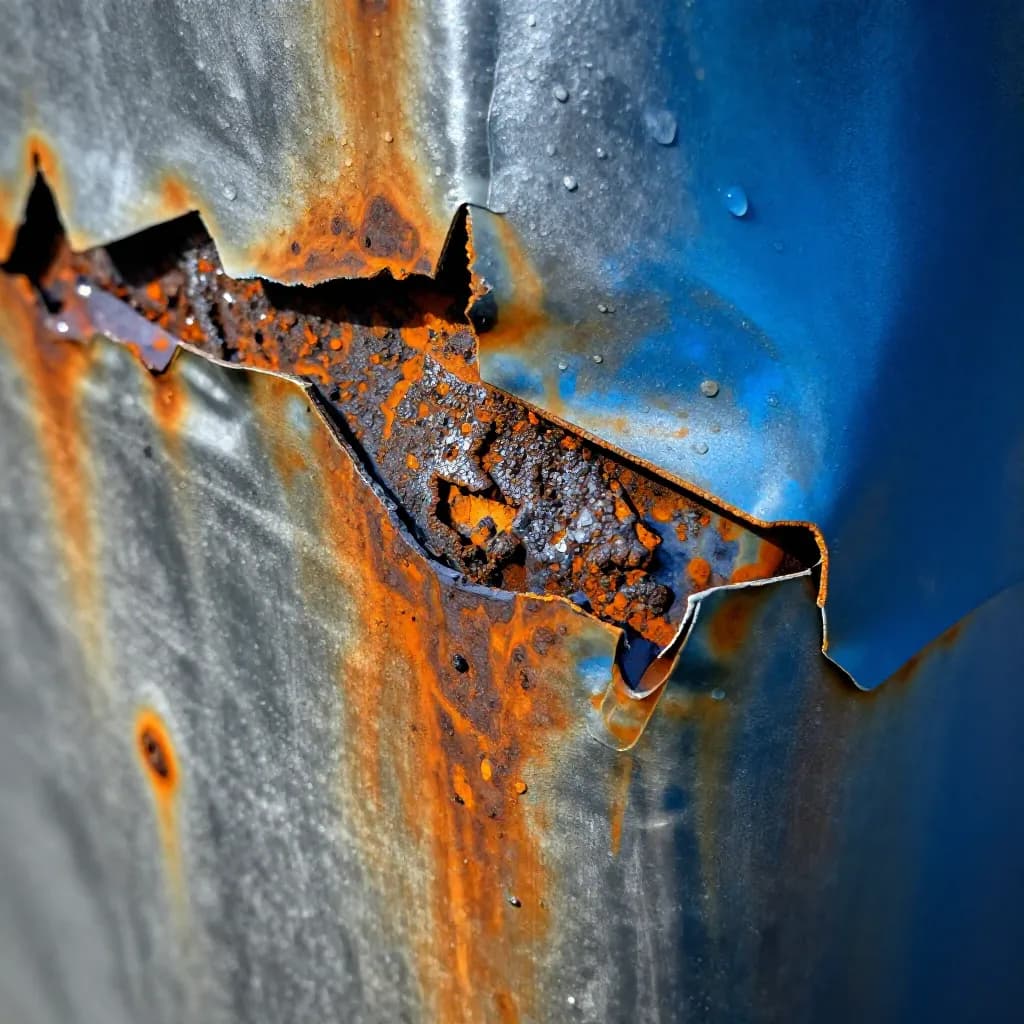
The corrosion of steel, the most commercially important corrosion problem, involves two simultaneous electrochemical reactions occurring at different locations on the metal surface. At anodic sites, iron atoms lose electrons and dissolve into the surrounding electrolyte as ferrous ions: Fe → Fe²⁺ + 2e⁻. At cathodic sites, these electrons are consumed by a reduction reaction, typically the reduction of dissolved oxygen in the presence of water: O₂ + 2H₂O + 4e⁻ → 4OH⁻. The ferrous ions and hydroxyl ions then combine and further oxidize to form the familiar red-brown iron oxide we know as rust.
Ready to Start Your Project?
From one-off customs to 15,000-part production runs — get precise pricing in 24 hours.
On This Page
The Electrochemistry of Metal Corrosion
For corrosion to proceed, four elements must be present simultaneously: an anode (where metal dissolves), a cathode (where electrons are consumed), an electrolyte (a conductive liquid, typically water with dissolved salts), and an electrical connection between anode and cathode (the metal itself). Removing any one of these four elements stops the corrosion process — and this is the fundamental principle underlying all corrosion protection strategies.
The rate of corrosion is governed by several factors: the electrochemical potential difference between anodic and cathodic sites, the conductivity of the electrolyte, the availability of oxygen and water at the metal surface, temperature, and the presence of aggressive species such as chloride ions. Chloride ions are particularly damaging because they penetrate protective oxide films, accelerate anodic dissolution, and increase electrolyte conductivity — which is why coastal and marine environments are so corrosive to unprotected steel.
Aluminum corrosion follows similar electrochemical principles but with important differences. Aluminum naturally forms a thin, adherent oxide layer (alumina) that provides significant passive protection. However, this oxide layer can be disrupted by chloride ions, extreme pH conditions, or galvanic contact with more noble metals, leading to localized pitting corrosion rather than the uniform surface corrosion typical of steel.
Barrier Protection: The Primary Defense Mechanism
The most fundamental way that powder coatings protect against corrosion is through barrier protection — physically separating the metal substrate from the corrosive environment. By interposing a continuous, impermeable film between the metal surface and the water, oxygen, and aggressive ions that drive corrosion, the coating prevents the electrochemical reactions from occurring.
Powder coatings are particularly effective barrier coatings for several reasons. Their typical film thickness of 60-120 microns is substantially greater than most liquid paint systems (25-50 microns), providing a thicker barrier against the diffusion of water, oxygen, and ions. The single-coat application eliminates inter-coat interfaces that can serve as pathways for moisture ingress. And the thermoset crosslinked network structure of cured powder coatings creates a dense, tightly packed polymer matrix that resists penetration by corrosive species.
However, no organic coating is a perfect barrier. All polymer films are permeable to water vapor and oxygen to some degree — the molecules are simply too small to be completely excluded by the polymer matrix. The rate of permeation depends on the polymer chemistry, crosslink density, film thickness, temperature, and the concentration gradient across the film. Water permeation rates through typical powder coatings are on the order of 1-10 grams per square meter per day, which is low but not zero.
This inherent permeability means that barrier protection alone is insufficient for long-term corrosion prevention in aggressive environments. Over time, water and oxygen will diffuse through even a well-applied powder coating and reach the metal surface. If the coating-metal interface is clean and well-bonded, the small amounts of water that permeate may not cause significant corrosion. But if adhesion is compromised — by poor surface preparation, contamination, or mechanical damage — the permeating water can accumulate at the interface and initiate under-film corrosion that progressively undermines the coating.
This is why surface preparation is so critical for corrosion protection. The barrier properties of the coating itself are only part of the equation; the quality of the bond between coating and substrate determines whether the barrier can maintain its protective function over the long term.
Inhibitive Pigments and Active Corrosion Protection
To supplement barrier protection, many powder coating formulations incorporate inhibitive pigments — specialized additives that actively interfere with the corrosion process when water eventually reaches the metal surface. These pigments provide a second line of defense that extends the coating's protective life beyond what barrier properties alone can achieve.
Zinc phosphate is one of the most widely used inhibitive pigments in powder coatings. When water permeates through the coating and contacts zinc phosphate particles, the pigment partially dissolves, releasing zinc and phosphate ions into the aqueous phase at the coating-metal interface. These ions react with the metal surface to form a thin, insoluble layer of zinc iron phosphate that passivates the metal and inhibits both anodic and cathodic corrosion reactions. The phosphate layer effectively seals the metal surface against further electrochemical activity.
Modified zinc phosphates — including zinc aluminum phosphate, zinc molybdenum phosphate, and zinc calcium phosphate — offer enhanced inhibitive performance through synergistic effects between the different metal ions. These modified pigments are increasingly preferred over traditional zinc phosphate for demanding applications.
Calcium-exchanged silica is another important class of inhibitive pigment. These amorphous silica particles contain calcium ions that are released in the presence of moisture, raising the local pH at the coating-metal interface and promoting the formation of protective oxide films on the metal surface. Calcium-exchanged silica pigments are particularly effective on aluminum substrates, where they help maintain the integrity of the natural alumina passive layer.
Strontium chromate was historically one of the most effective corrosion-inhibitive pigments, widely used in aerospace and military coating applications. However, the toxicity and carcinogenicity of hexavalent chromium compounds have led to progressive restrictions on their use, driving the development of chrome-free alternatives. The search for inhibitive pigments that match the performance of strontium chromate without its health and environmental risks remains one of the most active areas of corrosion protection research.
The effectiveness of inhibitive pigments depends on their concentration in the coating, their solubility characteristics, and the specific corrosion environment. Too little pigment provides insufficient inhibition; too much can compromise the coating's barrier properties by creating a porous, pigment-rich film. Optimal pigment loading is typically 5-15% by weight, depending on the pigment type and the performance requirements.
Cathodic Protection and Zinc-Rich Primers
Cathodic protection represents the most aggressive corrosion protection strategy available in coating technology. It works by making the protected metal the cathode in an electrochemical cell, forcing corrosion to occur on a sacrificial material instead. In the context of powder coatings, cathodic protection is achieved through zinc-rich primers that contain high loadings of metallic zinc powder.
Zinc is more electrochemically active (less noble) than steel, meaning it will preferentially corrode when both metals are in electrical contact in the presence of an electrolyte. In a zinc-rich primer, the zinc particles are in direct electrical contact with the steel substrate and with each other, forming a conductive network. When the coating is damaged or when moisture permeates to the metal surface, the zinc corrodes sacrificially, generating electrons that flow to the steel and maintain it in a cathodic (protected) state.
For cathodic protection to function, the zinc loading in the primer must be high enough to ensure electrical continuity between zinc particles and between the zinc network and the steel substrate. Typical zinc-rich powder primers contain 70-85% metallic zinc by weight in the dry film. Below this threshold, the zinc particles are too dispersed to form a continuous conductive network, and cathodic protection is lost.
The corrosion products of zinc — primarily zinc oxide and zinc hydroxide — are white and relatively compact, unlike the voluminous red-brown rust produced by iron corrosion. These zinc corrosion products tend to fill voids and seal the coating, providing additional barrier protection as the zinc is consumed. This self-healing characteristic extends the protective life of zinc-rich primer systems.
Zinc-rich powder primers are widely used as the first coat in multi-layer coating systems for steel structures exposed to aggressive environments. A typical system might consist of a zinc-rich powder primer (50-75 microns), followed by an epoxy powder intermediate coat (50-100 microns), and a polyester powder topcoat (50-80 microns). This three-layer system provides cathodic protection from the primer, barrier protection from all three layers, and UV resistance and aesthetics from the topcoat.
The application of zinc-rich powder primers requires careful attention to film thickness control and surface preparation. The steel surface must be blast-cleaned to a near-white or white metal standard (Sa 2.5 or Sa 3 per ISO 8501-1) to ensure good electrical contact between the zinc and the steel. Insufficient surface preparation compromises the cathodic protection mechanism.
Pretreatment: The Foundation of Corrosion Protection
The corrosion protection provided by any powder coating system is fundamentally dependent on the quality of the surface pretreatment applied to the metal substrate before coating. Pretreatment serves two critical functions: it removes contaminants that would prevent coating adhesion, and it creates a conversion coating layer that enhances both adhesion and corrosion resistance.
For steel substrates, the pretreatment process typically begins with alkaline cleaning to remove oils, greases, and other organic contaminants from the metal surface. This is followed by rinsing and then application of a conversion coating — most commonly iron phosphate or zinc phosphate. Iron phosphate pretreatment creates a thin (0.5-1.5 g/m²) amorphous iron phosphate layer that improves coating adhesion and provides modest corrosion resistance. Zinc phosphate pretreatment creates a thicker (2-5 g/m²) crystalline zinc phosphate layer that provides significantly better corrosion resistance and is preferred for demanding applications.
For aluminum substrates, pretreatment typically involves alkaline or acidic cleaning followed by a chromate or chrome-free conversion coating. Chromate conversion coatings (based on hexavalent or trivalent chromium) have been the gold standard for aluminum pretreatment for decades, providing excellent adhesion promotion and corrosion inhibition. However, environmental and health concerns about chromium compounds are driving a transition to chrome-free alternatives based on titanium, zirconium, or silane chemistry.
Zirconium-based conversion coatings have emerged as the leading chrome-free alternative for both steel and aluminum substrates. These nano-ceramic coatings deposit an ultra-thin (20-50 nanometer) layer of zirconium oxide on the metal surface that provides excellent coating adhesion and corrosion resistance. Zirconium pretreatments generate less sludge than phosphate systems, operate at lower temperatures, and use fewer process stages, offering both environmental and operational advantages.
The interaction between pretreatment and powder coating is synergistic — the conversion coating layer provides a chemically active surface that bonds strongly with the powder coating resin, while the powder coating provides the thick barrier layer that protects the conversion coating from dissolution and the metal from environmental exposure. Neither component alone provides adequate long-term corrosion protection; it is the combination of pretreatment and coating that delivers the performance required for demanding applications.
Testing and Evaluating Corrosion Protection
Evaluating the corrosion protection performance of powder coating systems requires a combination of accelerated laboratory tests and real-world exposure testing. Each method provides different information, and a comprehensive evaluation typically employs multiple test methods to build a complete picture of coating performance.
Salt spray testing (ASTM B117, ISO 9227) is the most widely used accelerated corrosion test for coated metals. Test panels are scribed through the coating to expose the bare metal substrate, then placed in a chamber where they are continuously exposed to a fine mist of 5% sodium chloride solution at 35°C. The panels are periodically evaluated for rust creepage from the scribe, blistering, and general corrosion. While salt spray testing is useful for quality control and comparative ranking, it is a poor predictor of real-world performance because it does not replicate the wet-dry cycling, UV exposure, and temperature variations that occur in natural environments.
Cyclic corrosion testing (such as ASTM D5894 or GMW 14872) addresses this limitation by alternating between salt spray, humidity, UV exposure, and drying phases in a programmed cycle. These tests more closely simulate the conditions experienced by coated products in service and generally provide better correlation with field performance than continuous salt spray testing.
Electrochemical impedance spectroscopy (EIS) is an advanced technique that measures the electrical impedance of the coating-substrate system as a function of frequency. EIS can detect the early stages of coating degradation — water uptake, loss of barrier properties, and initiation of under-film corrosion — long before visible defects appear. This makes EIS a powerful tool for predicting long-term coating performance and for comparing the protective properties of different coating systems.
Natural weathering exposure at test sites in corrosive environments — such as coastal, industrial, or tropical locations — provides the most realistic assessment of coating performance but requires years of exposure time. Major coating manufacturers and research organizations maintain exposure sites worldwide, with some test programs running for 10-20 years or more.
The correlation between accelerated test results and real-world performance is an ongoing area of research and debate in the coatings industry. No single accelerated test perfectly predicts field performance, which is why coating specifications typically require multiple test methods and why long-term exposure data remains the ultimate measure of corrosion protection effectiveness.
Designing Powder Coating Systems for Corrosion Protection
Designing an effective powder coating system for corrosion protection requires a systematic approach that considers the substrate material, the service environment, the expected service life, and the applicable performance standards. The goal is to select the combination of pretreatment, primer (if required), and topcoat that delivers the required protection at the lowest total system cost.
For mild interior environments with low corrosion risk, a simple system of iron phosphate pretreatment and a single coat of polyester or polyester-epoxy hybrid powder coating (60-80 microns) typically provides adequate protection for 10-20 years. This system is widely used for office furniture, interior architectural fittings, shelving, and electrical enclosures.
For moderate exterior environments — urban and suburban locations away from the coast — a more robust system is required. Zinc phosphate or zirconium pretreatment combined with a single coat of super-durable polyester powder coating (60-100 microns) provides good corrosion and weathering protection for 15-25 years. This system is standard for architectural aluminum, outdoor furniture, and general exterior metalwork.
For aggressive environments — coastal, industrial, or tropical locations with high humidity, salt exposure, or chemical contamination — a multi-coat system is typically specified. A zinc-rich epoxy primer (50-75 microns) provides cathodic protection, an epoxy intermediate coat (50-100 microns) adds barrier protection and chemical resistance, and a polyester topcoat (50-80 microns) provides UV resistance and aesthetics. This three-coat system can provide 25-40 years of protection in aggressive environments.
The ISO 12944 standard provides a systematic framework for selecting coating systems based on environmental corrosivity categories (C1 through CX) and desired durability (low, medium, high, or very high). While originally developed for liquid paint systems, the principles of ISO 12944 are increasingly applied to powder coating system design, with powder-specific performance data being generated by manufacturers and independent testing organizations.
Ultimately, the most effective corrosion protection strategy combines good design (avoiding water traps and crevices), thorough surface preparation, appropriate pretreatment, well-formulated powder coatings applied at the correct thickness, and proper curing. Each element of this chain contributes to the overall protection, and weakness in any single element can compromise the entire system.
Frequently Asked Questions
How does powder coating prevent corrosion?
Powder coating prevents corrosion through three mechanisms: barrier protection (physically separating the metal from water, oxygen, and ions), inhibitive pigments (actively interfering with corrosion reactions at the metal surface), and in zinc-rich primers, cathodic protection (sacrificial corrosion of zinc to protect the steel substrate).
Why is surface preparation important for corrosion protection?
Surface preparation removes contaminants and creates a conversion coating that enhances adhesion and corrosion resistance. Without proper preparation, moisture can accumulate at the coating-metal interface and initiate under-film corrosion. Even the best powder coating will fail prematurely on a poorly prepared surface.
What is a zinc-rich primer in powder coating?
A zinc-rich powder primer contains 70-85% metallic zinc by weight, forming a conductive network that provides cathodic (sacrificial) protection to steel. When moisture reaches the metal, zinc corrodes preferentially instead of the steel. Zinc-rich primers are used as the first coat in multi-layer systems for aggressive environments.
How is corrosion resistance tested in powder coatings?
Common tests include salt spray testing (ASTM B117), cyclic corrosion testing (ASTM D5894), and electrochemical impedance spectroscopy (EIS). Salt spray testing exposes scribed panels to continuous salt mist. Cyclic testing alternates between salt spray, humidity, UV, and drying. EIS detects early degradation before visible defects appear.
What are inhibitive pigments in powder coatings?
Inhibitive pigments like zinc phosphate, modified zinc phosphates, and calcium-exchanged silica actively interfere with corrosion when moisture reaches the metal surface. They release ions that form protective layers on the metal, passivating it against electrochemical corrosion. Typical loading is 5-15% by weight in the coating formulation.
Ready to Start Your Project?
From one-off customs to 15,000-part production runs — get precise pricing in 24 hours.