Blue is the world's most universally preferred color, consistently ranking as the favorite across cultures, demographics, and geographies. In powder coating, blue finishes serve an extraordinarily broad range of applications, from corporate signage and institutional buildings to marine equipment and artistic installations. Blue communicates trust, reliability, professionalism, and calm, making it the natural choice for organizations and environments that want to project these qualities.
Design
Powder Coating Blue Finishes: RAL 5010, 5015, 5024, Corporate Blue, Marine, and Architectural
Sundial Powder Coating·April 22, 2026·11 min
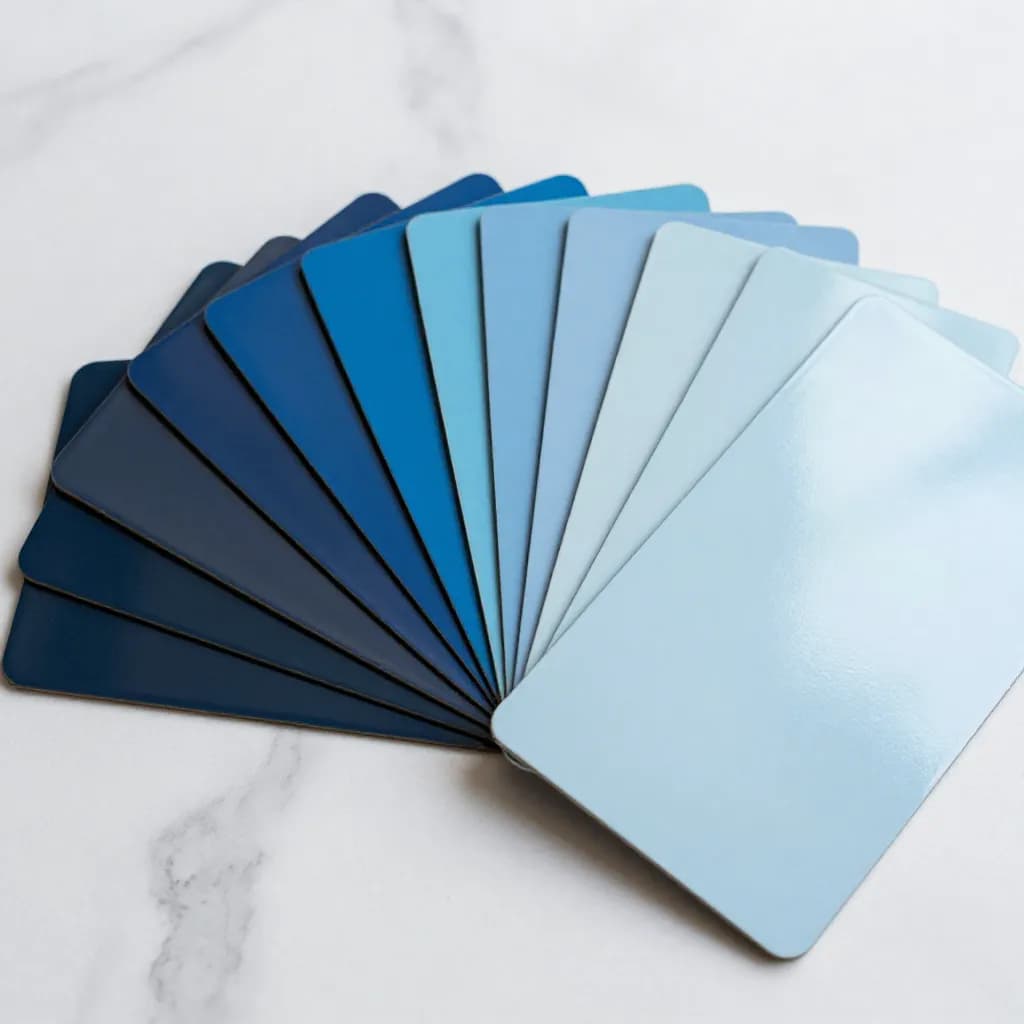
The RAL 5000 series contains over 25 distinct blue shades, spanning the full spectrum from near-violet deep blues to light, airy sky blues and from warm, greenish teals to cool, reddish navy blues. This diversity means that specifying blue requires the same precision as any other color family. The difference between a corporate blue and a marine blue, or between a warm blue and a cool blue, can fundamentally change the character of a finished product or building.
Ready to Start Your Project?
From one-off customs to 15,000-part production runs — get precise pricing in 24 hours.
On This Page
Blue Powder Coating: Trust, Authority, and Design Versatility
Blue powder coatings generally offer good UV stability compared to reds and yellows, thanks to the inherent lightfastness of many blue pigments. However, lighter blues and those containing organic pigments still require appropriate resin selection and UV stabilization for exterior applications. Understanding the technical characteristics of blue powder coatings alongside their aesthetic properties ensures that the finished result meets both design and performance expectations.
RAL 5010, 5015, and 5024: The Most Specified Blues
Three blues dominate powder coating specification across industries: RAL 5010 Gentian Blue, RAL 5015 Sky Blue, and RAL 5024 Pastel Blue. Each occupies a distinct position in the blue spectrum and serves different design and functional purposes.
RAL 5010 Gentian Blue is a medium-dark, saturated blue with a balanced undertone that reads as a classic, authoritative blue. It is the most widely specified blue for industrial equipment, agricultural machinery, commercial vehicles, and corporate applications. RAL 5010 has enough depth to convey seriousness and professionalism while remaining clearly identifiable as blue rather than navy or dark blue. Its versatility makes it the default choice when a strong, unambiguous blue is needed.
RAL 5015 Sky Blue is a bright, vivid medium blue that is lighter and more energetic than RAL 5010. It has a clean, optimistic character that makes it popular for recreational equipment, playground structures, retail signage, and applications where blue needs to feel approachable and inviting rather than corporate. RAL 5015 is also widely used in the aviation and aerospace industries.
RAL 5024 Pastel Blue is a soft, muted blue with a grey undertone that gives it a sophisticated, understated character. It is increasingly popular in architectural applications, interior design, and furniture where a gentle blue is desired without the intensity of RAL 5010 or RAL 5015. RAL 5024 coordinates well with neutral palettes and natural materials, making it a versatile choice for contemporary design schemes.
Other notable blues include RAL 5002 Ultramarine Blue, a deep, vivid blue with a slight violet undertone used for striking visual statements, and RAL 5003 Sapphire Blue, a dark, rich blue that approaches navy and is popular for premium automotive and architectural applications.
Corporate Blue: Matching Brand Identity in Powder Coating
Blue is the dominant color in corporate branding worldwide, with a significant proportion of major global brands using blue as their primary identity color. Translating these corporate blues into powder coating finishes for signage, architectural elements, retail fixtures, and branded equipment requires precise color matching and rigorous quality control.
Corporate blue matching follows the same process as any custom color match. The brand owner provides an approved physical color standard, typically a Pantone reference, painted sample, or existing approved component. The powder manufacturer measures this standard using a spectrophotometer and formulates a custom powder to match. The critical difference with corporate colors is the tolerance requirement, which is typically tighter than standard commercial work, often demanding Delta E values below 0.5 for premium brand applications.
The challenge with corporate blues is maintaining consistency across different substrates, gloss levels, and production facilities. A corporate blue that looks correct on a flat aluminum panel may appear slightly different on a curved steel tube due to differences in how light interacts with the surface geometry. Specifying the gloss level precisely and ensuring consistent film thickness across all components helps minimize these variations.
For multi-location brand deployments, establishing a single approved powder formulation and managing its distribution through a controlled supply chain is the most reliable approach to color consistency. This is preferable to having multiple coaters independently match the brand color, which inevitably introduces variation that becomes apparent when components from different sources are viewed together.
Digital color management tools can supplement physical sample approval but should not replace it. Screen-based color representations are inherently inaccurate for evaluating powder coating colors because they cannot replicate the surface texture, gloss, and light interaction characteristics of a coated metal surface. Always make final color decisions based on physical coated samples.
Marine Blue: Powder Coating for Coastal and Maritime Environments
Blue powder coating has a natural association with marine and coastal environments, and the combination of aesthetic appropriateness and technical performance makes it a popular choice for maritime applications. However, coastal and marine environments present some of the most demanding conditions for any coating system, requiring careful specification to ensure long-term durability.
Marine environments expose coated surfaces to salt spray, high humidity, intense UV radiation, and abrasive wind-borne particles. Standard powder coating systems may degrade prematurely under these conditions, with salt-induced corrosion undermining the coating from the substrate interface. For marine applications, the complete coating system, including pretreatment, primer, and topcoat, must be specified as an integrated system designed for coastal exposure.
Pretreatment is the foundation of marine durability. Chrome-free conversion coatings based on titanium or zirconium chemistry, combined with a corrosion-inhibiting primer coat, provide the substrate protection necessary for coastal environments. Qualicoat Seaside certification specifically addresses the requirements for powder-coated aluminum in marine environments, requiring enhanced pretreatment and accelerated salt spray testing beyond standard Qualicoat requirements.
For the topcoat, super-durable polyester formulations provide good UV stability and color retention in the intense sunlight typical of coastal locations. Fluoropolymer topcoats offer the ultimate level of protection for premium marine applications. The topcoat should achieve a minimum film thickness of 80 microns to provide an effective barrier against salt and moisture penetration.
Popular marine blues include RAL 5010 Gentian Blue for a classic nautical character, RAL 5015 Sky Blue for a brighter coastal aesthetic, and RAL 5009 Azure Blue for a deep, ocean-inspired tone. Dark navy blues such as RAL 5011 Steel Blue and RAL 5004 Black Blue are also popular for marine hardware and boat fittings where a sophisticated, understated appearance is desired.
Blue in Architectural Specification
Blue powder coating in architecture ranges from bold statement facades to subtle accent elements, with the shade, saturation, and application approach determining whether blue serves as the dominant design element or a supporting detail.
Bold blue facades using saturated shades like RAL 5010 or RAL 5002 Ultramarine Blue create landmark buildings that stand out in urban environments. These applications work best when the blue is used confidently on large surfaces, allowing the color to define the building's identity. Bold blue facades are particularly effective for cultural institutions, educational buildings, and commercial developments where visual distinctiveness is a design priority.
Subtle blue accents using muted shades like RAL 5024 Pastel Blue or RAL 5014 Pigeon Blue add color interest to otherwise neutral facades without overwhelming the composition. Blue window frames, spandrel panels, or entrance features can introduce a sense of calm and sophistication to buildings dominated by grey, white, or natural materials. This approach is popular in residential architecture and healthcare facilities where a soothing atmosphere is desired.
Blue is also used architecturally to reference context and environment. Coastal buildings often incorporate blues that echo the sea and sky, creating a visual connection between the building and its setting. Urban buildings may use industrial blues that reference the area's manufacturing heritage. These contextual color choices add meaning and narrative to architectural design.
For architectural blue specification, the same durability considerations apply as for any exterior color. Super-durable polyester is the minimum recommendation, with Qualicoat Class 2 or AAMA 2605 for projects requiring maximum long-term performance. Blue pigments generally offer better UV stability than reds and yellows, but lighter blues and those with organic pigment components should still be verified through accelerated weathering data.
Dark Blue and Navy Powder Coating Options
Dark blues and navy shades occupy a distinctive niche in powder coating, offering the depth and authority of black with the warmth and character that only color can provide. These shades are popular for premium applications where a sophisticated, understated appearance is desired.
RAL 5011 Steel Blue is a very dark blue that reads as near-black in low light but reveals its blue character in bright conditions. It is popular for architectural metalwork, premium furniture, and automotive components where a subtle alternative to black is desired. RAL 5011 pairs well with metallic accents in brass, copper, and brushed stainless steel.
RAL 5003 Sapphire Blue is a rich, deep blue with a classic character that evokes traditional craftsmanship and quality. It is widely used for heritage architectural restoration, premium gate and railing systems, and high-end furniture. RAL 5003 has enough color presence to be clearly identifiable as blue while maintaining the gravitas of a dark finish.
RAL 5004 Black Blue is the darkest blue in the RAL Classic system, appearing almost black with a subtle blue undertone that is visible only in direct light or when compared against true black. It is specified for applications where the designer wants the practical benefits of a very dark finish with a hint of color complexity that pure black lacks.
Dark blue powder coatings share many of the practical considerations of black finishes. They absorb significant solar radiation, requiring thermal performance assessment for exterior applications. They show fingerprints and handling marks more readily than lighter colors. And they demand consistent film thickness and curing parameters to avoid visible variations in depth and undertone across components.
Metallic dark blue finishes add another dimension, incorporating aluminum flakes that create a sparkling depth effect. These finishes are particularly striking on curved surfaces where the changing geometry reveals the metallic particles at different angles, creating a dynamic, premium appearance.
Specifying Blue Powder Coating: Practical Guidelines
Effective blue powder coating specification requires the same precision as any color, with particular attention to undertone, saturation, and the viewing context in which the finished components will be seen.
Undertone is the most critical factor in blue selection. Blues with a green undertone, such as RAL 5001 Green Blue or RAL 5009 Azure Blue, create a different mood than blues with a red or violet undertone, such as RAL 5002 Ultramarine Blue or RAL 5005 Signal Blue. The undertone determines how the blue coordinates with surrounding colors and materials. Green-toned blues feel natural and calming, while violet-toned blues feel richer and more dramatic.
Saturation determines the visual impact of the blue. Highly saturated blues like RAL 5015 Sky Blue demand attention and work as feature colors. Desaturated blues like RAL 5024 Pastel Blue or RAL 5014 Pigeon Blue recede visually and work as background colors or subtle accents. Matching the saturation level to the intended role of the blue in the overall design composition is essential.
For exterior applications, request accelerated weathering data specific to the blue shade being specified. While blue pigments generally offer good UV stability, performance varies between formulations. Lighter blues may show fading more visibly than darker shades simply because the color change is more apparent against a lighter background.
Gloss level affects the perception of blue color. High-gloss blue surfaces appear more saturated and vivid than matte surfaces of the same color, because the smooth, reflective surface allows more light to interact with the pigment. If maximum color impact is desired, specify a higher gloss level. If a softer, more muted blue is the goal, a satin or matte finish will naturally reduce the perceived saturation.
Always approve physical coated samples under representative lighting conditions. Blue is particularly susceptible to metamerism, appearing different under daylight, fluorescent, and LED lighting. Verify the color under all lighting conditions that will be present in the installation environment.
Frequently Asked Questions
What is the most popular blue for industrial powder coating?
RAL 5010 Gentian Blue is the most widely specified blue for industrial applications including equipment, machinery, and commercial vehicles. Its medium-dark, saturated tone conveys professionalism and authority while remaining clearly identifiable as blue.
Does blue powder coating fade in sunlight?
Blue pigments generally offer better UV stability than reds and yellows. However, lighter blues and those with organic pigment components can fade over time. Specify super-durable polyester formulations and request accelerated weathering data for any blue intended for exterior use.
What blue powder coating is best for coastal environments?
For coastal applications, specify a Qualicoat Seaside certified system with enhanced pretreatment and super-durable polyester or fluoropolymer topcoat. Popular marine blues include RAL 5010 for classic nautical character, RAL 5015 for bright coastal aesthetics, and RAL 5009 Azure Blue for deep ocean tones.
How do I match my corporate blue in powder coating?
Submit an approved physical color standard such as a Pantone chip to the powder manufacturer for spectrophotometer analysis. Specify Delta E tolerance below 1.0, or below 0.5 for premium brand applications. Require batch verification and maintain reference panels throughout the project.
What is the difference between RAL 5010 and RAL 5015 blue?
RAL 5010 Gentian Blue is a medium-dark, authoritative blue suited to corporate and industrial applications. RAL 5015 Sky Blue is lighter, brighter, and more energetic, popular for recreational equipment, retail, and applications where blue needs to feel approachable and inviting.
Ready to Start Your Project?
From one-off customs to 15,000-part production runs — get precise pricing in 24 hours.