Black is the single most requested color in the powder coating industry, and its dominance shows no sign of fading. From architectural facades and automotive components to furniture frames and industrial enclosures, black powder coating delivers a combination of visual authority, versatility, and practical performance that no other color can match. Designers return to black because it anchors compositions, recedes when needed, and commands attention when featured.
Design
Powder Coating Black Finishes: The Complete Guide to Matte, Gloss, Satin, and Textured Black
Sundial Powder Coating·April 22, 2026·12 min
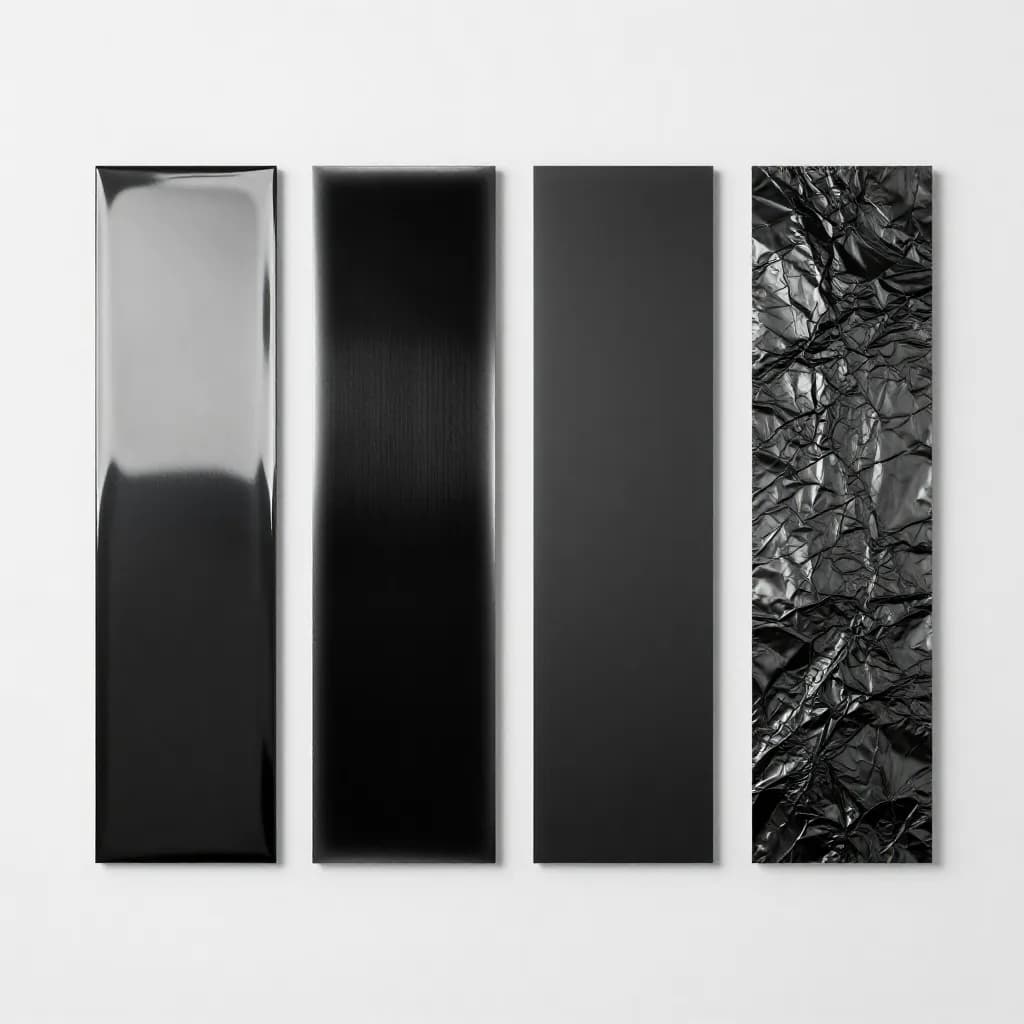
The appeal of black extends beyond aesthetics. Black finishes tend to hide minor surface imperfections more effectively than lighter colors, making them forgiving on substrates with slight irregularities. They also show less visible dirt accumulation in many environments, reducing the perceived need for frequent cleaning. For industrial and commercial applications, black communicates durability, professionalism, and technical sophistication.
Ready to Start Your Project?
From one-off customs to 15,000-part production runs — get precise pricing in 24 hours.
On This Page
Why Black Remains the Most Specified Powder Coating Color
However, specifying black powder coating is far from a simple decision. The range of black finishes available today is enormous, spanning deep jet blacks, warm off-blacks, cool blue-blacks, and brown-blacks. Each carries a different visual character and performs differently under various lighting conditions. Understanding the distinctions between RAL codes, gloss levels, and texture profiles is essential for achieving the exact black finish your project demands.
RAL 9005 vs RAL 9017 vs RAL 9011: Understanding the Differences
The three most commonly specified black RAL codes in powder coating are RAL 9005 Jet Black, RAL 9017 Traffic Black, and RAL 9011 Graphite Black. While all three appear black at first glance, they differ meaningfully in undertone, depth, and application suitability.
RAL 9005 Jet Black is the purest, deepest black in the RAL Classic system. It has a neutral undertone with no discernible warm or cool bias, making it the default choice when a true, uncompromising black is required. RAL 9005 is the standard specification for architectural metalwork, automotive trim, and any application where maximum contrast and depth are priorities. It is available in every gloss level from dead matte to high gloss.
RAL 9017 Traffic Black carries a subtle warm undertone that gives it a slightly softer appearance compared to RAL 9005. Originally developed for road signage and traffic infrastructure, RAL 9017 has found broader use in architectural and industrial applications where a marginally less stark black is preferred. The warmth becomes most apparent when RAL 9017 is placed directly alongside RAL 9005 under daylight.
RAL 9011 Graphite Black is the lightest of the three, with a noticeable cool, slightly bluish-grey undertone. It reads as a very dark charcoal rather than a pure black, particularly in bright lighting conditions. RAL 9011 is popular for automotive components, electronics enclosures, and architectural applications where a sophisticated dark tone is desired without the absolute depth of jet black. Designers often choose RAL 9011 when they want a black that reveals subtle dimension and character rather than absorbing all light.
Matte Black Powder Coating: Achieving the Perfect Flat Finish
Matte black powder coating has surged in popularity across virtually every design sector. Defined by a gloss level below 20 units measured at 60 degrees, matte black absorbs light rather than reflecting it, creating a surface that appears deep, tactile, and contemporary. The finish has become synonymous with modern design language in architecture, furniture, automotive, and consumer electronics.
Achieving a consistent matte black finish requires careful attention to powder formulation and application parameters. Matte powders typically use a blend of compatible and incompatible resins that create micro-texture during curing, scattering light to reduce gloss. The curing temperature and time must be precisely controlled because even slight overcuring can shift the gloss level noticeably. Undercuring, conversely, can leave the surface with poor chemical resistance and adhesion.
One practical consideration with matte black is fingerprint visibility. Flat finishes tend to show oils from skin contact more readily than gloss or textured surfaces. For applications where frequent handling is expected, such as door hardware, handrails, or consumer products, specifiers should consider a fine texture or satin finish as an alternative. Some powder manufacturers offer matte formulations with built-in anti-fingerprint properties that reduce this issue.
Matte black also requires careful handling during and after coating. Because the surface has no gloss to mask minor scratches or scuffs, any mechanical damage during transport or installation becomes immediately visible. Protective packaging and careful handling protocols are essential for maintaining the pristine appearance of matte black components through to final installation.
Gloss and Satin Black: When Reflectivity Matters
High-gloss black powder coating, typically measuring above 80 gloss units at 60 degrees, delivers a mirror-like reflective surface that communicates luxury, precision, and high-end craftsmanship. Gloss black is the traditional choice for automotive wheels, motorcycle frames, premium furniture, and decorative architectural elements where visual impact and depth of color are paramount.
The challenge with gloss black is that it reveals every imperfection. Substrate preparation must be flawless because any dent, scratch, weld mark, or surface irregularity will be amplified by the reflective finish. The powder application must achieve uniform film thickness without orange peel, sagging, or contamination. For this reason, gloss black is often considered the most demanding finish to execute at a consistently high standard.
Satin black occupies the middle ground between matte and gloss, typically measuring 30-50 gloss units at 60 degrees. This semi-reflective finish offers many of the aesthetic benefits of gloss black while being significantly more forgiving of substrate imperfections and handling marks. Satin black has become increasingly popular in architectural applications, particularly for window frames, curtain wall mullions, and exterior metalwork where a refined appearance is needed without the maintenance demands of a full gloss surface.
The choice between gloss, satin, and matte should be driven by the application environment and maintenance expectations. High-traffic areas benefit from satin or textured finishes that resist visible wear. Showcase applications where components are protected from contact can exploit the dramatic visual impact of high gloss. Specifying the correct gloss level at the outset prevents costly recoating when the finished appearance does not match expectations.
Textured Black Finishes: Wrinkle, Hammertone, and Sand
Textured black powder coatings add a tactile dimension that smooth finishes cannot replicate. The three most common texture profiles are wrinkle, hammertone, and sand, each creating a distinctive surface character suited to different applications and design intentions.
Wrinkle texture produces a fine, uniform crinkled surface that is exceptionally effective at hiding substrate imperfections. This makes it the preferred choice for industrial enclosures, electrical cabinets, toolboxes, and any fabricated metalwork where the substrate surface quality is variable. Wrinkle black is also highly resistant to showing fingerprints, scratches, and general wear, making it one of the most practical finishes for high-use environments.
Hammertone texture creates a pattern of overlapping circular indentations that resembles hand-hammered metal. This finish carries a distinctly industrial or artisanal character and is popular for workshop equipment, vintage-style furniture, and decorative metalwork. Hammertone finishes are available in single-color and multi-tone variations, with some formulations incorporating metallic flakes or contrasting color highlights within the texture pattern.
Sand texture produces a fine, granular surface similar to sandpaper or cast iron. It provides excellent grip characteristics, making it suitable for handles, tool housings, and equipment that must be securely held. Sand-textured black is also widely used in military and tactical applications where a non-reflective, durable surface is required.
All textured finishes share the practical advantage of superior scratch and wear resistance compared to smooth coatings. The raised texture profile means that light contact affects only the peaks of the texture rather than the full surface, significantly reducing the visibility of everyday wear. For projects where long-term appearance retention is critical in demanding environments, textured black finishes offer an excellent balance of aesthetics and durability.
Metallic and Special Effect Black Finishes
Beyond standard solid blacks, powder coating technology offers a range of metallic and special effect black finishes that add visual depth and complexity. These finishes incorporate metallic flakes, pearlescent pigments, or sparkle additives into the powder formulation, creating surfaces that shift in appearance as viewing angles and lighting conditions change.
Metallic black powder coatings contain fine aluminum flakes that create a subtle sparkle effect within the black base. The density and size of the metallic particles determine the intensity of the effect, ranging from a barely perceptible shimmer to a pronounced metallic character. Metallic black is popular for automotive wheels, motorcycle components, and premium consumer products where a standard solid black feels too flat or ordinary.
Black chrome effect powder coatings replicate the appearance of chrome plating with a dark, smoky tint. These finishes use specialized pigment technology to create a highly reflective, mirror-like surface with a deep black tone. While they do not achieve the exact reflectivity of electroplated chrome, they offer a striking alternative that avoids the environmental concerns and cost associated with hexavalent chromium plating processes.
Pearlescent black finishes incorporate mica-based pigments that create a color-shifting effect, revealing subtle hints of blue, purple, green, or copper depending on the viewing angle and light source. These finishes are particularly effective on curved surfaces where the changing geometry naturally showcases the color-shift effect. Pearlescent blacks are specified for high-end automotive components, luxury furniture, and architectural feature elements where a unique, premium appearance is desired.
When specifying metallic or effect blacks, it is important to approve physical samples rather than relying on digital color representations. The dynamic, angle-dependent nature of these finishes means they cannot be accurately represented on screen or in print.
Application Considerations for Black Powder Coating
Black powder coating presents specific application challenges that differ from lighter colors. The most significant is heat absorption. Black surfaces absorb substantially more solar radiation than lighter colors, which can cause higher surface temperatures on exterior components. For architectural applications in hot climates, this thermal loading must be considered in the design of the substrate and supporting structure, particularly for aluminum profiles that may experience thermal expansion.
Some powder coating manufacturers now offer solar-reflective black formulations that use specialized infrared-reflective pigments. These coatings appear visually identical to standard black but reflect a significantly higher proportion of near-infrared radiation, reducing surface temperatures by as much as 20-30 degrees Celsius compared to conventional black coatings. Solar-reflective blacks are increasingly specified for architectural facades, roofing components, and any exterior application where heat buildup is a concern.
Color consistency across production batches is another consideration specific to black finishes. Because the human eye is highly sensitive to variations in very dark colors, even minor differences in powder formulation, film thickness, or curing parameters can produce visible inconsistencies between components. Specifiers should require that all components for a single project are coated from the same powder batch wherever possible, and that color verification is performed using spectrophotometer measurements rather than visual assessment alone.
UV stability varies between black powder formulations. Standard polyester blacks offer good exterior durability for most applications, but super-durable polyester or fluoropolymer formulations should be specified for projects requiring maximum color retention over extended service lives. Qualicoat Class 2 or AAMA 2605 certification provides assurance of long-term UV performance for architectural applications.
Specifying Black Powder Coating for Your Project
Effective specification of black powder coating requires defining four key parameters: the RAL code or color reference, the gloss level, the texture profile, and the performance standard. Omitting any of these parameters leaves room for interpretation that can result in a finished product that does not match the designer's intent.
Start by selecting the specific black tone. RAL 9005 is the safe default for a true, neutral black. RAL 9017 suits applications where a slightly warmer black is appropriate. RAL 9011 works well when a sophisticated dark charcoal with cool undertones is desired. For custom blacks that fall outside the RAL system, provide a physical sample for spectrophotometer matching and specify acceptable color tolerance using Delta E values, typically Delta E less than 1.0 for critical color-match applications.
Next, define the gloss level numerically rather than using subjective terms. Specify the target gloss value and acceptable range measured at 60 degrees. For example, a matte finish might be specified as 10 plus or minus 5 gloss units at 60 degrees, while a satin finish could be 40 plus or minus 5 gloss units. This precision prevents disputes about whether the delivered finish matches the specification.
For textured finishes, provide an approved reference panel that defines the acceptable texture profile. Texture is difficult to specify numerically, so a physical standard is the most reliable method of communicating expectations between specifier, coater, and powder manufacturer.
Finally, specify the performance standard appropriate to the application environment. Interior applications may require only basic polyester performance, while exterior architectural projects should reference Qualicoat Class 1 or Class 2, GSB Master, or AAMA 2604 or 2605 depending on the exposure conditions and expected service life. Including the performance standard in the specification ensures that the coating system is formulated and applied to meet the demands of the intended environment.
Frequently Asked Questions
What is the difference between RAL 9005 and RAL 9017 black powder coating?
RAL 9005 Jet Black is the purest, deepest black with a neutral undertone. RAL 9017 Traffic Black has a subtle warm undertone that makes it appear slightly softer. The difference is most visible when the two are placed side by side under daylight. RAL 9005 is the standard choice for maximum depth and contrast.
Does matte black powder coating show fingerprints?
Yes, matte black finishes tend to show fingerprints and oils from skin contact more readily than gloss or textured surfaces. For frequently handled components, consider a fine texture or satin finish, or specify a matte powder with anti-fingerprint properties to reduce this issue.
Can black powder coating be used on exterior building facades?
Yes, but heat absorption must be considered. Black surfaces reach higher temperatures than lighter colors in direct sunlight. Solar-reflective black powder coatings use infrared-reflective pigments to reduce surface temperatures by up to 20-30 degrees Celsius while maintaining a visually identical black appearance.
What gloss level should I specify for black powder coating?
Specify gloss numerically at 60 degrees: below 20 units for matte, 30-50 for satin, and above 80 for high gloss. Always include an acceptable tolerance range, such as plus or minus 5 units. This prevents subjective disagreements about the finished appearance.
Which textured black finish is best for hiding surface imperfections?
Wrinkle texture is the most effective at concealing substrate imperfections such as weld marks, minor dents, and surface irregularities. It also resists showing fingerprints and everyday wear, making it the most practical textured finish for industrial and high-use applications.
Ready to Start Your Project?
From one-off customs to 15,000-part production runs — get precise pricing in 24 hours.