Automatic spray systems are the standard for high-volume powder coating operations, delivering consistent film thickness, reduced powder waste, and higher throughput than manual application can achieve. While manual spraying relies on operator skill and judgment, automatic systems use programmed motion paths and precisely controlled application parameters to apply powder with repeatable accuracy across thousands of identical parts.
Technical
Powder Coating Automatic Spray Systems: Reciprocators, Robots, and Gun Movers
Sundial Powder Coating·April 23, 2026·14 min
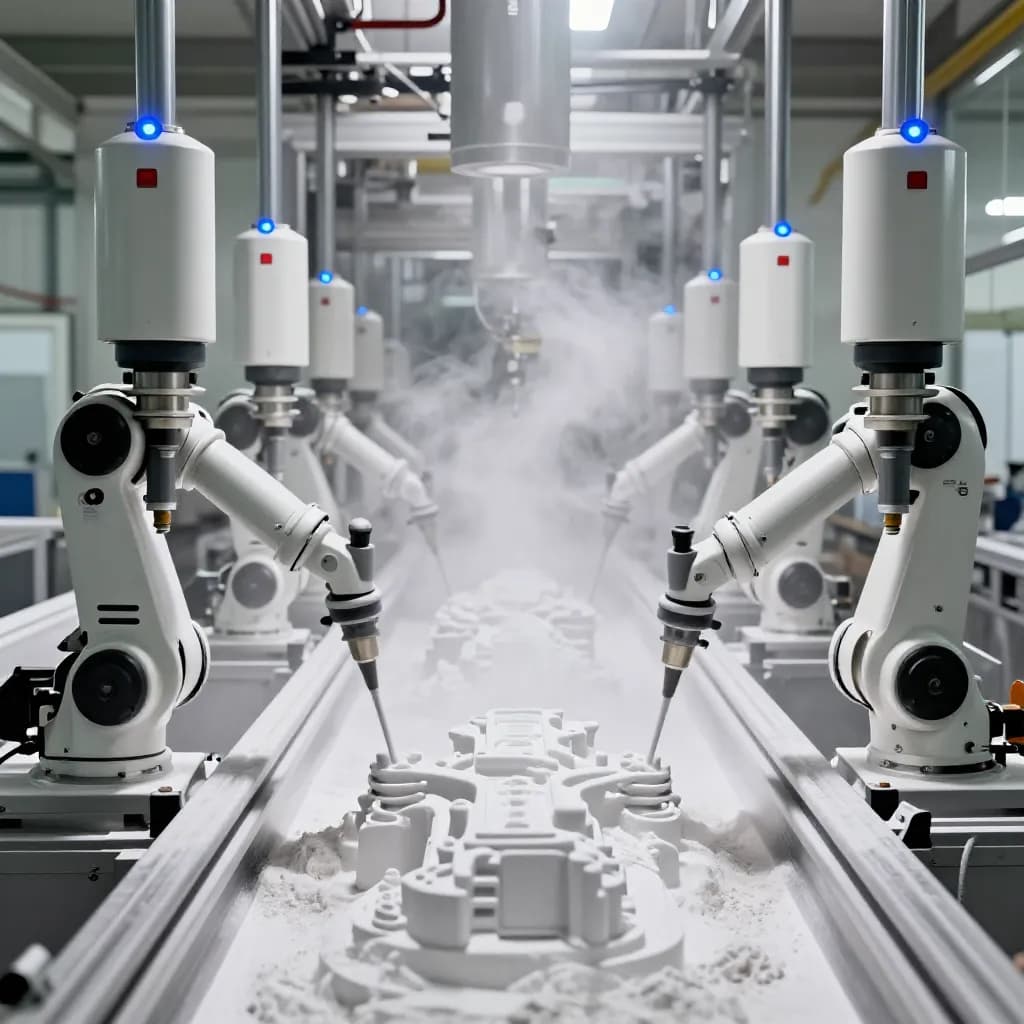
The economic case for automation is compelling. Automatic systems typically achieve transfer efficiency of 60–75% on first pass, compared to 40–60% for skilled manual operators. When combined with reclaim systems, overall material utilization can exceed 95%. Labor savings are equally significant — a single automatic system with 8–16 guns can replace 3–6 manual operators while maintaining tighter film thickness tolerances, typically ±5 microns compared to ±15–20 microns for manual application.
Ready to Start Your Project?
From one-off customs to 15,000-part production runs — get precise pricing in 24 hours.
On This Page
Why Automatic Spray Systems Matter in Powder Coating
Automatic spray systems are available in three primary configurations: reciprocators (vertical gun movers), multi-axis robots, and fixed or oscillating gun arrays. The choice between these technologies depends on part geometry complexity, production volume, the number of different part types processed, and the required color change frequency. Each technology has distinct advantages and limitations that must be matched to the specific production requirements of the coating operation.
Reciprocating Gun Movers: The Industry Workhorse
Reciprocators are the most widely used automatic spray technology in powder coating. A reciprocator consists of a vertical mast carrying multiple spray guns that moves up and down in a programmed stroke while parts travel horizontally past on a conveyor. The combination of vertical gun motion and horizontal part motion creates a crosshatch spray pattern that provides uniform coverage across the part surface.
Modern reciprocators are servo-driven, allowing precise control of stroke length, stroke speed, gun-to-part distance, and dwell time at the top and bottom of each stroke. Typical stroke lengths range from 1 to 3 meters, with stroke speeds of 0.1 to 1.0 meters per second. Gun spacing on the mast is adjustable, typically set at 200–300 mm center-to-center, and each gun can be individually enabled or disabled to match the part height and avoid spraying into empty space.
Reciprocators are typically deployed in pairs — one on each side of the conveyor — to coat both faces of flat or box-shaped parts simultaneously. For parts with complex geometry, additional reciprocators may be positioned at angles or aimed at specific features. The programming interface allows operators to create and store recipes for different part types, specifying stroke parameters, gun enable/disable patterns, and electrostatic settings for each recipe. Recipe changeover is typically instantaneous, triggered automatically by part identification sensors upstream of the spray booth. This capability makes reciprocators well-suited for mixed-model production lines where different part types are interspersed on the same conveyor.
Robotic Powder Coating: Complex Geometry Solutions
Six-axis articulated robots provide the ultimate flexibility for powder coating complex three-dimensional parts. Unlike reciprocators, which move in a simple vertical stroke, robots can position the spray gun at any angle and distance relative to the part surface, following contoured paths that maintain optimal gun-to-part distance and spray angle across complex geometries. This capability is essential for parts with deep recesses, internal cavities, sharp transitions, and varying surface orientations.
Robotic powder coating systems use offline programming software to generate spray paths from 3D CAD models of the parts. The software calculates gun trajectories that maintain consistent overlap, spray distance (typically 150–300 mm), and approach angle (ideally perpendicular to the surface) across the entire part geometry. Simulation tools verify coverage and identify potential collision points before the program is loaded to the robot controller. This offline programming capability dramatically reduces setup time compared to manual teach-pendant programming.
Robots are particularly valuable in automotive and aerospace applications where part geometries are complex and finish quality requirements are stringent. A single robot can replace multiple fixed guns or reciprocators while achieving more uniform coverage on contoured surfaces. However, robots have limitations: they are slower than reciprocators for simple flat parts, they require more sophisticated programming expertise, and their reach envelope limits the maximum part size they can coat. For many operations, the optimal solution combines reciprocators for flat surfaces with robots targeting complex features, leveraging the strengths of each technology.
Gun Control Parameters and Electrostatic Optimization
Regardless of the motion system — reciprocator, robot, or fixed mount — the spray gun parameters must be precisely controlled to achieve consistent coating quality. The critical parameters are powder flow rate, atomizing air pressure, pattern air pressure, electrostatic voltage, and current limit. Each parameter affects film build, surface finish, penetration into recesses, and the occurrence of defects such as orange peel, back-ionization, and picture framing.
Powder flow rate, measured in grams per minute, determines the amount of material delivered to the part surface per unit time. Typical flow rates for automatic guns range from 100 to 400 g/min, depending on the gun type and the required film thickness. Atomizing air pressure (typically 1.5–3.0 bar) controls the velocity and dispersion of the powder cloud, while pattern air pressure (0.5–2.0 bar) shapes the spray pattern width and density distribution.
Electrostatic charging is the mechanism that drives powder deposition onto the grounded part. Corona-charging guns apply a high voltage (typically 60–100 kV) to a charging electrode at the gun tip, creating a corona field that imparts a negative charge to powder particles as they pass through. The charged particles are attracted to the grounded part surface and held in place by electrostatic adhesion until curing. Current limiting (typically 10–80 microamps) prevents excessive ion bombardment of the part surface, which causes back-ionization — a condition where accumulated charge on the powder layer repels incoming particles, creating craters, orange peel, and poor coverage in recessed areas. Tribo-charging guns, which charge powder by friction rather than corona discharge, avoid back-ionization entirely and are preferred for Faraday cage geometries.
System Programming and Recipe Management
Effective programming is what transforms automatic spray hardware into a precision coating system. Modern automatic spray controllers store hundreds of recipes, each defining the complete set of motion and gun parameters for a specific part type. A recipe typically includes reciprocator stroke length and speed, gun enable/disable patterns, powder flow rate, air pressures, electrostatic voltage and current limit, and trigger timing relative to part position.
Part detection and identification systems upstream of the spray booth trigger automatic recipe selection. Simple systems use photoelectric sensors to detect part presence and height, selecting recipes based on part profile. More sophisticated systems use barcode readers, RFID tags, or vision cameras to identify specific part types and load the corresponding recipe. This automatic identification eliminates operator intervention during product changeovers and prevents the application of incorrect parameters to the wrong part.
Recipe optimization is an iterative process that begins with theoretical parameter settings based on the powder manufacturer's recommendations and the part geometry, then refines those settings through systematic testing. Film thickness measurements at multiple points on the part — using magnetic induction or eddy current gauges per ASTM D7091 — provide the feedback needed to adjust gun parameters for uniform coverage. Statistical analysis of thickness data across multiple parts reveals systematic patterns such as thin spots in recesses, heavy edges, or inconsistent coverage between gun positions. Advanced systems incorporate closed-loop feedback from in-line thickness sensors that automatically adjust powder flow rates in real time to maintain target film thickness as part geometry or powder characteristics vary.
Color Change Systems and Quick Changeover Design
Color change frequency is a critical factor in automatic spray system design. Every color change requires purging powder from the delivery system, cleaning the spray booth, and loading the new color — a process that can take anywhere from 3 minutes to 45 minutes depending on the system design and the degree of color contamination tolerance. For operations that change colors frequently, minimizing changeover time directly impacts productive capacity.
Quick color change systems use several design strategies to reduce changeover time. Powder delivery hoses are kept as short as possible to minimize the volume of powder that must be purged. Automatic purge sequences use compressed air pulses to blow residual powder from guns, hoses, and manifolds. Some systems use dedicated gun sets for each color, with automatic coupling mechanisms that connect the appropriate gun set when a color change is initiated. Dense-phase powder pumps, which transport powder in a concentrated slug rather than a dilute air stream, purge more completely and quickly than venturi-based systems.
Booth design is equally important for fast color changes. Cartridge-filter booths with smooth, non-porous interior surfaces can be purged and cleaned in 3–10 minutes, compared to 15–30 minutes for cyclone-based reclaim booths. Some facilities use dedicated booths for high-volume colors and a separate quick-change booth for low-volume colors, optimizing both reclaim efficiency and changeover speed. The integration of automatic color change with recipe management systems enables fully automated changeovers triggered by the production schedule, with no operator intervention required.
Transfer Efficiency and Powder Waste Reduction
Transfer efficiency — the percentage of sprayed powder that adheres to the part on first pass — is the primary measure of automatic spray system performance. Higher transfer efficiency means less powder in the overspray stream, less load on the reclaim system, lower risk of contamination from recycled powder, and reduced overall powder consumption. Optimizing transfer efficiency is a continuous process that involves gun positioning, electrostatic settings, powder flow rates, and booth airflow management.
Gun-to-part distance is one of the most influential factors. Too close, and the high-velocity air jet from the gun blows powder off the surface (blow-off effect). Too far, and the electrostatic field weakens, reducing deposition efficiency. The optimal distance varies by gun type and powder chemistry but typically falls between 200 and 300 mm for corona guns and 100 and 200 mm for tribo guns. Maintaining this distance consistently across the part surface is where automatic systems excel over manual application.
Booth airflow velocity must be sufficient to contain overspray and prevent powder from escaping the booth enclosure, but not so high that it strips deposited powder from the part surface. The target face velocity at the booth opening is typically 0.5–0.75 m/s per NFPA 33 requirements. Airflow uniformity across the booth cross-section is equally important — turbulent or uneven airflow creates inconsistent deposition patterns and can carry powder to areas where it causes contamination. Computational fluid dynamics (CFD) modeling is increasingly used during booth design to optimize airflow patterns for maximum transfer efficiency and containment.
Integration, Commissioning, and Performance Validation
Integrating an automatic spray system into a powder coating line requires careful coordination between the conveyor, booth, powder feed, reclaim, and control systems. The spray system must be synchronized with the conveyor speed so that gun triggering, recipe selection, and stroke timing align precisely with part position. Encoder signals from the conveyor drive typically provide the position reference for the spray controller, ensuring that gun operation tracks part movement regardless of minor speed variations.
Commissioning begins with mechanical alignment — verifying that reciprocator strokes are centered on the conveyor path, gun-to-part distances are correct, and all guns are aimed at the intended target zones. Electrostatic grounding is verified by measuring resistance from the part hanger through the conveyor to earth ground, which must be below 1 megohm per most equipment manufacturer specifications. Each gun is then calibrated for powder flow rate using a timed collection test, and electrostatic output is verified with a field meter.
Performance validation involves coating a statistically significant sample of parts (typically 30–50 per recipe) and measuring film thickness at defined locations per the control plan. Capability analysis using Cp and Cpk indices confirms that the system can consistently produce film thickness within specification. A Cpk of 1.33 or higher is the typical acceptance criterion for automatic spray systems, indicating that the process mean is centered within the tolerance and the variation is well controlled. Ongoing monitoring through statistical process control charts ensures that the system maintains this capability over time, with control limits triggering investigation and corrective action when process drift is detected.
Frequently Asked Questions
How many manual operators can an automatic spray system replace?
A typical automatic spray system with 8–16 guns can replace 3–6 manual operators while achieving tighter film thickness tolerances (±5 microns vs. ±15–20 microns for manual). The exact replacement ratio depends on part complexity, line speed, and the number of surfaces requiring coating.
What is the difference between a reciprocator and a robotic spray system?
Reciprocators move guns in a simple vertical stroke and are ideal for flat or box-shaped parts. Robots have six axes of motion and can follow complex contoured surfaces, maintaining optimal gun angle and distance. Reciprocators are faster for simple parts; robots provide better coverage on complex 3D geometries.
How long does a color change take on an automatic system?
Color change time ranges from 3 to 45 minutes depending on system design. Quick color change systems with short hoses, dense-phase pumps, and cartridge-filter booths can achieve 3–10 minute changeovers. Cyclone-based reclaim systems with longer delivery lines typically require 15–30 minutes.
What causes back-ionization in automatic powder coating?
Back-ionization occurs when excessive electrical charge accumulates on the powder layer, repelling incoming charged particles. It is caused by too-high voltage or current settings on corona-charging guns. Reducing voltage, lowering current limits, or switching to tribo-charging guns resolves the issue.
What transfer efficiency should an automatic system achieve?
First-pass transfer efficiency for automatic systems typically ranges from 60–75%, depending on part geometry and gun settings. With powder reclaim, overall material utilization can exceed 95%. Transfer efficiency is optimized by controlling gun-to-part distance, electrostatic settings, and booth airflow velocity.
Ready to Start Your Project?
From one-off customs to 15,000-part production runs — get precise pricing in 24 hours.