Agricultural equipment operates in one of the most punishing environments for protective coatings. Farm machinery and implements face a relentless combination of UV radiation during long hours of outdoor operation, chemical exposure from fertilizers, herbicides, pesticides, and animal waste, abrasive contact with soil, gravel, and crop residue, and wide temperature swings from sub-zero winter storage to 50°C+ summer field conditions. These combined stresses can destroy inadequate coatings within a single growing season.
Industrial
Powder Coating Agricultural Equipment: Heavy-Duty Protection for Farm Machinery and Implements
Sundial Powder Coating·April 22, 2026·11 min
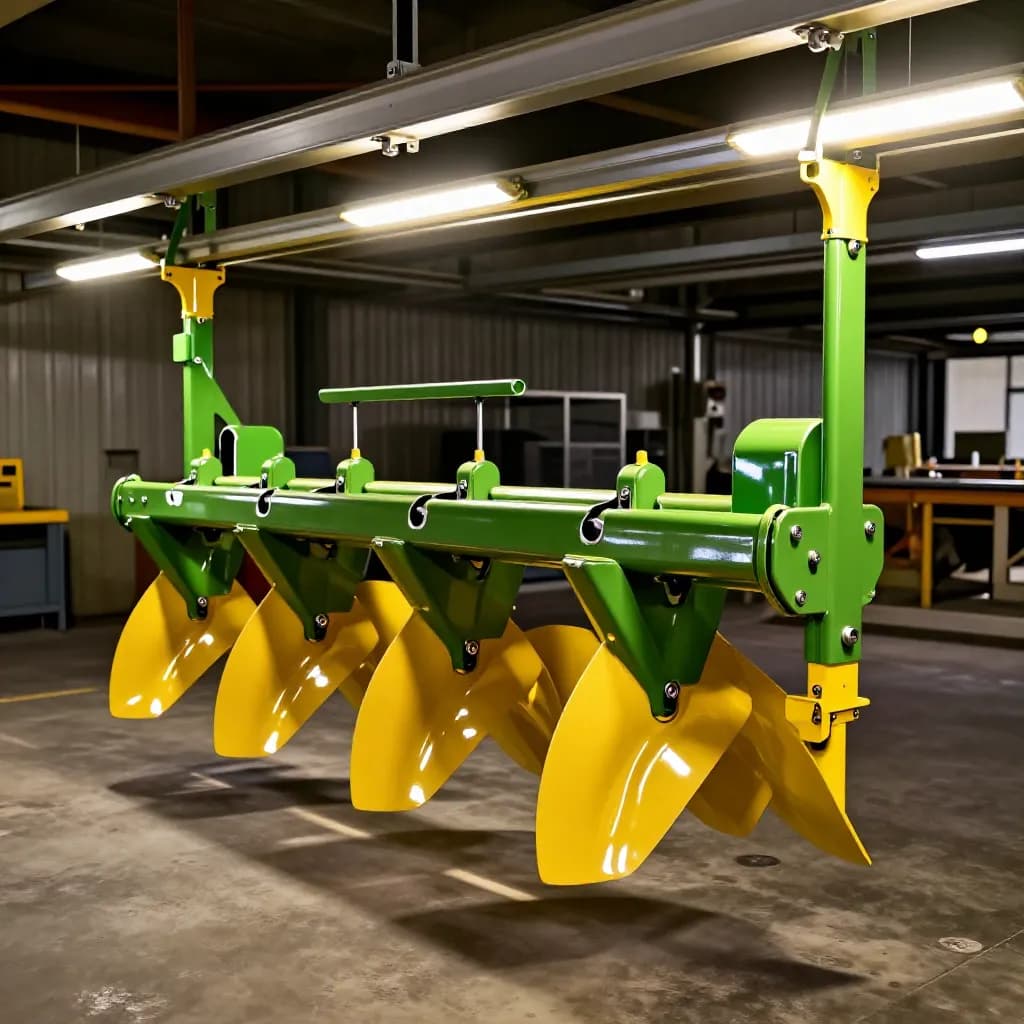
Powder coating has become the dominant finishing technology for agricultural OEMs and aftermarket refinishers because its thermoset film structure provides the multi-threat resistance that farm equipment demands. The dense, cross-linked polymer film resists chemical penetration from agricultural chemicals, maintains flexibility through thermal cycling, and provides impact and abrasion resistance that far exceeds conventional liquid paint systems. Major agricultural equipment manufacturers including John Deere, Case IH, AGCO, and Kubota use powder coating extensively on their production lines.
Ready to Start Your Project?
From one-off customs to 15,000-part production runs — get precise pricing in 24 hours.
On This Page
Why Agricultural Equipment Demands Superior Coating Performance
The economic case for powder coating agricultural equipment is compelling. Equipment that spends 10-15 years in active service must maintain both protective performance and visual appearance to preserve resale value. A properly applied powder coating system can protect agricultural equipment for the full service life of the machine, eliminating the need for costly field repainting that takes equipment out of service during critical planting or harvest windows.
Coating Systems for Tractors, Combines, and Self-Propelled Equipment
Large self-propelled agricultural equipment — tractors, combines, sprayers, and forage harvesters — represents the most demanding category of agricultural powder coating. These machines combine large surface areas, complex geometries, and exposure to the full range of agricultural environmental stresses. OEM coating specifications for this equipment class typically require multi-coat systems with total film builds of 100-175 microns.
The standard OEM coating system for agricultural equipment consists of a zinc phosphate pretreatment, an epoxy primer at 50-75 microns, and a polyester or super-durable polyester topcoat at 60-100 microns. The zinc phosphate pretreatment provides a crystalline conversion coating that dramatically improves adhesion and corrosion resistance compared to iron phosphate alternatives. The epoxy primer delivers excellent corrosion protection and chemical resistance, while the polyester topcoat provides UV stability, color retention, and the brand-specific appearance that is essential for manufacturer identity.
John Deere green (similar to RAL 6017 or Pantone 364C), Case IH red (similar to RAL 3020), New Holland blue (similar to RAL 5010), and Kubota orange (similar to RAL 2004) are among the most recognizable colors in agriculture. These brand colors must be matched precisely across all components of a machine, requiring tight color tolerance control in the powder manufacturing and application process. Delta E values of 1.0 or less between components are typical OEM requirements, ensuring visual consistency across hoods, fenders, frames, and implements.
For aftermarket refinishing of agricultural equipment, matching the original OEM color and gloss is critical for maintaining resale value. Specialty powder manufacturers offer agricultural color matches that have been spectrophotometrically verified against original OEM panels, ensuring accurate color reproduction even on equipment that has faded from years of UV exposure.
Implements and Attachments: Plows, Discs, Planters, and Tillage Tools
Agricultural implements and attachments face even more severe abrasion and impact conditions than self-propelled equipment. Plows, disc harrows, cultivators, and tillage tools are in direct contact with soil and rock, creating extreme abrasive wear that can remove coating from contact surfaces within hours of operation. Planters, seeders, and fertilizer applicators face chemical exposure from seed treatments, liquid fertilizers, and granular chemicals that can attack coating films through chemical degradation.
For soil-engaging components, powder coating serves primarily as corrosion protection during storage and transport rather than as a permanent wear surface. The coating on plow moldboards, disc blades, and cultivator sweeps will be worn away by soil contact during normal operation, but it prevents rust formation during the off-season storage period that can last 6-9 months. A single-coat hybrid epoxy-polyester powder at 75-100 microns provides adequate storage protection at an economical cost for these high-wear components.
Non-soil-engaging implement components — frames, toolbars, hoppers, and shields — require the same multi-coat protection as self-propelled equipment. These components must resist UV degradation, chemical exposure from agricultural products, and mechanical damage from field debris and transport vibration over a 10-20 year service life. Super-durable polyester topcoats with enhanced UV stabilizer packages are specified for implement frames and visible components to maintain color and gloss retention throughout the implement's service life.
Fertilizer and chemical applicator components present a specific coating challenge due to the corrosive nature of many agricultural chemicals. Ammonium nitrate, urea, potassium chloride, and liquid UAN solutions are all corrosive to steel and can attack standard polyester powder coatings through chemical degradation. For chemical applicator tanks, booms, and distribution systems, epoxy or vinyl ester powder coatings provide superior chemical resistance, though they must be protected from UV exposure by a polyester topcoat on exterior surfaces.
Heavy-Duty Pretreatment for Agricultural Steel and Iron
Agricultural equipment is predominantly fabricated from hot-rolled steel, cold-rolled steel, and cast iron — substrates that present significant pretreatment challenges due to mill scale, weld spatter, laser cutting oxide, and the heavy oil and grease contamination typical of fabrication environments. Inadequate pretreatment is the primary cause of coating failure on agricultural equipment, making the pretreatment process the most critical step in the coating operation.
Mill scale — the blue-black iron oxide layer formed during hot rolling — is the most problematic contaminant on agricultural steel components. Mill scale is cathodic to the underlying steel, creating a galvanic cell that accelerates corrosion beneath the coating if not completely removed. Mechanical removal by shot blasting with steel grit to Sa 2.5 (near-white metal) per ISO 8501-1 is the most effective method. The blast profile should be 40-75 micrometers to provide optimal mechanical adhesion for the powder coat.
For fabricated assemblies that cannot be shot blasted due to size or geometry constraints, chemical pretreatment using a heavy-duty alkaline cleaner followed by iron phosphate or zinc phosphate conversion coating provides an alternative. However, chemical pretreatment alone cannot remove mill scale, so components with significant mill scale must be mechanically prepared before chemical treatment. Many agricultural equipment manufacturers use a combination approach: shot blast individual components before welding, then chemically pretreat the welded assembly.
Zinc phosphate pretreatment is strongly preferred over iron phosphate for agricultural equipment due to its superior corrosion protection. Zinc phosphate crystals create a denser, more uniform conversion coating that provides better adhesion and a more effective barrier against moisture and chemical penetration. The additional cost and complexity of zinc phosphate processing is justified by the significant improvement in coating durability for equipment that must perform in harsh agricultural environments for 10-15 years.
UV and Weathering Resistance for Outdoor Agricultural Service
Agricultural equipment spends the majority of its service life outdoors, exposed to intense UV radiation that degrades polymer coatings through photo-oxidation. In agricultural regions with high solar irradiance — the American Midwest, Australian outback, Brazilian cerrado, and Mediterranean Europe — UV exposure can exceed 6,000 MJ/m² annually, placing extreme demands on coating UV resistance. Color fading, gloss loss, and chalking are the visible symptoms of UV degradation, while the underlying polymer degradation also reduces the coating's protective performance.
Super-durable polyester powder coatings have been developed specifically to address the UV demands of outdoor equipment applications. These formulations incorporate enhanced UV absorber and hindered amine light stabilizer (HALS) packages that significantly extend the coating's resistance to photo-oxidation. In accelerated weathering tests per ASTM G154 or ISO 11507, super-durable polyesters typically maintain Delta E color change below 5 and gloss retention above 50% after 3,000 hours of UV-B exposure — approximately equivalent to 8-10 years of outdoor agricultural service.
Fluoropolymer-modified polyester powders represent the highest tier of UV performance for agricultural applications. These formulations incorporate PVDF (polyvinylidene fluoride) or FEVE (fluoroethylene vinyl ether) resins that provide UV resistance approaching that of full fluoropolymer coatings at a lower cost. They are typically specified for premium equipment lines where long-term color retention is a brand differentiator.
Gloss level selection also affects perceived weathering performance. High-gloss finishes (80+ GU at 60°) show gloss loss more visibly than semi-gloss (40-60 GU) or satin (20-40 GU) finishes. Many agricultural equipment manufacturers specify semi-gloss or satin finishes for this reason — they maintain an acceptable appearance longer than high-gloss finishes even as the coating undergoes normal UV aging.
Chemical Resistance: Fertilizers, Herbicides, and Fuel Exposure
Agricultural equipment is routinely exposed to a wide range of chemicals that can attack coating films through chemical degradation, solvent swelling, or acid/alkali hydrolysis. Fertilizers (ammonium nitrate, urea, potassium chloride, phosphoric acid), herbicides (glyphosate, atrazine, 2,4-D), insecticides, fungicides, diesel fuel, hydraulic fluid, and animal waste all present chemical exposure risks that the coating system must resist.
The chemical resistance of powder coatings varies significantly by resin chemistry. Epoxy powders provide the best broad-spectrum chemical resistance, withstanding concentrated acids, alkalis, solvents, and agricultural chemicals with minimal degradation. However, epoxy's poor UV resistance limits its use to primers or components shielded from sunlight. Polyester powders offer good resistance to dilute acids, alkalis, and most agricultural chemicals, but can be attacked by concentrated solvents and strong acids. Hybrid epoxy-polyester powders provide intermediate chemical resistance suitable for moderate exposure conditions.
For equipment components with heavy chemical exposure — sprayer booms, fertilizer hoppers, chemical tanks, and mixing systems — a two-coat system with an epoxy primer and polyester topcoat provides the optimal combination of chemical resistance (from the epoxy) and UV resistance (from the polyester). The epoxy primer acts as the primary chemical barrier, while the polyester topcoat protects the epoxy from UV degradation and provides the desired color and appearance.
Diesel fuel and hydraulic fluid exposure is a constant concern for agricultural equipment coatings. These petroleum-based fluids can soften and swell some powder coating formulations, particularly at elevated temperatures. Polyester powders with high cross-link density and low residual unsaturation provide the best resistance to petroleum fluid exposure. Testing per ASTM D1308 (chemical resistance of organic coatings) with the specific fluids used in the application is recommended for critical components.
Large-Scale Application: Coating Oversized Agricultural Components
Agricultural equipment components are often significantly larger than typical powder coating substrates, presenting challenges for spray booth capacity, oven size, and handling logistics. Combine headers spanning 12 meters, tractor frames exceeding 4 meters in length, and grain tank assemblies with complex three-dimensional geometries all require specialized coating facilities and application techniques.
Large-component powder coating facilities for agricultural equipment typically feature conveyorized systems with booth openings of 3-4 meters wide by 3-4 meters tall, and cure ovens with internal dimensions to match. Batch oven systems are common for the largest components, allowing individual pieces to be loaded on rolling carts and cured in walk-in ovens. Infrared cure systems are increasingly used for large agricultural components because they can achieve faster heat-up rates and more uniform temperature distribution than convection ovens on heavy steel assemblies.
Electrostatic application of powder to large components requires careful attention to Faraday cage effects in recessed areas, inside corners, and box-section structures. These areas resist electrostatic powder deposition due to the electric field geometry, resulting in thin or absent coating in critical areas. Experienced applicators address Faraday cage effects by adjusting gun voltage (reducing from 80-100 kV to 40-60 kV for recessed areas), increasing powder flow rate, and using specialized nozzles designed for penetration into recessed geometries.
For extremely large components that exceed oven capacity, hybrid coating approaches are used. The component is powder coated in sections or subassemblies before final welding, with weld joints and heat-affected zones touched up with liquid primer and topcoat after assembly. While this approach introduces a liquid paint element, it allows the majority of the surface area to benefit from powder coating's superior performance while accommodating the practical constraints of component size.
Quality Control and Testing for Agricultural Coating Systems
Quality control for agricultural powder coating must verify that the coating system will perform reliably through 10-15 years of harsh outdoor service. OEM specifications typically define requirements for film thickness, adhesion, hardness, impact resistance, chemical resistance, salt spray resistance, and accelerated weathering performance. Incoming quality checks, in-process monitoring, and final inspection protocols ensure that every coated component meets these requirements.
Film thickness measurement is the most fundamental quality check, performed using magnetic or eddy current gauges per ISO 2808 or ASTM D7091. Agricultural OEM specifications typically require minimum film thicknesses of 50-75 microns for primers and 60-100 microns for topcoats, with maximum thickness limits to prevent issues such as orange peel, sagging, or reduced impact resistance. Measurements are taken at multiple points on each component, with particular attention to edges, corners, and recessed areas where thin coverage is most likely.
Adhesion testing per ISO 2409 (cross-cut test) or ASTM D3359 (tape test) verifies that the coating is properly bonded to the pretreated substrate. A rating of 0 (no detachment) or 1 (less than 5% detachment) is typically required. For critical components, the pull-off adhesion test per ISO 4624 or ASTM D4541 provides a quantitative adhesion value, with minimum requirements typically in the range of 5-8 MPa for agricultural applications.
Salt spray testing per ISO 9227 or ASTM B117 is the standard accelerated corrosion test for agricultural coating systems. OEM specifications typically require 500-1,000 hours of neutral salt spray exposure with maximum scribe creep of 2-3 mm. While salt spray testing has well-known limitations as a predictor of real-world performance, it remains the industry standard for comparative evaluation and quality assurance of agricultural coating systems.
Frequently Asked Questions
How long does powder coating last on farm equipment?
A properly applied powder coating system with zinc phosphate pretreatment, epoxy primer, and super-durable polyester topcoat can protect agricultural equipment for 10-15 years of outdoor service. Actual performance depends on UV exposure, chemical contact, and mechanical wear. Soil-engaging components will lose coating through abrasion during normal operation.
Can powder coating match John Deere green and other OEM colors?
Yes. Specialty powder manufacturers offer spectrophotometrically verified color matches for all major agricultural OEM colors including John Deere green, Case IH red, New Holland blue, and Kubota orange. Delta E values of 1.0 or less ensure visual consistency across components.
What pretreatment is best for agricultural steel equipment?
Shot blasting to Sa 2.5 (near-white metal) with a 40-75 micrometer profile, followed by zinc phosphate conversion coating, provides the best corrosion protection for agricultural steel. Zinc phosphate is strongly preferred over iron phosphate due to its superior barrier properties and adhesion promotion in harsh agricultural environments.
Does powder coating resist fertilizer and herbicide chemicals?
Polyester topcoats resist most dilute agricultural chemicals. For heavy chemical exposure on sprayer booms and fertilizer equipment, a two-coat system with epoxy primer and polyester topcoat provides optimal protection — the epoxy resists chemical penetration while the polyester provides UV protection.
Why do agricultural coatings fade and chalk over time?
UV radiation causes photo-oxidation of the polymer coating, breaking down the resin and releasing pigment particles as chalk. Super-durable polyester powders with enhanced UV absorbers and HALS stabilizers significantly slow this process. Semi-gloss finishes also show aging less visibly than high-gloss finishes.
Can oversized agricultural components be powder coated?
Yes, though they require specialized facilities with large booth openings and batch cure ovens. Components exceeding oven capacity can be coated in subassemblies before final welding, with weld joints touched up afterward. Infrared cure systems help achieve uniform heating on heavy steel assemblies.
Ready to Start Your Project?
From one-off customs to 15,000-part production runs — get precise pricing in 24 hours.