Military powder coating specifications represent the most demanding performance standards in the coatings industry. Unlike commercial specifications that focus primarily on appearance and basic durability, military specifications require coatings to withstand chemical warfare agent exposure, extreme temperature cycling, prolonged salt spray immersion, ballistic impact, and years of field service in the harshest environments on earth. Meeting these specifications requires specialized formulations, rigorous testing, and formal qualification through the Department of Defense's Qualified Products List (QPL) process.
Technical
Military Powder Coating Specifications: MIL-PRF-32348 and Beyond
Sundial Powder Coating·April 20, 2026·11 min
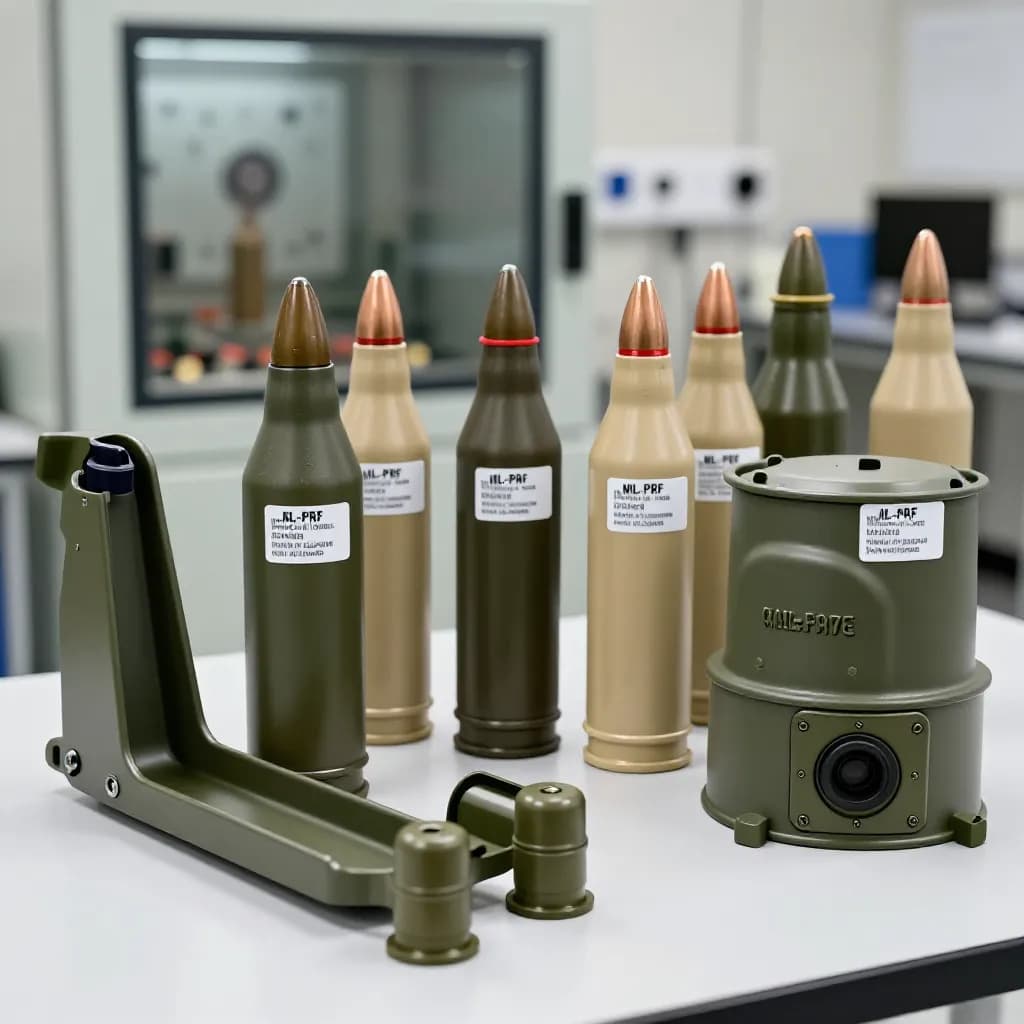
The adoption of powder coating technology by the US military and allied defense forces marks a significant shift in military coating philosophy. For decades, solvent-based liquid coatings were the only option for military applications, but growing environmental regulations, worker safety concerns, and the operational advantages of powder coating have driven the development of military-grade powder formulations. Today, powder coatings qualified to military specifications are used on tactical vehicles, naval vessels, aircraft ground support equipment, weapons systems, and a wide range of support equipment.
Ready to Start Your Project?
From one-off customs to 15,000-part production runs — get precise pricing in 24 hours.
On This Page
Introduction to Military Powder Coating Specifications
Understanding the landscape of military powder coating specifications is essential for coating manufacturers seeking qualification, defense contractors specifying coatings for military programs, and military maintenance facilities transitioning from liquid to powder coating operations. The specifications covered in this guide represent the primary standards governing powder coating use in US and allied military applications.
MIL-PRF-32348: The Primary Military Powder Coating Specification
MIL-PRF-32348, titled "Coating, Powder, Chemical Agent Resistant," is the cornerstone specification for powder coatings used on US military tactical equipment. First approved in 2010, this specification was developed to provide a powder coating alternative to the traditional liquid CARC system defined by MIL-DTL-64159 (topcoat) and MIL-DTL-53022 (primer). Products qualified under MIL-PRF-32348 must demonstrate chemical agent resistance equivalent to liquid CARC, ensuring that contaminated surfaces can be effectively decontaminated.
The specification covers multiple coating types including powder CARC topcoats and powder primers. Topcoat formulations must meet requirements for chemical agent resistance (tested against HD mustard and GD nerve agent simulants), near-infrared reflectance for camouflage effectiveness, salt spray resistance (minimum 1,000 hours per ASTM B117), humidity resistance (minimum 1,000 hours per ASTM D1735), UV weathering resistance, flexibility, adhesion, impact resistance, and fluid resistance to fuels, lubricants, hydraulic fluids, and decontamination solutions.
Qualification under MIL-PRF-32348 requires manufacturers to submit products for testing at approved government laboratories, typically the US Army Combat Capabilities Development Command (DEVCOM) Chemical Biological Center. The qualification process can take 12 to 24 months and involves extensive testing against all specification requirements. Once qualified, products are listed on the QPL and may be procured by military facilities and defense contractors. Manufacturers must maintain quality control programs and submit to periodic surveillance testing to retain their QPL listing.
MIL-PRF-24712: Powder Coatings for Naval Vessels
MIL-PRF-24712, "Coating, Powder, for Naval Shipboard Use," defines requirements for powder coatings used on US Navy and Coast Guard vessels. This specification covers twelve distinct coating types designed for different shipboard applications, including coatings for steel bulkheads and overheads, aluminum structures, copper-nickel piping, and deck surfaces. Each type has specific performance requirements tailored to its intended service environment.
The naval environment presents unique challenges that differ from land-based military applications. Shipboard coatings must withstand constant salt spray exposure, high humidity, temperature cycling from tropical to arctic conditions, vibration from machinery and wave action, and exposure to fuels, lubricants, and cleaning chemicals. Fire resistance is a critical requirement for interior shipboard coatings, as fire at sea is one of the most dangerous situations a vessel can face. MIL-PRF-24712 includes specific requirements for flame spread, smoke generation, and toxicity of combustion products.
Powder coatings qualified under MIL-PRF-24712 have gained significant traction in naval applications, particularly for interior spaces where the zero-VOC characteristic eliminates concerns about air quality in enclosed shipboard compartments. The Navy has found that powder coatings offer superior durability compared to liquid coatings in many shipboard applications, reducing maintenance frequency and lifecycle costs. The specification continues to evolve as new powder coating technologies become available and the Navy gains operational experience with powder-coated surfaces.
Other Relevant Military Coating Specifications
Beyond MIL-PRF-32348 and MIL-PRF-24712, several other military specifications are relevant to powder coating applications in defense. MIL-PRF-22750 covers high-solids epoxy coatings used as primers and single-coat systems on military equipment. While originally written for liquid coatings, epoxy powder coatings can be formulated to meet many of the performance requirements in this specification, particularly for interior applications where UV resistance is not required.
MIL-PRF-85285 defines requirements for polyurethane topcoats used on military aircraft. This specification demands exceptional UV stability, flexibility, chemical resistance, and appearance retention. While liquid polyurethane coatings currently dominate aircraft applications due to the large surface areas and complex geometries involved, powder coating technology is being evaluated for aircraft components and ground support equipment where the specification's performance requirements apply.
MIL-DTL-53039 covers single-component CARC topcoats designed for field-level touch-up and repair. Although this specification addresses liquid coatings, it highlights an important consideration for powder coating adoption: field repairability. Since powder coatings require oven curing, they cannot be applied in the field for touch-up, and compatible liquid touch-up systems must be identified for maintenance of powder-coated equipment. Additional specifications such as MIL-PRF-23377 (epoxy primer for aerospace) and MIL-C-46168 (enamel coatings) round out the military coating specification landscape.
Qualification and Testing Requirements
The qualification process for military powder coatings is rigorous and comprehensive, designed to ensure that only coatings meeting the full range of performance requirements are approved for use on military equipment. The process begins with the manufacturer submitting a qualification request along with product samples to the designated testing facility. For MIL-PRF-32348, the primary testing authority is the US Army DEVCOM Chemical Biological Center at Aberdeen Proving Ground, Maryland.
Testing encompasses dozens of individual test methods covering every aspect of coating performance. Chemical agent resistance testing exposes coated panels to chemical warfare agent simulants and evaluates the ability to decontaminate the surface to safe levels. Salt spray testing per ASTM B117 subjects panels to continuous salt fog for 1,000 hours or more, after which adhesion and corrosion are evaluated. Humidity resistance testing per ASTM D1735 exposes panels to 100% relative humidity at elevated temperature. Accelerated weathering per ASTM G154 or ASTM G155 evaluates UV stability and color retention. Adhesion testing per ASTM D3359 (tape test) and ASTM D4541 (pull-off test) verifies coating bond strength.
Additional tests include flexibility testing per ASTM D522 (mandrel bend), impact resistance per ASTM D2794, pencil hardness per ASTM D3363, fluid resistance to JP-8 fuel, hydraulic fluid, lubricating oil, and decontamination solutions, and near-infrared reflectance measurement across the 700-1200nm wavelength range. Products that pass all required tests are added to the Qualified Products List (QPL), which is the official list of approved products that military procurement activities may purchase. Maintaining QPL status requires ongoing quality control and periodic re-testing.
Benefits of Powder Coating for Military Applications
The adoption of powder coating for military applications delivers substantial benefits across environmental, operational, and economic dimensions. The most immediate benefit is the elimination of volatile organic compound emissions. Traditional liquid CARC contains approximately 340 g/L of VOCs, and military coating facilities processing large volumes of tactical equipment generate significant solvent emissions requiring expensive air pollution control equipment. Powder coatings produce virtually zero VOC emissions, eliminating the need for thermal oxidizers or carbon adsorption systems and dramatically simplifying environmental compliance.
From an operational perspective, powder coatings offer several advantages over liquid CARC. Material utilization rates of 95% or higher are achievable with reclaim systems, compared to 50-65% for liquid spray operations. Powder coatings have no pot life limitations — unlike two-component liquid CARC that must be used within hours of mixing, powder material can be stored for months and used on demand with zero waste from expired mixed material. The single-coat application capability of many powder formulations reduces processing time compared to the multi-coat liquid CARC system. Powder coatings also provide superior edge coverage, reducing the corrosion vulnerability at edges and corners that is a common failure mode with liquid coatings.
Economically, the total cost of ownership for powder coating operations is typically lower than liquid CARC operations when facility volume justifies the capital investment in powder coating equipment. Reduced material waste, eliminated solvent costs, lower environmental compliance costs, reduced personal protective equipment requirements (no isocyanate exposure), and faster throughput all contribute to lower per-unit coating costs. The US Army has documented significant cost savings at depot-level maintenance facilities that have transitioned from liquid CARC to powder CARC for applicable components.
Frequently Asked Questions
What is MIL-PRF-32348?
MIL-PRF-32348 is the US military specification for chemical agent resistant powder coatings. It defines performance requirements for powder coating topcoats and primers used on tactical military equipment as an alternative to traditional liquid CARC coatings. Products must be tested and qualified through the QPL process before they can be used on military equipment.
Can powder coating replace liquid CARC on all military equipment?
Not entirely. Powder coating requires oven curing at 350-400°F, which limits its use to individual components and subassemblies that can fit in a curing oven. Fully assembled vehicles and large structures still require liquid CARC for final coating and touch-up. However, powder coating is increasingly used for components such as frames, brackets, housings, and panels that are coated before assembly.
How do I find products on the Qualified Products List?
The QPL for military specifications can be found through the Defense Logistics Agency's ASSIST database (assist.dla.mil) or through the Defense Standardization Program Office. Search by specification number (e.g., MIL-PRF-32348) to find the current list of qualified manufacturers and products. Only products listed on the QPL should be used for military applications requiring specification compliance.
What testing is required for MIL-PRF-32348 qualification?
Qualification testing includes chemical agent resistance, salt spray resistance (1,000+ hours), humidity resistance (1,000+ hours), UV weathering, adhesion, flexibility, impact resistance, hardness, fluid resistance to fuels and hydraulic fluids, decontamination solution resistance, and near-infrared reflectance measurement. Testing is conducted at approved government laboratories and typically takes 12 to 24 months.
Are military powder coating specifications recognized internationally?
US military specifications are widely recognized and often referenced by allied nations, but many countries have their own military coating standards. NATO STANAG agreements help harmonize requirements among alliance members. Some allied nations accept US QPL-listed products, while others require additional testing to their national standards.
Ready to Start Your Project?
From one-off customs to 15,000-part production runs — get precise pricing in 24 hours.