Isocyanates are a family of highly reactive chemical compounds widely used as hardeners (crosslinkers) in two-component (2K) polyurethane coating systems. The most common isocyanates in coatings are hexamethylene diisocyanate (HDI), isophorone diisocyanate (IPDI), and toluene diisocyanate (TDI), typically supplied as polyisocyanate adducts or prepolymers. When mixed with a hydroxyl-functional resin (the base component), isocyanates react to form a tough, chemically resistant polyurethane film.
Environmental
Isocyanate Exposure in Coating Work: Risks and Safer Alternatives
Sundial Powder Coating·April 20, 2026·9 min
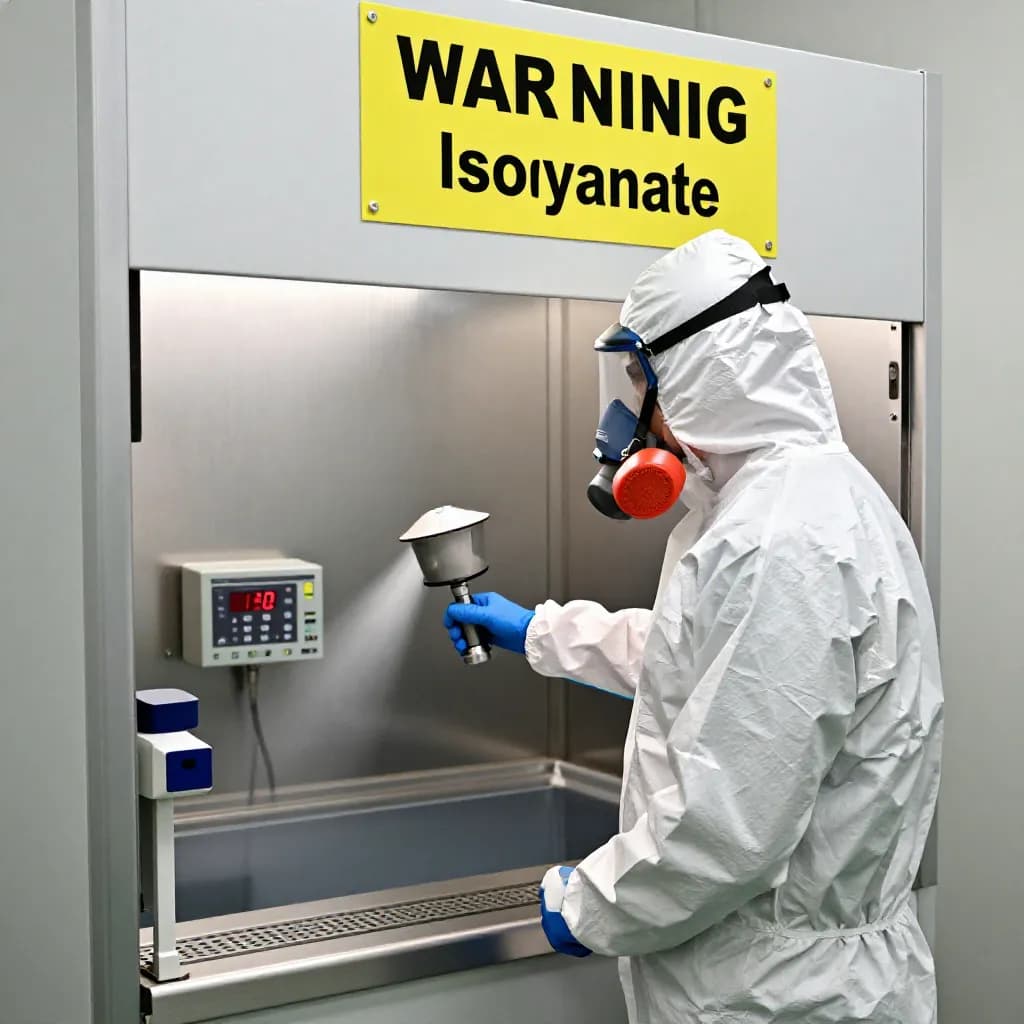
Two-pack polyurethane coatings are valued for their excellent gloss retention, chemical resistance, and weathering performance, which is why they have been widely used in automotive refinishing, aerospace, marine, and industrial maintenance applications. However, the very reactivity that makes isocyanates effective crosslinkers also makes them potent respiratory sensitizers and a serious occupational health hazard.
Ready to Start Your Project?
From one-off customs to 15,000-part production runs — get precise pricing in 24 hours.
On This Page
What Are Isocyanates?
Isocyanates become airborne during spray application as a component of the paint mist, and they can also be released as vapor, particularly at elevated temperatures. Once mixed, the pot life of a 2K system is limited, and any unused material becomes waste. The handling, mixing, and application of isocyanate-containing coatings require stringent safety measures that add complexity and cost to coating operations.
Health Risks: Occupational Asthma, Sensitization, and Lung Damage
Isocyanates are the leading cause of occupational asthma in industrialized countries. Exposure can trigger sensitization — an irreversible immune response where the body develops an allergy to isocyanates. Once sensitized, a worker may experience severe asthmatic reactions upon exposure to even trace amounts of isocyanate, far below the occupational exposure limit. Sensitization can occur after a single high-dose exposure or through repeated low-level exposures over time.
The respiratory effects of isocyanate exposure range from mild irritation and coughing to severe bronchospasm, chest tightness, and life-threatening asthma attacks. Chronic exposure can lead to permanent reduction in lung function and irreversible obstructive airway disease. Skin contact with isocyanates can also cause dermal sensitization, leading to contact dermatitis and potentially contributing to respiratory sensitization through skin absorption.
The insidious nature of isocyanate sensitization is that it is unpredictable and irreversible. There is no reliable way to identify which workers will become sensitized, and once sensitization occurs, the affected individual can never safely work with isocyanates again. This has profound implications for workers' careers and quality of life, and it represents a significant liability for employers.
Regulatory Requirements: Exposure Limits, Health Surveillance, and RPE
Occupational exposure to isocyanates is tightly regulated in most jurisdictions. In the United Kingdom, the workplace exposure limit (WEL) for isocyanates is 0.02 mg/m³ as an 8-hour time-weighted average (TWA), with a short-term exposure limit (STEL) of 0.07 mg/m³ over 15 minutes. The US OSHA permissible exposure limit (PEL) for TDI is 0.02 ppm (0.14 mg/m³) as a ceiling value. The EU has established binding occupational exposure limits under Directive 2020/1182.
Employers using isocyanate-containing coatings must implement a hierarchy of controls: elimination or substitution first, then engineering controls (enclosed spray booths with dedicated extraction), administrative controls (restricted access, training), and finally personal protective equipment (PPE). Supplied-air respirators or powered air-purifying respirators with appropriate organic vapor cartridges are required during spray application, as standard particulate masks do not protect against isocyanate vapor.
Health surveillance is mandatory for workers exposed to isocyanates in many jurisdictions. This typically includes pre-employment lung function testing, periodic spirometry, and symptom questionnaires. Workers showing signs of sensitization or declining lung function must be removed from isocyanate exposure immediately. The administrative burden of health surveillance, RPE fit testing, training, and record-keeping adds significant overhead to operations using 2K polyurethane coatings.
How Powder Coating Eliminates Isocyanate Exposure
Powder coating technology completely eliminates isocyanate exposure because the curing chemistry does not involve isocyanates. Powder coatings achieve crosslinking through entirely different mechanisms — polyester powders cure with triglycidyl isocyanurate (TGIC) or TGIC-free hardeners such as hydroxyalkylamide (HAA) or glycidyl esters, while epoxy powders cure with dicyandiamide or phenolic hardeners. None of these systems generate isocyanate vapor or aerosol during application or curing.
The health and safety profile of powder coating application is fundamentally different from 2K liquid spraying. Powder coating booths manage inert powder particulate rather than toxic chemical vapor, and standard dust extraction with cartridge filtration provides effective containment. Workers in powder coating operations typically require only basic dust masks or half-face particulate respirators rather than the supplied-air systems mandated for isocyanate work.
For applications that have traditionally relied on 2K polyurethane coatings for their performance characteristics — such as high-gloss finishes, chemical resistance, and exterior durability — modern polyester and superdurable powder coatings now offer comparable or superior performance. This means that the transition away from isocyanates does not require a compromise on coating quality.
Transitioning from 2K Liquid to Powder for Worker Safety
Organizations considering a transition from two-pack polyurethane liquid coatings to powder coating should begin with a thorough assessment of their current product range and performance requirements. Many applications that historically used 2K liquid systems — including architectural metalwork, automotive components, agricultural equipment, and general industrial finishing — can be successfully converted to powder with equivalent or better results.
The transition involves capital investment in powder application equipment (spray booths, electrostatic guns, recovery systems) and curing ovens, but this is offset by the elimination of isocyanate-related costs including supplied-air respiratory equipment, health surveillance programs, specialist training, hazardous waste disposal, and the potential liability associated with occupational disease claims. Many facilities report that the total cost of ownership for powder coating is lower than for 2K liquid systems when all health and safety costs are included.
A phased approach often works best, starting with the highest-volume or simplest product lines and progressively converting more complex applications as the team builds experience with powder technology. Powder coating suppliers can provide technical support for the transition, including formulation matching to achieve the color, gloss, and performance specifications previously met by liquid systems.
Frequently Asked Questions
What makes isocyanates dangerous in coatings?
Isocyanates are highly reactive chemicals used as hardeners in two-pack polyurethane paints. They are potent respiratory sensitizers that can cause occupational asthma, and once a worker becomes sensitized, the condition is irreversible. Even trace exposure can trigger severe asthmatic reactions in sensitized individuals.
Can standard dust masks protect against isocyanate exposure?
No. Standard particulate dust masks do not protect against isocyanate vapor. Workers spraying 2K polyurethane coatings require supplied-air respirators or powered air-purifying respirators with appropriate organic vapor cartridges, along with full skin protection to prevent dermal sensitization.
Do powder coatings contain isocyanates?
No. Powder coatings use entirely different curing chemistries that do not involve isocyanates. Polyester powders cure with hardeners such as TGIC, HAA, or glycidyl esters, while epoxy powders use dicyandiamide or phenolic crosslinkers. This eliminates isocyanate exposure from the coating process entirely.
Can powder coating match the performance of 2K polyurethane liquid paint?
Yes, in most applications. Modern superdurable polyester powder coatings offer excellent gloss retention, chemical resistance, and weathering performance comparable to 2K polyurethane systems. For many industrial and architectural applications, powder coatings meet or exceed the performance of liquid polyurethane alternatives.
Ready to Start Your Project?
From one-off customs to 15,000-part production runs — get precise pricing in 24 hours.