Additive manufacturing — commonly known as 3D printing — has matured from a prototyping curiosity into a legitimate production technology for metal components across aerospace, automotive, medical, and industrial sectors. Metal 3D printing processes including selective laser sintering, direct metal laser sintering, electron beam melting, and binder jetting produce functional parts with complex geometries impossible to achieve through conventional manufacturing. However, as-printed metal parts typically have rough surface finishes, visible layer lines, and unfinished aesthetics that are unacceptable for many end-use applications.
Innovation
3D Printing and Powder Coating: Finishing Additively Manufactured Metal Parts
Sundial Powder Coating·April 22, 2026·11 min
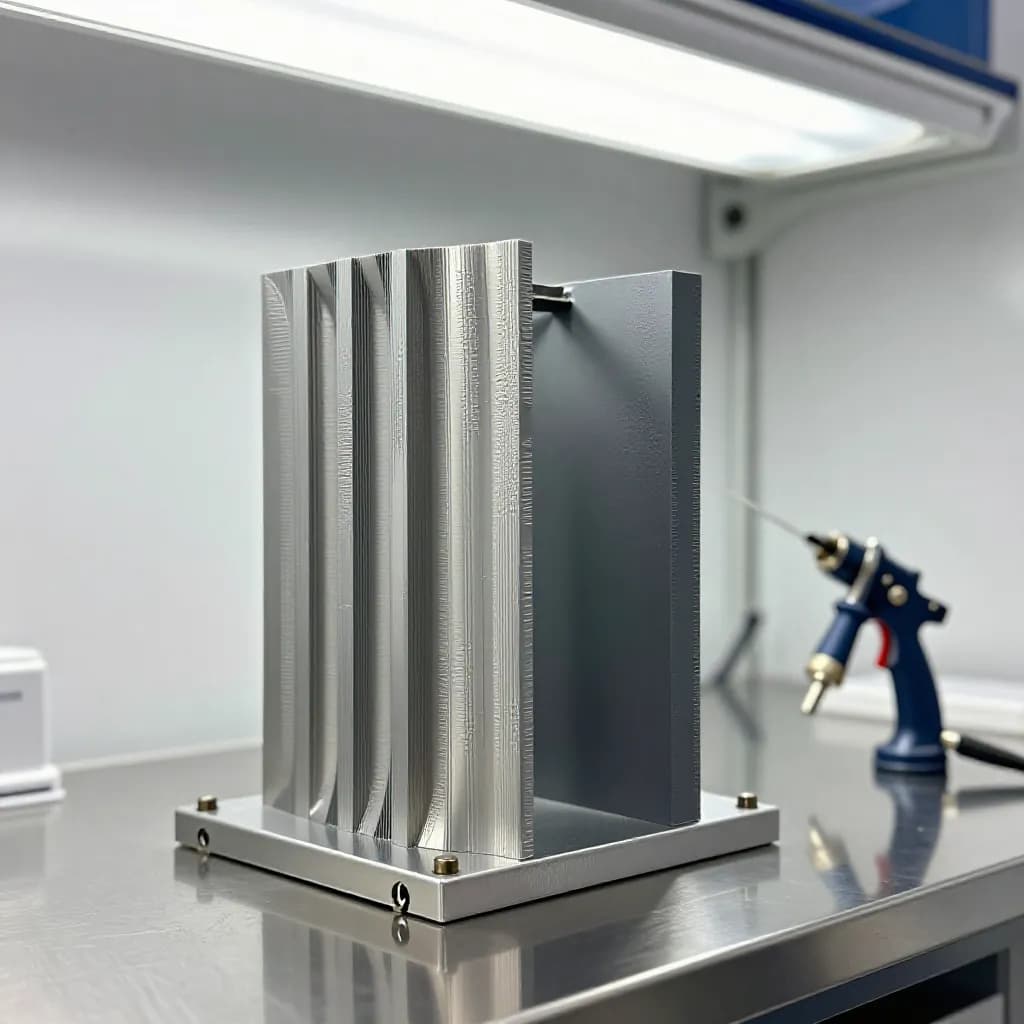
Powder coating is emerging as an ideal finishing technology for 3D printed metal parts, offering the combination of surface smoothing, corrosion protection, color, and durability that these parts require for commercial deployment. The thick film build of powder coating — typically 60-120 microns — effectively masks the surface roughness and layer lines characteristic of metal 3D printing, transforming a raw printed part into a finished product with professional appearance and functional protection.
Ready to Start Your Project?
From one-off customs to 15,000-part production runs — get precise pricing in 24 hours.
On This Page
The Convergence of Additive Manufacturing and Surface Finishing
The synergy between additive manufacturing and powder coating extends beyond aesthetics. 3D printing enables design freedom that creates complex internal channels, lattice structures, and organic geometries. Powder coating provides the protective and functional surface properties — corrosion resistance, chemical resistance, UV stability, electrical insulation, and wear resistance — that enable these innovative designs to perform reliably in their intended service environments. Together, the two technologies create a complete manufacturing pathway from digital design to finished functional part.
Surface Characteristics of Metal 3D Printed Parts
Understanding the surface characteristics of metal 3D printed parts is essential for successful powder coating. The as-printed surface finish varies significantly depending on the printing technology, process parameters, material, and part orientation during printing. Selective laser sintering and direct metal laser sintering typically produce surfaces with roughness values of Ra 6-20 microns on vertical walls and Ra 10-30 microns on down-facing surfaces, compared to Ra 0.4-1.6 microns for machined metal surfaces.
The surface roughness results from partially sintered powder particles adhering to the part surface, staircase effects from the layer-by-layer build process, and melt pool dynamics that create rippled surface textures. Up-facing surfaces are generally smoother than down-facing surfaces because down-facing surfaces are built on support structures that leave attachment marks when removed. Overhanging features and surfaces at shallow angles to the build platform exhibit the most pronounced staircase effects.
Beyond roughness, 3D printed metal surfaces may contain residual powder particles trapped in surface pores, oxide layers formed during printing in inert atmospheres, and residual stress that can cause distortion during subsequent thermal processing. These characteristics influence both the surface preparation requirements and the powder coating adhesion and appearance. A thorough understanding of the specific printing process and its surface output is the starting point for developing an effective powder coating specification for 3D printed parts.
Surface Preparation for Powder Coating 3D Printed Metals
Surface preparation is the most critical step in powder coating 3D printed metal parts, and it requires approaches adapted to the unique characteristics of additively manufactured surfaces. Standard metal preparation processes — alkaline cleaning, phosphate conversion coating, and chromate-free pretreatment — remain applicable but must be supplemented with additional steps to address the specific challenges of 3D printed surfaces.
Media blasting is typically the first preparation step, serving to remove partially sintered powder particles, smooth the surface texture, and create a uniform surface profile for coating adhesion. The choice of blast media — aluminum oxide, glass bead, steel shot, or plastic media — and blast parameters must be carefully selected based on the part material, geometry, and target surface finish. Aggressive blasting with coarse media can damage thin walls and fine features common in 3D printed designs, while insufficient blasting leaves surface defects that telegraph through the powder coating.
For parts with internal channels or complex geometries that cannot be reached by line-of-sight blasting, chemical etching or electropolishing may be necessary to clean and smooth internal surfaces. Ultrasonic cleaning in appropriate solvents removes residual powder and blasting media from blind holes and narrow passages. After mechanical and chemical preparation, standard conversion coating processes — iron phosphate, zinc phosphate, or zirconium-based treatments — provide the chemical bonding layer that ensures long-term adhesion of the powder coating to the metal substrate. The entire preparation sequence must be validated for each combination of printing material, printing process, and powder coating system.
Powder Coating Application on Complex 3D Geometries
The complex geometries enabled by 3D printing present both opportunities and challenges for powder coating application. Organic shapes, lattice structures, internal channels, and thin-walled features that are routine in additive manufacturing can be difficult to coat uniformly using conventional electrostatic spray techniques. The Faraday cage effect — where electrostatic field lines concentrate on outer edges and corners while bypassing recessed areas — is particularly pronounced on the complex topographies of 3D printed parts.
Triboelectric charging, which does not rely on an external electric field and therefore avoids the Faraday cage effect, can improve powder penetration into recesses and internal features. Fluidized bed coating, where the heated part is dipped into a bed of fluidized powder, provides uniform coverage on complex geometries by relying on thermal fusion rather than electrostatic attraction. For parts with accessible internal channels, powder can be drawn through the channels using vacuum or blown through using compressed air to achieve internal coating.
The design-for-manufacturing principle applies to the intersection of 3D printing and powder coating. Designers should consider coating accessibility when designing 3D printed parts, avoiding features that create inaccessible cavities or extremely narrow passages that cannot be coated or inspected. Minimum wall thicknesses should account for the thermal mass required to achieve proper powder melt and cure without overheating thin sections. Drainage holes should be incorporated in enclosed volumes to prevent powder accumulation and ensure complete coating coverage. This design-for-coating mindset, integrated early in the product development process, ensures that the full potential of both additive manufacturing and powder coating is realized.
Material-Specific Considerations
The range of metals used in 3D printing — including stainless steels, tool steels, aluminum alloys, titanium alloys, nickel superalloys, and cobalt-chrome — each present specific considerations for powder coating. Stainless steel 316L and 17-4PH are among the most commonly 3D printed metals and are generally straightforward to powder coat using standard pretreatment and coating processes. The main consideration is ensuring complete removal of residual sintering powder and oxide layers that can compromise adhesion.
Aluminum alloys, particularly AlSi10Mg, are widely used in 3D printing for lightweight structural applications. Powder coating aluminum 3D prints follows similar principles to coating cast or wrought aluminum, with chromate-free conversion coatings providing the adhesion-promoting pretreatment layer. The higher surface roughness of 3D printed aluminum compared to machined surfaces may require thicker powder coating films to achieve acceptable appearance, particularly for decorative applications.
Titanium alloys, used extensively in aerospace and medical applications, present unique challenges due to their high reactivity and the tenacious oxide layer that forms on the surface. Specialized pretreatment processes — including fluoride-based etching or sol-gel conversion coatings — may be required to achieve reliable adhesion. Nickel superalloys used in high-temperature applications require powder coatings that can withstand the elevated service temperatures, potentially necessitating silicone-based or ceramic-filled formulations. For each material, the powder coating specification must be developed and validated through adhesion testing, thermal cycling, and environmental exposure testing relevant to the intended application.
Quality Assurance and Inspection Challenges
Quality assurance for powder-coated 3D printed parts must address both the unique characteristics of the substrate and the challenges of inspecting coatings on complex geometries. Standard coating quality tests — film thickness measurement, adhesion testing, hardness, gloss, and visual inspection — remain applicable but may require adapted techniques for 3D printed substrates.
Film thickness measurement on 3D printed parts is complicated by the irregular surface profile. Magnetic or eddy current thickness gauges measure the distance from the probe to the substrate surface, but on rough 3D printed surfaces, this measurement includes both the coating thickness and the surface roughness amplitude. Cross-sectional microscopy provides the most accurate thickness measurement but is destructive and limited to sample parts. Non-contact optical measurement techniques, including confocal microscopy and optical coherence tomography, offer non-destructive alternatives for measuring coating thickness on rough substrates.
Adhesion testing using cross-cut or pull-off methods must account for the surface roughness of the substrate, which can influence the failure mode and apparent adhesion strength. Parts with complex geometries require inspection strategies that ensure coating coverage and quality in all areas, including recessed features and internal surfaces. Borescope inspection of internal coated channels, CT scanning for non-destructive evaluation of coating uniformity on complex parts, and fluorescent penetrant inspection for detecting coating discontinuities are advanced inspection techniques applicable to high-value 3D printed components.
Applications and Industry Adoption
The combination of 3D printing and powder coating is gaining traction across multiple industries. In aerospace, powder-coated 3D printed brackets, housings, and ductwork are entering service on commercial and military aircraft, where the weight savings from topology-optimized 3D printed designs are complemented by the corrosion protection and environmental resistance of powder coatings. The ability to produce complex, lightweight, fully finished components in short lead times is particularly valuable for spare parts and low-volume production.
The automotive industry is adopting powder-coated 3D printed parts for both prototyping and limited production applications. Custom interior trim, performance vehicle components, and aftermarket accessories benefit from the design freedom of 3D printing combined with the durable, high-quality finish of powder coating. Electric vehicle manufacturers, in particular, are leveraging 3D printing for complex thermal management components and structural nodes that are then powder coated for corrosion protection and aesthetic finish.
Medical device manufacturers use powder-coated 3D printed components for surgical instruments, diagnostic equipment housings, and prosthetic devices. The antimicrobial and easy-clean properties available in specialized powder coating formulations add functional value to 3D printed medical components. Industrial equipment, consumer products, and architectural hardware are additional growth areas where the convergence of additive manufacturing and powder coating is creating new product possibilities and manufacturing efficiencies.
Future Directions: Integrated Manufacturing Workflows
The future of 3D printing and powder coating integration points toward increasingly seamless manufacturing workflows where the two processes are optimized as a unified system rather than sequential operations. Digital thread concepts — where the design data that drives the 3D printer also informs the powder coating process — enable automated generation of coating specifications, spray programs, and quality inspection criteria directly from the part's digital model.
In-process surface treatment technologies that prepare the 3D printed surface for coating during or immediately after printing are under development. Laser surface texturing, integrated into the 3D printing build process, can create optimized surface profiles for coating adhesion without the need for post-print blasting. Atmospheric plasma treatment systems positioned at the exit of 3D printers can clean and activate surfaces in-line, reducing handling and preparation time.
The development of powder coating formulations specifically optimized for 3D printed substrates is another frontier. These formulations would account for the higher surface roughness, different thermal mass characteristics, and specific alloy compositions of 3D printed metals, providing optimized flow, adhesion, and appearance without the need for extensive surface preparation. As both 3D printing and powder coating technologies continue to advance, their integration will become increasingly natural and efficient, establishing a complete digital manufacturing pathway from design concept to finished, coated product.
Frequently Asked Questions
Can all 3D printed metals be powder coated?
Most metals used in 3D printing — including stainless steels, aluminum alloys, titanium alloys, and nickel superalloys — can be powder coated with appropriate surface preparation and coating selection. Each material requires specific pretreatment processes to ensure adhesion. The main requirement is that the metal can withstand the powder coating cure temperature, typically 160-200°C, which is well within the tolerance of all common 3D printing metals.
Does powder coating hide the layer lines on 3D printed parts?
Yes, powder coating is effective at masking the layer lines and surface roughness characteristic of metal 3D printing. The typical 60-120 micron film thickness of powder coating fills and smooths surface irregularities, producing a finished appearance comparable to conventionally manufactured parts. Very rough surfaces may require media blasting or filling before coating for the best results.
What surface preparation is needed before powder coating 3D printed parts?
Typical preparation includes media blasting to remove partially sintered particles and smooth the surface, followed by chemical cleaning and conversion coating for adhesion promotion. Parts with internal channels may require chemical etching or ultrasonic cleaning. The specific preparation sequence depends on the printing material, geometry complexity, and coating performance requirements.
Can internal channels of 3D printed parts be powder coated?
Coating internal channels is challenging but possible for channels with sufficient diameter and accessibility. Techniques include drawing powder through channels using vacuum, fluidized bed coating of heated parts, and specialized internal spray nozzles. Very narrow or tortuous channels may not be coatable, and designers should consider coating accessibility when designing internal features.
Is powder coating 3D printed parts more expensive than coating conventional parts?
The coating process itself is similar in cost, but 3D printed parts typically require more extensive surface preparation — particularly media blasting and cleaning — which adds to the total finishing cost. Complex geometries may also require more time for coating application and inspection. However, the total manufacturing cost including 3D printing and finishing is often competitive with conventional manufacturing plus finishing for complex, low-volume parts.
Ready to Start Your Project?
From one-off customs to 15,000-part production runs — get precise pricing in 24 hours.