Triboelectric powder coating is an electrostatic application method that charges powder particles through friction rather than a high-voltage electrode. As powder flows through the gun barrel, it contacts specially selected materials — typically PTFE or nylon — that strip electrons from the powder particles through the triboelectric effect. This gives the particles a positive charge, causing them to be attracted to the grounded workpiece without the need for an external power supply at the gun tip.
Guides
What Is Triboelectric Powder Coating? Friction Charging Explained
Sundial Powder Coating·April 23, 2026·11 min
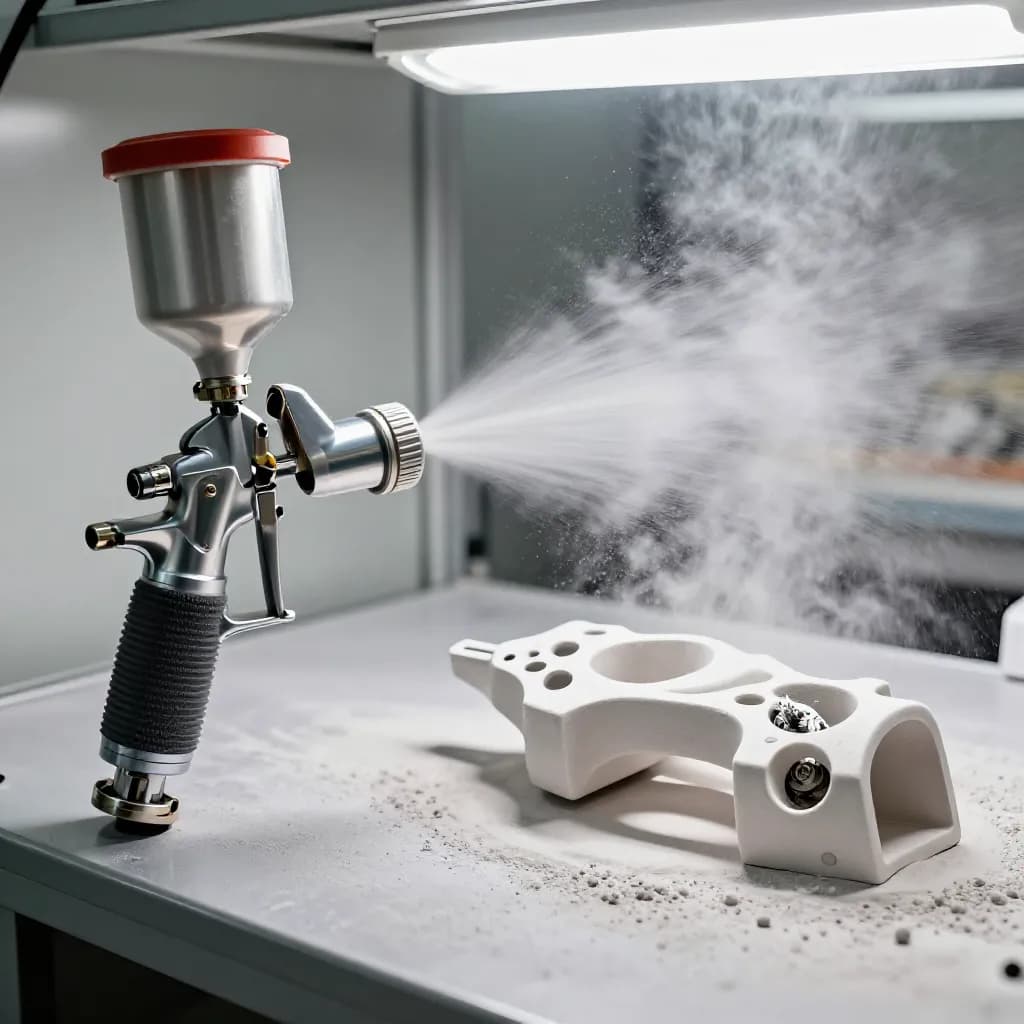
The term triboelectric comes from the Greek word tribos, meaning to rub. The triboelectric series ranks materials by their tendency to gain or lose electrons when rubbed together. In a tribo gun, the powder resin chemistry and the gun barrel material are selected to sit far apart on this series, maximizing charge transfer during contact.
Ready to Start Your Project?
From one-off customs to 15,000-part production runs — get precise pricing in 24 hours.
On This Page
What Triboelectric Powder Coating Is
Triboelectric charging produces a fundamentally different electrostatic field pattern compared to corona charging. Because there is no high-voltage electrode generating ions, the field around a tribo gun is softer and more uniform. This characteristic gives triboelectric application a significant advantage when coating parts with complex geometries, deep recesses, and tight inside corners where corona guns struggle with the Faraday cage effect.
While triboelectric guns represent a smaller share of the overall powder coating market compared to corona guns, they occupy an important niche in applications where coating quality on complex parts is paramount.
How Friction Charging Differs from Corona Charging
The fundamental difference between triboelectric and corona charging lies in how the electrical charge is imparted to the powder particles. In corona charging, a high-voltage electrode at the gun tip creates a cloud of free ions that attach to powder particles as they pass through the field. This produces negatively charged particles and generates a strong, directional electrostatic field between the gun and the grounded part.
In triboelectric charging, no external voltage is applied. Instead, the charge is generated by physical contact between the powder particles and the gun's internal surfaces. As particles tumble and slide through the barrel, electrons transfer from the powder to the barrel material, leaving the particles positively charged. The charge level depends on the contact area, the speed of powder flow, and the triboelectric compatibility between the powder chemistry and the barrel material.
This difference in charging mechanism has several practical consequences. Corona guns can charge virtually any powder chemistry because the ionization process is independent of the powder's triboelectric properties. Tribo guns, by contrast, work best with specific powder chemistries — particularly polyester and hybrid formulations — that have favorable triboelectric characteristics. Some powder chemistries, such as certain epoxies, charge poorly in tribo guns and may require specially formulated tribo-grade versions.
The absence of free ions in triboelectric application eliminates back ionization, a common defect in corona coating where excessive ion bombardment causes the deposited powder layer to repel incoming particles. This makes tribo guns particularly effective for building thick films or applying multiple coats without the cratering and texture problems that can occur with corona guns at high film builds.
The Faraday Cage Advantage
The most celebrated advantage of triboelectric powder coating is its superior performance in Faraday cage areas. The Faraday cage effect occurs when electrostatic field lines concentrate on the outer edges and high points of a part, leaving recessed areas, inside corners, and narrow channels with weak or absent electrostatic attraction. This is a fundamental limitation of corona charging, where the strong directional field created by the high-voltage electrode exacerbates the problem.
Triboelectric guns produce a much softer electrostatic field because the charge resides only on the powder particles themselves, not in a surrounding ion cloud. Without the strong field lines that characterize corona application, charged particles can penetrate into recesses and corners more effectively, driven by air flow and their own momentum rather than being steered away by field line concentration on outer edges.
This advantage is particularly valuable for parts with complex cross-sections, such as aluminum extrusions with deep channels, tubular structures, wire baskets, heat sinks with closely spaced fins, and automotive components with intricate geometries. In these applications, tribo guns can achieve uniform coverage that would require extensive manual touch-up or specialized gun positioning with corona equipment.
The practical impact is significant. Parts that require multiple passes or manual intervention with corona guns can often be coated in a single pass with tribo guns, reducing labor, improving consistency, and increasing throughput. For manufacturers whose product lines feature predominantly complex geometries, triboelectric application can be the more productive and cost-effective choice despite its limitations with certain powder chemistries.
When to Choose Tribo Over Corona
Selecting between triboelectric and corona application depends on the specific requirements of the coating operation. Tribo guns are the preferred choice when part geometry is complex and Faraday cage areas are a primary concern. If the production mix consists largely of parts with deep recesses, tight corners, or intricate profiles, triboelectric application will deliver more consistent coverage with less manual intervention.
Tribo guns also excel in applications requiring thick film builds. Because triboelectric charging does not produce free ions, there is no back ionization limit on film thickness. Corona guns begin to experience back ionization at film thicknesses above 100-125 microns, causing surface defects that limit further powder deposition. Tribo guns can build films well beyond this threshold without quality degradation.
Corona guns remain the better choice for flat or simple geometries where their higher deposition rate and broader powder chemistry compatibility provide clear advantages. Corona application is also preferred for high-speed production lines where maximum throughput is the priority, as corona guns generally deposit powder faster than tribo guns due to their stronger electrostatic field.
Many production facilities use both technologies in combination. Corona guns handle the bulk of the coating on flat surfaces and simple geometries, while tribo guns are used for touch-up in Faraday cage areas or for dedicated lines running complex parts. This hybrid approach leverages the strengths of each technology while minimizing their respective limitations.
Powder chemistry compatibility is a critical factor in the decision. If the application requires epoxy or certain specialty powders that do not charge well triboelectrically, corona is the only practical option unless tribo-grade formulations are available from the powder supplier.
Triboelectric Gun Design and Maintenance
Triboelectric guns are designed to maximize the contact between powder particles and the charging surfaces inside the barrel. The internal geometry typically features a long, narrow barrel with multiple contact points or a helical path that forces particles to tumble and rub against the barrel walls as they travel toward the gun tip. Some designs use replaceable PTFE tubes or inserts that can be swapped when worn.
The barrel material is critical to charging performance. PTFE is the most common choice because it sits at the extreme negative end of the triboelectric series, maximizing electron transfer from polyester and hybrid powders. Nylon barrels are used for some powder chemistries that charge better against nylon than PTFE. The barrel material must be matched to the powder chemistry for optimal charging.
Maintenance requirements for tribo guns differ from corona guns. The internal barrel surfaces must be kept clean and free of powder buildup, which can insulate the contact surfaces and reduce charging efficiency. Regular cleaning with compressed air and periodic replacement of worn barrel inserts are essential to maintaining consistent charge levels.
Humidity control is more critical for triboelectric application than for corona. High humidity reduces the triboelectric charging efficiency because moisture on particle surfaces provides a conductive path that dissipates the charge. Most tribo operations maintain spray booth humidity below 50 percent relative humidity, with some facilities targeting 40 percent or lower for optimal performance.
Charge monitoring is an important quality control tool for tribo operations. Faraday cup measurements or inline charge sensors verify that the gun is delivering consistently charged powder. A drop in charge level may indicate barrel wear, powder chemistry variation, or humidity problems that need to be addressed.
Powder Chemistry Considerations for Tribo
Not all powder coatings charge equally well in triboelectric guns. The triboelectric charging efficiency depends on the chemical composition of the resin system, the particle size distribution, and the presence of additives that may affect surface conductivity. Understanding these factors is essential for achieving consistent results with tribo application.
Polyester powders are generally the best performers in tribo guns, particularly those formulated with TGIC or HAA crosslinkers. These chemistries have favorable triboelectric properties against PTFE barrels and typically achieve charge levels comparable to corona application. Most polyester powder manufacturers offer tribo-optimized grades that have been formulated for maximum charging efficiency.
Hybrid powders, which combine polyester and epoxy resins, also perform well in tribo guns. The polyester component provides good triboelectric charging, while the epoxy component contributes chemical resistance and adhesion. Hybrid powders are widely used in tribo applications for indoor products such as furniture, shelving, and appliances.
Pure epoxy powders present the greatest challenge for triboelectric application. Epoxy resins sit closer to PTFE on the triboelectric series, resulting in less electron transfer and lower charge levels. Some epoxy formulations can be modified with triboelectric additives to improve charging, but these tribo-grade epoxies may have slightly different flow or appearance characteristics compared to their standard counterparts.
Metallic and textured powders require special attention in tribo systems. Metallic pigments can affect charging behavior, and the mechanical action inside the tribo barrel can alter the orientation and distribution of metallic flakes, potentially changing the visual appearance of the finish. Testing and adjustment are essential when running metallic powders through tribo equipment.
Applications Best Suited for Triboelectric Coating
Triboelectric powder coating finds its strongest applications in industries that produce parts with complex geometries requiring uniform coverage. The aluminum extrusion industry is a major user of tribo technology, as window and door profiles often feature deep channels, narrow slots, and intricate cross-sections that are difficult to coat uniformly with corona guns alone.
The wire goods industry — manufacturers of shelving, racks, baskets, and display fixtures — relies heavily on triboelectric application. Wire products present extreme Faraday cage challenges because the intersections of wire create countless small recesses that corona field lines cannot penetrate. Tribo guns deliver consistent coverage on wire products with minimal touch-up.
Automotive component manufacturers use tribo guns for parts such as heat exchangers, brackets with complex bends, and structural components with box sections. The ability to coat inside surfaces and tight corners without manual intervention improves both quality and production efficiency.
Electrical enclosures and switchgear housings benefit from triboelectric application because these products often feature internal ribs, mounting bosses, and ventilation slots that create Faraday cage conditions. Uniform coating in these areas is important for both corrosion protection and electrical insulation.
Agricultural and construction equipment manufacturers use tribo guns for components with welded joints, gussets, and structural reinforcements that create deep recesses. The ability to achieve full coverage in these areas without excessive film build on exposed surfaces reduces material consumption and improves overall coating quality.
In each of these applications, the triboelectric advantage translates directly into reduced rework, lower material waste, and more consistent finished product quality.
Frequently Asked Questions
What is the main advantage of triboelectric over corona powder coating?
The primary advantage is superior penetration into Faraday cage areas — deep recesses, inside corners, and complex geometries. Because tribo guns produce a softer electrostatic field without free ions, charged particles can reach areas that corona guns struggle to coat uniformly.
Do all powder coatings work with triboelectric guns?
No. Triboelectric charging efficiency depends on the powder's resin chemistry. Polyester and hybrid powders generally charge well in tribo guns, while pure epoxy powders may require specially formulated tribo-grade versions. Always verify compatibility with your powder supplier.
Why does humidity affect triboelectric powder coating?
High humidity creates a conductive moisture layer on powder particle surfaces that dissipates the triboelectric charge. Most tribo operations maintain spray booth humidity below 50 percent relative humidity to ensure consistent charging performance.
Can you use tribo and corona guns on the same coating line?
Yes. Many facilities use corona guns for primary coverage on flat surfaces and tribo guns for touch-up in Faraday cage areas. This hybrid approach leverages the strengths of both technologies for optimal coverage and efficiency.
How do you maintain a triboelectric powder coating gun?
Regular maintenance includes cleaning the internal barrel surfaces to remove powder buildup, replacing worn PTFE or nylon inserts, monitoring charge levels with Faraday cup measurements, and controlling booth humidity. Consistent maintenance ensures reliable charging performance.
Ready to Start Your Project?
From one-off customs to 15,000-part production runs — get precise pricing in 24 hours.