Super durable powder coating is a category of polyester powder coating formulated with modified resin systems that provide significantly enhanced resistance to ultraviolet degradation and weathering compared to standard polyester. While standard polyester powder coatings offer good outdoor performance for 5-10 years, super durable formulations extend this to 15-20 years, bridging the performance gap between standard polyester and premium fluoropolymer coatings.
Technical
What Is Super Durable Powder Coating? Enhanced UV Resistance Explained
Sundial Powder Coating·April 23, 2026·11 min
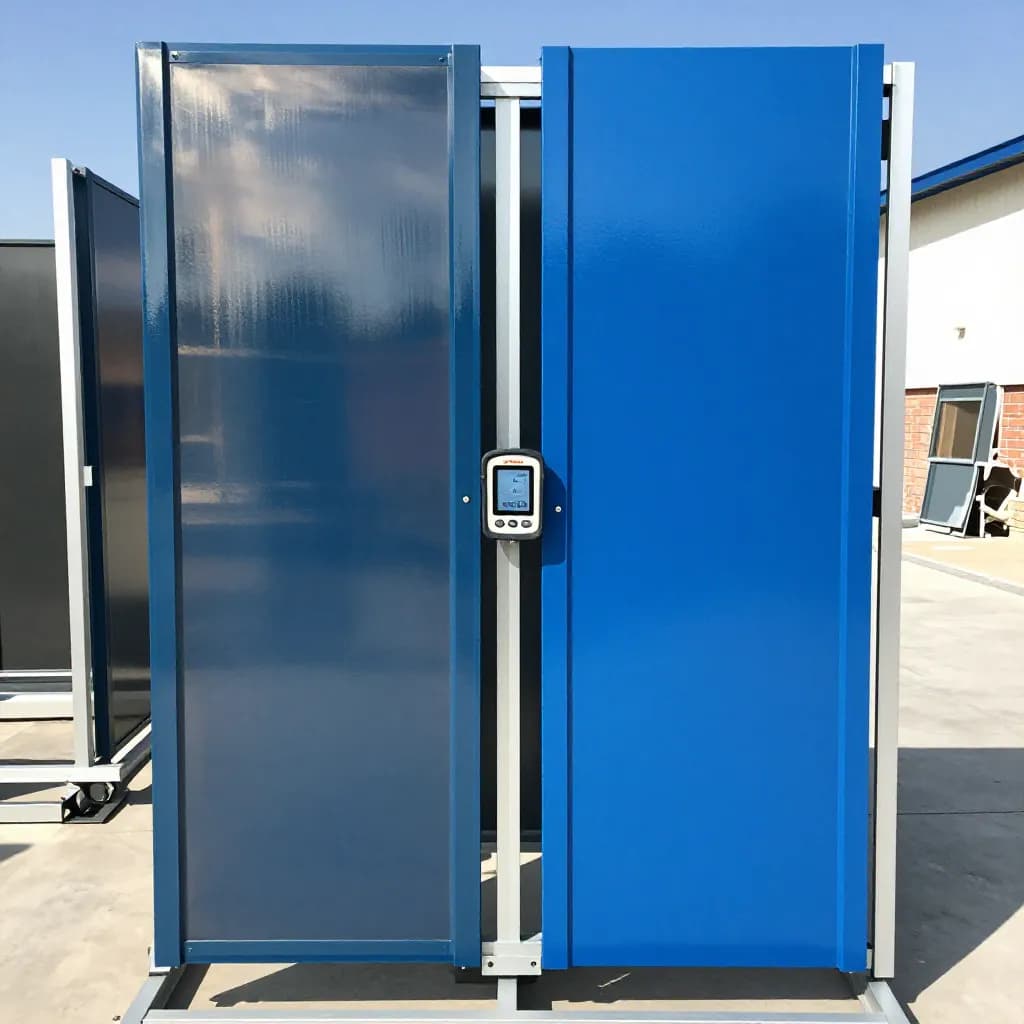
The term super durable is an industry designation rather than a formal chemical classification. It refers to polyester powder coatings that meet the enhanced weathering requirements of mid-tier architectural specifications such as Qualicoat Class 2, GSB Master, and AAMA 2604. These specifications demand accelerated weathering performance approximately twice as demanding as standard polyester requirements, along with extended natural outdoor exposure data.
Ready to Start Your Project?
From one-off customs to 15,000-part production runs — get precise pricing in 24 hours.
On This Page
What Super Durable Powder Coating Is
Super durable polyester achieves its enhanced performance through modifications to the polyester resin backbone. The specific modifications vary by manufacturer but generally involve using monomers and molecular architectures that are more resistant to UV-induced bond breaking. The resulting resin systems maintain their integrity under prolonged UV exposure, resisting the chalking, fading, and gloss loss that eventually degrade standard polyester coatings.
The practical significance of super durable powder coating is substantial. It provides a meaningful upgrade in outdoor durability over standard polyester at a moderate specification increase, making it the most commonly specified coating for commercial and institutional architecture where long-term performance is important but the premium specification of fluoropolymer is not required.
How Super Durable Achieves Enhanced UV Resistance
The enhanced UV resistance of super durable polyester coatings is achieved through deliberate modifications to the polyester resin chemistry that make the polymer backbone more resistant to photodegradation. Understanding these modifications helps explain why super durable coatings outperform standard polyester and where their performance limits lie.
Standard polyester resins contain aromatic structures — typically isophthalic or terephthalic acid units — that absorb UV radiation and can undergo photochemical reactions that break polymer chains. These chain-breaking reactions are the fundamental mechanism of UV degradation, leading to loss of molecular weight, surface erosion, chalking, and eventually color change and gloss loss.
Super durable polyester resins modify this vulnerability through several approaches. Some formulations use alternative aromatic monomers that are more resistant to photochemical attack. Others incorporate aliphatic or cycloaliphatic monomers that do not absorb UV radiation as readily as aromatic structures. Some use combinations of both approaches to optimize the balance between UV resistance and other properties such as hardness, flexibility, and chemical resistance.
The crosslinker system also contributes to durability. Both TGIC and HAA crosslinkers are used in super durable formulations, with the choice depending on regional regulations and the specific performance requirements. The crosslink density and the stability of the crosslink bonds influence the coating's resistance to UV-induced degradation.
UV absorbers and hindered amine light stabilizers (HALS) are incorporated into super durable formulations to provide additional protection. UV absorbers convert UV radiation into harmless heat, while HALS scavenge the free radicals generated by UV exposure before they can attack the polymer chains. These additives work synergistically with the modified resin to extend the coating's outdoor service life.
The result of these combined modifications is a polyester coating that maintains its appearance and protective properties approximately twice as long as standard polyester under equivalent outdoor exposure conditions.
Testing and Performance Standards
Super durable powder coatings are validated through a combination of accelerated laboratory testing and natural outdoor exposure that demonstrates their enhanced weathering performance relative to standard polyester.
Accelerated weathering testing using xenon arc chambers is the primary screening method. Test panels are exposed to controlled cycles of UV radiation, heat, and moisture that simulate the degradation effects of outdoor exposure in a compressed timeframe. Super durable coatings are typically tested for 2000-3000 hours of xenon arc exposure, compared to 1000 hours for standard polyester.
The key performance metrics in accelerated weathering are gloss retention and color change. Super durable coatings must retain at least 50 percent of their original gloss after the specified exposure period and must not exceed defined limits for color change (Delta E). These requirements are approximately twice as demanding as those for standard polyester at equivalent exposure times.
Natural outdoor exposure testing supplements accelerated testing with real-world performance data. Test panels are exposed at outdoor test sites — typically in South Florida for North American standards and at various European and global sites for Qualicoat and GSB — and evaluated periodically for gloss retention, color change, chalking, and film integrity.
Qualicoat Class 2 requires super durable polyester coatings to pass enhanced accelerated weathering tests and demonstrate acceptable performance in natural Florida exposure. The specific requirements are defined in the Qualicoat specification and are updated periodically to reflect advances in coating technology and testing methods.
GSB Master certification requires comparable enhanced weathering performance, with testing protocols specific to the GSB system. The performance outcomes are similar to Qualicoat Class 2, though the specific test conditions and numerical requirements may differ.
AAMA 2604 requires 5 years of South Florida exposure with specific performance limits for gloss retention, color change, chalk rating, and film erosion. This real-world exposure requirement provides the most direct evidence of long-term outdoor performance.
Powder manufacturers submit their super durable products for certification testing by the relevant quality bodies. Products that meet the requirements are added to approved product lists and can be used by certified applicators.
When to Specify Super Durable vs. Standard Polyester
Choosing between standard and super durable polyester requires evaluating the project's environmental exposure, expected service life, maintenance strategy, and quality expectations. The decision framework is straightforward once these factors are understood.
Specify super durable polyester when the project involves exterior applications in moderate to high UV environments, when the expected coating service life is 10-20 years, when the building owner expects minimal maintenance, or when the project specification requires Qualicoat Class 2, GSB Master, or AAMA 2604 compliance. These conditions describe the majority of commercial and institutional building projects.
Standard polyester is adequate for interior applications where UV exposure is minimal, for exterior applications in low-UV environments with shorter expected service lives, for products that will be maintained or replaced on shorter cycles, and for projects where AAMA 2603 or Qualicoat Class 1 compliance is sufficient. Standard polyester is also appropriate for industrial and general-purpose products where the coating's functional performance is more important than long-term aesthetic retention.
Geographic location is a significant factor. Projects in tropical, subtropical, and high-altitude locations experience more intense UV exposure and benefit more from super durable specification. Projects in temperate, northern, or shaded locations may achieve adequate performance with standard polyester.
Building orientation matters as well. South-facing and west-facing facades receive the most UV exposure and benefit most from super durable specification. North-facing facades and shaded areas receive less UV and may perform adequately with standard polyester. Some projects specify super durable for exposed facades and standard polyester for shaded areas to optimize the specification.
The decision should also consider the building's design life and the owner's maintenance philosophy. A building designed for a 30-year service life with minimal maintenance clearly benefits from super durable or fluoropolymer specification. A temporary structure or a building with planned renovation cycles may not need the enhanced durability.
Super Durable vs. Fluoropolymer: Where Each Fits
Super durable polyester and fluoropolymer coatings represent the mid-tier and top-tier of architectural coating performance, respectively. Understanding where each fits helps specifiers make appropriate choices without over-specifying or under-specifying.
Super durable polyester provides 15-20 years of outdoor performance, meeting Qualicoat Class 2, GSB Master, and AAMA 2604 requirements. It is applied as a single coat at standard cure temperatures using conventional powder coating equipment. The processing is identical to standard polyester, making it accessible to any qualified powder coating applicator.
Fluoropolymer coatings (PVDF and FEVE) provide 25-30 years or more of outdoor performance, meeting Qualicoat Class 3, GSB Premium, and AAMA 2605 requirements. PVDF requires a two-coat system with elevated cure temperatures, while FEVE can be applied as a single coat at standard temperatures. Both chemistries represent a significant step up in proven durability.
The performance gap between super durable polyester and fluoropolymer is most evident in extreme environments. In high-UV tropical locations, coastal environments with salt exposure, and industrial atmospheres with chemical pollutants, fluoropolymer coatings maintain their appearance significantly longer than super durable polyester. In moderate environments, the performance difference is less pronounced, and super durable polyester may provide adequate service life.
For most commercial and institutional buildings in moderate environments, super durable polyester provides an excellent balance of performance and practicality. It delivers meaningful durability enhancement over standard polyester without the additional complexity and specification requirements of fluoropolymer systems.
For landmark buildings, high-rise facades, coastal projects, and buildings with 30-year-plus design lives, fluoropolymer specification is justified by the extended performance and reduced lifecycle maintenance. The higher initial specification is offset by fewer recoating cycles over the building's life.
Some projects use both tiers strategically. Fluoropolymer is specified for the most exposed facades and high-visibility areas, while super durable polyester is used for less exposed areas, interior-facing surfaces, and secondary components. This approach optimizes the specification to match the actual exposure conditions across the building.
Color and Finish Availability
Super durable powder coatings are available in a comprehensive range of colors and finishes that support architectural design requirements. The color palette is comparable to standard polyester, though some specific colors and effects may have limited availability in super durable formulations.
The full RAL Classic color range is available in super durable formulations from major powder manufacturers. Custom color matching to NCS, Pantone, or project-specific references is also available, though minimum order quantities may apply for custom colors. Standard architectural colors — whites, grays, blacks, and earth tones — are stocked by most manufacturers for immediate availability.
Gloss levels from high gloss to deep matte are available in super durable chemistry. The most common architectural gloss levels are semi-gloss (40-60 GU at 60 degrees) and satin (20-40 GU), which provide an attractive appearance while minimizing the visibility of surface imperfections and orange peel texture.
Metallic finishes are available in super durable formulations, including aluminum flake, mica, and copper effects. Metallic super durable coatings are widely used for architectural applications where a metallic appearance is desired with enhanced durability. Bonded metallic formulations provide the most consistent metallic appearance and are preferred for large architectural projects.
Textured finishes — fine texture, coarse texture, and structured effects — are available in super durable chemistry. Textured finishes are used for architectural applications where the texture provides aesthetic character or practical benefits such as hiding substrate imperfections.
Anodic-look finishes that replicate the appearance of anodized aluminum are available in super durable formulations. These finishes provide the visual character of anodizing with the color consistency and repairability advantages of powder coating.
Wood-grain effects achieved through sublimation transfer technology can be applied over super durable base coats, providing realistic wood appearance with enhanced outdoor durability. This combination is increasingly popular for residential and commercial facade applications.
Application and Processing
One of the significant practical advantages of super durable powder coating is that it processes identically to standard polyester. No special equipment, modified cure schedules, or additional application steps are required. Any applicator equipped to apply standard polyester can apply super durable polyester with no changes to their process.
Cure schedules are the same as standard polyester — typically 10-15 minutes at 180-200 degrees Celsius metal temperature. Both TGIC and HAA crosslinked super durable formulations are available, and the cure behavior of each is consistent with their standard polyester counterparts.
Application by corona and triboelectric electrostatic spray follows the same parameters as standard polyester. Gun voltage, current, powder flow rate, and gun-to-part distance settings are unchanged. Super durable powders charge and deposit in the same manner as standard polyester, and overspray reclamation and reuse follow the same procedures.
Film thickness targets are the same as standard polyester — typically 60-80 microns for architectural applications, with a minimum of 60 microns per Qualicoat and GSB requirements. The same film thickness measurement and quality control procedures apply.
Storage conditions and shelf life are comparable to standard polyester. Super durable powders should be stored below 25 degrees Celsius in dry conditions and used within the manufacturer's recommended shelf life, typically 12 months from manufacture.
This processing equivalence means that the decision to upgrade from standard to super durable polyester is purely a material specification decision with no impact on the applicator's equipment, process, or throughput. The upgrade path is seamless, which has contributed to the rapid adoption of super durable polyester in the architectural market.
Quality control testing for super durable coatings follows the same procedures as standard polyester, with the addition of any specific tests required by the applicable quality certification (Qualicoat Class 2, GSB Master, or AAMA 2604).
Frequently Asked Questions
What makes super durable powder coating different from standard polyester?
Super durable polyester uses modified resin systems with enhanced UV resistance, plus UV absorbers and light stabilizers. These modifications approximately double the outdoor service life compared to standard polyester, from 5-10 years to 15-20 years.
What standards require super durable powder coating?
Qualicoat Class 2, GSB Master, and AAMA 2604 all require super durable polyester performance. These mid-tier architectural specifications demand enhanced accelerated weathering results and, in the case of AAMA 2604, 5 years of South Florida outdoor exposure data.
Is super durable powder coating harder to apply than standard polyester?
No. Super durable polyester processes identically to standard polyester — same cure temperatures, same application equipment, same film thickness targets. The upgrade from standard to super durable is purely a material specification change with no impact on the applicator's process.
When should I specify super durable instead of fluoropolymer?
Super durable is appropriate for most commercial buildings in moderate environments with 10-20 year coating expectations. Fluoropolymer is justified for landmark buildings, high-rises, coastal projects, and 30-year-plus design lives. Super durable provides meaningful durability enhancement at a lower specification tier.
How long does super durable powder coating last outdoors?
Super durable polyester maintains acceptable appearance for 15-20 years in moderate outdoor environments. Performance varies with UV intensity, orientation, and atmospheric conditions. In high-UV tropical locations, service life may be shorter; in temperate northern locations, it may be longer.
Ready to Start Your Project?
From one-off customs to 15,000-part production runs — get precise pricing in 24 hours.