Outgassing in powder coating is the release of trapped gases from a substrate during the curing process, causing defects such as pinholes, craters, and bubbles in the finished coating. As the coated part is heated in the curing oven, gases trapped within the substrate expand and escape through the still-molten powder coating. If the gas escapes before the coating has fully cross-linked and solidified, the coating can flow back and heal the disruption. If the gas escapes after the coating has begun to gel, the escape path remains as a permanent defect in the cured film.
Guides
What Is Powder Coating Outgassing? Causes, Prevention, and Fixes
Sundial Powder Coating·April 23, 2026·11 min
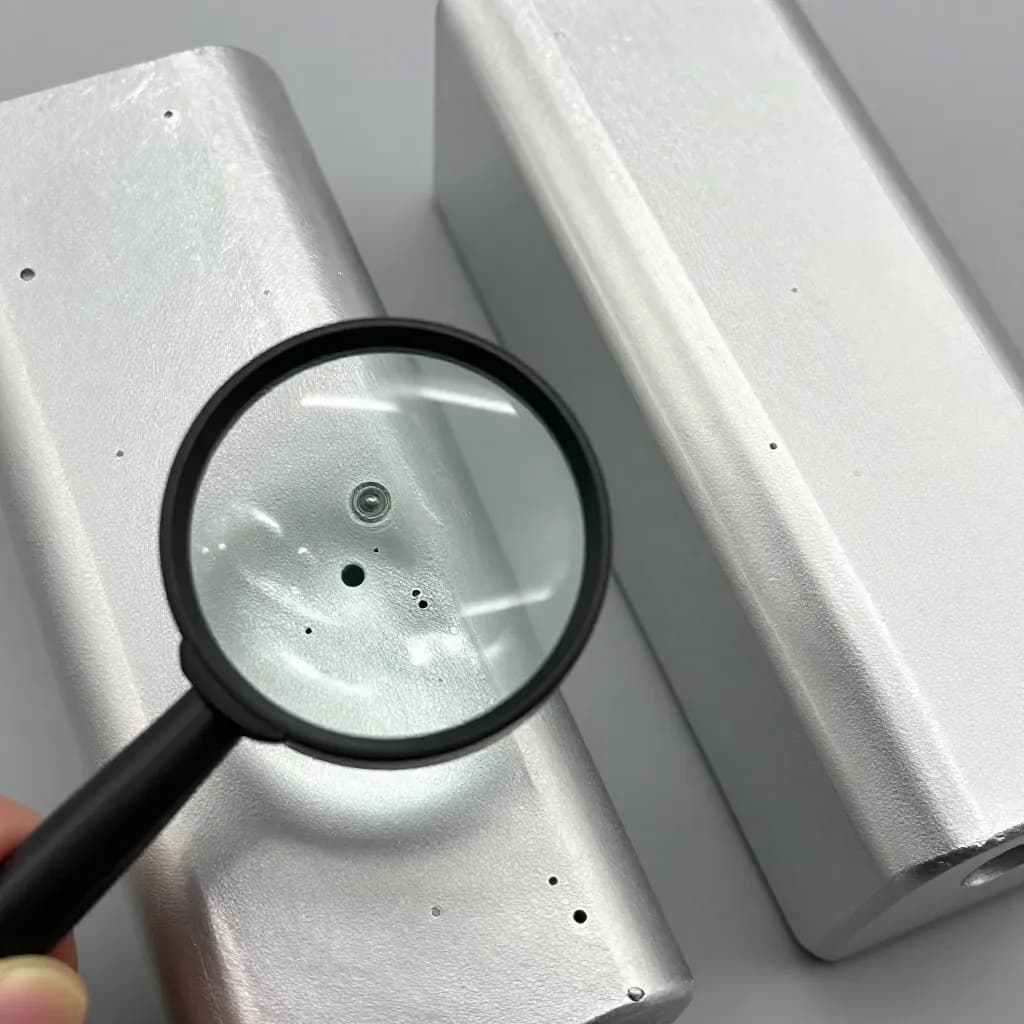
Outgassing is one of the most common and frustrating defects in powder coating, particularly when coating porous substrates such as cast aluminum, cast iron, hot-dip galvanized steel, and certain types of welded fabrications. The gases involved are typically air trapped in surface porosity, moisture absorbed into the substrate, hydrogen from galvanizing reactions, or volatile compounds from oils and contaminants trapped in pores.
Ready to Start Your Project?
From one-off customs to 15,000-part production runs — get precise pricing in 24 hours.
On This Page
What Outgassing Is in Powder Coating
The visual appearance of outgassing defects ranges from tiny pinholes barely visible to the naked eye to large craters several millimeters in diameter. In severe cases, the coating surface may resemble a moonscape, with hundreds of small eruptions across the entire surface. Even mild outgassing can be unacceptable for decorative applications where a smooth, defect-free finish is required.
Understanding the causes of outgassing and the methods available to prevent or mitigate it is essential for any powder coating operation that handles cast, galvanized, or porous substrates.
Which Substrates Cause Outgassing
Cast metals are the most common source of outgassing problems in powder coating. The casting process inherently creates porosity — tiny voids and channels within the metal — that trap air and moisture. When the casting is heated during powder curing, these trapped gases expand and force their way through the coating.
Cast aluminum is particularly problematic because aluminum castings often have significant subsurface porosity that is not visible on the surface. Die castings, sand castings, and gravity castings all exhibit porosity to varying degrees, with sand castings typically having the most porosity and die castings the least. The porosity may be distributed throughout the casting or concentrated in specific areas depending on the casting process and part geometry.
Cast iron presents similar challenges, with the added complication that the graphite structure of cast iron can absorb oils and cutting fluids during machining operations. These absorbed contaminants vaporize during curing, adding to the outgassing problem. Ductile iron and gray iron castings both exhibit outgassing, though the severity varies with the specific alloy and casting method.
Hot-dip galvanized steel is another common source of outgassing. The zinc coating applied during galvanizing can trap hydrogen gas generated by the acid pickling step that precedes galvanizing. This hydrogen diffuses slowly out of the zinc layer and can cause pinholes in powder coatings applied over galvanized surfaces. The zinc surface itself may also contain porosity and inclusions that contribute to outgassing.
Welded fabrications can outgas from porosity in weld beads, flux residues trapped in weld joints, and moisture absorbed into weld spatter. Proper weld preparation — grinding smooth, removing spatter, and cleaning flux residues — reduces but may not eliminate outgassing from welded areas.
Machined surfaces that have been exposed to cutting fluids, coolants, or lubricants can outgas if these fluids penetrate into surface porosity or grain boundaries. Thorough cleaning and degreasing before coating is essential, but deeply absorbed fluids may still cause problems.
How to Visually Identify Outgassing Defects
Recognizing outgassing defects and distinguishing them from other coating defects is important for diagnosing the root cause and selecting the appropriate corrective action. Outgassing produces characteristic defect patterns that experienced coaters learn to identify quickly.
Pinholes are the most common outgassing defect. They appear as tiny holes in the coating surface, typically 0.1-1.0 millimeters in diameter, that penetrate partially or completely through the film. When viewed under magnification, pinholes from outgassing often show a raised rim or crater edge where the escaping gas pushed the molten coating aside. The hole may extend to the substrate surface, exposing bare metal that is vulnerable to corrosion.
Craters are larger defects, typically 1-5 millimeters in diameter, with a distinct bowl shape. The center of the crater is thinner than the surrounding coating, and the rim may be slightly raised. Craters form when a larger volume of gas escapes, displacing more coating material. In severe cases, the crater center may be completely bare.
Bubbles or blisters form when gas is trapped beneath the coating surface without breaking through. The coating stretches over the gas pocket, creating a raised dome that may be visible or detectable only by touch. Bubbles may remain intact or may rupture during handling, leaving a crater-like defect.
Fish eyes are circular defects with a clear center and a raised ring, similar in appearance to craters but typically caused by surface contamination rather than substrate outgassing. Distinguishing fish eyes from outgassing craters requires examining the defect location and pattern — outgassing defects tend to be distributed across the entire surface or concentrated in areas of known porosity, while fish eyes are often random and associated with contamination sources.
The distribution pattern of defects provides diagnostic information. Outgassing from cast substrates typically produces defects distributed across the entire casting surface, with higher concentrations in areas of greater porosity. Outgassing from galvanized steel may be concentrated in areas of thicker zinc coating. Outgassing from welds is localized to the weld zone.
Prevention Methods: Pre-Bake and Degassing
The most effective method for preventing outgassing is pre-baking, also called degassing. The substrate is heated in an oven to a temperature at or above the powder coating cure temperature before any powder is applied. This drives out trapped gases while the surface is bare, eliminating or greatly reducing the gas available to cause defects during the subsequent coating and curing cycle.
Pre-bake temperatures typically range from 200 to 230 degrees Celsius, held for 15-30 minutes depending on the substrate type and thickness. Cast aluminum parts may require longer pre-bake times because gas must diffuse through the metal from deep within the casting. Galvanized steel may need only 10-15 minutes because the hydrogen is concentrated in the thin zinc layer.
The pre-bake process must be followed immediately by powder application while the part is still warm. If the part cools completely and is exposed to humid air, it may reabsorb moisture and require re-baking. Some operations apply powder to the warm pre-baked part, taking advantage of the residual heat to improve powder adhesion and flow.
For production environments where pre-baking every part is impractical, a targeted approach can be effective. Parts from substrate lots known to cause outgassing are pre-baked, while parts from clean substrate lots are processed normally. Incoming quality checks — including test coating a sample part from each lot — help identify problematic substrates before they enter production.
The pre-bake approach has limitations. It adds an extra oven cycle to the production process, increasing energy consumption and reducing throughput. For high-volume operations, the additional oven capacity required for pre-baking may represent a significant capital investment. These practical constraints have driven the development of alternative approaches for managing outgassing.
Prevention Methods: Primers and Outgassing-Resistant Powders
Epoxy primer coatings provide an effective solution for outgassing-prone substrates. A thin layer of epoxy powder, typically 25-50 microns, is applied and cured before the decorative topcoat. During the primer cure cycle, trapped gases escape through the thin primer film, which is more tolerant of gas passage than a thicker decorative coating. The cured primer then seals the surface porosity, preventing further outgassing during the topcoat cure cycle.
The two-coat approach — epoxy primer plus decorative topcoat — is widely used for cast aluminum components in the automotive and industrial markets. The primer provides both outgassing management and enhanced corrosion protection, while the topcoat delivers the desired color, gloss, and texture. The additional material and processing cost is justified by the elimination of outgassing defects and the improved overall coating performance.
Outgassing-resistant powder coatings are specially formulated to tolerate gas passage without forming permanent defects. These formulations use resin systems with extended gel times, allowing the coating to remain liquid longer during curing so that gas bubbles can escape and the coating can flow back to heal the disruption. Some formulations also include degassing additives that promote gas release at lower temperatures before the coating begins to gel.
Low-temperature cure powders can also help manage outgassing by reducing the thermal energy available to drive gas expansion. If the coating can cure at a lower temperature, less gas is generated and the gas that does form has less pressure to force through the coating. However, low-temperature cure alone may not be sufficient for severely porous substrates.
Powder particle size can influence outgassing susceptibility. Finer particle size distributions produce thinner initial films that allow gas to escape more easily before the coating gels. Some applicators use finer-grind powders specifically for outgassing-prone substrates.
The choice between pre-baking, primer application, and outgassing-resistant powders depends on the severity of the outgassing problem, the production volume, and the quality requirements of the finished product. Many operations use a combination of approaches for optimal results.
Substrate-Specific Solutions
Each outgassing-prone substrate type benefits from specific mitigation strategies tailored to its particular characteristics.
For cast aluminum, the most effective approach combines proper casting quality control with pre-baking and primer application. Working with the casting supplier to minimize porosity through optimized casting parameters, gating design, and alloy selection addresses the root cause. Pre-baking at 200-220 degrees Celsius for 20-30 minutes drives out trapped gases, and an epoxy primer seals remaining porosity before the topcoat is applied.
For cast iron, thorough cleaning is critical because absorbed machining fluids are a major contributor to outgassing. Alkaline cleaning followed by high-temperature pre-baking at 220-230 degrees Celsius for 30-45 minutes is typically required. The longer pre-bake time reflects the need to vaporize deeply absorbed oils and fluids. Shot blasting before cleaning helps open surface porosity for more effective fluid removal.
For hot-dip galvanized steel, the primary concern is hydrogen trapped in the zinc layer. A moderate pre-bake at 200 degrees Celsius for 10-15 minutes is usually sufficient to drive out hydrogen. Some galvanizers offer powder-coating-grade galvanizing with reduced hydrogen entrapment, which can eliminate the need for pre-baking. Sweep blasting the galvanized surface with fine abrasive improves powder adhesion and can help release surface-trapped gases.
For welded fabrications, proper weld preparation is the first line of defense. Grinding welds smooth, removing spatter, and cleaning flux residues eliminate the most common sources of weld-related outgassing. For critical applications, a pre-bake cycle after weld preparation ensures that any remaining trapped gases are released before coating.
For machined parts with absorbed cutting fluids, aqueous alkaline cleaning at elevated temperatures (60-80 degrees Celsius) with extended soak times helps draw fluids out of surface porosity. Ultrasonic cleaning can enhance fluid removal from deep pores. A pre-bake cycle after cleaning provides additional assurance.
Quality Control and Troubleshooting
Effective quality control for outgassing requires a systematic approach that begins with incoming substrate inspection and continues through the finished coating.
Incoming substrate inspection should include visual examination for porosity, contamination, and surface condition. For cast substrates, test coating a sample part from each incoming lot identifies outgassing-prone material before it enters production. This simple screening step can prevent entire batches of defective parts.
Process monitoring during pre-baking and coating ensures that temperatures, times, and other parameters are maintained within their specified ranges. Deviations from target values should trigger investigation and corrective action. Temperature profiling of the pre-bake and cure ovens verifies that parts reach the required temperatures for the required times.
Finished coating inspection should include visual examination under appropriate lighting conditions. Outgassing defects are often more visible under raking light (light at a low angle to the surface) than under direct overhead lighting. Magnification may be needed to identify small pinholes that are not visible to the naked eye.
When outgassing defects are detected, systematic troubleshooting identifies the root cause. Key questions include: Is the defect pattern consistent with substrate porosity? Has the substrate source or lot changed? Are pre-bake parameters being maintained? Has the powder formulation or supplier changed? Is the cure oven temperature profile correct?
Documentation of outgassing incidents, including photographs, substrate identification, process parameters, and corrective actions, builds a knowledge base that helps prevent recurrence. Over time, this documentation reveals patterns that guide process improvements and substrate sourcing decisions.
For operations that regularly coat outgassing-prone substrates, establishing a formal outgassing management procedure — including substrate qualification, pre-bake protocols, primer specifications, and inspection criteria — ensures consistent results and reduces the incidence of defective parts reaching customers.
Frequently Asked Questions
What causes outgassing in powder coating?
Outgassing is caused by trapped gases escaping from porous substrates during oven curing. Common sources include air trapped in cast metal porosity, moisture in the substrate, hydrogen in galvanized coatings, and vaporized oils or cutting fluids absorbed into surface pores.
Which metals are most prone to outgassing?
Cast aluminum, cast iron, and hot-dip galvanized steel are the most common outgassing-prone substrates. Sand castings have more porosity than die castings. Welded fabrications and machined parts with absorbed cutting fluids can also outgas during powder curing.
How do you prevent outgassing in powder coating?
The main prevention methods are pre-baking the substrate at 200-230 degrees Celsius before coating, applying an epoxy primer to seal porosity, using outgassing-resistant powder formulations with extended gel times, and ensuring thorough cleaning to remove absorbed contaminants.
What does outgassing look like on a powder-coated part?
Outgassing produces pinholes (tiny holes 0.1-1.0 mm), craters (larger bowl-shaped defects 1-5 mm), and bubbles or blisters beneath the coating surface. Defects are typically distributed across the surface or concentrated in areas of known substrate porosity.
Can you fix outgassing after powder coating is cured?
Cured outgassing defects cannot be repaired without stripping and recoating. The defective coating must be removed by chemical stripping or abrasive blasting, the substrate pre-baked to release remaining gases, and the part recoated. Prevention is far more effective than correction.
Ready to Start Your Project?
From one-off customs to 15,000-part production runs — get precise pricing in 24 hours.