Orange peel is a surface texture defect in powder coating that resembles the dimpled skin of an orange. The coating surface displays a pattern of small, rounded bumps and valleys rather than the smooth, flat finish that is typically desired. The texture results from incomplete flow and leveling of the powder coating during the curing process — the molten powder does not fully flatten before it gels and solidifies, leaving a permanent textured surface.
Guides
What Is Orange Peel in Powder Coating? Causes, Levels, and Fixes
Sundial Powder Coating·April 23, 2026·11 min
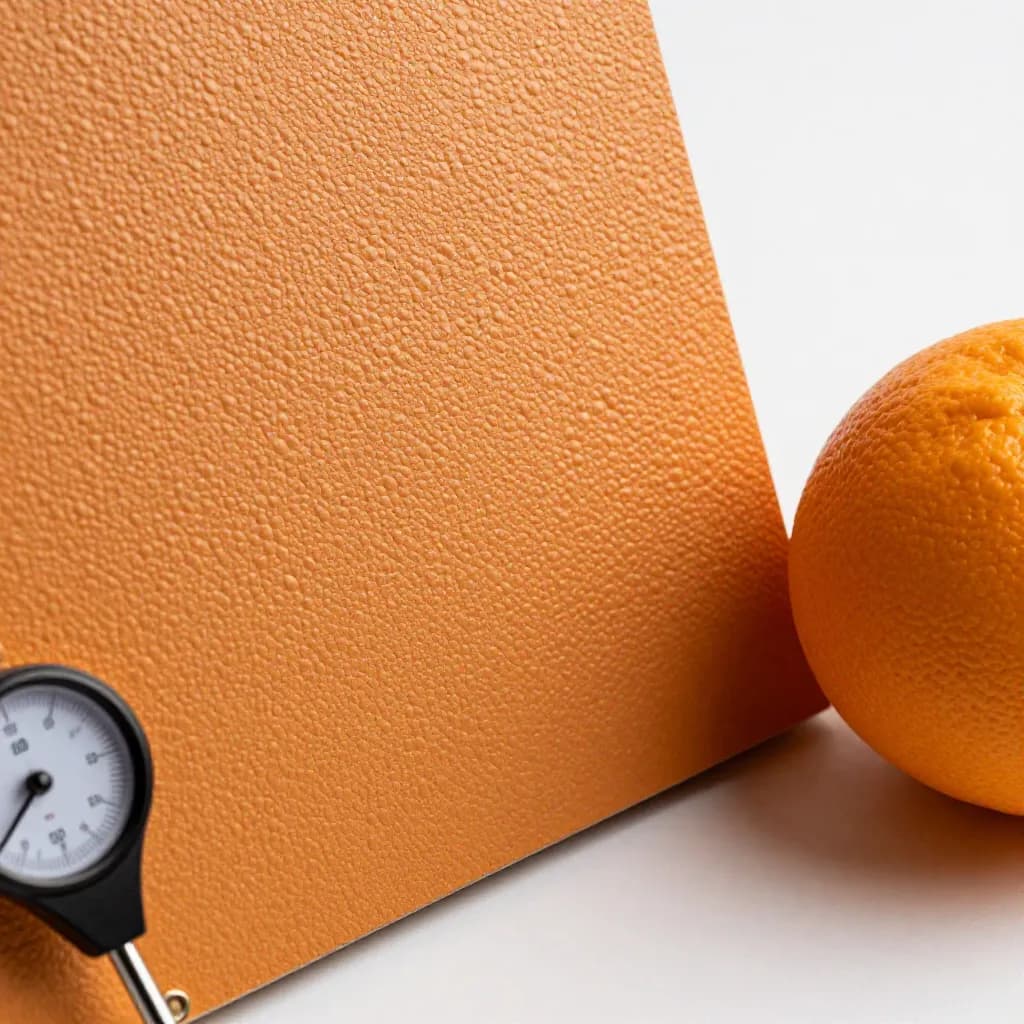
Orange peel is arguably the most common surface quality issue in powder coating, and some degree of orange peel is present in virtually every powder-coated surface. The question is not whether orange peel exists, but whether its severity is acceptable for the intended application. A slight texture that is invisible at normal viewing distances may be perfectly acceptable for industrial equipment, while the same texture would be unacceptable on a premium automotive component or high-end consumer product.
Ready to Start Your Project?
From one-off customs to 15,000-part production runs — get precise pricing in 24 hours.
On This Page
What Orange Peel Is in Powder Coating
The term orange peel is used broadly in the coatings industry to describe any waviness or texture in the coating surface, regardless of the specific cause. However, understanding the root causes of orange peel is essential for controlling it, because different causes require different corrective actions. A texture caused by excessive film thickness requires a different solution than one caused by incorrect cure temperature or poor powder quality.
Orange peel is measured and quantified using instruments that scan the coating surface and analyze the waviness pattern. This objective measurement allows applicators to set quality standards, monitor process consistency, and communicate finish quality requirements with customers and powder suppliers.
What Causes Orange Peel Texture
Orange peel in powder coating results from the interaction of multiple factors during the melt and cure phase. Understanding these factors is the key to controlling surface texture.
Powder particle size distribution is a primary factor. Coarser powders with larger average particle sizes produce more orange peel because the larger particles create thicker initial deposits that require more flow to level. Finer powders produce smoother finishes because the thinner initial deposit requires less flow to achieve a flat surface. Most standard powder coatings have a median particle size of 30-40 microns, while ultra-smooth formulations may use 20-25 micron median sizes.
Film thickness affects orange peel in a counterintuitive way. Both too-thin and too-thick films can increase orange peel. Thin films may not have enough material to flow and level properly, while excessively thick films have more mass to move and may gel before leveling is complete. The optimal film thickness for minimum orange peel varies by powder formulation but is typically in the 60-80 micron range for standard powders.
Cure temperature and heating rate influence flow and leveling. The powder must reach a low enough melt viscosity to flow before cross-linking begins to increase viscosity. If the part heats too slowly, the powder may begin to gel before it has fully melted and flowed. If the part heats too quickly, the surface may skin over while the interior is still flowing, trapping texture. Optimal heating rates depend on the powder chemistry and the part's thermal mass.
Application voltage in electrostatic spray affects surface texture. Excessive voltage causes back ionization, which disrupts the deposited powder layer and creates a rough texture that persists through curing. Reducing voltage, particularly on second coats or thick films, can significantly improve surface smoothness.
Powder formulation plays a fundamental role. The resin system's melt viscosity, gel time, and flow additive package determine how well the powder flows and levels during curing. Some powder formulations are specifically designed for ultra-smooth finishes, using low-viscosity resins and optimized flow additives to maximize leveling.
Acceptable Levels for Different Applications
The acceptable level of orange peel varies dramatically depending on the application, the viewing distance, and the customer's quality expectations. Establishing clear, measurable standards for surface texture prevents disputes and ensures that both the applicator and the customer have aligned expectations.
Industrial and functional applications typically have the most relaxed surface texture requirements. Agricultural equipment, structural steel, industrial machinery, and utility enclosures are viewed at arm's length or greater and are valued primarily for their protective function rather than their decorative appearance. Moderate orange peel is generally acceptable for these applications, and the focus is on coating integrity, adhesion, and corrosion resistance rather than surface smoothness.
Architectural applications have moderate to high surface quality requirements. Window frames, door systems, and cladding panels are viewed at close range and must present an attractive, consistent appearance. Qualicoat and GSB specifications include surface appearance requirements, and architectural coaters typically maintain tighter process controls to achieve smoother finishes. However, some degree of texture is accepted as inherent to powder coating.
Automotive and premium consumer products have the most demanding surface quality requirements. Automotive wheels, trim components, and high-end consumer electronics are viewed at very close range under critical lighting conditions. These applications often require ultra-smooth finishes that approach the quality of liquid paint, demanding specialized powder formulations, precise application parameters, and careful process control.
PCI (Powder Coating Institute) and other industry organizations provide visual standards and rating scales for surface texture that help standardize quality expectations. These standards typically use numbered panels or photographs representing different texture levels, allowing applicators and customers to agree on acceptable quality before production begins.
It is important to recognize that powder coating inherently produces some surface texture compared to liquid paint. Setting unrealistic smoothness expectations for powder coating leads to frustration and unnecessary rejection of acceptable parts.
How to Measure Orange Peel
Objective measurement of orange peel removes subjectivity from quality assessments and enables data-driven process control. Several measurement technologies are available, ranging from simple visual comparison to sophisticated surface analysis instruments.
Wave-scan instruments are the industry standard for quantifying surface texture on coated surfaces. These instruments project a laser beam onto the coating surface and measure the reflected light as the instrument is drawn across the surface. The reflected signal is analyzed to separate the surface texture into different wavelength ranges — short-wave (0.3-1.2 millimeters) and long-wave (1.2-12 millimeters) — that correspond to different visual aspects of the texture.
Short-wave values correlate with the fine, granular texture that is most visible at close viewing distances. Long-wave values correlate with the broader waviness that is visible at greater distances. By measuring both components separately, wave-scan instruments provide a detailed picture of the surface quality that correlates well with visual perception.
Gloss measurement provides an indirect indication of surface texture. Smoother surfaces reflect more light at the specular angle, producing higher gloss readings. However, gloss is also affected by the powder formulation's inherent gloss level, so gloss measurement alone cannot distinguish between a matte powder with a smooth surface and a glossy powder with orange peel.
Profilometry measures the physical surface profile using a stylus or optical sensor that traces across the surface. The resulting profile data can be analyzed to calculate roughness parameters such as Ra (average roughness) and Rz (average peak-to-valley height). While profilometry provides precise physical measurements, it is slower than wave-scan measurement and is typically used for detailed analysis rather than production quality control.
Visual comparison against reference standards remains a practical quality control method, particularly for operations that do not have access to wave-scan instruments. Standardized visual panels representing different texture levels allow trained inspectors to rate surface quality consistently.
How to Reduce Orange Peel: Powder Selection
Selecting the right powder formulation is the most effective way to control orange peel, because the powder's inherent flow and leveling characteristics set the baseline for achievable surface quality. No amount of application optimization can overcome the limitations of a powder that is not formulated for smooth finishes.
Ultra-smooth or high-flow powder formulations are specifically designed to minimize orange peel. These formulations use low-viscosity resin systems that achieve very fluid melt states during curing, allowing the coating to flow and level extensively before gelling. They also contain optimized flow additive packages — typically based on acrylate copolymers — that reduce surface tension and promote leveling.
Finer particle size distributions improve surface smoothness. Powders ground to a median particle size of 20-25 microns produce smoother finishes than standard 30-40 micron powders. However, finer powders can be more difficult to fluidize and transport, may have higher Faraday cage sensitivity, and can increase the risk of back ionization. The applicator must balance the smoothness benefit against these processing considerations.
Polyurethane powder coatings inherently produce smoother finishes than standard polyester or hybrid chemistries. The blocked isocyanate crosslinker in polyurethane systems provides an extended flow period before cross-linking begins, allowing more time for leveling. For applications where surface smoothness is critical, polyurethane chemistry offers a significant advantage.
Powder age and storage conditions affect flow and leveling. Fresh powder typically flows better than aged powder because the resin has not undergone any advancement (partial reaction) during storage. Powder stored at elevated temperatures may have reduced flow, producing more orange peel. Using fresh powder and maintaining proper storage conditions helps ensure consistent surface quality.
Consulting with the powder supplier about surface quality requirements is essential. Suppliers can recommend specific products optimized for smooth finishes and provide application guidelines that maximize the powder's flow and leveling potential.
How to Reduce Orange Peel: Application and Cure Optimization
Beyond powder selection, optimizing the application and curing process can significantly reduce orange peel. These process adjustments work within the capabilities of the chosen powder formulation to achieve the best possible surface quality.
Film thickness optimization is critical. Apply the powder at the manufacturer's recommended thickness range, typically 60-80 microns for standard decorative applications. Use a film thickness gauge to verify consistency across the part surface. Avoid both under-application (insufficient material for leveling) and over-application (excessive mass that resists leveling).
Electrostatic gun settings affect surface texture. Reduce voltage to the minimum level that provides adequate powder deposition and wrap-around. Excessive voltage causes back ionization that disrupts the powder layer and increases texture. For second coats or thick films, reducing voltage to 40-60 kilovolts can dramatically improve surface smoothness.
Gun-to-part distance influences the deposited powder layer's uniformity. Maintaining a consistent distance of 200-300 millimeters ensures even deposition without excessive impact velocity that can compact the powder layer and reduce flow during curing.
Oven temperature profile optimization ensures that the powder reaches its minimum melt viscosity before cross-linking begins. A moderate initial heating rate allows the powder to melt and flow before the surface begins to gel. Avoid placing parts directly in a hot oven at full cure temperature — a gradual ramp-up produces better flow and leveling.
Infrared pre-heating before convection curing can improve surface smoothness by rapidly melting the powder surface and initiating flow before the bulk of the coating reaches cure temperature. This technique is used in high-quality automotive and consumer product finishing lines.
Part orientation in the oven can affect surface quality. Horizontal surfaces tend to level better than vertical surfaces because gravity assists the flow process. Where possible, orienting critical surfaces horizontally during curing can improve smoothness.
Consistent process control is essential. Variations in film thickness, oven temperature, or conveyor speed from part to part produce inconsistent surface quality. Monitoring and controlling these variables within tight tolerances ensures repeatable results.
When Orange Peel Is Intentional: Textured Finishes
While orange peel is typically considered a defect in smooth-finish applications, controlled surface texture is deliberately created in textured powder coatings. These formulations produce specific texture patterns — fine texture, coarse texture, leather grain, wrinkle, and hammertone — that serve both aesthetic and functional purposes.
Fine texture finishes produce a subtle, uniform surface texture that hides substrate imperfections, reduces the visibility of fingerprints and handling marks, and provides a distinctive tactile quality. Fine textures are widely used for electrical enclosures, industrial equipment, and office furniture where a smooth finish would show every scratch and fingerprint.
Coarse texture and wrinkle finishes produce more pronounced surface patterns that provide aggressive hiding of substrate imperfections. These finishes are used for heavy industrial equipment, outdoor enclosures, and applications where the substrate surface quality is variable and a smooth finish would reveal every flaw.
Textured finishes offer practical advantages beyond aesthetics. The textured surface scatters light rather than reflecting it specularly, reducing glare and making the surface less reflective. The texture also provides a slight grip that can be beneficial for handles, controls, and surfaces that are frequently touched.
From a production standpoint, textured finishes are more forgiving than smooth finishes. They tolerate wider variations in film thickness, application parameters, and substrate condition without visible quality differences. This makes textured finishes practical for high-volume production of parts with variable geometry and surface quality.
The key distinction is between uncontrolled orange peel (a defect) and controlled texture (a design choice). When texture is specified intentionally, the powder formulation, application parameters, and quality standards are all designed to produce a consistent, attractive texture pattern. When orange peel appears on a part that should be smooth, it represents a process or material problem that needs to be addressed.
Frequently Asked Questions
What causes orange peel in powder coating?
Orange peel results from incomplete flow and leveling during curing. Key causes include coarse powder particle size, incorrect film thickness, improper cure temperature or heating rate, excessive electrostatic voltage causing back ionization, and powder formulations with limited flow characteristics.
How much orange peel is acceptable?
Acceptable levels depend on the application. Industrial equipment tolerates moderate texture, architectural products require smoother finishes, and automotive components demand ultra-smooth surfaces. Establish measurable standards using wave-scan instruments or visual reference panels before production begins.
How do you fix orange peel on powder-coated parts?
Once cured, orange peel cannot be fixed without stripping and recoating. Prevention is key: use smooth-flow powder formulations, optimize film thickness to 60-80 microns, reduce electrostatic voltage, control oven heating rate, and maintain consistent application parameters.
Does film thickness affect orange peel?
Yes. Both too-thin and too-thick films increase orange peel. Thin films lack sufficient material to level, while thick films have too much mass to flow before gelling. The optimal range is typically 60-80 microns for standard decorative powders, though this varies by formulation.
Can powder coating be as smooth as liquid paint?
Ultra-smooth powder formulations, particularly polyurethane chemistries, can approach liquid paint smoothness. However, standard powder coatings inherently produce slightly more texture than liquid paint. For the smoothest powder finishes, use fine-particle, high-flow formulations with optimized application and cure parameters.
Ready to Start Your Project?
From one-off customs to 15,000-part production runs — get precise pricing in 24 hours.