The Faraday cage effect in powder coating is the phenomenon where electrostatic field lines concentrate on the outer edges and high points of a grounded workpiece, leaving recessed areas, inside corners, and enclosed spaces with weak or absent electrostatic attraction. Charged powder particles follow these field lines, depositing heavily on outer surfaces while bypassing the recessed areas that the field cannot reach. The result is uneven coating — thick on exposed surfaces and thin or absent in recesses.
Guides
What Is the Faraday Cage Effect in Powder Coating? Physics and Solutions
Sundial Powder Coating·April 23, 2026·11 min
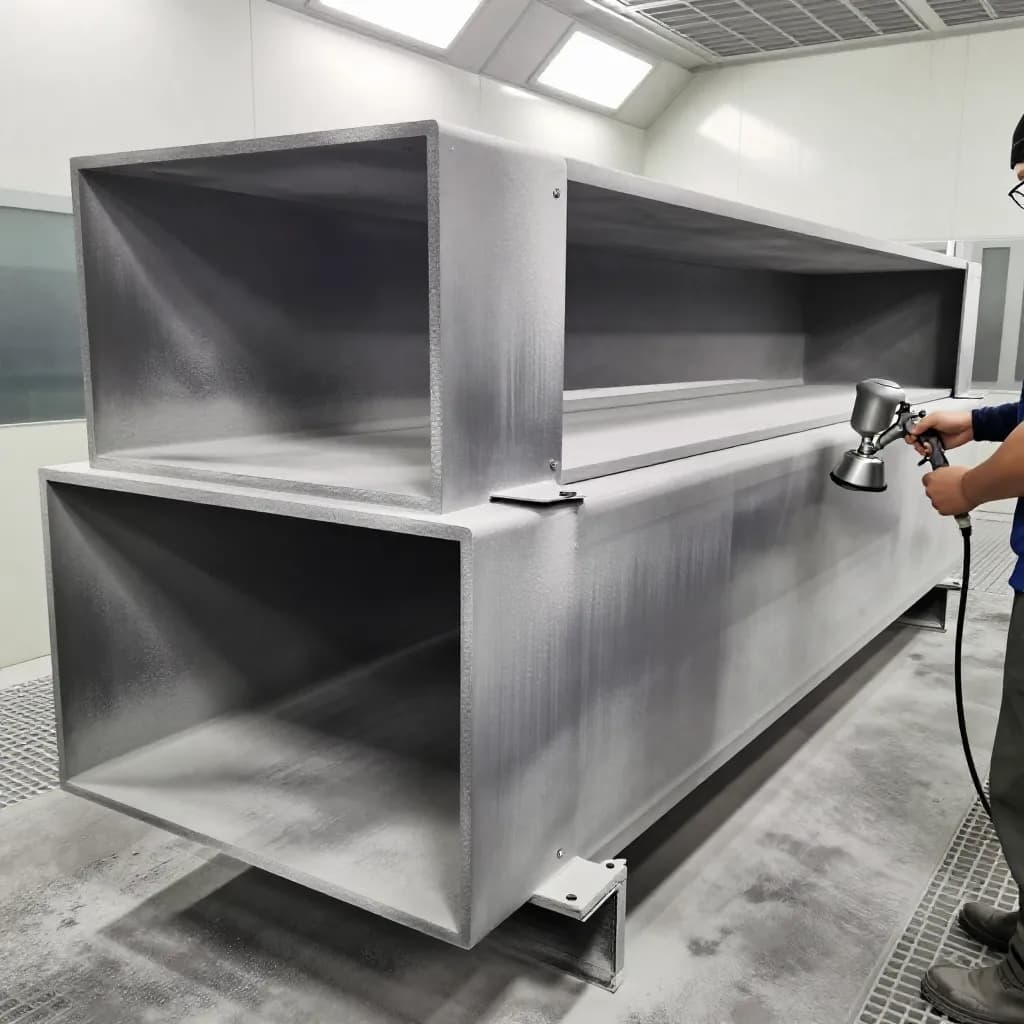
The effect is named after Michael Faraday, who demonstrated in the 1830s that an electrical conductor enclosing a space shields the interior from external electric fields. In powder coating, the principle applies whenever the part geometry creates enclosed or semi-enclosed spaces that the electrostatic field cannot penetrate effectively.
Ready to Start Your Project?
From one-off customs to 15,000-part production runs — get precise pricing in 24 hours.
On This Page
What the Faraday Cage Effect Is
The Faraday cage effect is one of the most significant practical challenges in electrostatic powder coating. It affects every part with complex geometry — from simple L-brackets with inside corners to intricate aluminum extrusions with deep channels. Understanding the physics behind the effect and the strategies available to mitigate it is essential for achieving uniform coating coverage on real-world parts.
The severity of the Faraday cage effect depends on the part geometry, the electrostatic gun type and settings, the powder characteristics, and the application technique. Some combinations of these factors produce severe coverage problems, while others allow acceptable coating even in moderately recessed areas.
The Physics Simplified
Understanding the Faraday cage effect does not require advanced physics — the basic principle is straightforward. Electric field lines always take the shortest path from a charged source to a grounded surface. When a charged powder particle approaches a grounded part, it follows these field lines toward the nearest grounded surface, which is almost always an outer edge or high point rather than a recessed area.
Imagine a U-shaped channel being powder coated. The electrostatic field lines from the corona gun travel toward the grounded channel and terminate on the outer edges and the tops of the channel walls — the closest grounded surfaces. Very few field lines penetrate into the bottom of the channel because the walls on either side intercept them first. Charged powder particles follow these field lines, depositing heavily on the outer edges and wall tops while the channel bottom receives little or no powder.
The effect is amplified by the geometry of the recess. Deeper, narrower recesses create stronger Faraday cage conditions because the walls intercept a larger proportion of the field lines. A shallow, wide recess may receive adequate coating because some field lines can reach the bottom. A deep, narrow slot may receive virtually no coating because the walls capture all available field lines.
Corona charging exacerbates the Faraday cage effect because the high-voltage electrode creates a strong, directional field that concentrates on the nearest grounded surfaces. The free ions produced by the corona discharge also concentrate on outer surfaces, adding to the charge imbalance between exposed and recessed areas.
Triboelectric charging produces a softer, less directional field because the charge resides only on the powder particles, not in a surrounding ion cloud. This softer field allows charged particles to penetrate further into recesses, which is why triboelectric guns are preferred for parts with significant Faraday cage areas.
Common Problem Areas on Parts
Recognizing Faraday cage areas on parts before coating begins allows operators to plan their application strategy and set appropriate expectations for coverage. Certain geometric features consistently create Faraday cage conditions.
Inside corners are the most common Faraday cage area. Where two surfaces meet at an angle less than 180 degrees, the electrostatic field concentrates on the outer edges of the angle, leaving the inside corner with reduced field strength. The tighter the angle, the more severe the effect. A 90-degree inside corner is a moderate Faraday cage, while a 45-degree corner is more severe.
Deep channels and slots in extruded profiles create strong Faraday cage conditions. Aluminum window and door profiles often feature channels for hardware, drainage, and thermal breaks that are difficult to coat uniformly. The depth-to-width ratio of the channel determines the severity — channels deeper than they are wide present the greatest challenge.
Box sections and enclosed tubes are extreme Faraday cage geometries. The interior of a closed box section is almost completely shielded from the external electrostatic field, making it nearly impossible to coat the inside surfaces with electrostatic spray. If interior coating is required, the part design must include access openings or the coating must be applied before the section is closed.
Wire products — baskets, racks, shelving, and fencing — present unique Faraday cage challenges. The intersections of wires create countless small recesses that the electrostatic field cannot penetrate. The wire diameter and spacing determine the severity — closely spaced thin wires create more severe Faraday cage conditions than widely spaced thick wires.
Welded assemblies with gussets, brackets, and reinforcing plates create Faraday cage areas at the junctions between components. The overlapping surfaces and tight gaps at weld joints are difficult to coat and are often the first areas to show corrosion in service.
Heat sinks with closely spaced fins are a classic Faraday cage geometry. The narrow gaps between fins shield the fin surfaces from the electrostatic field, making uniform coating extremely challenging.
Solutions: Gun Settings and Technique
Adjusting electrostatic gun settings and application technique is the first line of defense against Faraday cage coverage problems. These adjustments can significantly improve penetration into recessed areas without requiring equipment changes or part redesign.
Reducing corona voltage is the single most effective gun adjustment for improving Faraday cage penetration. Lower voltage produces a weaker, less directional electrostatic field that does not concentrate as aggressively on outer edges. Reducing voltage from the typical 80-100 kilovolts to 40-60 kilovolts can dramatically improve coverage in inside corners and shallow recesses. The trade-off is slower deposition rate on flat surfaces.
Increasing gun-to-part distance spreads the electrostatic field over a larger area, reducing the concentration on outer edges. Moving the gun from 200 millimeters to 300-400 millimeters from the part allows more field lines to reach recessed areas. This also reduces the velocity of powder particles hitting the surface, which can improve adhesion in recesses.
Directing the gun into the recess rather than at the part's outer surface forces powder into the Faraday cage area. Manual operators can angle the gun to aim directly into channels, corners, and recesses. Automatic systems can be programmed with gun positions and angles optimized for specific part geometries.
Using a combination of automatic and manual application is common for complex parts. Automatic guns provide consistent coverage on flat and exposed surfaces, while manual operators target Faraday cage areas with adjusted gun settings and directed application. This hybrid approach balances production efficiency with coverage quality.
Powder flow rate adjustment can help. Lower flow rates produce a less dense powder cloud that can penetrate further into recesses before the particles are deflected by the electrostatic field. Higher flow rates produce a denser cloud that tends to deposit on the nearest surface.
Air velocity management in the spray booth affects powder penetration. Excessive booth air velocity can sweep powder away from recessed areas before it has time to deposit. Reducing air velocity in the coating zone — while maintaining adequate velocity for overspray capture — can improve coverage in Faraday cage areas.
Solutions: Equipment and Technology
When gun setting adjustments alone are insufficient, equipment changes and technology upgrades can provide additional Faraday cage penetration capability.
Triboelectric guns are the most effective equipment solution for Faraday cage problems. As discussed earlier, tribo guns produce a softer electrostatic field without free ions, allowing charged particles to penetrate further into recesses. Many facilities use tribo guns specifically for Faraday cage areas, either as dedicated guns on automatic systems or as manual touch-up guns.
Lance guns are specialized narrow-profile guns designed to reach into deep recesses, channels, and box sections. The gun barrel is long and thin, allowing it to be inserted into openings that standard guns cannot reach. Lance guns are available in both corona and triboelectric configurations and are essential for coating the interiors of tubular structures and deep channels.
Flat spray nozzles produce a fan-shaped powder pattern that can be directed into narrow openings more effectively than the conical pattern of standard round nozzles. Flat spray patterns are useful for coating between closely spaced fins, into narrow slots, and along the length of channels.
Robotic gun positioning allows precise, repeatable gun placement and angle for each part geometry. Robots can position guns at angles and distances that would be difficult for manual operators to maintain consistently, and they can follow complex part contours to optimize coverage in Faraday cage areas.
Dual-technology systems that combine corona and triboelectric guns on the same coating line provide the flexibility to use the optimal charging method for each area of the part. Corona guns handle the flat surfaces where their higher deposition rate is advantageous, while tribo guns handle the Faraday cage areas where their softer field provides better penetration.
Powder formulation can also help. Some powder manufacturers offer formulations with enhanced Faraday cage penetration, using modified charge characteristics or particle size distributions that improve deposition in recessed areas.
Part Design for Better Coating Coverage
The most effective long-term solution to Faraday cage problems is designing parts with coating coverage in mind. When product designers understand the limitations of electrostatic powder coating, they can make geometry choices that minimize Faraday cage areas and improve coating uniformity.
Opening up inside corners by adding radii reduces the severity of the Faraday cage effect. A sharp 90-degree inside corner is much more difficult to coat than a corner with a 5-10 millimeter radius. Even a small radius allows electrostatic field lines to reach the corner surface, dramatically improving coverage.
Widening channels and slots relative to their depth improves field penetration. A channel with a width-to-depth ratio of 1:1 or greater is much easier to coat than a narrow slot with a ratio of 1:3 or worse. Where functional requirements allow, designing wider, shallower channels instead of narrow, deep ones improves coating coverage.
Providing access openings in box sections and enclosed structures allows powder to reach interior surfaces. Strategically placed holes or slots in the walls of box sections allow the electrostatic field to penetrate the interior and provide a path for powder to enter. These openings can often be incorporated into the design without compromising structural integrity.
Avoiding unnecessary complexity in part geometry reduces the number of Faraday cage areas that must be managed during coating. Simplifying weld joint designs, reducing the number of overlapping components, and eliminating decorative features that create deep recesses all improve coating coverage and reduce production complexity.
Specifying minimum coating thickness requirements for Faraday cage areas separately from exposed surfaces sets realistic expectations. Rather than requiring uniform thickness everywhere, specifying a lower minimum thickness for recessed areas acknowledges the physical limitations of electrostatic coating and focuses quality control on achievable targets.
Collaboration between product designers and coating engineers during the design phase prevents costly problems in production. A brief review of the part geometry by an experienced coater can identify potential Faraday cage issues and suggest design modifications that improve coatability without compromising product function.
Measuring and Specifying Coverage in Faraday Areas
Establishing measurable standards for coating coverage in Faraday cage areas is essential for quality control and customer satisfaction. Without clear specifications, disagreements about acceptable coverage are inevitable.
Film thickness measurement in Faraday cage areas requires appropriate tools and techniques. Standard magnetic or eddy current thickness gauges work well on accessible surfaces but may not fit into narrow recesses. Miniature probes with small-diameter tips are available for measuring in tight spaces. For areas that cannot be reached with contact probes, destructive cross-section analysis provides accurate thickness data.
Specifying minimum film thickness for Faraday cage areas should reflect the physical limitations of electrostatic coating. While exposed surfaces may achieve 60-80 microns, inside corners and recesses may realistically achieve only 30-50 microns. Specifying the same minimum thickness for all areas sets an unachievable standard that leads to excessive material use on exposed surfaces and continued shortfalls in recesses.
A tiered specification approach defines different minimum thicknesses for different areas of the part. Zone A (exposed surfaces) might require 60-80 microns, Zone B (moderate recesses) might require 40-60 microns, and Zone C (deep Faraday cage areas) might require 25-40 microns. This approach acknowledges physical reality while ensuring adequate protection in all areas.
Test panels that replicate the part's Faraday cage geometry provide a practical quality control tool. These panels are coated alongside production parts and measured to verify that the coating process is achieving the specified coverage in recessed areas. Deviations from target values trigger process adjustments before defective parts are produced.
Corrosion testing of coated parts with intentional focus on Faraday cage areas validates that the achieved coverage provides adequate protection. Salt spray or cyclic corrosion testing with evaluation of recessed areas confirms that the coating system — including pretreatment, primer if used, and topcoat — provides the required corrosion resistance even at reduced film thicknesses.
Documenting the agreed coverage standards, measurement methods, and acceptance criteria in a written specification prevents misunderstandings and provides a reference for resolving any quality disputes.
Frequently Asked Questions
What is the Faraday cage effect in powder coating?
The Faraday cage effect occurs when electrostatic field lines concentrate on outer edges and high points of a part, leaving recessed areas with weak electrostatic attraction. Charged powder particles follow these field lines, resulting in thick coating on exposed surfaces and thin or absent coating in recesses.
How do you fix Faraday cage problems in powder coating?
Key solutions include reducing corona voltage to 40-60 kV, increasing gun-to-part distance, using triboelectric guns for recessed areas, directing guns into recesses, using lance guns for deep channels, and designing parts with radii on inside corners and wider channels.
Why are triboelectric guns better for Faraday cage areas?
Triboelectric guns produce a softer electrostatic field without free ions, allowing charged particles to penetrate further into recesses. Corona guns create a strong directional field that concentrates on outer edges, making Faraday cage problems worse.
Can part design reduce Faraday cage problems?
Yes. Adding radii to inside corners, widening channels relative to their depth, providing access openings in box sections, and simplifying geometry all improve coating coverage. Collaboration between designers and coating engineers during the design phase prevents costly production problems.
What coating thickness can be achieved in Faraday cage areas?
Faraday cage areas typically achieve 30-50 microns compared to 60-80 microns on exposed surfaces. A tiered specification with different minimum thicknesses for different zones acknowledges physical limitations while ensuring adequate protection throughout the part.
Ready to Start Your Project?
From one-off customs to 15,000-part production runs — get precise pricing in 24 hours.