Epoxy powder coating is a thermoset finishing system based on epoxy resin that delivers the highest chemical resistance and adhesion of any standard powder coating chemistry. Epoxy coatings form an extremely dense, tightly cross-linked film that resists attack by acids, alkalis, solvents, and a wide range of industrial chemicals. This makes epoxy the powder coating of choice for functional applications where chemical protection is the primary requirement.
Technical
What Is Epoxy Powder Coating? Chemical Resistance and Functional Use
Sundial Powder Coating·April 23, 2026·11 min
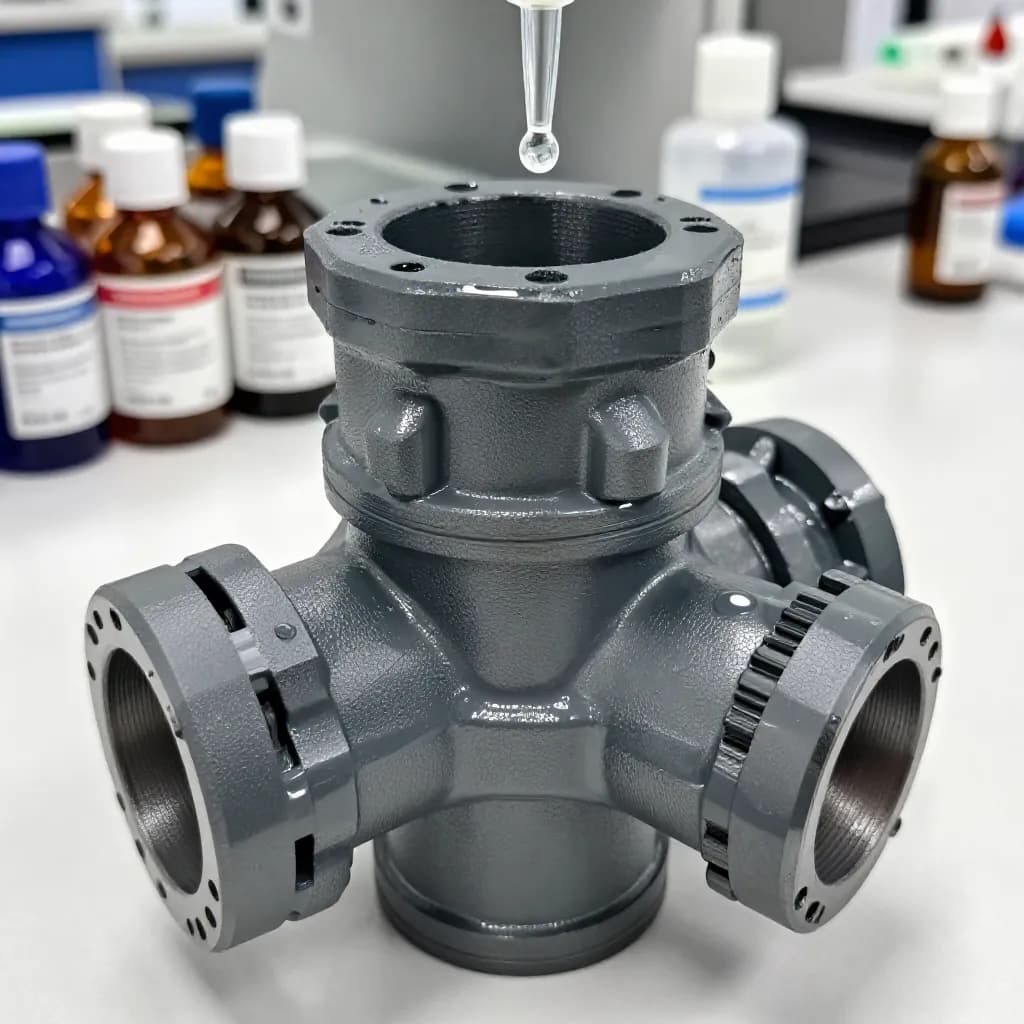
The epoxy resin system used in powder coatings is typically based on bisphenol A diglycidyl ether (BADGE/DGEBA), cross-linked with hardeners such as dicyandiamide, phenolic resins, or anhydrides. During curing at 180-200 degrees Celsius, the epoxy and hardener react to form a highly cross-linked thermoset network with excellent mechanical properties, strong substrate adhesion, and outstanding barrier performance against moisture and chemicals.
Ready to Start Your Project?
From one-off customs to 15,000-part production runs — get precise pricing in 24 hours.
On This Page
What Epoxy Powder Coating Is
Epoxy powder coatings were among the first powder coating chemistries developed commercially and remain essential for applications where their specific strengths are required. However, epoxy has one critical limitation: it is not UV-stable. When exposed to sunlight, epoxy coatings chalk rapidly, losing gloss and developing a powdery surface within weeks or months of outdoor exposure. This degradation is cosmetic rather than structural — the coating continues to provide corrosion and chemical protection even after chalking — but it restricts epoxy to interior use or applications where appearance is not a concern.
Despite this limitation, epoxy powder coatings occupy an important and irreplaceable position in the powder coating market, serving applications where no other chemistry can match their performance.
Chemical Resistance: Epoxy's Defining Strength
The chemical resistance of epoxy powder coatings is unmatched among standard powder coating chemistries. The dense, highly cross-linked epoxy network creates a barrier that resists penetration by a broad spectrum of aggressive chemicals, making epoxy the standard choice for equipment and structures exposed to chemical environments.
Epoxy coatings resist strong acids including hydrochloric, sulfuric, and phosphoric acid at moderate concentrations. They withstand alkali exposure from sodium hydroxide, potassium hydroxide, and ammonia solutions. Organic solvents including ketones, esters, and aromatic hydrocarbons have minimal effect on properly cured epoxy films. This broad chemical resistance profile is essential for applications in chemical processing, water treatment, pharmaceutical manufacturing, and laboratory environments.
The mechanism behind epoxy's chemical resistance lies in its molecular structure. The high cross-link density creates a tight network with minimal free volume for chemical molecules to penetrate. The ether linkages in the epoxy backbone are inherently resistant to hydrolysis, and the aromatic rings provide stability against many organic solvents. This combination of structural features produces a coating that maintains its integrity in chemical environments that would rapidly degrade polyester or hybrid coatings.
Corrosion resistance is closely related to chemical resistance, and epoxy coatings excel here as well. Salt spray testing of epoxy-coated steel panels routinely exceeds 1000-2000 hours, depending on film thickness and pretreatment. The coating's low moisture permeability and strong adhesion to steel create an effective barrier against the electrochemical processes that drive corrosion.
For applications requiring both chemical resistance and outdoor exposure, epoxy is used as a primer under a UV-stable polyester or fluoropolymer topcoat, combining the adhesion and chemical resistance of epoxy with the weathering performance of the topcoat.
Epoxy as a Primer and in Multi-Coat Systems
One of epoxy's most important roles in the powder coating industry is as a primer in multi-coat systems. Epoxy's exceptional adhesion to metal substrates and its outstanding corrosion resistance make it the ideal foundation layer for high-performance coating systems that require both substrate protection and exterior durability.
In a typical two-coat system, an epoxy primer is applied at 50-75 microns, followed by a polyester or fluoropolymer topcoat at 50-80 microns. The epoxy primer provides the adhesion and corrosion barrier, while the topcoat provides UV resistance, color, and aesthetic properties. This combination delivers performance that neither coating could achieve alone.
Epoxy primers are specified in demanding applications such as architectural aluminum in coastal environments, offshore structures, heavy industrial equipment, and transportation infrastructure. The Qualicoat Seaside specification, for example, requires a two-coat system with an epoxy or modified epoxy primer for aluminum profiles exposed to marine atmospheres.
The adhesion of epoxy primers to metal substrates is among the strongest of any organic coating. Pull-off adhesion values for epoxy on properly prepared steel typically exceed 10 MPa, compared to 5-8 MPa for polyester coatings. This strong adhesion resists cathodic disbondment, chemical undercutting, and mechanical stress that can cause coating delamination in aggressive environments.
Epoxy primers also serve as a barrier against outgassing from cast substrates. When cast aluminum or cast iron is powder coated, gases trapped in the porous casting can escape during curing, causing pinholes and craters in the topcoat. An epoxy primer applied and cured first seals the surface porosity, allowing the topcoat to cure without defects. This technique is widely used in the automotive and industrial casting industries.
Functional Coating Applications
Epoxy powder coatings serve a broad range of functional applications where their chemical resistance, adhesion, and barrier properties are more important than UV stability or decorative appearance.
The pipeline industry uses fusion bonded epoxy as the primary corrosion protection for buried and submerged steel pipelines. Applied at 300-500 microns to preheated pipe, FBE provides decades of corrosion protection in conjunction with cathodic protection systems. This is the largest single functional application for epoxy powder coatings.
Electrical insulation is another major functional application. Epoxy powder coatings provide excellent dielectric properties, with breakdown voltages exceeding 20 kV per millimeter of film thickness. Motor stators, transformer cores, bus bars, and electrical connectors are coated with epoxy to prevent short circuits and protect against moisture ingress. The coating's thermal stability at operating temperatures up to 130-155 degrees Celsius (depending on the formulation class) makes it suitable for electrical equipment that generates significant heat.
Rebar coating for concrete reinforcement uses epoxy powder to prevent chloride-induced corrosion in bridge decks, parking structures, and marine structures. The epoxy barrier prevents chloride ions from reaching the steel surface, extending the service life of concrete infrastructure by decades.
Chemical processing equipment including tanks, vessels, piping, and valves uses epoxy coatings for internal protection against process chemicals. The coating's resistance to acids, alkalis, and solvents protects the steel substrate from corrosion and contamination.
Automotive underbody components, including chassis members, suspension parts, and brake components, use epoxy primers for their corrosion resistance in the harsh under-vehicle environment. These components are not exposed to direct sunlight, so epoxy's UV limitation is irrelevant.
Interior Decorative Applications
While epoxy is primarily valued for its functional properties, it also serves decorative applications in interior environments where UV exposure is not a concern. The coating's excellent mechanical properties, smooth finish capability, and broad color availability make it suitable for a range of indoor products.
Office furniture is a significant market for decorative epoxy coatings. Filing cabinets, desk frames, shelving units, and storage systems are commonly coated with epoxy for its combination of hardness, scratch resistance, and chemical resistance to cleaning agents. The indoor environment eliminates UV concerns, allowing epoxy to deliver long-term aesthetic performance.
Electrical enclosures and switchgear housings use epoxy coatings for both functional protection and decorative appearance. The coating provides electrical insulation, corrosion resistance, and an attractive finish in a single application. Standard colors such as RAL 7035 (light grey) and RAL 7032 (pebble grey) are widely used for electrical equipment.
Interior architectural metalwork, including handrails, balustrades, elevator interiors, and decorative screens, can be finished with epoxy when the installation is entirely indoors. The coating's hardness and scratch resistance are advantageous for high-traffic interior surfaces.
Medical and laboratory equipment uses epoxy coatings for their chemical resistance and cleanability. Laboratory benches, fume hood components, and medical device housings benefit from epoxy's ability to withstand repeated cleaning with disinfectants and laboratory chemicals.
For interior applications where the choice between epoxy and hybrid is not driven by specific chemical resistance requirements, hybrid coatings (epoxy-polyester blends) are often preferred for their slightly better flexibility and overbake tolerance. However, when maximum chemical resistance is needed, pure epoxy remains the superior choice.
Why Epoxy Chalks Outdoors and What It Means
Understanding why epoxy coatings are restricted to interior use requires understanding the mechanism of UV degradation. When ultraviolet radiation strikes an epoxy coating, it has sufficient energy to break the chemical bonds in the bisphenol A backbone of the resin. This bond-breaking process, called photodegradation, releases small molecular fragments from the coating surface, leaving behind a layer of loose pigment particles and degraded resin — the characteristic chalky appearance.
The rate of chalking depends on UV intensity, coating color, and film thickness. Dark colors absorb more UV energy and may chalk faster than light colors. Thin films degrade through their full thickness more quickly than thick films. In tropical or high-altitude locations with intense UV, chalking can become visible within weeks of exposure. In temperate climates with lower UV intensity, the process is slower but still inevitable.
Importantly, chalking is primarily a surface phenomenon. While the outer surface degrades, the bulk of the coating beneath the chalked layer continues to provide corrosion and chemical protection. An epoxy-coated pipeline buried underground, where no UV reaches the coating, will perform for decades without any degradation. The UV limitation is relevant only for exposed surfaces where appearance matters.
This understanding informs proper specification. Epoxy should never be specified for exterior decorative applications where appearance must be maintained. However, it is perfectly appropriate for exterior functional applications where the coating is buried, submerged, or otherwise shielded from UV exposure. It is also appropriate for exterior applications where chalking is acceptable — some industrial equipment coatings, for example, prioritize chemical resistance over long-term aesthetics.
For applications requiring both epoxy's chemical resistance and outdoor appearance retention, the two-coat approach — epoxy primer plus UV-stable topcoat — provides the optimal solution.
Epoxy Powder Coating Formulation Variants
The epoxy powder coating family includes several formulation variants optimized for specific applications. Understanding these variants helps specifiers select the right product for their requirements.
Standard decorative epoxies are formulated for smooth, glossy finishes with good flow and leveling. They are used for interior furniture, enclosures, and general-purpose applications where chemical resistance and appearance are both important. These formulations typically cure at 180-200 degrees Celsius and achieve film thicknesses of 60-80 microns.
Functional epoxies for pipeline and rebar applications are formulated for maximum adhesion, flexibility, and chemical resistance rather than decorative appearance. They use different hardener systems and may include flexibilizers to improve impact resistance and resistance to cathodic disbondment. These formulations are applied at much greater thicknesses — 175-500 microns — and are cured by the heat of the preheated substrate rather than in a conventional oven.
Electrical-grade epoxies are formulated to maximize dielectric strength and thermal stability. They may use specialized resin systems with higher glass transition temperatures to maintain performance at elevated operating temperatures. Electrical epoxies are classified by thermal endurance class, with common ratings of Class B (130 degrees Celsius), Class F (155 degrees Celsius), and Class H (180 degrees Celsius).
Anti-corrosion epoxy primers are formulated with zinc-rich or zinc-free corrosion-inhibiting pigments for maximum substrate protection. Zinc-rich epoxy primers provide galvanic protection similar to hot-dip galvanizing, while zinc-free primers use alternative corrosion inhibitors for applications where zinc is not appropriate.
Low-temperature cure epoxies that cross-link at 140-160 degrees Celsius are available for heat-sensitive substrates and energy-saving applications. These formulations use more reactive hardener systems to achieve full cure at reduced temperatures.
Frequently Asked Questions
Why can't epoxy powder coating be used outdoors?
Epoxy resin is not UV-stable. Ultraviolet radiation breaks chemical bonds in the epoxy backbone, causing the surface to chalk and lose gloss. This degradation is cosmetic — the coating still protects against corrosion — but it makes epoxy unsuitable for exterior applications where appearance must be maintained.
What is epoxy powder coating best used for?
Epoxy excels in applications requiring chemical resistance, corrosion protection, electrical insulation, or strong substrate adhesion. Key applications include pipeline protection, rebar coating, electrical insulation, chemical processing equipment, and as a primer under UV-stable topcoats.
How does epoxy compare to polyester powder coating?
Epoxy offers superior chemical resistance, adhesion, and corrosion protection but cannot withstand UV exposure. Polyester provides excellent UV resistance for outdoor use but has lower chemical resistance. For outdoor applications, polyester is preferred. For indoor chemical resistance, epoxy is superior.
Can epoxy powder coating be used as a primer?
Yes. Epoxy is widely used as a primer in two-coat systems, providing adhesion and corrosion resistance under a UV-stable polyester or fluoropolymer topcoat. This combination is specified for demanding applications such as coastal architecture, offshore structures, and heavy industrial equipment.
What chemicals can epoxy powder coating resist?
Epoxy resists strong acids (hydrochloric, sulfuric, phosphoric), alkalis (sodium hydroxide, ammonia), and organic solvents (ketones, esters, aromatics). This broad chemical resistance makes it the standard choice for chemical processing, water treatment, and laboratory environments.
Ready to Start Your Project?
From one-off customs to 15,000-part production runs — get precise pricing in 24 hours.