Electrostatic powder coating is a dry finishing process that uses electrically charged powder particles to coat grounded metal substrates. The powder, composed of finely ground resin, pigment, and additives, is sprayed through a specialized gun that imparts an electrical charge to each particle. These charged particles are attracted to the grounded workpiece, adhering uniformly to its surface before being cured in an oven where the powder melts, flows, and cross-links into a continuous, durable film.
Guides
What Is Electrostatic Powder Coating? Corona Charging Explained
Sundial Powder Coating·April 23, 2026·12 min
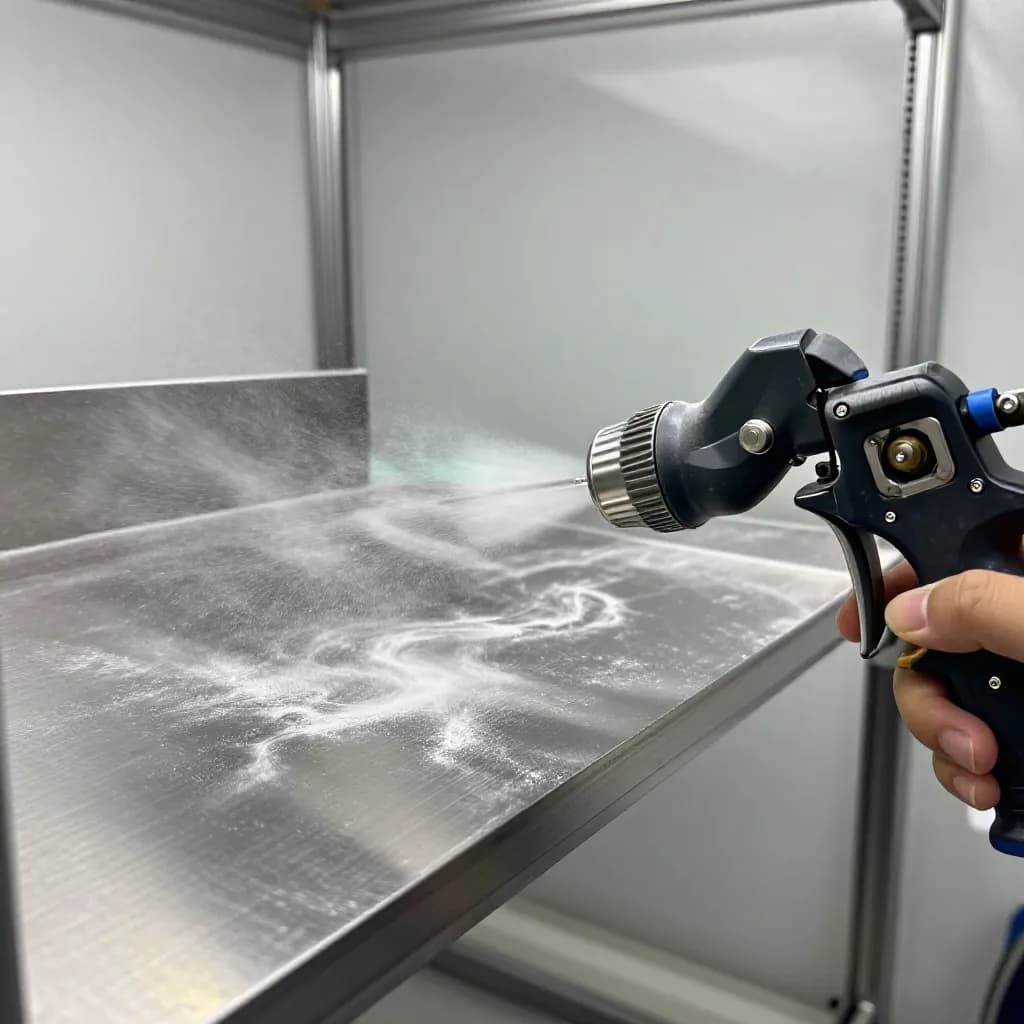
This technology is the most widely used method of applying powder coatings in industrial settings, accounting for the vast majority of all powder coating operations worldwide. Its dominance stems from a combination of efficiency, versatility, and environmental responsibility. Unlike liquid paint, electrostatic powder coating produces zero volatile organic compound emissions, achieves material utilization rates of 95-98 percent through overspray reclamation, and delivers a thick, uniform finish in a single application.
Ready to Start Your Project?
From one-off customs to 15,000-part production runs — get precise pricing in 24 hours.
On This Page
What Electrostatic Powder Coating Is and Why It Matters
The electrostatic principle at the heart of this process is straightforward: opposite charges attract. By charging the powder particles and grounding the workpiece, the process creates an electrostatic field that draws particles toward the substrate and holds them in place until curing. This fundamental mechanism enables consistent coverage on complex geometries, reduces material waste, and eliminates the drips and runs common in liquid painting.
How Corona Charging Works
The most common method of electrostatic powder coating is corona charging, which uses a high-voltage electrode at the tip of the spray gun to ionize the surrounding air. As powder particles pass through this ionized field, they pick up free electrons and become negatively charged. The charged particles then follow the electrostatic field lines toward the grounded workpiece, depositing on its surface in a uniform layer.
A typical corona gun operates at voltages between 60 and 100 kilovolts, though modern controllers allow precise adjustment of voltage and current to suit different powder chemistries, part geometries, and film thickness requirements. The electrode, often called a charging pin or corona needle, generates a visible corona discharge — a faint blue glow at the gun tip that indicates active ionization.
The strength of the electrostatic field determines how aggressively particles are attracted to the substrate. Higher voltages create stronger fields and faster deposition rates, but excessive voltage can cause problems such as back ionization, orange peel texture, or difficulty coating recessed areas. Skilled operators and modern automatic systems balance these parameters to achieve optimal coverage and finish quality.
Corona charging is effective across a wide range of powder types, including polyester, epoxy, hybrid, polyurethane, and fluoropolymer chemistries. This versatility makes it the default choice for most production environments, from small job shops to high-volume automotive and appliance manufacturing lines.
The Complete Electrostatic Application Process
The electrostatic powder coating process involves several carefully controlled stages, each critical to achieving a high-quality, durable finish. The process begins with surface preparation, which typically includes cleaning, degreasing, and applying a chemical pretreatment such as iron phosphate, zinc phosphate, or zirconium-based conversion coating. Proper pretreatment ensures strong adhesion between the powder coating and the substrate.
After pretreatment, parts are dried and moved to the powder spray booth. The booth is designed to contain overspray and facilitate powder reclamation. Parts are hung on a conveyor system or placed on racks, ensuring they are properly grounded through contact with the conveyor hooks or fixtures. Grounding is essential — without a clear path to ground, the electrostatic attraction that drives the process cannot function.
Inside the booth, corona guns — either manual or automatic — apply the charged powder to the parts. Automatic systems use reciprocating gun banks that move up and down to provide consistent coverage across the part surface. Sensors and controllers monitor film thickness in real time, adjusting gun parameters to maintain target specifications.
Overspray powder that does not adhere to the parts is captured by the booth's recovery system, typically using cyclone separators or cartridge filters. This reclaimed powder is sieved to remove contaminants and returned to the feed hoppers for reuse. The high reclamation rate is one of the key economic and environmental advantages of the electrostatic process.
Finally, coated parts enter a curing oven where they are heated to the powder manufacturer's specified temperature, typically between 160 and 200 degrees Celsius, for a defined period. During curing, the powder particles melt, flow together, and chemically cross-link to form a hard, continuous film.
Advantages Over Liquid Paint and Other Methods
Electrostatic powder coating offers numerous advantages over conventional liquid painting. The most significant is environmental performance. With zero VOC emissions and near-complete material utilization, powder coating eliminates the air pollution, hazardous waste, and solvent handling concerns associated with liquid paint operations. This simplifies regulatory compliance and reduces the environmental footprint of finishing operations.
Durability is another major advantage. Powder coatings typically achieve film thicknesses of 60-120 microns in a single coat, compared to 25-50 microns for most liquid paints. This thicker film provides superior resistance to chipping, scratching, fading, and corrosion. Powder-coated surfaces also resist chemical exposure, moisture, and UV degradation more effectively than most liquid paint systems.
Economic efficiency favors powder coating as well. The ability to reclaim and reuse overspray means that 95-98 percent of the powder purchased ends up on parts, compared to 30-70 percent transfer efficiency for liquid spray painting. This dramatically reduces material costs per square meter of coated surface. The single-coat process also reduces labor, eliminates the need for primer in many applications, and shortens production cycles.
From a safety perspective, powder coating eliminates the fire and explosion risks associated with flammable solvents. Powder coating facilities do not require the extensive fire suppression systems, explosion-proof electrical equipment, and solvent storage infrastructure that liquid paint operations demand. This reduces capital investment and ongoing compliance costs.
Equipment and System Components
A complete electrostatic powder coating system consists of several integrated components. The powder feed system includes a fluidizing hopper that aerates the powder to create a consistent, flowable mixture, and a venturi or dense-phase pump that transports the powder through hoses to the spray guns. Dense-phase pumps deliver more consistent powder flow and reduce powder degradation compared to traditional venturi systems.
The spray guns themselves are available in manual and automatic configurations. Manual guns are used for small-batch work, touch-up, and complex geometries that require operator judgment. Automatic guns are mounted on reciprocators or robotic arms for high-volume production, providing consistent coverage and repeatable film thickness across thousands of parts per shift.
The spray booth contains the application process and manages overspray recovery. Booths are constructed from non-conductive materials to prevent powder accumulation on walls and are designed for rapid color changes. Quick-change booth systems can switch colors in as little as 10-15 minutes, a critical capability for job shops that handle multiple colors per day.
The curing oven is typically a convection or infrared oven sized to match the production line's throughput. Convection ovens are the most common, using heated air circulation to bring parts to curing temperature. Infrared ovens offer faster heat-up times and are often used in combination with convection ovens for high-speed lines. Temperature uniformity within the oven is critical — variations of more than 10 degrees Celsius can cause inconsistent cure, leading to defects in gloss, hardness, or adhesion.
Control systems tie everything together, monitoring and adjusting gun voltage, current, powder flow rate, conveyor speed, and oven temperature to maintain consistent quality throughout the production run.
Common Applications and Industries
Electrostatic powder coating serves an extraordinarily broad range of industries and applications. In the automotive sector, it is used for wheels, chassis components, engine parts, brackets, and trim pieces. The combination of corrosion resistance, mechanical durability, and aesthetic quality makes it ideal for components that must withstand harsh road conditions while maintaining their appearance.
Architectural applications represent another major market. Aluminum extrusions for windows, doors, curtain walls, and cladding panels are routinely powder coated to achieve long-term weather resistance and color stability. Architectural powder coatings certified to standards such as Qualicoat, GSB, or AAMA 2605 are expected to perform for 20-30 years in exterior exposure.
The appliance industry relies heavily on electrostatic powder coating for refrigerators, washing machines, dryers, dishwashers, and small appliances. The process delivers the smooth, durable finishes consumers expect while meeting the industry's demanding production speed and consistency requirements.
Furniture and shelving manufacturers use powder coating for both indoor and outdoor products. Office furniture, retail display systems, patio furniture, and playground equipment all benefit from the scratch resistance, color variety, and weather durability that powder coating provides.
Industrial and agricultural equipment, electrical enclosures, HVAC components, lighting fixtures, and medical devices round out the application landscape. Virtually any metal product that requires a durable, attractive, and environmentally responsible finish is a candidate for electrostatic powder coating.
Limitations and Considerations
While electrostatic powder coating is versatile and efficient, it does have limitations that specifiers and applicators should understand. The most significant is the Faraday cage effect, which occurs when electrostatic field lines cannot penetrate deep recesses, inside corners, or narrow channels in a part's geometry. Charged particles follow the field lines to the nearest grounded surface, leaving recessed areas with thin or absent coverage.
Substrate conductivity is another consideration. Electrostatic powder coating requires a conductive, grounded substrate to function. Non-conductive materials such as wood, plastic, and glass cannot be coated using standard electrostatic methods without special preparation, such as applying a conductive primer or using heat-assisted techniques.
Minimum film thickness is generally higher for powder coating than for liquid paint. While this is usually an advantage, it can be a limitation for applications requiring very thin films, such as certain electronic components or precision-fit assemblies where tight tolerances must be maintained.
Color matching and small-batch economics can also present challenges. Custom color development requires minimum order quantities for powder, and color-matching across different production batches requires careful quality control. For very small runs or one-off custom colors, liquid paint may offer more flexibility.
Despite these limitations, electrostatic powder coating remains the most efficient, durable, and environmentally responsible finishing technology for the vast majority of metal coating applications. Understanding its constraints allows specifiers to design parts and select processes that maximize the technology's considerable strengths.
Future Developments in Electrostatic Powder Coating
The electrostatic powder coating industry continues to evolve with advances in materials science, application technology, and process control. Low-temperature cure powders that cross-link at 140-150 degrees Celsius are expanding the range of substrates that can be powder coated, including heat-sensitive materials such as medium-density fiberboard, engineered wood, and certain plastics.
Ultra-thin film powders are being developed to achieve film thicknesses below 40 microns while maintaining full coverage and performance. These formulations use finer particle sizes and optimized flow characteristics to deliver smooth, thin films that were previously achievable only with liquid paint.
Digital process control is transforming production efficiency. Modern systems use real-time film thickness measurement, automatic gun parameter adjustment, and predictive maintenance algorithms to minimize waste, reduce defects, and maximize uptime. Integration with Industry 4.0 platforms enables comprehensive data collection and analysis across the entire coating line.
Sustainability-driven innovation is also accelerating. Bio-based resins derived from renewable feedstocks are entering the market, reducing the carbon footprint of powder coatings. Improved reclamation systems are pushing material utilization even closer to 100 percent, and energy-efficient curing technologies are reducing the energy consumption of the overall process.
These developments ensure that electrostatic powder coating will remain at the forefront of industrial finishing technology, continuing to deliver the performance, efficiency, and environmental responsibility that modern manufacturing demands.
Frequently Asked Questions
What is the difference between electrostatic and regular powder coating?
Electrostatic powder coating uses electrically charged particles attracted to a grounded workpiece, which is the standard spray application method. The alternative is fluidized bed coating, where preheated parts are dipped into a bed of aerated powder. Electrostatic application is far more common and offers better control over film thickness and finish quality.
How does corona charging work in powder coating?
A high-voltage electrode at the spray gun tip ionizes the surrounding air, creating free electrons that attach to powder particles as they pass through the field. These negatively charged particles are then attracted to the grounded workpiece, adhering to its surface until cured in an oven.
What voltage is used in electrostatic powder coating?
Corona charging guns typically operate between 60 and 100 kilovolts. The exact voltage is adjusted based on the powder chemistry, part geometry, and desired film thickness. Lower voltages are used for recessed areas or second coats, while higher voltages provide faster deposition on flat surfaces.
Can electrostatic powder coating be applied to non-metal surfaces?
Standard electrostatic application requires a conductive, grounded substrate. Non-conductive materials like wood, plastic, or glass require special preparation such as conductive primers or heat-assisted techniques. Some MDF and engineered wood products can be powder coated using low-temperature cure powders and preheating methods.
What is the typical film thickness of electrostatic powder coating?
Electrostatic powder coating typically achieves 60-120 microns in a single coat. This is significantly thicker than liquid paint at 25-50 microns, providing superior durability, corrosion resistance, and mechanical protection.
Ready to Start Your Project?
From one-off customs to 15,000-part production runs — get precise pricing in 24 hours.