Smooth, glossy finishes dominate the powder coating world, yet textured finishes occupy a critical niche that no flat film can fill. Texture serves two broad purposes: it hides substrate imperfections and it adds functional performance that a smooth surface cannot deliver. Cast iron, rough aluminum castings, and welded fabrications often carry surface irregularities — porosity, weld spatter marks, grinding scratches — that a smooth gloss finish would magnify rather than conceal. A textured powder coating absorbs those flaws into its own deliberate surface pattern, turning a cosmetic liability into a non-issue.
Guides
Textured Powder Coating Finishes: Wrinkle, Hammer-Tone, Sand, Leather, and River Vein Explained
Sundial Powder Coating·April 22, 2026·14 min
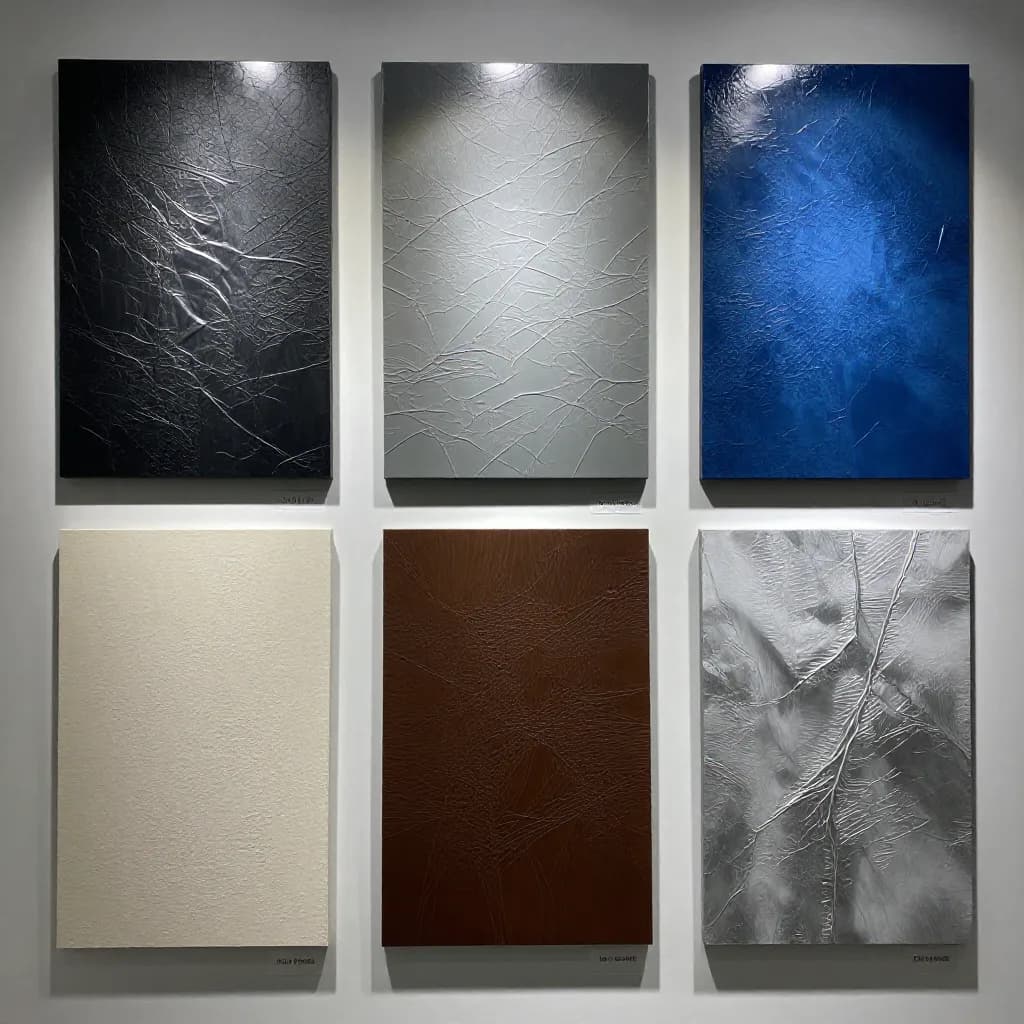
Beyond cosmetics, texture changes how a surface interacts with its environment. A wrinkle or sand finish scatters light in multiple directions, reducing glare on equipment housings and instrument panels. Textured surfaces also improve grip, making them practical for handles, tool bodies, and racking systems. In architectural applications, texture adds visual depth and tactile interest that flat coatings cannot replicate, giving designers another dimension to work with.
Ready to Start Your Project?
From one-off customs to 15,000-part production runs — get precise pricing in 24 hours.
On This Page
Why Textured Powder Coatings Exist
Textured finishes are formulated differently from their smooth counterparts. The texture is not created by the application technique alone — it is engineered into the powder chemistry. Specific additives, resin combinations, and cure profiles cause the film to flow unevenly during the melt phase, producing controlled surface disruption. Understanding how each texture type is formulated helps specifiers choose the right finish for the job and set realistic expectations for appearance consistency across production runs.
Wrinkle Finish: Formulation and Characteristics
Wrinkle finishes — sometimes called crinkle or crackle finishes — produce a tight, irregular pattern of fine ridges and valleys across the coated surface. The effect resembles crumpled fabric or dried mud, and it ranges from a fine micro-wrinkle to a coarse, deeply furrowed texture depending on formulation and cure conditions. Wrinkle finishes are among the most popular textured powder coatings, widely used on electrical enclosures, toolboxes, engine valve covers, and industrial equipment housings.
The wrinkle effect is created by differential cure rates within the film. The powder formulation contains additives — typically modified silicones or incompatible resin blends — that cause the outer surface of the film to cure and shrink faster than the underlying layers. As the interior continues to flow and gas escapes, the already-rigid outer skin buckles and folds, producing the characteristic wrinkled pattern. The degree of wrinkling is controlled by additive concentration, film thickness, and oven temperature profile.
Film thickness is a critical variable. Wrinkle finishes typically require heavier application — 75 to 125 microns or more — to develop their full texture. Too thin an application produces an incomplete, patchy wrinkle that looks like a defect rather than a deliberate finish. Oven temperature ramp rate also matters: a fast ramp encourages more aggressive wrinkling, while a slow ramp produces a subtler effect. This sensitivity to process variables means that wrinkle finishes demand tighter process control than smooth coatings to achieve consistent results across batches.
Hammer-Tone Finish: The Classic Industrial Texture
Hammer-tone finishes produce a distinctive pattern of overlapping dimples that resembles the surface of hand-hammered metal. This finish has a long history in industrial coating, predating powder coating itself — it was originally achieved with solvent-based paints. The powder coating version replicates the same aesthetic with better durability and none of the VOC emissions. Hammer-tone is a staple finish for electrical panels, safes, office furniture, gym equipment, and decorative metalwork.
The hammer-tone pattern is created by incorporating small amounts of incompatible materials — often silicone oils or specific wax additives — into the powder formulation. During the melt and flow phase in the cure oven, these additives create localized surface tension differences that cause the molten film to pull apart into discrete circular or oval cells. Each cell forms a slight dome or depression, and the boundaries between cells create the characteristic overlapping dimple pattern.
Hammer-tone finishes are available in single-color and multi-color variants. Multi-color hammer-tones blend two or three pigment systems that separate slightly during cure, producing a speckled or mottled appearance within the dimple pattern. These multi-tone versions are exceptionally effective at hiding surface imperfections and fingerprints, making them popular for high-touch surfaces. The finish is typically specified in a semi-gloss to satin sheen range, and it provides moderate texture that is easy to clean while still offering good imperfection concealment. Application thickness is usually in the 60 to 100 micron range, making it less demanding than wrinkle finishes in terms of film build requirements.
Sand and Leather Textures: Subtle Surface Effects
Sand textures and leather textures represent the finer end of the textured powder coating spectrum. These finishes add just enough surface disruption to change the visual and tactile character of the coating without creating the bold, obvious patterns of wrinkle or hammer-tone finishes. They are popular in applications where a smooth finish would look too plain or too prone to showing fingerprints, but a heavy texture would be inappropriate — think consumer electronics housings, medical device enclosures, premium appliance panels, and architectural hardware.
Sand texture produces a fine, granular surface that resembles wet-packed sand or fine sandpaper. It is created by incorporating texturing agents — typically PTFE-based or modified polyethylene wax particles — into the powder formulation. These particles do not fully melt during cure, creating tiny raised points across the surface. The density and size of the texturing agent particles determine whether the result is a fine, almost imperceptible grain or a coarser, more tactile surface. Sand textures are often specified in matte or low-gloss formulations, reinforcing the understated aesthetic.
Leather texture aims to replicate the look and feel of natural leather grain. It produces a slightly irregular, organic-looking surface with soft undulations rather than sharp peaks. The formulation approach is similar to sand texture but uses different additive chemistries and particle sizes to create broader, more rounded surface features. Leather textures are particularly effective in dark colors — blacks, deep browns, and charcoals — where they closely mimic genuine leather. Both sand and leather textures are applied at standard film thicknesses of 60 to 80 microns and are less sensitive to process variables than wrinkle or hammer-tone finishes, making them easier to reproduce consistently.
River Vein Texture: Dramatic Visual Depth
River vein texture — also called vein or antique vein finish — is the most visually dramatic of the standard textured powder coatings. It produces a pattern of raised ridges and channels that flow across the surface like river tributaries or cracked earth, creating a bold, three-dimensional appearance. River vein finishes are popular for decorative applications including ornamental ironwork, fireplace surrounds, furniture frames, lighting fixtures, and custom automotive parts where visual impact is the primary goal.
The river vein effect is produced by a fundamentally different mechanism than other textures. The powder formulation contains a blend of two incompatible resin systems or a resin combined with a specific veining agent. During the cure cycle, these components phase-separate, with one system flowing and the other resisting flow. The result is a network of raised veins where the higher-viscosity component has accumulated, separated by smoother valleys where the lower-viscosity component has settled. The pattern is inherently random and organic, meaning no two parts will have identical vein patterns — a characteristic that adds to the artisanal appeal but can complicate quality acceptance criteria.
River vein finishes require careful process control to achieve the desired pattern density and vein prominence. Film thickness, oven temperature, and cure time all influence the final appearance. Heavier films and higher temperatures tend to produce bolder, more widely spaced veins, while thinner films and lower temperatures yield finer, more densely packed patterns. Color options for river vein finishes often feature contrasting tones — a dark base with lighter veins, or a metallic base with matte veins — to maximize the visual depth effect. These finishes are typically specified at 80 to 120 microns and are best suited to parts with relatively simple geometry, as complex shapes can cause uneven vein distribution.
Choosing the Right Texture for Your Application
Selecting a textured powder coating requires balancing aesthetic goals, functional requirements, and practical constraints. The first consideration is the substrate condition. If the primary motivation for texture is hiding surface imperfections, the severity of those imperfections determines the minimum texture intensity needed. Light scratches and minor porosity can be concealed by sand or leather textures, while heavy weld spatter, deep casting marks, or significant surface variation may require wrinkle or hammer-tone finishes with their more aggressive surface disruption.
Functional requirements narrow the field further. If the coated surface will be handled frequently, a texture that resists fingerprint visibility — hammer-tone or sand — is preferable to a smooth or wrinkle finish. If glare reduction is important, any matte texture will outperform a glossy smooth finish, but sand and leather textures offer the most uniform light diffusion. For outdoor applications, consider that textured surfaces can trap dirt and moisture in their valleys, potentially requiring more frequent cleaning than smooth finishes in heavily polluted or coastal environments.
Cleanability is an often-overlooked factor. Fine sand textures and leather textures are relatively easy to wipe clean because their surface features are shallow. Wrinkle and river vein finishes, with their deeper valleys and sharper ridges, can trap contaminants more stubbornly. In food processing, pharmaceutical, or cleanroom environments, smooth finishes are almost always preferred for hygiene reasons, and textured finishes should be avoided unless specifically validated for the cleanliness requirements of the application.
Application and Quality Control Considerations
Applying textured powder coatings requires adjustments to standard application parameters. Because many textures are sensitive to film thickness, applicators must pay closer attention to mil gauge readings and adjust gun settings to achieve the heavier builds that wrinkle and river vein finishes demand. Electrostatic wrap-around — the tendency of charged powder to seek ground paths around part edges — can cause thicker deposits on edges and thinner deposits in recesses, leading to inconsistent texture development across complex geometries.
Racking and part orientation also influence texture consistency. Gravity affects the flow of molten powder during cure, so vertically oriented surfaces may develop slightly different texture patterns than horizontal surfaces on the same part. For critical appearance parts, applicators may need to orient parts consistently in the oven and establish acceptance standards that account for normal variation between horizontal and vertical surfaces.
Quality control for textured finishes is inherently more subjective than for smooth coatings. While film thickness can be measured with standard gauges, texture appearance is typically evaluated by visual comparison against approved reference panels. Specifiers should establish limit samples — showing the acceptable range from minimum to maximum texture intensity — and agree on these standards with the coating applicator before production begins. Gloss measurement is less meaningful on heavily textured surfaces because the texture itself scatters the measurement beam, producing readings that do not correlate well with visual perception. For textured finishes, visual assessment against reference standards remains the most reliable quality control method.
Combining Textures with Color and Effect
Textured powder coatings are available in the full range of colors, and combining texture with metallic, pearlescent, or color-shift effects can produce finishes of remarkable visual complexity. A hammer-tone finish with aluminum flake pigment creates a surface that shimmers differently in each dimple cell, producing a jewel-like effect. A wrinkle finish in a deep candy red with subtle metallic undertones can replicate the look of exotic leather or reptile skin. River vein textures with contrasting metallic and matte phases create surfaces that resemble natural stone or aged bronze.
These combination finishes are increasingly popular in premium consumer products, custom automotive work, and high-end architectural hardware where visual distinction is a competitive advantage. However, combining texture with special-effect pigments adds complexity to both formulation and application. Metallic pigments can orient differently in textured films than in smooth films, and the texture pattern can either enhance or diminish the metallic effect depending on how light interacts with the surface geometry.
When specifying textured finishes with special effects, it is essential to evaluate actual coated samples rather than relying on color chips or digital renderings. The interaction between texture and effect pigments is difficult to predict from flat samples, and the final appearance can vary significantly with viewing angle and lighting conditions. Request sprayed panels on the actual substrate material and evaluate them under the lighting conditions where the finished product will be used. This investment in sample evaluation prevents costly surprises when production parts arrive looking different from expectations.
Frequently Asked Questions
What is the best textured powder coating for hiding surface imperfections?
Wrinkle and hammer-tone finishes are the most effective at concealing surface imperfections such as weld marks, casting porosity, and grinding scratches. Their bold, deliberate patterns absorb irregularities that would be visible under a smooth finish. For lighter imperfections, sand or leather textures may be sufficient.
Are textured powder coatings as durable as smooth finishes?
Yes, textured powder coatings use the same base resin chemistries as smooth finishes and offer equivalent corrosion protection and UV resistance. The texture is created by additives that affect surface flow during cure, not by compromising the protective properties of the film. In some cases, the thicker film builds required for textures provide additional protection.
Can textured powder coatings be used outdoors?
Absolutely. Textured finishes based on polyester or super-durable polyester resins perform well in exterior applications. However, heavily textured surfaces may trap dirt and moisture more readily than smooth finishes, so periodic cleaning is recommended, especially in coastal or high-pollution environments.
How is texture consistency controlled in production?
Texture consistency depends on controlling film thickness, oven temperature profile, and cure time within tight tolerances. Quality is assessed by visual comparison against approved reference panels showing acceptable minimum and maximum texture intensity. Limit samples should be agreed upon between the specifier and applicator before production begins.
What is the difference between wrinkle and hammer-tone finishes?
Wrinkle finishes produce a tight pattern of fine ridges and valleys resembling crumpled fabric, created by differential cure rates in the film. Hammer-tone finishes produce overlapping circular dimples resembling hand-hammered metal, created by surface tension differences from incompatible additives. Wrinkle tends to be more aggressive in texture, while hammer-tone is smoother and easier to clean.
Can I get a textured powder coating in any color?
Yes, textured powder coatings are available across the full RAL color range and can be custom-matched to specific color references. They can also be combined with metallic, pearlescent, and other special-effect pigments, though sample evaluation is strongly recommended when combining texture with effect pigments.
Ready to Start Your Project?
From one-off customs to 15,000-part production runs — get precise pricing in 24 hours.