Temperature-indicating powder coatings are functional coatings that change color in response to temperature variations, providing a visual signal of thermal conditions on coated surfaces. These coatings integrate thermochromic pigments into a powder coating matrix, creating a finish that serves both protective and diagnostic functions. The color change can be reversible — returning to the original color when the temperature normalizes — or irreversible, providing a permanent record that a specific temperature threshold has been exceeded.
Innovation
Temperature-Indicating Powder Coatings: Thermochromic Technology for Industrial Monitoring
Sundial Powder Coating·April 22, 2026·11 min
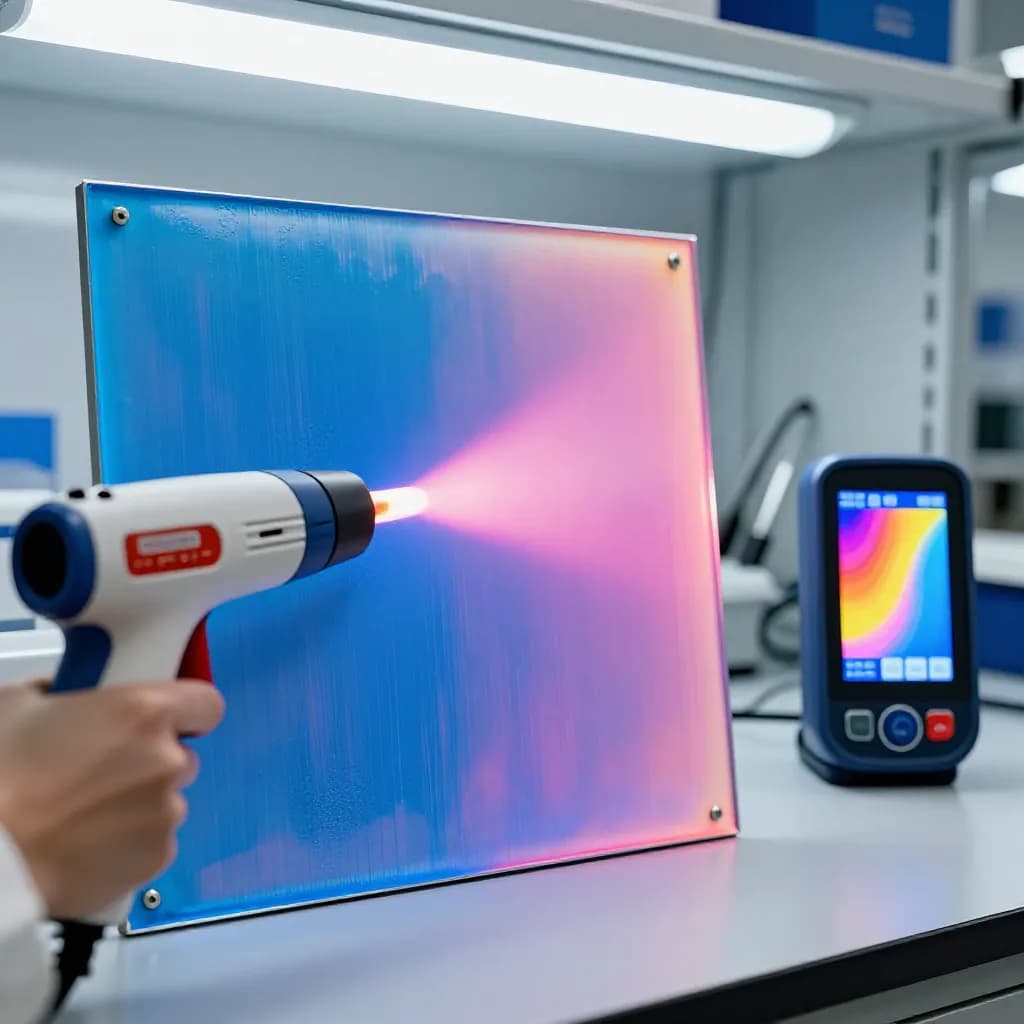
The technology bridges the gap between passive protective coatings and active monitoring systems. Traditional temperature monitoring relies on thermocouples, infrared cameras, or adhesive temperature labels, all of which require either wiring, specialized equipment, or manual inspection. A thermochromic powder coating transforms the entire coated surface into a temperature sensor, providing immediate, intuitive visual feedback without any additional instrumentation.
Ready to Start Your Project?
From one-off customs to 15,000-part production runs — get precise pricing in 24 hours.
On This Page
What Are Temperature-Indicating Powder Coatings?
The applications span industries where thermal management is critical: electrical switchgear, steam and process piping, heat exchangers, exhaust systems, industrial ovens, and safety-critical components in power generation and petrochemical facilities. By making temperature visible, these coatings enable faster detection of overheating, insulation failures, and process deviations, reducing the risk of equipment damage, fire, and unplanned downtime.
Thermochromic Pigment Chemistry and Mechanisms
Thermochromic pigments used in powder coatings operate through two primary chemical mechanisms. Leuco dye systems consist of a color-forming dye, a developer compound, and a co-solvent, all encapsulated within a polymer shell typically 1-10 microns in diameter. Below the activation temperature, the dye and developer interact to produce a visible color. Above the activation temperature, the co-solvent melts and disrupts the dye-developer interaction, causing the color to disappear or shift. This mechanism is inherently reversible and is used for coatings that need to cycle between colored and decolorized states repeatedly.
Liquid crystal thermochromic systems use cholesteric liquid crystals that selectively reflect different wavelengths of light depending on temperature. As temperature increases, the helical pitch of the liquid crystal structure changes, shifting the reflected color through the visible spectrum. These systems can provide a continuous color gradient across a temperature range, enabling semi-quantitative temperature estimation from the observed color.
For irreversible temperature indication, powder coatings incorporate pigments based on metal oxide or metal salt reactions that undergo permanent chemical or crystallographic changes at specific temperatures. These include compounds that decompose, oxidize, or undergo phase transitions at defined thresholds. Once the color change occurs, it cannot be reversed, providing a tamper-proof record that the component reached or exceeded the critical temperature. This irreversibility is essential for safety applications where evidence of overheating must be preserved for inspection and documentation.
Reversible vs. Irreversible Indicator Systems
The choice between reversible and irreversible thermochromic powder coatings depends on the application's monitoring requirements. Reversible systems are ideal for real-time process monitoring where operators need to see current thermal conditions. A steam pipe coated with a reversible thermochromic powder coating, for example, would visually indicate whether the pipe is at operating temperature, below temperature suggesting insulation failure, or above temperature indicating a process upset. The coating continuously reflects the current state, functioning as a distributed temperature display.
Irreversible systems serve a fundamentally different purpose: they provide evidence of historical temperature exceedance. This is critical for safety-critical components where overheating may cause invisible material degradation. An electrical busbar that has experienced a transient overheating event due to a loose connection may appear normal after cooling, but an irreversible thermochromic coating would retain the color change, alerting maintenance personnel to investigate. Similarly, fire-exposed structural steel can be assessed for heat damage by examining the color state of an irreversible indicator coating.
Some advanced systems combine both approaches in a single coating, using a reversible thermochromic layer for real-time monitoring overlaid on an irreversible indicator layer that records peak temperature exposure. This dual-function approach provides both operational awareness and historical documentation, addressing the needs of both process operators and maintenance inspectors. The engineering challenge is ensuring that both pigment systems remain functional and visually distinguishable within the same coating film.
Formulation Challenges for Powder Coating Integration
Incorporating thermochromic pigments into powder coatings presents unique formulation challenges that differ significantly from liquid paint systems. The primary concern is thermal stability during the powder manufacturing and curing process. Standard powder coatings are extruded at 90-120°C and cured at 160-200°C, temperatures that can degrade or prematurely activate thermochromic pigments, particularly leuco dye systems with activation temperatures below the curing range.
Formulators address this challenge through several strategies. Encapsulation technology has advanced to produce thermochromic pigments with enhanced thermal stability, using high-melting-point shell materials that protect the active components during processing. Low-temperature cure powder coating chemistries, curing at 120-140°C, expand the window for incorporating pigments with lower activation temperatures. Post-addition techniques, where thermochromic pigments are dry-blended with the base powder after extrusion rather than co-extruded, avoid exposing the pigments to the high-shear, high-temperature extrusion environment.
Color intensity and contrast are additional formulation considerations. Thermochromic pigments must produce a color change that is clearly visible against the base coating color under the lighting conditions of the intended application. This requires careful selection of base coat color, pigment loading level, and film thickness. For industrial environments with poor lighting, high-contrast color transitions — such as white to red or green to black — are preferred over subtle shifts. UV stability is another concern, as some thermochromic pigments are susceptible to photodegradation, limiting outdoor applications unless UV-absorbing additives or protective clear coats are incorporated.
Industrial Monitoring and Safety Applications
The most compelling applications for temperature-indicating powder coatings are in industrial environments where thermal anomalies signal equipment malfunction or safety hazards. Electrical infrastructure is a prime example: switchgear, busbars, cable terminations, and transformer housings can be coated with irreversible thermochromic powder coatings that change color if connection resistance increases and causes localized heating. This provides a simple, visual inspection method that supplements thermal imaging programs and can detect problems between scheduled infrared surveys.
Process piping in chemical plants, refineries, and power stations benefits from reversible thermochromic coatings that indicate whether pipes are at the correct operating temperature. Insulation failures, steam trap malfunctions, and heat tracing system faults become immediately visible as color anomalies on the pipe surface, enabling maintenance teams to identify and prioritize repairs without specialized equipment. The visual nature of the indication means that any plant personnel — not just trained thermographers — can spot potential issues during routine walkthroughs.
Fire protection is another significant application area. Structural steel members coated with irreversible temperature-indicating powder coatings provide post-fire assessment capability, allowing engineers to determine which members experienced temperatures high enough to compromise structural integrity. This information is critical for making safe re-occupancy decisions after a fire event and for prioritizing structural repairs. The coating effectively creates a permanent temperature map of the fire exposure across the entire coated structure.
Automotive and Consumer Product Applications
Beyond heavy industry, temperature-indicating powder coatings are finding applications in automotive and consumer products where thermal feedback enhances safety or user experience. Automotive exhaust components, brake calipers, and engine covers coated with thermochromic powder coatings can provide visual warnings of abnormal operating temperatures, alerting drivers or mechanics to potential problems before they escalate to component failure.
In the consumer space, thermochromic powder coatings on cookware, beverage containers, and heated appliances provide intuitive temperature feedback. A powder-coated kettle that changes color as water approaches boiling temperature, or a radiator cover that indicates heating system status through color change, adds functional value to everyday products. The durability and food-contact safety of powder coatings make them well-suited to these applications compared to thermochromic liquid paints or adhesive labels.
Architectural applications are emerging as well. Facade panels and roofing elements coated with reversible thermochromic powder coatings can visually indicate surface temperature, providing information relevant to urban heat island studies, building energy performance assessment, and occupant comfort. While these applications are still largely experimental, they demonstrate the breadth of possibilities when protective coatings are enhanced with temperature-sensing functionality. The aesthetic integration of thermochromic effects into architectural design — where color change becomes a deliberate design feature rather than a purely functional indicator — represents an intriguing convergence of engineering and architecture.
Testing Standards and Performance Validation
Validating the performance of temperature-indicating powder coatings requires testing protocols that go beyond standard coating property measurements. The critical performance parameters include activation temperature accuracy, color change contrast, response time, cycling durability for reversible systems, and long-term stability of both the thermochromic function and the base coating properties.
Activation temperature accuracy is typically verified using calibrated hot plates or environmental chambers, with the color transition temperature measured to within plus or minus 1-2°C of the specified value. For safety-critical applications, this accuracy must be maintained across the coating's entire service life, requiring accelerated aging studies that combine thermal cycling, UV exposure, humidity, and chemical exposure to simulate years of field conditions.
Reversible systems must demonstrate consistent color change over thousands of thermal cycles without degradation of contrast or shift in activation temperature. Irreversible systems must prove that the color change is truly permanent and cannot be reversed by subsequent heating, cooling, or chemical exposure. Industry standards for thermochromic coatings are still evolving, with organizations such as ASTM and ISO developing test methods specific to temperature-indicating materials. In the interim, manufacturers typically reference a combination of standard coating tests for mechanical and chemical properties alongside proprietary thermochromic performance specifications validated through independent laboratory testing.
Frequently Asked Questions
What temperature ranges can thermochromic powder coatings indicate?
Thermochromic powder coatings can be formulated to indicate temperatures from approximately 30°C to over 500°C, depending on the pigment chemistry. Leuco dye systems typically cover the 30-120°C range, liquid crystal systems operate in the 20-90°C range, and inorganic irreversible pigments can indicate temperatures from 100°C to above 500°C. Custom activation temperatures can be specified for specific applications.
How accurate are temperature-indicating coatings?
Well-formulated thermochromic powder coatings can indicate temperature transitions with an accuracy of plus or minus 1-3°C for leuco dye and liquid crystal systems. Irreversible inorganic systems are typically accurate to plus or minus 5-10°C. While not as precise as electronic temperature sensors, the visual indication across an entire surface provides spatial temperature information that point sensors cannot match.
Do thermochromic powder coatings lose their function over time?
Reversible thermochromic pigments can degrade over time due to UV exposure, chemical attack, or thermal fatigue from repeated cycling. Typical functional lifespans range from 2-5 years for outdoor applications and 5-10 years for indoor use. Irreversible systems are generally more stable because they only need to function once. UV-protective clear coats and stabilizer additives can extend functional life.
Can temperature-indicating coatings replace thermal imaging?
Temperature-indicating coatings complement rather than replace thermal imaging. They provide continuous, always-on visual monitoring that any observer can interpret, while thermal imaging provides precise, quantitative temperature data at specific inspection intervals. The combination of both technologies provides the most comprehensive thermal monitoring strategy for critical industrial assets.
Are thermochromic powder coatings suitable for food-contact surfaces?
Some thermochromic powder coating formulations can be designed for food-contact compliance, but this requires careful selection of pigments and encapsulation materials that meet FDA or EU food-contact regulations. Not all thermochromic pigments are food-safe, so specific formulations must be validated for migration and toxicity before use on cookware, food processing equipment, or beverage containers.
Ready to Start Your Project?
From one-off customs to 15,000-part production runs — get precise pricing in 24 hours.