Green building certification systems such as LEED, BREEAM, and DGNB evaluate buildings across multiple sustainability criteria, and the choice of coatings and finishes can contribute to credits in several categories. While coatings may seem like a minor component compared to structural systems or HVAC equipment, they are applied to vast surface areas throughout a building — walls, ceilings, floors, facades, window frames, doors, and metalwork — making their cumulative environmental impact significant.
Technical
Sustainable Coatings for Green Building: LEED, BREEAM & Beyond
Sundial Powder Coating·April 20, 2026·10 min
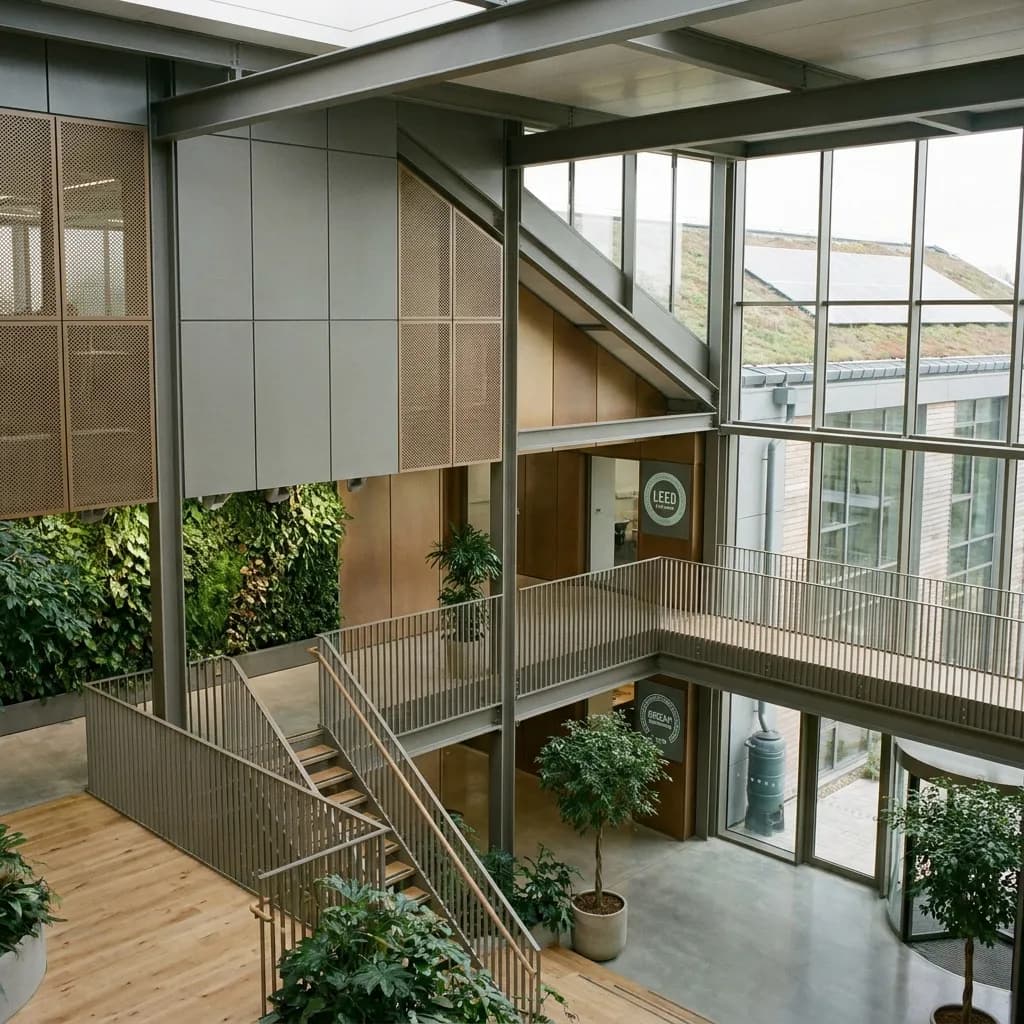
Coatings affect indoor air quality through VOC emissions, contribute to the building's embodied carbon through their manufacturing footprint, influence energy performance through solar reflectance properties, and determine the maintenance and replacement cycle of finished surfaces. A coating that lasts 25 years instead of 10 reduces the lifecycle environmental impact by more than half, as it avoids the resource consumption, waste generation, and disruption associated with recoating.
Ready to Start Your Project?
From one-off customs to 15,000-part production runs — get precise pricing in 24 hours.
On This Page
Why Coatings Matter for Green Building Certification
For project teams pursuing green building certification, understanding how coating choices affect available credits can help optimize the overall sustainability score. Early engagement with coating manufacturers during the design phase allows specifiers to identify products with the best environmental credentials and obtain the documentation — such as Environmental Product Declarations, VOC test reports, and recycled content certificates — needed to support credit claims during the certification process.
Powder Coating's Sustainability Advantages
Powder coating is inherently one of the most sustainable coating technologies available, offering environmental advantages across multiple dimensions. The most significant benefit is the virtual elimination of VOC emissions. Because powder coatings are applied as dry powder without any solvents, the application process releases no volatile organic compounds into the atmosphere. This contrasts sharply with conventional solvent-based liquid coatings, which can contain 300 to 500 grams per liter of VOCs, and even waterborne coatings, which typically contain 50 to 150 grams per liter.
Material efficiency is another major sustainability advantage. In a well-managed powder coating operation, overspray powder is collected by the recovery system and recycled back into the application process, achieving material utilization rates of 95 to 98 percent. This means that virtually all of the powder purchased ends up on the finished product, with minimal waste. Liquid coating operations, by comparison, typically achieve 30 to 70 percent transfer efficiency, with the remainder lost as overspray waste that must be disposed of as hazardous material.
Powder coating operations also generate no hazardous liquid waste, require no solvent storage or handling infrastructure, and produce no wastewater from coating application (though pretreatment processes do generate wastewater that must be treated). The absence of solvents eliminates fire and explosion risks associated with solvent-based coating operations, reducing insurance costs and safety infrastructure requirements. Energy consumption for curing is a consideration, but advances in low-temperature cure powder coatings have reduced oven temperatures by 20 to 50 degrees Celsius compared to standard formulations, delivering meaningful energy savings.
LEED Credits Related to Coatings
The LEED (Leadership in Energy and Environmental Design) green building rating system, developed by the U.S. Green Building Council, includes several credit categories where coating choices can contribute to points. Under the Indoor Environmental Quality (IEQ) category, the Low-Emitting Materials credit requires that interior paints, coatings, adhesives, and sealants meet specified VOC content limits. Powder-coated interior surfaces easily satisfy these requirements since powder coatings contain no VOCs. For liquid coatings used on interior surfaces, products must comply with VOC limits defined by standards such as SCAQMD Rule 1113 or the California Department of Public Health Standard Method.
The Materials and Resources (MR) category offers credits for Building Product Disclosure and Optimization. Products with Environmental Product Declarations (EPDs) that conform to ISO 14025 and EN 15804 can contribute to the Building Product Disclosure credit. Products that demonstrate reduced environmental impact through lifecycle assessment — such as lower global warming potential, reduced resource depletion, or lower waste generation — can contribute to the Optimization credit. Several major powder coating manufacturers now publish EPDs for their product ranges.
Additional LEED credits that coatings can influence include Recycled Content (powder coatings can incorporate recycled materials), Regional Materials (locally manufactured coatings reduce transportation impacts), and Heat Island Reduction (high-reflectance coatings on roof and facade surfaces can help reduce the urban heat island effect). While no single coating choice will make or break a LEED certification, the cumulative contribution of well-specified coatings across a large project can add meaningful points to the overall score.
BREEAM Credits Related to Coatings
BREEAM (Building Research Establishment Environmental Assessment Method), the world's oldest and most widely used green building certification system, originated in the United Kingdom and is now applied globally. BREEAM evaluates buildings across categories including Health and Wellbeing, Materials, Energy, and Pollution, several of which are influenced by coating specifications.
Under the Health and Wellbeing category, BREEAM awards credits for indoor air quality, including the specification of low-VOC interior finishes. Products that carry recognized eco-labels such as the EU Ecolabel, Blue Angel, or Nordic Swan, or that meet the emission requirements of standards like ISO 16000 or the French VOC labeling scheme, can contribute to these credits. Powder-coated interior surfaces inherently meet the most stringent emission requirements due to their zero-VOC composition.
The Materials category in BREEAM evaluates the responsible sourcing and environmental impact of building materials. Products with third-party verified EPDs, responsible sourcing certifications, and demonstrated lifecycle environmental performance can earn credits in this category. BREEAM also considers the durability and maintenance requirements of materials — coatings that provide longer service life and require less frequent replacement score more favorably in lifecycle assessments. The Pollution category addresses emissions to air, land, and water during construction and operation, where the zero-VOC and minimal-waste characteristics of powder coating provide clear advantages over solvent-based alternatives.
Environmental Product Declarations and What They Tell You
An Environmental Product Declaration (EPD) is a standardized, third-party verified document that transparently communicates the environmental performance of a product throughout its lifecycle. EPDs are prepared according to ISO 14025 and, for construction products, EN 15804, and they are based on lifecycle assessment (LCA) data that quantifies the environmental impacts associated with raw material extraction, manufacturing, transportation, use, and end-of-life disposal.
Key environmental indicators reported in an EPD include Global Warming Potential (GWP), measured in kilograms of CO2 equivalent, which quantifies the product's contribution to climate change. Ozone Depletion Potential, Acidification Potential, Eutrophication Potential, and Photochemical Ozone Creation Potential are also reported, providing a comprehensive picture of the product's environmental footprint. Resource consumption indicators cover the use of renewable and non-renewable primary energy, as well as water consumption. Waste indicators report the quantities of hazardous and non-hazardous waste generated.
For specifiers and project teams, EPDs provide an objective, comparable basis for evaluating the environmental credentials of different coating products. When comparing EPDs, it is important to ensure that the products are compared on a like-for-like basis — the same functional unit (such as one square meter of coated surface at a specified film thickness and service life), the same lifecycle stages, and the same impact assessment methodology. EPDs from different manufacturers that follow the same Product Category Rules (PCR) are designed to be comparable. The availability of EPDs for powder coatings is growing, and several major manufacturers now offer product-specific or product-group EPDs that can be used to support green building credit applications.
The Future of Sustainable Coatings
The coatings industry is actively pursuing several innovation pathways that promise to further reduce the environmental footprint of coating products and processes. Bio-based resins derived from renewable feedstocks such as plant oils, sugars, and lignin are being developed as alternatives to petroleum-based raw materials. While bio-based powder coatings are still in the early stages of commercialization, several manufacturers have introduced products incorporating 25 to 40 percent bio-based content, with the goal of reaching higher levels as the technology matures.
Circular economy principles are gaining traction in the coatings industry. This includes designing coatings for easier removal and substrate recovery at end of life, increasing the use of recycled raw materials in coating formulations, and developing closed-loop systems where coating waste is collected and reprocessed into new products. Some powder coating manufacturers have introduced take-back programs for unused powder and are investing in recycling technologies that can recover and reuse powder coating waste streams.
Carbon-neutral and carbon-negative manufacturing is an emerging goal for leading coating companies. This involves reducing energy consumption through process optimization and low-cure technologies, transitioning to renewable energy sources for manufacturing and curing operations, and offsetting remaining emissions through verified carbon credit programs. Digital color matching and on-demand manufacturing are reducing waste from obsolete inventory and overproduction. As green building standards continue to evolve and tighten their requirements, the coatings industry's commitment to sustainability innovation will play an increasingly important role in enabling the construction sector to meet its environmental targets.
Frequently Asked Questions
Is powder coating considered a green product?
Powder coating is widely recognized as one of the most environmentally friendly coating technologies available. It contains virtually zero VOCs, achieves 95-98% material utilization through overspray recycling, generates no hazardous liquid waste, and eliminates fire risks associated with solvents. These characteristics make powder coating a strong contributor to green building certifications like LEED and BREEAM.
What is an EPD and why does it matter for coatings?
An Environmental Product Declaration (EPD) is a third-party verified document that reports the environmental impacts of a product across its lifecycle, based on standardized lifecycle assessment methodology. EPDs matter for coatings because they provide objective, comparable data on environmental performance that can be used to support green building credit applications under LEED, BREEAM, and other certification systems.
Do powder coatings contain any VOCs?
Powder coatings are considered virtually zero-VOC products. They contain no solvents and release no volatile organic compounds during application or curing. Trace amounts of volatile substances may be released during the curing process from minor formulation components, but these are negligible compared to liquid coatings and well below any regulatory thresholds.
How do coatings contribute to LEED certification?
Coatings can contribute to LEED credits in several categories: Low-Emitting Materials (zero or low-VOC coatings for interior surfaces), Building Product Disclosure (products with EPDs), Environmental Product Optimization (products with demonstrated reduced environmental impact), Recycled Content, Regional Materials, and Heat Island Reduction (high-reflectance coatings). The specific credits available depend on the LEED version and project type.
What makes a coating sustainable?
A sustainable coating minimizes environmental impact across its entire lifecycle. Key factors include low or zero VOC content, high material efficiency with minimal waste, low energy consumption during manufacturing and application, use of renewable or recycled raw materials, long service life that reduces recoating frequency, and responsible end-of-life management. Third-party certifications, eco-labels, and EPDs help verify sustainability claims.
Ready to Start Your Project?
From one-off customs to 15,000-part production runs — get precise pricing in 24 hours.