The RAL color system is the most widely used standardized color matching system in Europe and one of the most recognized color standards worldwide. RAL stands for Reichsausschuss fuer Lieferbedingungen, which translates to the National Committee for Delivery Terms and Quality Assurance. The system was established in 1927 in Germany with an initial collection of just 40 colors, created to provide a standardized reference that manufacturers, suppliers, and customers could use to communicate color specifications without ambiguity.
Technical
RAL Color Chart: The Complete Guide to RAL Classic Colors
Sundial Powder Coating·April 20, 2026·11 min
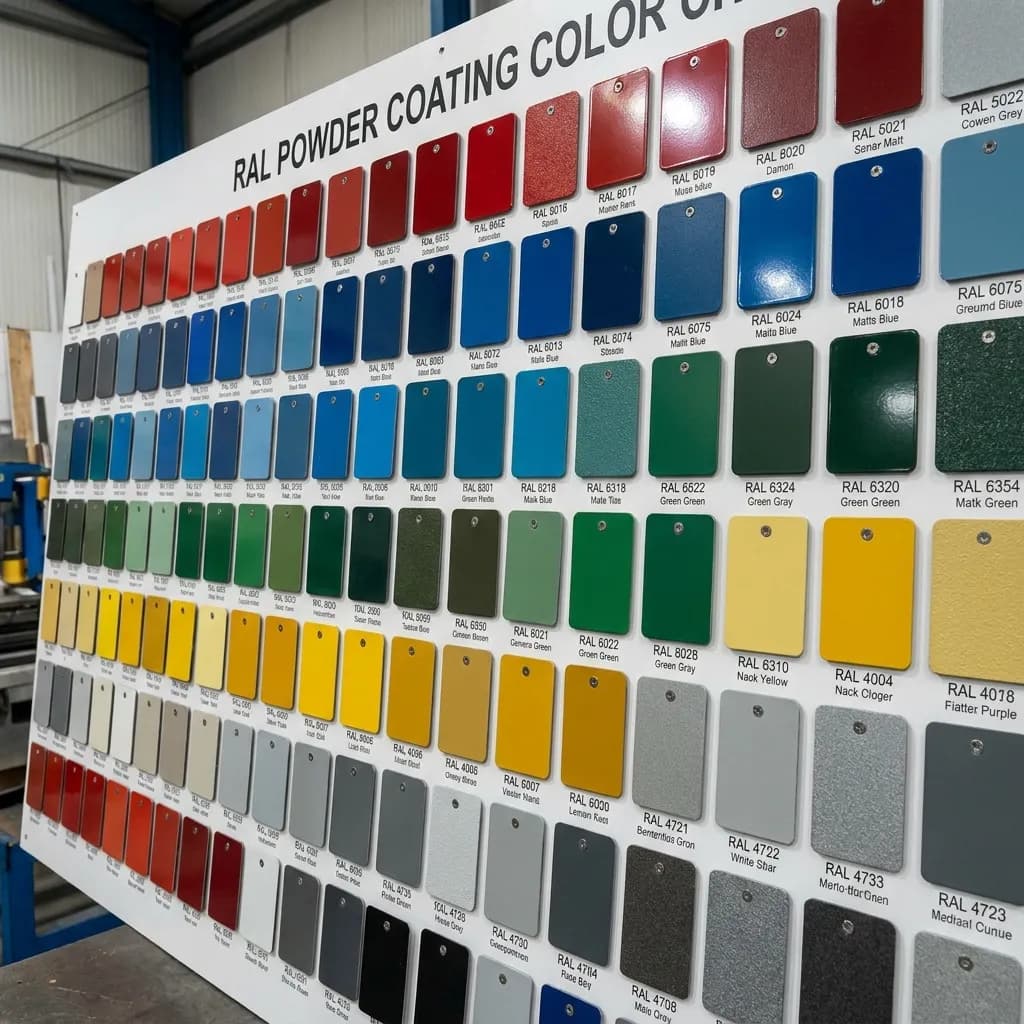
Over the decades, the RAL Classic collection has grown to include 216 colors, each assigned a unique four-digit code. The system is maintained and administered by RAL gGmbH, a subsidiary of the RAL Institute based in Bonn, Germany. RAL colors are defined by precise colorimetric values, ensuring that any product manufactured to a specific RAL code will match the standard regardless of where or by whom it is produced. This consistency is essential in industries like construction, automotive, and industrial manufacturing where color accuracy across different components and suppliers is critical.
Ready to Start Your Project?
From one-off customs to 15,000-part production runs — get precise pricing in 24 hours.
On This Page
What Is the RAL Color System?
The RAL color system has become the default color reference for the European powder coating industry. When an architect specifies a facade color, a window manufacturer orders powder coating, or a designer selects a finish for furniture, the RAL code is the common language that ensures everyone is referring to exactly the same color. Physical RAL color fans and charts are available for visual reference, and digital spectrophotometric data is used for precise color matching in manufacturing.
How RAL Codes Work
Each RAL Classic color is identified by a four-digit code where the first digit indicates the hue family and the remaining three digits identify the specific color within that family. This systematic numbering makes it easy to navigate the color range and understand the general character of a color from its code alone. For example, any code beginning with 5 belongs to the blue family, while codes beginning with 9 are in the white and black family.
The numbering within each family is not strictly sequential in terms of lightness or saturation — the numbers were assigned as colors were added to the system over time. However, the first digit provides an immediate indication of the color's hue group, which is helpful when browsing the range or communicating specifications. Some numbers within each family have been reserved for future additions, which is why there are gaps in the numbering sequence.
When specifying a RAL color, the code is typically written as "RAL" followed by the four-digit number, for example RAL 7016 or RAL 9010. In some contexts, the color name is also included for clarity, such as RAL 7016 Anthracite Grey or RAL 9010 Pure White. It is important to always reference the RAL code rather than relying on the color name alone, as names can vary between languages and may not be unique across different color systems.
The Nine RAL Color Families
The RAL Classic system is organized into nine color families, each identified by the first digit of the four-digit code. The Yellow family (1xxx) includes 30 colors ranging from light ivory and cream tones through bright signal yellows to deep golden and olive shades. The Orange family (2xxx) contains 13 colors spanning from pale pastel orange through vivid signal orange to deep red-orange tones. The Red family (3xxx) offers 25 colors from soft pink and salmon through bright fire red and signal red to deep wine red and ruby.
The Violet family (4xxx) is the smallest with just 10 colors, including soft lilac, pastel violet, signal violet, and deep purple tones. The Blue family (5xxx) comprises 25 colors ranging from light pastel blue and sky blue through vivid signal blue and ultramarine to deep navy and distant blue. The Green family (6xxx) includes 36 colors — the largest family — covering everything from pale pastel green and mint through bright signal green and emerald to deep fir green and olive.
The Grey family (7xxx) contains 38 colors and is one of the most commercially important families, spanning from very light silver grey through medium tones like window grey and stone grey to dark shades like anthracite and graphite. The Brown family (8xxx) includes 20 colors from light beige and sand through chocolate and mahogany to deep sepia. Finally, the White and Black family (9xxx) contains 14 colors including pure white, cream white, traffic white, signal white, and various black shades. The grey, white, and black families together account for a disproportionately large share of powder coating consumption.
Most Popular RAL Colors
While all 216 RAL Classic colors are available in powder coating, a relatively small number of colors dominate commercial demand. RAL 7016 Anthracite Grey has emerged as one of the most popular architectural colors in recent years, prized for its sophisticated dark grey tone that complements both modern and traditional building designs. It is the go-to choice for window frames, doors, and facade elements across Europe, offering a contemporary alternative to black that is less stark and more versatile.
RAL 9010 Pure White remains one of the highest-volume colors in the powder coating industry. Its clean, slightly warm white tone is universally popular for interior and exterior applications, from window frames and ceiling systems to furniture and appliances. RAL 7035 Light Grey is another perennial bestseller, widely used for electrical enclosures, industrial equipment, laboratory furniture, and interior architectural elements. Its neutral, light tone provides a clean, professional appearance that works in virtually any setting.
RAL 9005 Jet Black is the standard choice when a true black finish is required, popular for decorative ironwork, automotive accessories, furniture, and architectural accents. RAL 8017 Chocolate Brown has maintained strong demand in the window and door market, particularly in regions where traditional brown window frames are preferred. Other consistently popular colors include RAL 9016 Traffic White, RAL 7021 Black Grey, RAL 7024 Graphite Grey, RAL 6005 Moss Green, and RAL 3000 Flame Red. Regional preferences vary significantly, with Scandinavian markets favoring lighter tones and Mediterranean markets showing stronger demand for warmer earth tones.
RAL Classic vs RAL Design vs RAL Effect
Beyond the well-known RAL Classic collection, the RAL organization has developed two additional color systems to meet different needs. RAL Design, introduced in 1993, is a systematically organized collection of 1,825 colors arranged according to the CIELab color space. Unlike RAL Classic, where colors were added incrementally over decades, RAL Design was created as a comprehensive, logically structured system where colors are defined by their hue, lightness, and chroma values. Each RAL Design color is identified by a seven-digit code in the format HHH LL CC, making it easy to understand the color's position in color space.
RAL Design is particularly popular among architects, interior designers, and product designers who need access to a wider range of precisely defined colors. The systematic arrangement makes it easy to find harmonious color combinations, create gradients, or select colors with specific lightness or saturation characteristics. However, RAL Design colors are less commonly stocked by powder coating manufacturers than RAL Classic colors, so they may require custom manufacturing with associated minimum order quantities and lead times.
RAL Effect, launched in 2007, is the newest addition to the RAL family and includes 420 solid colors and 70 metallic colors. The RAL Effect collection was developed with a focus on industrial design and incorporates colors inspired by nature, fashion, and contemporary design trends. The metallic colors in RAL Effect are particularly noteworthy, as they provide standardized references for metallic finishes that were previously difficult to specify consistently. For powder coating applications, RAL Classic remains the dominant reference system, but RAL Design and RAL Effect provide valuable additional options for projects requiring specific colors outside the Classic range.
How to Specify RAL Colors for Your Project
Properly specifying RAL colors for a project requires attention to several details beyond simply selecting a four-digit code. The specification should include the complete RAL code, the desired gloss level (measured in gloss units at 60 degrees), and the surface texture (smooth, fine texture, or other). These three parameters together define the complete finish specification, as the same RAL color can look significantly different at different gloss levels or with different textures.
When evaluating colors, always use an official RAL color fan or register rather than relying on colors displayed on computer screens or printed materials. Screen and print colors are approximations that can vary significantly from the actual RAL standard depending on the display calibration, printing process, and viewing conditions. For critical color decisions, request spray-out samples from the powder coating manufacturer on the actual substrate material, as the substrate can influence the final appearance. Evaluate samples under multiple lighting conditions including natural daylight, fluorescent light, and incandescent light.
For projects involving multiple suppliers or coating applicators, ensure that all parties are working to the same RAL reference and that acceptable color tolerances are defined in the specification. Color tolerances are typically expressed as Delta E values, with architectural specifications commonly requiring Delta E of 1.0 or less between production batches and the RAL standard. Including the RAL code, gloss range, texture description, and color tolerance in the project specification eliminates ambiguity and helps ensure consistent results across all coated components.
RAL Colors in Powder Coating
The powder coating industry has a particularly close relationship with the RAL color system. Every major powder coating manufacturer maintains a comprehensive stock range covering the most popular RAL Classic colors in various gloss levels and textures, available for rapid delivery. Colors like RAL 9010, RAL 7016, RAL 9005, and RAL 7035 are produced in such high volumes that they are typically available from stock within days. Less common RAL colors may be manufactured to order with lead times of one to three weeks.
Powder coating manufacturers invest significant effort in ensuring that their RAL color formulations match the official RAL standards as closely as possible. Each production batch is measured with a spectrophotometer and compared against the RAL reference values before being released for sale. Quality certification systems like Qualicoat and GSB include color accuracy requirements as part of their approval criteria, providing an additional layer of quality assurance for architectural applications.
It is worth noting that achieving an exact RAL color match in powder coating can be more challenging for certain colors and effects than others. Very light colors, very dark colors, and colors with high chroma (saturation) can be particularly sensitive to slight variations in pigment loading, film thickness, and curing conditions. Metallic and textured finishes add further complexity, as the visual appearance is influenced by the orientation and distribution of effect pigments and the surface profile. For these reasons, production samples should always be approved before full-scale coating begins, and consistent application parameters should be maintained throughout the production run.
Frequently Asked Questions
How many RAL Classic colors are there?
The RAL Classic collection currently contains 216 standardized colors organized into nine color families. The collection has grown gradually since its founding in 1927, when it started with just 40 colors. New colors are added periodically by the RAL Institute based on industry demand and market trends.
What is the most popular RAL color?
RAL 9010 Pure White and RAL 7016 Anthracite Grey are consistently the most popular RAL colors in the powder coating industry. RAL 9010 dominates in volume due to its widespread use across architectural, industrial, and consumer applications. RAL 7016 has seen rapidly growing demand as the preferred dark grey for modern architectural projects, particularly window frames and facades.
Can I match a Pantone color to RAL?
While there is no direct one-to-one conversion between Pantone and RAL color systems because they use different color definitions and measurement methods, approximate matches can be found using cross-reference tools and spectrophotometric comparison. Powder coating manufacturers can also create custom formulations to match specific Pantone colors. For critical applications, always verify the match with physical samples rather than relying on digital conversions.
Are RAL colors free to use?
The RAL color codes and names can be freely referenced in specifications and communications. However, the RAL color standards themselves (the precise colorimetric data and physical color samples) are proprietary products of RAL gGmbH. Official RAL color fans, registers, and digital color data must be purchased from authorized distributors. Using RAL trademarks in commercial products requires licensing.
What is the difference between RAL 9010 and RAL 9016?
RAL 9010 Pure White has a slightly warm, creamy undertone, while RAL 9016 Traffic White is a cooler, brighter white with a slight blue undertone. RAL 9010 is generally considered more versatile and forgiving, as its warmth complements a wide range of surrounding colors and materials. RAL 9016 appears crisper and more clinical, making it popular for applications where a bright, clean white is desired. The difference is subtle but noticeable when the two are placed side by side.
Ready to Start Your Project?
From one-off customs to 15,000-part production runs — get precise pricing in 24 hours.