Zinc die castings, produced primarily from Zamak alloys (Zamak 3, Zamak 5, and Zamak 7), are among the most widely used precision-cast components in consumer products, automotive trim, hardware, and electronics. The Zamak family — zinc-aluminum-magnesium-copper alloys — offers exceptional castability, allowing the production of thin-walled, complex-geometry parts with tight dimensional tolerances and excellent surface finish directly from the die. Zamak 3 (4% aluminum, 0.04% magnesium) is the most common alloy, while Zamak 5 adds 1% copper for increased strength and hardness.
Technical
Powder Coating Zinc Die Castings (Zamak): Outgassing, Low-Cure Powders, and Decorative Finishing
Sundial Powder Coating·April 22, 2026·13 min
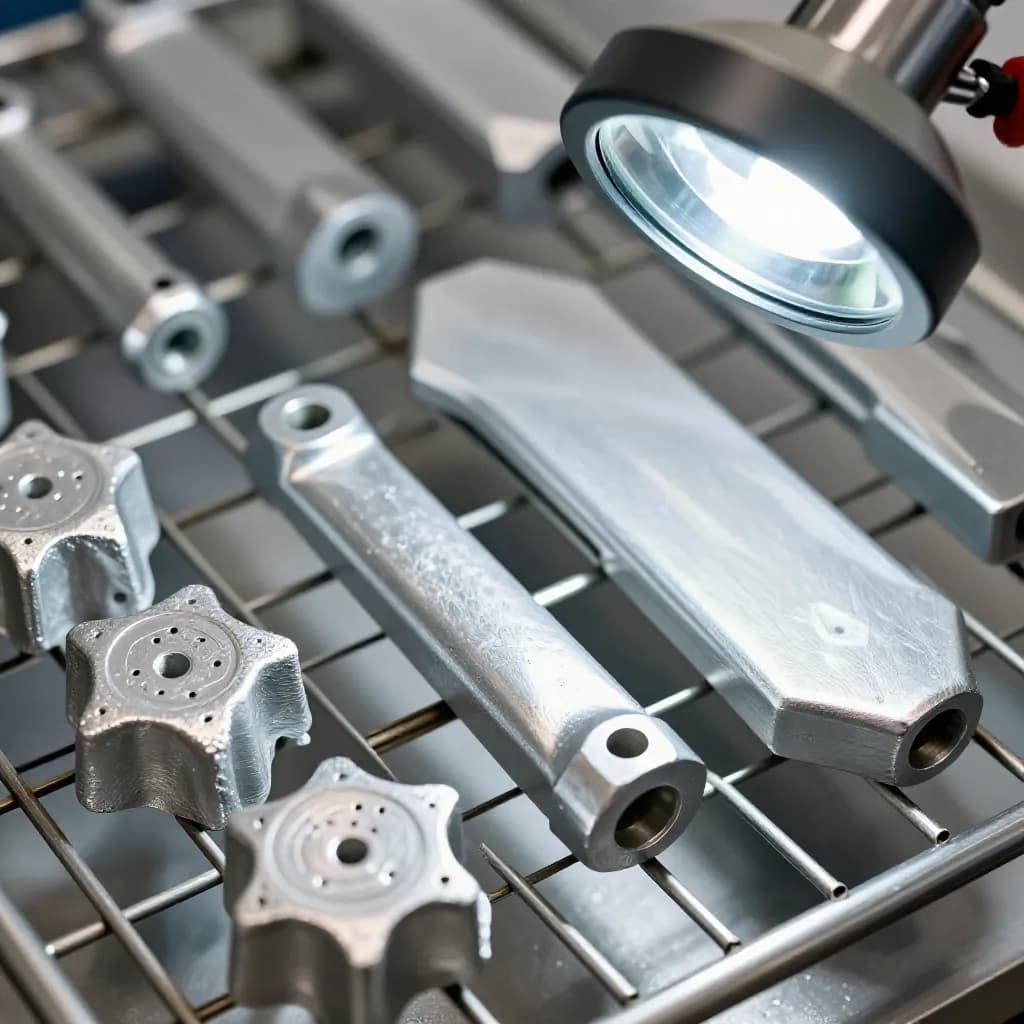
Powder coating zinc die castings serves both decorative and protective purposes. Decoratively, powder coating provides unlimited color options, textures, and gloss levels that electroplating cannot easily achieve — matte blacks, textured bronzes, soft-touch finishes, and custom colors are all readily available. Protectively, powder coating shields the zinc surface from white corrosion (zinc oxide/hydroxide formation) that occurs in humid environments, and from tarnishing and fingerprint marking that affect the appearance of uncoated zinc hardware.
Ready to Start Your Project?
From one-off customs to 15,000-part production runs — get precise pricing in 24 hours.
On This Page
Zinc Die Castings: Properties and Coating Drivers
The primary challenge in powder coating zinc die castings is managing outgassing from the casting's inherent porosity, compounded by the relatively low melting point of zinc alloys (approximately 380-390°C for Zamak 3). This low melting point limits the degas temperature that can be safely applied and restricts the cure temperature of the powder coating, making zinc die castings one of the more technically demanding substrates for powder coating despite their widespread use.
Outgassing Mechanisms in Zinc Die Castings
Zinc die castings outgas through the same fundamental mechanism as aluminum die castings — trapped air, moisture, and process contaminants in the casting's porosity escape when heated during the powder cure cycle. However, zinc die castings present some unique outgassing characteristics. The high-pressure die casting process used for virtually all zinc castings operates at very high injection speeds (30-50 m/s gate velocity), which entraps more air than the lower speeds used for aluminum die casting. Porosity levels in zinc die castings typically range from 1-3% by volume, concentrated near the surface and at flow convergence points within the casting.
Die lubricant contamination is a particularly significant outgassing source in zinc die castings. Water-based die lubricants are sprayed onto the die surfaces between each shot cycle, and residues penetrate the surface porosity of the casting during solidification. These lubricant residues decompose and volatilize at 150-250°C, producing gases that escape through the curing powder film. The problem is exacerbated by the fact that zinc die castings are often produced at very high cycle rates (hundreds or thousands of shots per hour), which can lead to lubricant buildup on the die surfaces and increased contamination of the castings.
Subsurface blistering is a defect unique to zinc die castings that differs from standard outgassing pinholes. It occurs when gas pressure builds beneath the coating but is insufficient to break through the cured film, creating raised blisters that may not appear until hours or days after coating. This delayed blistering is caused by slow diffusion of gases from deep within the casting wall, and it is particularly problematic because it may pass initial quality inspection only to be discovered by the end customer. Thorough degassing and the use of permeable primer systems that allow residual gas to escape without blistering are the primary countermeasures.
Low-Cure Powder Formulations for Zinc
Low-cure powder coatings are particularly advantageous for zinc die castings because they reduce the thermal stress on the substrate and minimize the temperature differential between the powder's gel point and the gas release temperature of trapped contaminants. Standard powder coatings cure at 180-200°C for 10-15 minutes, but low-cure formulations achieve full crosslinking at 140-160°C for 10-20 minutes. This lower cure temperature provides several benefits for zinc substrates.
First, the reduced cure temperature decreases the driving force for outgassing — gases expand less at 150°C than at 200°C, and some volatile contaminants that would decompose at 200°C remain stable at 150°C. This means that fewer gases are released during the cure cycle, and those that are released have lower pressure, reducing the severity of any defects that do occur. Second, the lower temperature reduces the risk of substrate distortion — zinc die castings with thin walls (0.5-1.5 mm) can warp or distort at elevated temperatures, particularly if the casting has residual stresses from the die casting process.
Modern low-cure powder formulations are available in polyester, epoxy-polyester hybrid, and epoxy chemistries, with performance properties that approach or match standard-cure equivalents. Advances in resin and crosslinker technology have largely eliminated the historical trade-offs of low-cure powders — earlier formulations sometimes exhibited reduced mechanical properties, limited color range, or poor storage stability. Current-generation low-cure powders offer full color ranges, good storage stability (6-12 months at 25°C), and mechanical properties suitable for decorative and functional applications. The slightly longer cure times required at lower temperatures (15-20 minutes versus 10-15 minutes) are offset by reduced energy consumption and improved substrate quality.
Pretreatment for Zinc Die Castings
Pretreatment of zinc die castings requires chemistry specifically formulated for zinc substrates — many pretreatment chemicals designed for steel or aluminum are too aggressive for zinc and will cause excessive surface attack, dimensional changes, or hydrogen embrittlement. The pretreatment sequence typically consists of alkaline cleaning, rinse, acid activation or conversion coating, rinse, and optional seal rinse.
Alkaline cleaning for zinc die castings should use mild, non-etching formulations with pH below 11 and temperature below 60°C. Strongly alkaline cleaners (pH above 12) dissolve zinc, causing surface roughening and dimensional loss. The cleaner must effectively remove die lubricant residues, which are the primary surface contaminant on zinc castings, without attacking the base metal. Ultrasonic cleaning can enhance lubricant removal from surface porosity without chemical aggression.
Conversion coating options for zinc include zinc phosphate, iron phosphate, and chromate-free alternatives. Zinc phosphate is the natural choice for zinc substrates — the phosphating reaction proceeds readily on zinc surfaces, producing a dense, well-adhered crystal layer of 2-5 g/m² that provides excellent adhesion and corrosion resistance. Iron phosphate systems can also be used but produce lighter coating weights on zinc than on steel. Trivalent chromium and zirconium-based conversion coatings offer chrome-free alternatives with good performance. Regardless of the conversion coating chemistry, thorough rinsing after each stage is critical to prevent chemical residues from being trapped in surface porosity, where they would contribute to outgassing during cure.
Decorative Hardware and Consumer Products
Zinc die castings dominate the decorative hardware market — door handles, cabinet knobs and pulls, bathroom accessories, furniture fittings, and fashion hardware (belt buckles, zipper pulls, buttons) are overwhelmingly produced from Zamak alloys. Powder coating has gained significant market share in this segment, competing with electroplating (chrome, nickel, brass plating) and electropainting (e-coat) as the preferred finishing technology for many product categories.
The aesthetic capabilities of powder coating on zinc die castings have expanded dramatically with advances in powder formulation technology. Metallic finishes that replicate the appearance of chrome, brushed nickel, antique brass, and oil-rubbed bronze are available as single-coat powder applications, eliminating the multi-step plating processes and associated environmental concerns. Textured finishes — wrinkle, hammer-tone, sand, and leather textures — add tactile interest that plating cannot provide. Soft-touch and rubber-feel powder coatings create a warm, comfortable grip on handles and controls. These specialty finishes have opened new design possibilities for product designers who previously were limited to the metallic finishes achievable through plating.
Quality requirements for decorative hardware are primarily aesthetic — surface defects, color inconsistency, and texture variation are the main concerns. Pinholes from outgassing are particularly problematic on decorative parts because they are immediately visible on the smooth, high-quality surface expected by consumers. Functional requirements include adhesion (cross-hatch test classification 0-1), scratch resistance (pencil hardness H-2H), and corrosion resistance (typically 96-240 hours neutral salt spray for interior hardware, 480+ hours for exterior). Chemical resistance to household cleaning products, hand creams, and perspiration is also tested for hardware that will be frequently touched.
Automotive Trim and Functional Components
The automotive industry uses zinc die castings extensively for interior and exterior trim components — door handles, mirror housings, emblem bezels, grille inserts, and interior switch plates. Powder coating these components must meet automotive OEM specifications that are significantly more demanding than consumer hardware standards, with requirements for UV resistance, thermal cycling, chemical resistance, and long-term corrosion protection.
Exterior automotive trim faces the full range of environmental stresses: UV radiation, temperature extremes (-40°C to +90°C), road salt, car wash chemicals, fuel splash, and stone chip impact. Powder coating systems for exterior zinc trim typically consist of an epoxy primer (25-40 micrometers) for adhesion and corrosion protection, followed by a polyester or acrylic topcoat (40-60 micrometers) for UV resistance and aesthetics. Total system thickness of 70-100 micrometers provides adequate protection without excessive build that could affect fit and function of precision trim components.
Corrosion testing for automotive zinc trim follows OEM-specific cyclic corrosion test protocols — GM 9540P, Ford CETP 00.00-L-467, VW PV1210, or equivalent — that simulate real-world automotive corrosion through alternating cycles of salt spray, humidity, drying, and temperature variation. These tests are more predictive of field performance than traditional constant salt spray testing. Typical requirements are 60-120 cycles (equivalent to 5-10 years of field exposure) without blistering, delamination, or substrate corrosion exceeding defined limits. Adhesion must be maintained after thermal cycling (-40°C to +90°C, 10-30 cycles) and after immersion in simulated car wash solution, fuel, and brake fluid.
Process Optimization and Defect Prevention
Optimizing the powder coating process for zinc die castings requires a systematic approach that addresses each potential defect source. The most effective strategy combines upstream quality control (casting quality, die lubricant management), thorough pretreatment (cleaning and conversion coating), appropriate degassing (when required), and optimized powder selection and cure parameters.
Casting quality is the foundation — working with the die casting supplier to minimize porosity through optimized gating design, vacuum-assisted die casting, and controlled die lubricant application reduces outgassing at its source. Incoming inspection of castings should include visual examination for surface porosity, flow lines, and cold shuts, along with periodic cross-sectioning to assess internal porosity levels. Castings with excessive porosity should be rejected before they enter the coating process.
Degas cycles for zinc die castings must respect the alloy's thermal limitations. A maximum degas temperature of 200-220°C is recommended for Zamak alloys — significantly lower than the 230-260°C used for cast iron or aluminum castings. Degas time of 15-30 minutes at temperature is typical, with thicker sections requiring longer soak times. The lower degas temperature means that some deep-seated contaminants may not be fully driven off, making the combination of degassing with outgassing-tolerant powder formulations particularly important for zinc substrates. Process documentation should record degas parameters for each part number, and any change in casting supplier or die lubricant formulation should trigger revalidation of the degas cycle.
Frequently Asked Questions
What temperature can zinc die castings withstand during powder coating?
Zamak alloys melt at approximately 380-390°C, so standard powder cure temperatures of 180-200°C are safe. However, degas temperatures should not exceed 200-220°C to avoid microstructural changes. Low-cure powders curing at 140-160°C are preferred because they reduce thermal stress, minimize outgassing severity, and prevent distortion of thin-walled castings.
Why do zinc die castings blister after powder coating?
Blistering is caused by trapped gases (air, moisture, die lubricant residues) in the casting's porosity that expand during cure and push against the coating film. Subsurface blistering may appear hours or days after coating due to slow gas diffusion from deep within the casting. Prevention requires thorough degassing, outgassing-tolerant powder formulations, and upstream casting quality control.
Can powder coating replace chrome plating on zinc hardware?
Yes, metallic powder coatings can replicate the appearance of chrome, brushed nickel, antique brass, and other plated finishes in a single-coat application. While the reflectivity of powder coating does not match bright chrome plating, it provides a wider range of finishes (matte, satin, textured) with lower environmental impact and without the hazardous chemicals used in plating processes.
What conversion coating works best on zinc die castings?
Zinc phosphate is the natural choice — it reacts readily with zinc surfaces to produce a dense crystal layer of 2-5 g/m² with excellent adhesion and corrosion resistance. Trivalent chromium and zirconium-based systems offer chrome-free alternatives. Pretreatment chemicals must be specifically formulated for zinc — steel or aluminum chemistries are often too aggressive.
How do you prevent outgassing on zinc die castings?
Use a multi-pronged approach: control casting quality and die lubricant application upstream, clean thoroughly to remove surface contaminants, degas at 200-220°C for 15-30 minutes when needed, use low-cure outgassing-tolerant powder formulations, and apply moderate film thickness (60-80 micrometers). Slow cure ramp rates through the 100-160°C range also help.
Ready to Start Your Project?
From one-off customs to 15,000-part production runs — get precise pricing in 24 hours.