Yellowing is a specific form of color change that affects powder coatings, particularly whites, light pastels, and clear coats. Unlike general fading, which involves a loss of color intensity, yellowing is the development of an unwanted yellow or amber tint that shifts the coating's appearance away from its intended color. It is one of the most common complaints in powder coating, especially for white and near-white architectural finishes.
Technical
Powder Coating Yellowing: Over-Cure, Resin Degradation, White and Light Color Issues, and Prevention
Sundial Powder Coating·April 23, 2026·11 min
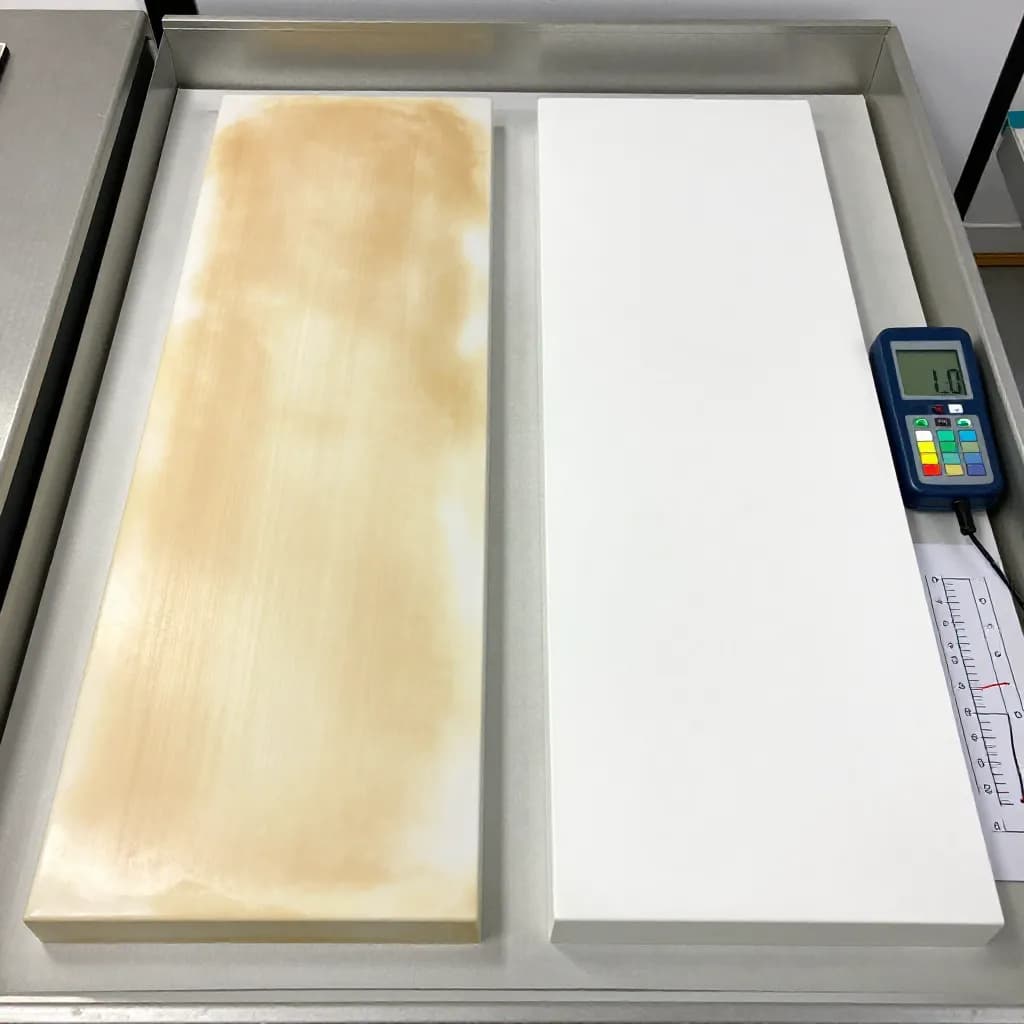
The yellowing phenomenon has multiple potential causes, each producing a slightly different pattern and timeline. Some yellowing occurs during the curing process itself, appearing immediately when the part exits the oven. Other yellowing develops gradually over weeks, months, or years of service. Understanding which type of yellowing is occurring is essential for identifying the cause and implementing the correct prevention strategy.
Ready to Start Your Project?
From one-off customs to 15,000-part production runs — get precise pricing in 24 hours.
On This Page
Understanding Yellowing in Powder Coatings
Yellowing is most visible and most problematic on white and very light-colored coatings because the human eye is extremely sensitive to yellow shifts in neutral colors. A degree of yellowing that would be completely invisible on a dark blue or black coating becomes glaringly obvious on a bright white. This sensitivity means that white and light-colored powder coatings require more careful process control and material selection than darker colors.
The impact of yellowing ranges from a minor cosmetic concern to a significant quality failure depending on the application. On industrial equipment or hidden structural elements, slight yellowing may be completely acceptable. On architectural facades, appliances, or retail fixtures where white is a specified design element, yellowing can render the finish unacceptable and may trigger warranty claims or rejection of the coated product.
This article examines the technical causes of yellowing in powder coatings, with particular focus on over-cure, resin degradation, and the specific challenges of white and light-colored formulations. It provides practical prevention strategies for applicators and specifiers.
Over-Cure: The Most Common Cause of Yellowing
Over-curing is the single most frequent cause of yellowing in powder coatings, and it is entirely preventable with proper process control. Over-cure occurs when the coating is exposed to higher temperatures or longer cure times than the powder manufacturer specifies, causing thermal degradation of the resin and pigments.
Every powder coating has a defined cure window specified by the manufacturer, expressed as a combination of temperature and time. For example, a typical polyester powder might specify curing at 180 degrees Celsius for 15 minutes, measured at the substrate surface. The cure window has both a minimum, below which the coating is under-cured, and a maximum, above which the coating is over-cured.
When the coating exceeds the maximum cure parameters, the excess thermal energy begins to break down the polymer chains and oxidize organic components in the formulation. This thermal degradation produces yellow-colored byproducts that discolor the coating. The degree of yellowing is proportional to the severity of the over-cure: a slight over-cure produces faint yellowing, while a severe over-cure can turn a white coating distinctly yellow or even brown.
Over-cure can result from several process errors. Oven temperature set too high is the most obvious cause. Excessive cure time, often caused by slow line speeds or parts remaining in the oven during stoppages, is equally common. Hot spots within the oven that expose some parts to higher temperatures than the setpoint can cause localized yellowing. Heavy substrates that retain heat after exiting the oven continue to cure during cooling, potentially exceeding the total thermal exposure limit.
The cure window varies between powder formulations. Some powders have a wide cure window that tolerates moderate over-cure without yellowing. Others, particularly some white and clear formulations, have narrow cure windows where even slight over-cure produces visible yellowing. The powder manufacturer's technical data sheet specifies the cure window, and this information should be followed precisely.
Oven temperature profiling using data loggers attached to test parts is the definitive method for verifying that the actual cure conditions match the specification. The data logger records the temperature at the substrate surface throughout the oven cycle, revealing the actual peak temperature, time at temperature, and any hot spots or temperature variations that could cause over-cure.
Resin Degradation and Thermal Sensitivity
Beyond over-cure, the inherent thermal sensitivity of different resin systems affects their susceptibility to yellowing. Some resin chemistries are more prone to yellowing than others, and understanding these differences helps with both material selection and process optimization.
Epoxy resins are the most thermally sensitive common powder coating chemistry. Epoxy coatings yellow readily when over-cured and can develop yellowing even within the specified cure window if the cure temperature is at the upper end of the range. For white and light-colored epoxy coatings, curing at the lower end of the specified temperature range and the shorter end of the time range minimizes yellowing.
Polyester-epoxy hybrid resins inherit some of the epoxy component's thermal sensitivity. The degree of yellowing susceptibility depends on the ratio of polyester to epoxy in the formulation. Higher epoxy content increases yellowing risk. Hybrids are generally more yellowing-resistant than pure epoxies but less resistant than pure polyesters.
Standard polyester resins have good thermal stability and resist yellowing better than epoxies and hybrids. However, they are not immune, and significant over-cure will produce yellowing in polyester coatings as well. The yellowing threshold for polyester is higher than for epoxy, providing a wider margin of safety in the curing process.
Super-durable polyester resins are formulated for maximum thermal and UV stability. They are the most yellowing-resistant of the common powder coating chemistries and are the preferred choice for white and light-colored exterior applications where yellowing resistance is critical.
The specific pigments and additives in the formulation also affect yellowing susceptibility. Some organic pigments and optical brighteners used in white coatings are thermally sensitive and can contribute to yellowing independently of the resin system. Powder manufacturers formulate their products to balance color performance with thermal stability, but the cure window must still be respected.
For applications where yellowing is a critical concern, request the powder manufacturer's yellowing data, which shows the degree of yellow shift at various cure conditions. This data helps the applicator identify the optimal cure parameters that achieve full cure with minimum yellowing.
Yellowing in White and Light-Colored Coatings
White and light-colored powder coatings present unique yellowing challenges that require specific attention from both the specifier and the applicator. The high visibility of yellowing on these colors means that process control must be tighter and material selection more careful than for darker colors.
White powder coatings rely on titanium dioxide as the primary pigment, which is inherently UV-stable and heat-resistant. However, the other components of the formulation, including the resin, flow agents, degassing additives, and optical brighteners, can all contribute to yellowing. Optical brighteners, which are added to make whites appear brighter and bluer, are particularly susceptible to thermal degradation and can yellow significantly when over-cured.
The choice between warm white and cool white formulations affects yellowing perception. Warm whites with a slight yellow or cream undertone are more forgiving of slight yellowing because the yellow shift is less noticeable against the already-warm base color. Cool whites with a blue undertone show yellowing more dramatically because the yellow shift contrasts sharply with the intended blue-white appearance.
Light pastels including light grays, light blues, light greens, and light pinks are also vulnerable to visible yellowing, though less so than pure whites. The pastel base color provides some masking of the yellow shift, but significant yellowing will still be apparent, particularly when compared to a reference sample of the intended color.
Clear coats and transparent tinted coatings are highly susceptible to yellowing because there is no opaque pigment to mask the discoloration. Any yellowing of the clear coat is directly visible and affects the appearance of whatever is beneath it. Clear coats require the most precise cure control of any powder coating type.
For critical white and light-colored applications, consider specifying a powder formulation that has been specifically optimized for yellowing resistance. Major powder manufacturers offer premium white formulations with enhanced thermal stability, wider cure windows, and reduced yellowing tendency. These products may use different resin systems, stabilizer packages, or pigment combinations than standard whites.
Batch-to-batch consistency in white powder coatings is important because even small variations in formulation can produce visible color differences. Specify a single batch for large projects, or require the powder manufacturer to provide batch-matched material with verified color consistency.
Environmental and In-Service Yellowing
Not all yellowing occurs during the curing process. Some yellowing develops after the coating has been placed in service, caused by environmental exposure, chemical contact, or inherent material aging.
UV-induced yellowing affects some powder coating formulations, particularly those containing certain organic UV absorbers or optical brighteners that degrade under prolonged UV exposure. This type of yellowing develops gradually over months or years and is most noticeable on white and light-colored coatings in full sun exposure. It is distinct from the general fading that affects all exterior coatings and specifically involves the development of a yellow tint.
Chemical exposure can cause yellowing of powder coated surfaces. Nitrogen oxide gases from combustion sources, industrial processes, or vehicle exhaust can react with the coating surface to produce yellow discoloration. This is sometimes called gas yellowing or NOx yellowing and is most common in industrial environments and near busy roads. The yellowing may be reversible if the coating is cleaned promptly, but prolonged exposure can cause permanent discoloration.
Heat exposure in service can cause yellowing on coatings near heat sources such as radiators, heating ducts, lighting fixtures, and industrial equipment. The mechanism is the same as over-cure yellowing: thermal degradation of the resin and additives. Coatings specified for high-temperature service should use heat-resistant formulations designed to withstand the expected operating temperature without yellowing.
Moisture and humidity can contribute to yellowing in some coating formulations, particularly those containing certain types of curing agents or additives that are sensitive to hydrolysis. This type of yellowing is less common than thermal or UV-induced yellowing but can occur in consistently humid environments.
Aging of the uncured powder before application can also cause yellowing. Powder coatings have a limited shelf life, typically 12 to 24 months when stored properly. Powder that has exceeded its shelf life or been stored in hot conditions may have partially reacted or degraded, leading to yellowing when cured. Always check the manufacture date and storage conditions of powder before use.
Prevention Strategies for Applicators
Applicators have the most direct control over yellowing prevention because the curing process is where the majority of yellowing occurs. Implementing rigorous process controls eliminates the most common cause of yellowing and ensures consistent results.
Oven temperature profiling should be performed regularly and whenever process conditions change. Attach data loggers to representative parts and record the actual substrate temperature throughout the cure cycle. Compare the recorded profile to the powder manufacturer's specified cure window. Adjust oven temperature, conveyor speed, or part positioning to ensure that the substrate temperature stays within the specified range without exceeding the maximum.
Monitor oven temperature uniformity across the full width and height of the oven chamber. Hot spots near heating elements, at the oven entrance and exit, and at different heights within the chamber can cause localized over-cure. Map the temperature distribution and position parts to avoid hot spots, or adjust the oven to improve uniformity.
Adjust cure parameters for substrate mass. Heavy parts absorb more heat and retain it longer than light parts, potentially exceeding the cure window during the cooling phase. Lighter parts may need longer oven time to reach cure temperature. Group parts by mass and adjust the cure cycle for each group rather than using a single setting for all parts.
Use the powder manufacturer's recommended cure schedule as the starting point, and target the middle of the cure window rather than the upper end. This provides margin for process variation without risking over-cure. For yellowing-sensitive whites and clears, target the lower end of the cure window and verify full cure through testing.
Implement incoming quality checks on powder materials. Verify the manufacture date, storage conditions, and batch number. For white and light-colored powders, spray and cure a test panel from each new batch and compare it to the color standard before coating production parts. This catches any batch-to-batch variation or material degradation before it affects production.
Maintain clean oven conditions. Contamination inside the oven from powder overspray, outgassing residue, or combustion byproducts can deposit on parts during cure and cause discoloration. Regular oven cleaning prevents contamination-related yellowing.
Prevention Strategies for Specifiers and End Users
Specifiers and end users influence yellowing prevention through material selection, applicator qualification, and maintenance practices. While they do not control the curing process directly, their decisions set the framework within which the applicator operates.
Specify the coating chemistry appropriate for the application's thermal and UV exposure. For white and light-colored exterior applications, super-durable polyester provides the best combination of UV resistance and yellowing resistance. For interior applications, standard polyester or hybrid coatings may be acceptable, but verify the yellowing performance with the powder manufacturer if the application involves heat exposure or UV from windows.
Request yellowing test data from the powder manufacturer for the specific product and color being specified. The manufacturer should be able to provide data showing the degree of yellow shift at various cure conditions and after accelerated weathering. This data helps set realistic expectations and identifies products with superior yellowing resistance.
Qualify the applicator based on their process control capabilities. Certified applicators under Qualicoat, GSB, or similar programs are required to maintain documented cure control procedures and submit to regular audits. For critical white and light-colored applications, visit the applicator's facility to verify their oven profiling practices, temperature monitoring, and quality control procedures.
Specify acceptance criteria for yellowing in the coating specification. Define the maximum allowable yellow index or Delta b value for the cured coating, and require the applicator to verify compliance on production parts. This creates a clear, measurable standard that both parties can reference.
For in-service yellowing prevention, maintain the coating according to the manufacturer's guidelines. Regular cleaning removes atmospheric contaminants that can cause chemical yellowing. Avoid exposing the coating to aggressive chemicals, particularly nitrogen oxide sources and strong oxidizers. For coatings near heat sources, verify that the operating temperature does not exceed the coating's thermal rating.
When yellowing is discovered on a coated product, document it promptly with photographs and color measurements. Contact the applicator and powder manufacturer with the documentation. Early reporting facilitates root cause analysis and supports warranty claims if the yellowing is due to a material or process defect.
Frequently Asked Questions
Why did my white powder coating turn yellow?
The most common cause is over-curing, where the coating was exposed to higher temperatures or longer cure times than specified. Other causes include UV degradation of optical brighteners, chemical exposure to nitrogen oxides, and use of thermally sensitive resin or additive components. Over-cure yellowing appears immediately; environmental yellowing develops gradually.
Can yellowed powder coating be fixed?
Mild yellowing from environmental exposure may be partially improved by thorough cleaning or light polishing. Yellowing caused by over-cure or thermal degradation is permanent because the chemical change is irreversible. The only remedy for significant yellowing is stripping and recoating with proper cure control.
Which powder coating resin is most resistant to yellowing?
Super-durable polyester resins offer the best yellowing resistance among common powder coating chemistries. Standard polyester is also good. Polyester-epoxy hybrids have moderate yellowing resistance. Pure epoxy resins are the most susceptible to yellowing and should be avoided for white and light-colored applications where yellowing is a concern.
How do I prevent yellowing when curing white powder coating?
Use oven temperature profiling to verify that substrate temperatures stay within the powder manufacturer's specified cure window. Target the middle or lower end of the cure window rather than the upper end. Monitor oven uniformity to eliminate hot spots. Adjust cure parameters for substrate mass. Use powder within its shelf life and store it properly.
Does UV exposure cause powder coating to yellow?
UV exposure can cause yellowing in some formulations, particularly those containing optical brighteners or certain UV absorbers that degrade under prolonged sun exposure. This is most noticeable on white coatings. Super-durable polyester formulations with UV-stable components resist UV-induced yellowing better than standard formulations.
Ready to Start Your Project?
From one-off customs to 15,000-part production runs — get precise pricing in 24 hours.