Wood has been a beloved architectural material for millennia, valued for its warmth, natural beauty, and the sense of organic connection it brings to built environments. However, wood in exterior applications presents significant challenges: susceptibility to moisture damage, rot, insect attack, UV degradation, and fire risk, combined with ongoing maintenance requirements for staining, sealing, and replacement. These limitations have driven architects and builders to seek materials that deliver the aesthetic of wood with the performance of metal.
Technical
Wood Grain Sublimation on Powder-Coated Aluminum: Process, Design, and Durability
Sundial Powder Coating·April 22, 2026·11 min
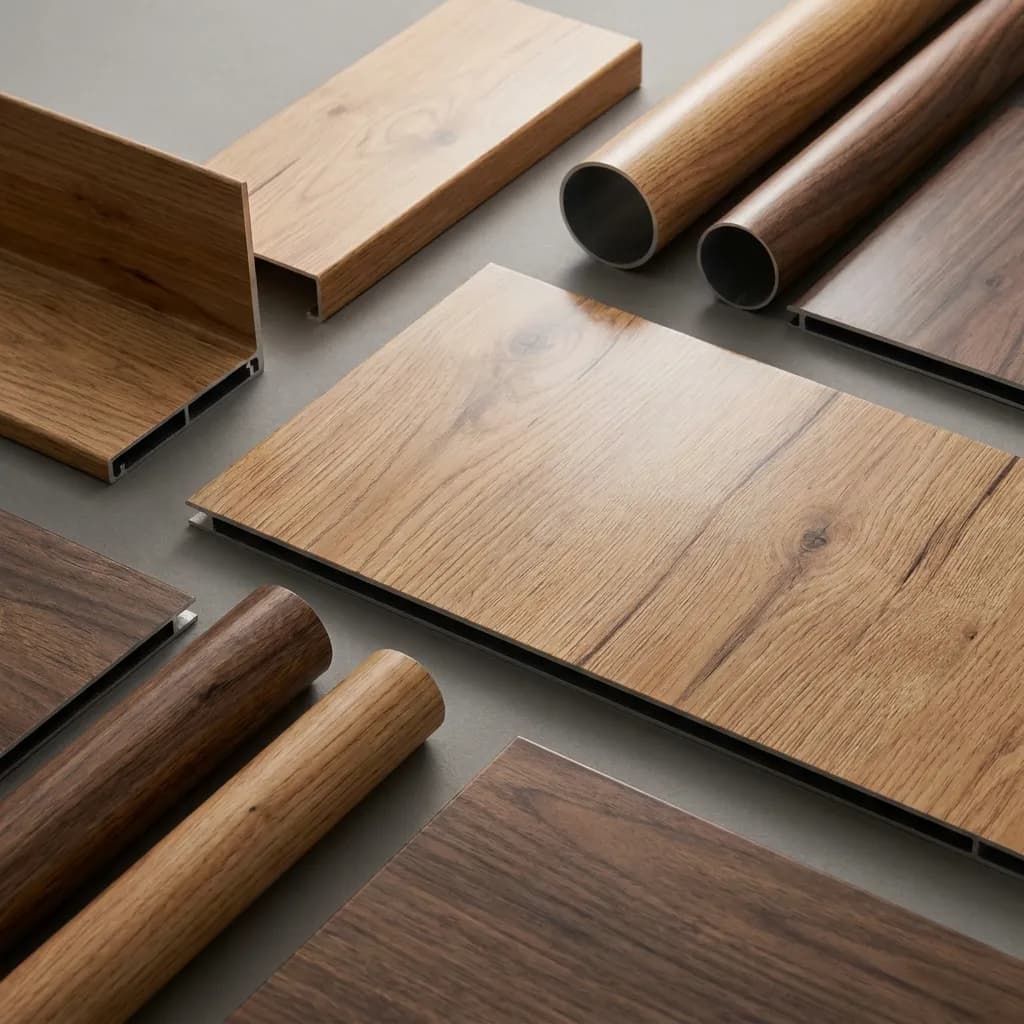
Wood grain sublimation on powder-coated aluminum provides exactly this combination. Through a thermal transfer process, photorealistic wood grain patterns — complete with grain texture, color variation, and knot details — are permanently bonded into the surface of a powder-coated aluminum profile. The result is a product that is visually indistinguishable from natural wood at normal viewing distances but offers the durability, fire resistance, dimensional stability, and low maintenance of aluminum.
Ready to Start Your Project?
From one-off customs to 15,000-part production runs — get precise pricing in 24 hours.
On This Page
The Appeal of Wood-Effect Aluminum in Architecture
The technology has gained widespread adoption in architectural applications including window and door frames, curtain wall mullions, cladding panels, pergolas, fencing, decking, and interior trim. The ability to specify wood-effect finishes on aluminum enables architects to achieve warm, natural aesthetics in applications where real wood would be impractical, non-compliant with fire regulations, or prohibitively expensive to maintain. The growing catalog of available wood patterns — from light oak and maple to dark walnut and teak — provides design flexibility that rivals the natural wood species palette.
The Sublimation Transfer Process Explained
Sublimation transfer is a thermal process that uses heat and vacuum to transfer a printed pattern from a carrier film into the surface of a powder-coated substrate. The process exploits the principle of sublimation — the direct transition of a substance from solid to gas phase without passing through a liquid state — to drive dye molecules from the printed film into the powder coating surface.
The process begins with a specially formulated powder coating base coat, typically a polyester system designed to accept sublimation dyes. The base coat color is selected to complement the wood grain pattern — a warm brown or tan base for dark wood effects, a lighter cream or beige for light wood patterns. The base coat is applied and fully cured using standard powder coating processes.
The sublimation transfer film — a heat-resistant carrier printed with the wood grain pattern using sublimation dyes — is then wrapped around the coated profile, held in close contact by vacuum bagging or shrink-wrap techniques. The wrapped profile is placed in a sublimation oven at 180-210°C for 8-15 minutes. At this temperature, the sublimation dyes on the film transition to gas phase and migrate into the softened surface of the powder coating, penetrating to a depth of 20-40 microns. The dyes become permanently trapped within the polymer matrix as the coating cools, creating a pattern that is integral to the coating rather than sitting on the surface. After cooling, the carrier film is removed, revealing the wood grain pattern on the powder-coated surface.
Film Selection and Pattern Quality
The quality and realism of the wood grain effect depend critically on the sublimation transfer film. Film manufacturers offer extensive catalogs of wood patterns, ranging from faithful reproductions of specific wood species to stylized interpretations that emphasize particular grain characteristics. The selection process involves matching the desired aesthetic — species, grain pattern, color tone, and scale — to the available film options, with custom patterns available for large-volume projects.
Film quality is determined by several factors. Print resolution affects the sharpness and detail of the grain pattern — higher resolution films produce more realistic effects with finer grain detail and more natural color transitions. Dye concentration affects the color intensity and depth of the transferred pattern — films with higher dye loading produce richer, more saturated colors that better replicate the depth of natural wood. Registration accuracy — the alignment of the pattern across the film width and along its length — affects the consistency of the pattern on the finished product, particularly for profiles where multiple film wraps must align seamlessly.
The carrier film material must withstand the sublimation temperature without melting, shrinking, or releasing contaminants that could affect the coating surface. Polyester-based carrier films are standard, with specialized release coatings that prevent the film from bonding to the powder coating surface during the transfer process. Film thickness, typically 30-50 microns, must be sufficient to carry the required dye loading while remaining flexible enough to conform to the profile geometry, including corners, grooves, and decorative details.
Architectural Profile Applications
Architectural aluminum profiles are the primary application for wood grain sublimation, with window and door systems representing the largest market segment. Wood-effect aluminum windows combine the thermal performance of thermally broken aluminum frames with the warm aesthetic of timber, meeting both energy efficiency requirements and design preferences. The wood grain finish can be applied to the interior face only — maintaining a contemporary aluminum exterior with a warm wood interior — or to both faces for a fully wood-effect appearance.
Curtain wall and facade cladding applications use wood grain sublimation to create large-scale wood-effect surfaces on aluminum panels and profiles. The fire resistance of aluminum — achieving A1 or A2 Euroclass ratings with powder coating — enables wood-effect facades on buildings where real wood cladding would not comply with fire regulations. This is particularly significant for mid-rise and high-rise buildings where combustible facade materials are restricted following high-profile fire incidents.
Exterior applications including pergolas, fencing, gates, balustrades, and decking systems benefit from the combination of wood aesthetics with aluminum's resistance to rot, insects, and moisture. In coastal, tropical, and high-humidity environments where natural wood deteriorates rapidly, wood-effect aluminum provides a maintenance-free alternative that maintains its appearance for decades. Interior applications — ceiling systems, wall panels, partition frames, and furniture — use wood grain sublimation to achieve consistent wood-effect finishes across large areas without the color and grain variation inherent in natural wood.
Durability Compared to Natural Wood
The durability comparison between wood grain sublimated aluminum and natural wood is overwhelmingly in favor of the aluminum system for exterior applications. Natural wood exposed to the elements requires regular maintenance — typically annual or biennial staining, sealing, or painting — to prevent moisture damage, UV degradation, and biological attack. Even with diligent maintenance, exterior wood components have finite service lives, typically 15-30 years depending on species, treatment, and exposure conditions.
Wood grain sublimated powder-coated aluminum requires no maintenance beyond periodic cleaning with mild detergent and water. The sublimation dyes are protected within the powder coating matrix, which itself provides UV resistance, moisture barrier, and chemical resistance. Accelerated weathering tests demonstrate that wood grain sublimated finishes maintain their color and pattern integrity through exposure equivalent to 10-15 years of South Florida weathering, with minimal fading or pattern degradation.
The dimensional stability of aluminum eliminates the warping, swelling, shrinking, and cracking that affect natural wood with changes in moisture content and temperature. Aluminum does not rot, is not attacked by insects, and does not support mold or fungal growth. The fire performance of powder-coated aluminum — non-combustible with A1/A2 Euroclass ratings — is fundamentally superior to wood, which is combustible regardless of fire-retardant treatments. For lifecycle cost analysis, the higher initial cost of wood-effect aluminum is typically recovered within 5-10 years through eliminated maintenance costs, with the aluminum system continuing to perform maintenance-free for decades beyond.
Quality Standards and Testing
Wood grain sublimated powder coatings are subject to the same quality certification systems as standard architectural powder coatings, with additional requirements specific to the sublimation process. Qualicoat, the leading European quality label for architectural powder coatings, includes specific provisions for sublimation-decorated coatings under its Seaside and Décor quality marks, defining requirements for pattern adhesion, color fastness, and weathering resistance of the sublimated finish.
The base powder coating must meet all standard Qualicoat or AAMA requirements for film thickness, adhesion, hardness, flexibility, and chemical resistance before the sublimation process is applied. The sublimation step must not compromise these base coating properties — adhesion testing after sublimation confirms that the thermal cycle does not degrade the coating-substrate bond.
Pattern-specific quality tests include color fastness to light per ISO 105-B02, which evaluates the resistance of the sublimation dyes to UV-induced fading. A minimum rating of 6-7 on the blue wool scale is typically required for architectural applications, indicating excellent light fastness. Abrasion resistance testing confirms that the sublimated pattern is not removed by normal cleaning or surface contact. Accelerated weathering testing per ISO 11341 or ASTM G155 evaluates the combined durability of the base coating and sublimated pattern under simulated outdoor exposure. The sublimation film manufacturer and the coating applicator share responsibility for the quality of the finished product, with traceability systems linking each coated profile to the specific powder batch, film lot, and sublimation process parameters used.
Design Trends and Future Developments
Design trends in wood grain sublimation are evolving beyond traditional wood species reproductions toward more creative and contemporary applications. Weathered and reclaimed wood effects — with distressed textures, gray patinas, and visible aging — are increasingly popular for both exterior and interior applications, reflecting the broader design trend toward authentic, natural materials. These effects are achieved through specialized film designs that replicate the visual characteristics of aged wood.
Combination finishes that pair wood grain sublimation with other powder coating effects are emerging as a design trend. A profile might feature wood grain on the visible face with a solid metallic or textured finish on the structural face, or wood grain panels might be combined with solid-color framing elements for visual contrast. The ability to apply different finishes to different faces of an aluminum profile — using masking techniques during sublimation — enables design flexibility that natural wood cannot match.
Technological developments are expanding the capabilities of the sublimation process. Higher-resolution digital printing of transfer films enables more photorealistic patterns with finer detail. Extended color gamut dyes provide richer, more saturated colors that better replicate the depth and warmth of natural wood. Three-dimensional texture effects — where the powder coating surface is textured to replicate the tactile feel of wood grain in addition to the visual pattern — are being developed to create wood-effect finishes that are convincing to both sight and touch. The combination of visual realism, tactile texture, and the inherent performance advantages of powder-coated aluminum is making wood grain sublimation an increasingly compelling alternative to natural wood in architectural design.
Frequently Asked Questions
How realistic do wood grain sublimation finishes look?
Modern wood grain sublimation finishes are highly realistic, with photographic-quality reproduction of grain patterns, color variations, and knot details. At normal viewing distances of 1-2 meters, they are virtually indistinguishable from natural wood. Close inspection may reveal the uniform surface texture of the powder coating compared to the tactile grain of real wood, though textured base coats can address this.
How long do wood grain sublimation finishes last outdoors?
Wood grain sublimated powder coatings on aluminum are designed for 15-25 years of exterior service, depending on the exposure conditions and the quality of the base coating and sublimation film. Accelerated weathering data demonstrates excellent color retention and pattern integrity through exposure equivalent to 10-15 years of South Florida conditions. This significantly exceeds the maintenance-free life of natural wood.
Can wood grain sublimation be applied to any powder-coated surface?
Sublimation transfer works best with polyester-based powder coatings specifically formulated to accept sublimation dyes. Not all powder coatings are suitable — epoxy and some hybrid formulations may not absorb the dyes effectively. The base coat color must also be compatible with the desired wood pattern. Consult with the sublimation film and powder coating suppliers to ensure system compatibility.
Is wood grain sublimated aluminum fire-safe for building facades?
Yes. Wood grain sublimated powder-coated aluminum achieves A1 or A2 Euroclass fire ratings, classifying it as non-combustible. This is a significant advantage over natural wood cladding, which is combustible and may not comply with fire regulations for mid-rise and high-rise buildings. The sublimation dyes add negligible organic content to the already thin powder coating film.
How many wood grain patterns are available?
Major sublimation film manufacturers offer catalogs of 50-200 or more wood grain patterns, covering popular species including oak, walnut, teak, mahogany, cedar, pine, and cherry in various color tones and grain styles. Custom patterns can be developed for large-volume projects. The pattern selection continues to expand with new designs reflecting current architectural and interior design trends.
Ready to Start Your Project?
From one-off customs to 15,000-part production runs — get precise pricing in 24 hours.