Powder coating and vinyl wrapping represent fundamentally different approaches to changing the appearance and protecting the surface of metal components. Powder coating is a permanent finish — a thermosetting polymer film that chemically crosslinks during curing and becomes an integral part of the component's surface. Vinyl wrapping is a temporary or semi-permanent covering — a pressure-sensitive adhesive film that is applied over an existing surface and can be removed without damaging the substrate beneath.
Comparison
Powder Coating vs Vinyl Wrap: Durability, Longevity, and Customization
Sundial Powder Coating·April 22, 2026·12 min
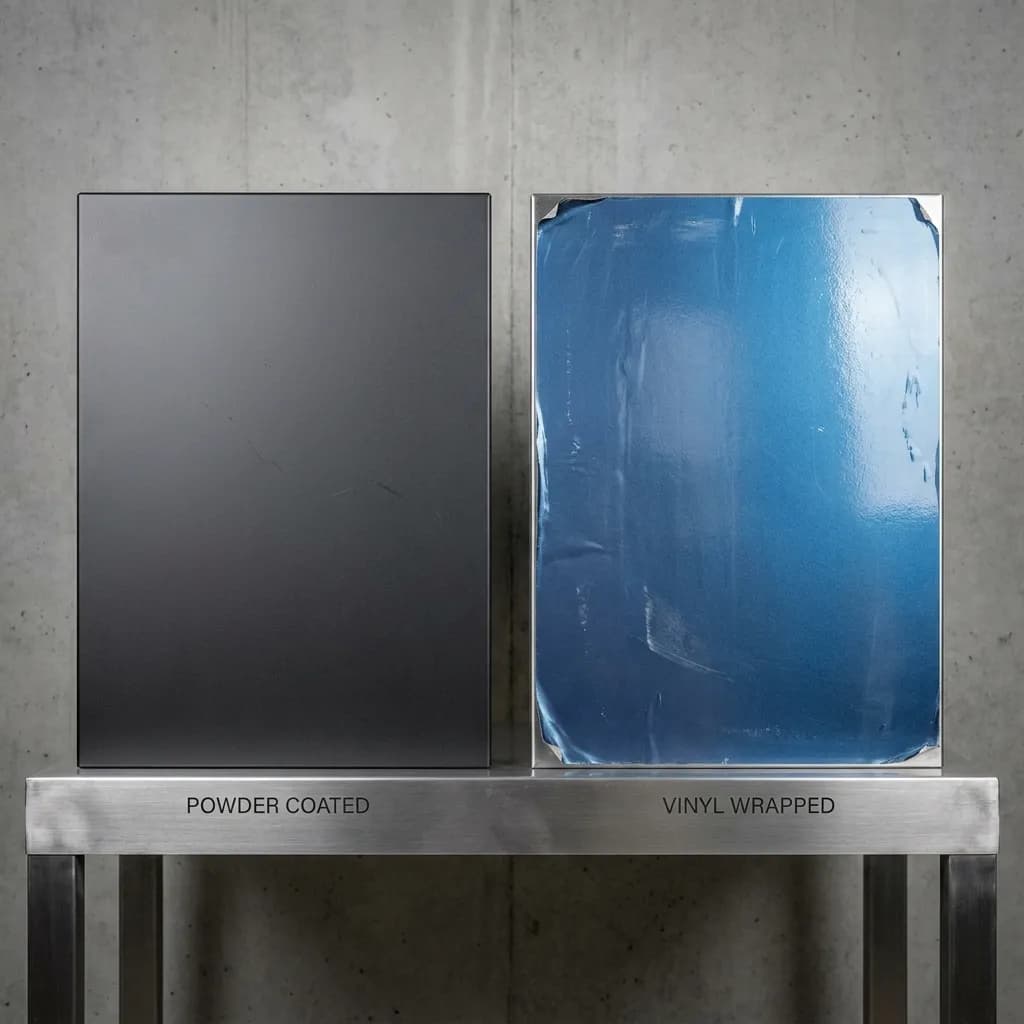
This fundamental difference in permanence defines the strengths and appropriate applications of each technology. Powder coating is chosen when long-term durability, chemical bonding to the substrate, and maximum protection are priorities. Vinyl wrapping is chosen when reversibility, rapid color changes, and preservation of the original finish are priorities. Neither is universally superior — they serve different needs and different mindsets.
Ready to Start Your Project?
From one-off customs to 15,000-part production runs — get precise pricing in 24 hours.
On This Page
Two Different Approaches to Surface Customization
Powder coating involves stripping any existing finish, pretreating the bare metal substrate, electrostatically applying dry powder particles, and curing in an oven at 160-200°C. The result is a tough, chemically crosslinked film of 60-120 microns that is bonded to the metal and cannot be removed without chemical stripping or abrasive blasting. The process is irreversible in the sense that the original surface condition is altered.
Vinyl wrapping involves cleaning the existing surface, applying a cast or calendered vinyl film using heat and pressure, conforming the film to the surface contours using heat guns and squeegees, and trimming excess material. The adhesive bond is designed to be strong enough to resist peeling during normal use but weak enough to allow clean removal when desired. Premium cast vinyl films from manufacturers like 3M, Avery Dennison, and Hexis are engineered for conformability, durability, and clean removability.
The automotive aftermarket is where these two technologies most directly compete. Car enthusiasts, fleet managers, and custom builders must choose between powder coating (for wheels, calipers, engine components, and chassis parts) and vinyl wrapping (for body panels, trim, and interior surfaces) based on the specific requirements of each component and the owner's long-term intentions.
Durability and Longevity: Permanent vs Temporary
Durability is the dimension where powder coating most decisively outperforms vinyl wrap. A properly applied powder coating on a well-pretreated metal substrate will last 15-25 years in exterior exposure, maintaining its color, gloss, and protective properties throughout. Architectural powder coatings certified to Qualicoat Class 2 or AAMA 2605 standards are tested to demonstrate this level of long-term performance through accelerated weathering and real-world Florida exposure testing.
Vinyl wraps have a significantly shorter lifespan. Premium cast vinyl films are typically warranted for 5-7 years of vertical exterior exposure, with some high-end films claiming up to 10 years. In practice, vinyl wraps on vehicles — which experience horizontal exposure, heat cycling, stone chipping, car wash abrasion, and chemical exposure — typically last 3-5 years before showing signs of degradation including edge lifting, fading, cracking, and adhesive failure. Calendered (lower-cost) vinyl films may begin degrading within 1-3 years of exterior exposure.
The failure modes of the two technologies differ fundamentally. Powder coating degrades gradually through UV-induced chalking and slow color fade — the coating remains adhered and protective even as its appearance slowly changes. Vinyl wrap fails through adhesive degradation, edge lifting, shrinkage, and cracking — once the film begins to fail, it can peel, tear, and expose the surface beneath to damage. A failing vinyl wrap requires prompt removal to prevent adhesive residue from bonding permanently to the underlying surface.
For components that will remain in service for many years — architectural elements, industrial equipment, outdoor furniture, and vehicle wheels — powder coating's permanence and longevity are clear advantages. For components where the owner wants the option to change appearance every few years — vehicle body color, commercial fleet graphics, and promotional vehicles — vinyl wrap's shorter lifespan is acceptable because the intent is temporary customization rather than permanent protection.
UV Resistance and Weathering Performance
UV resistance is a critical performance metric for any exterior finish, and powder coating holds a substantial advantage over vinyl wrap in this dimension. Superdurable polyester powder coatings are specifically engineered for UV stability, using UV-absorbing additives, hindered amine light stabilizers (HALS), and carefully selected pigments that resist photodegradation. These formulations maintain color stability with Delta E values below 3-5 after 10+ years of South Florida exposure — the industry's most demanding real-world weathering benchmark.
Vinyl wraps use UV stabilizers in both the vinyl film and the printed or colored layer, but the organic dyes and pigments used in vinyl films are inherently less UV-stable than the inorganic and high-performance organic pigments used in powder coatings. Colored vinyl films typically show noticeable fading after 3-5 years of direct sun exposure, with darker colors and certain reds and blues fading faster than whites and silvers. Printed vinyl wraps — where the design is digitally printed onto white or clear film — are particularly susceptible to UV degradation of the printed inks.
The thickness difference compounds the UV performance gap. Powder coating's 60-120 micron film contains UV stabilizers distributed throughout a substantial cross-section, providing a deep reservoir of protection. Vinyl films at 50-100 microns (including adhesive) have less material volume to incorporate stabilizers, and the UV-protective capacity is exhausted more quickly. Additionally, powder coating's crosslinked thermoset chemistry is inherently more resistant to UV-induced chain scission than the thermoplastic PVC or polyurethane chemistry of vinyl films.
For vehicles parked outdoors in sunny climates, the UV performance difference is particularly noticeable. A powder-coated wheel will maintain its color and gloss for the life of the vehicle, while a vinyl-wrapped body panel may show visible fading within 3-4 years. Vehicle owners in high-UV environments (Arizona, Florida, Australia, Middle East) should factor this accelerated degradation into their decision, as vinyl wraps in these climates may need replacement every 2-3 years to maintain acceptable appearance.
Customization, Design, and Aesthetic Options
Vinyl wrapping offers customization capabilities that powder coating cannot match in certain dimensions, while powder coating excels in others. Vinyl wrap's greatest aesthetic strength is the ability to produce complex graphics, photographic images, gradients, and multi-color designs through digital printing. A vinyl-wrapped vehicle can display any image, pattern, or design that can be printed — from corporate branding and advertising graphics to artistic designs and photorealistic imagery. This capability makes vinyl wrap the only practical option for commercial fleet graphics, promotional vehicles, and artistic vehicle customization.
Vinyl films are also available in specialty finishes that are difficult or impossible to achieve with powder coating: chrome mirror, brushed metal, carbon fiber texture, color-shifting chameleon, and holographic effects. These specialty films allow vehicle owners to achieve dramatic visual effects without the complexity and cost of custom paint or specialty powder coating formulations. The ability to combine different vinyl finishes on different panels — matte black roof, gloss body, carbon fiber accents — provides a level of mix-and-match customization that would require multiple powder coating applications and careful masking.
Powder coating's aesthetic strengths lie in different areas. The depth and richness of a high-gloss powder coating finish — particularly in metallic and pearlescent formulations — exceeds what vinyl film can achieve. The three-dimensional texture options available in powder coating (wrinkle, hammer-tone, sand, leather) provide tactile as well as visual interest that flat vinyl films cannot replicate. Sublimation transfer technology enables photorealistic wood-grain and stone effects on powder-coated surfaces with a durability that far exceeds printed vinyl.
For automotive wheels specifically, powder coating is the clear aesthetic winner. The smooth, deep finish of a powder-coated wheel — whether gloss black, satin bronze, or custom metallic — has a quality and permanence that vinyl-wrapped wheels cannot match. Vinyl wrap on wheels is subject to rapid degradation from brake heat, stone chipping, and cleaning chemicals, making it impractical for anything beyond very short-term use.
Removal, Reversibility, and Substrate Protection
Reversibility is vinyl wrap's defining advantage and the primary reason many vehicle owners choose it over permanent finishes. A properly applied premium vinyl wrap can be removed cleanly by heating the film with a heat gun to soften the adhesive and peeling it away at a controlled angle. When removed within the manufacturer's recommended lifespan (typically 3-7 years), the original paint or finish beneath should be undamaged and in the same condition as when the wrap was applied. This makes vinyl wrap an ideal choice for leased vehicles, vehicles with high resale value, and owners who enjoy changing their vehicle's appearance periodically.
However, removal is not always clean or damage-free. Vinyl wraps left in place beyond their recommended lifespan can develop adhesive that bonds permanently to the underlying surface, requiring solvents and significant labor to remove. Wraps applied over damaged, repainted, or poorly adhered original paint can pull the underlying finish off during removal. Wraps on surfaces exposed to extreme heat — near exhaust outlets, on engine covers — can bake the adhesive into the surface, making clean removal difficult or impossible.
Powder coating removal is a more involved process. Chemical strippers, media blasting, or burn-off ovens are required to remove cured powder coating from a substrate. This is not a casual DIY operation — it requires equipment, expertise, and proper waste handling. However, the substrate beneath a stripped powder coating is typically in excellent condition, ready for re-pretreatment and recoating. The permanence of powder coating is a feature, not a limitation, for applications where long-term protection is the goal.
For protecting the original finish of a vehicle, vinyl wrap serves as a sacrificial barrier — absorbing stone chips, minor scratches, and UV exposure that would otherwise damage the paint. This paint protection function is a significant secondary benefit of vinyl wrapping, particularly for high-value vehicles where maintaining original paint condition is important for resale value. Powder coating does not serve this paint-protection role because it replaces rather than covers the original finish — it is applied to bare metal, not over existing paint.
Application Scope: What Can and Cannot Be Wrapped or Coated
The physical requirements of each technology limit their application scope in different ways. Powder coating requires a conductive substrate (typically metal) that can withstand oven curing temperatures of 160-200°C. This excludes plastic components, rubber parts, wood, and any assembly containing heat-sensitive elements like bearings, seals, or electronic components. Parts must be disassembled to their individual metal components before powder coating — a vehicle wheel must be removed from the tire, a bicycle frame must be stripped of all components, and an engine part must be removed from the engine.
Vinyl wrap can be applied to virtually any smooth, clean surface regardless of material — metal, plastic, glass, fiberglass, and composite surfaces can all be wrapped. Vinyl can be applied to assembled components and complete vehicles without disassembly, making it far more convenient for vehicle body applications. A complete vehicle color change with vinyl wrap can be completed in 2-5 days without removing any body panels, while achieving the same result with paint or powder coating would require complete disassembly, stripping, coating, and reassembly over several weeks.
Geometric complexity affects both technologies differently. Vinyl wrap conforms well to gentle curves and moderate compound curves but struggles with deep recesses, sharp edges, and highly complex three-dimensional surfaces. Wrapping a flat or gently curved body panel is straightforward; wrapping a deeply sculpted bumper or complex grille requires significant skill and may result in stretching, bridging, or visible seams. Powder coating handles complex geometries more naturally — the electrostatic spray process deposits powder on all accessible surfaces regardless of curvature, though deep recesses may require attention to achieve adequate coverage.
For vehicle customization, the practical division is clear: vinyl wrap for body panels, roof, hood, trunk, and trim pieces; powder coating for wheels, calipers, suspension components, engine parts, and chassis elements. Each technology is applied to the components where it performs best, and many custom vehicles use both — powder-coated wheels and calipers complementing a vinyl-wrapped body — to achieve a comprehensive custom appearance.
Making the Right Choice for Your Project
The decision between powder coating and vinyl wrap should be guided by four key factors: permanence, substrate type, performance requirements, and budget. If you want a finish that will last 15-25 years, provides maximum protection, and you have no intention of changing it, powder coating is the clear choice. If you want the flexibility to change colors every few years, want to protect an original finish, or need complex graphics and branding, vinyl wrap is the better option.
Substrate type often makes the decision automatically. Metal components that can be disassembled and oven-cured — wheels, frames, brackets, enclosures — are powder coating candidates. Assembled vehicles, plastic trim, and components that cannot withstand heat are vinyl wrap candidates. There is relatively little overlap in the components that each technology can practically serve.
Performance requirements should drive the decision for components where both technologies could technically work. For a set of wheels that will be exposed to brake dust, road salt, stone chips, and car wash brushes for years, powder coating's durability, chemical resistance, and permanence make it the superior choice. For a vehicle body that the owner wants to customize for a few years before selling, vinyl wrap's reversibility and paint protection make it the smarter option.
Budget considerations favor vinyl wrap for short-term applications and powder coating for long-term applications. A full vehicle vinyl wrap costs less than a full respray but more than powder coating individual components. However, when amortized over the expected lifespan — 3-5 years for vinyl versus 15-25 years for powder coating — the cost per year of service strongly favors powder coating for permanent applications. The most cost-effective approach for vehicle customization typically combines powder-coated wheels and components (permanent, long-lasting) with vinyl wrap on body panels (reversible, changeable), optimizing both budget and flexibility.
Frequently Asked Questions
Does powder coating last longer than vinyl wrap?
Yes, significantly. Powder coating lasts 15-25 years in exterior exposure, while vinyl wrap typically lasts 3-5 years on vehicles and up to 7 years in ideal conditions. Powder coating is a permanent, chemically bonded finish; vinyl wrap is a temporary adhesive film designed to be removable.
Can you vinyl wrap powder-coated wheels?
Technically possible but not recommended. Vinyl wrap on wheels degrades rapidly from brake heat, stone chipping, and cleaning chemicals. Powder coating is the superior choice for wheels due to its permanence, chemical resistance, and ability to withstand the harsh wheel environment. Vinyl wrap on wheels rarely lasts more than a few months.
Is vinyl wrap easier to remove than powder coating?
Yes, much easier. Vinyl wrap can be removed by heating with a heat gun and peeling, typically leaving the original surface undamaged. Powder coating removal requires chemical stripping, media blasting, or burn-off ovens. Vinyl wrap's easy removability is its primary advantage for temporary customization.
Which is better for UV resistance, powder coating or vinyl wrap?
Powder coating offers substantially better UV resistance. Superdurable polyester powder coatings maintain color for 10-25+ years in direct sun. Vinyl wraps typically show noticeable fading after 3-5 years, with faster degradation in high-UV climates. The thicker film and more stable chemistry of powder coating provide a clear UV performance advantage.
Can you powder coat a car body instead of wrapping it?
Powder coating individual body panels is theoretically possible but impractical for complete vehicles. Each panel would need to be removed, stripped to bare metal, pretreated, coated, and cured at 160-200°C — a process that would take weeks and risk heat damage to the vehicle structure. Vinyl wrap is the practical choice for full vehicle color changes.
Ready to Start Your Project?
From one-off customs to 15,000-part production runs — get precise pricing in 24 hours.