Aerosol spray paint and powder coating are both used to color and protect metal surfaces, but they operate at fundamentally different levels of performance, durability, and application complexity. Spray paint — the familiar rattle can from the hardware store — is the most accessible finishing option available. It requires no special equipment, no electrical power, no oven, and minimal surface preparation. Anyone can pick up a can and start spraying. Powder coating requires specialized equipment (electrostatic spray gun, compressed air, curing oven), proper surface preparation, and some technical knowledge to achieve good results.
Comparison
Powder Coating vs Spray Paint: DIY Durability and Finish Quality
Sundial Powder Coating·April 22, 2026·12 min
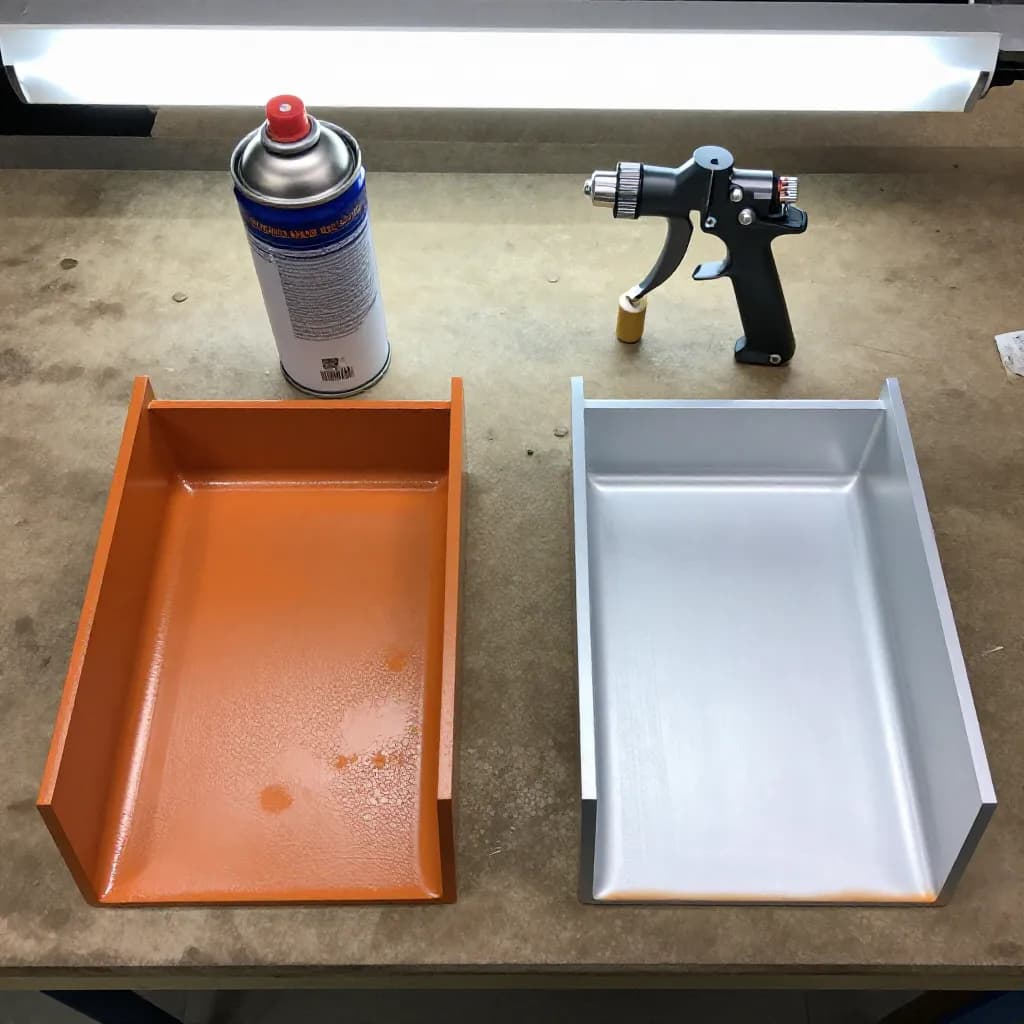
This accessibility difference is the primary reason spray paint remains popular despite its well-known limitations. For quick touch-ups, temporary finishes, craft projects, and situations where convenience outweighs durability, spray paint serves a legitimate purpose. But for any application where the finish must last more than a year or two in exterior exposure, withstand mechanical abuse, or provide genuine corrosion protection, the performance gap between spray paint and powder coating is enormous.
Ready to Start Your Project?
From one-off customs to 15,000-part production runs — get precise pricing in 24 hours.
On This Page
Spray Paint and Powder Coating: Different Leagues of Finishing
Aerosol spray paint is a solvent-based liquid coating in a pressurized can. The paint consists of pigments and resins dissolved in organic solvents, with a propellant gas (typically a hydrocarbon or compressed gas) that atomizes and propels the paint when the valve is pressed. The paint exits the nozzle as a fine mist, deposits on the surface, and dries as the solvents evaporate. The resulting film is typically 15-30 microns thick per coat — thin, often porous, and bonded to the surface primarily through weak mechanical adhesion.
Powder coating deposits a 60-120 micron film of electrostatically charged dry powder that is then cured at 160-200°C, causing the powder to melt, flow, and chemically crosslink into a continuous, dense, chemically bonded film. The crosslinked thermoset network is fundamentally different from the dried solvent-based film of spray paint — it is harder, more chemically resistant, more UV stable, and far more durable. The comparison is not between two equivalent technologies at different price points; it is between a convenience product and a professional finishing system.
Durability and Protection: A Stark Contrast
The durability difference between powder coating and spray paint is the most important factor for anyone choosing between them. Powder coating on properly pretreated metal provides 15-25 years of exterior protection, maintaining color, gloss, and corrosion resistance throughout. Spray paint on the same substrate might last 1-3 years before showing significant degradation — fading, chalking, peeling, and rust breakthrough.
The reasons for this performance gap are rooted in chemistry and physics. Powder coating's crosslinked thermoset film is a three-dimensional polymer network that resists UV degradation, chemical attack, and moisture permeation far more effectively than the linear polymer chains in dried spray paint. The crosslinks prevent the polymer chains from being pulled apart by environmental stresses, maintaining film integrity over decades. Spray paint's dried film is held together by weaker intermolecular forces that are more easily disrupted by UV radiation, solvents, and moisture.
Film thickness compounds the durability difference. Powder coating at 60-120 microns provides a substantial physical barrier — moisture must permeate through a thick, dense film to reach the metal substrate. Spray paint at 15-30 microns (even with multiple coats reaching 40-60 microns) provides a much thinner barrier that moisture can permeate more quickly. In salt spray testing (ASTM B117), powder-coated panels routinely achieve 1,000-3,000 hours of resistance, while spray-painted panels typically fail within 100-300 hours.
Adhesion is another critical difference. Powder coating over proper pretreatment (chemical cleaning, conversion coating) achieves adhesion ratings of 5B (the highest rating on the ASTM D3359 cross-hatch adhesion test). Spray paint applied to minimally prepared surfaces often achieves only 2B-3B adhesion, and without proper preparation, the paint can peel off in sheets with minimal effort. The combination of weak adhesion, thin film, and non-crosslinked chemistry means spray paint is fundamentally a temporary finish — adequate for short-term use but unsuitable for any application requiring lasting protection.
Finish Quality and Aesthetic Comparison
Finish quality is an area where the difference between spray paint and powder coating is immediately visible to anyone who has seen both. A well-applied powder coating produces a smooth, uniform, consistent finish with controlled gloss, even color, and no visible defects. The electrostatic application process and oven curing produce a film that flows and levels to a quality comparable to professional liquid paint finishes. High-gloss powder coatings achieve a depth and richness that spray paint cannot approach.
Spray paint finish quality is inherently limited by the application method. The aerosol nozzle produces a relatively coarse spray pattern compared to professional spray equipment, leading to visible texture (orange peel), uneven coverage, and inconsistent film thickness. Achieving a smooth, uniform finish with spray paint requires multiple thin coats with careful technique — and even then, the result is noticeably inferior to powder coating or professional liquid paint. Runs, sags, dry spots, and dust contamination are common spray paint defects that require sanding and recoating to correct.
Color consistency is another differentiator. Powder coatings are manufactured to precise color specifications with batch-to-batch consistency verified by spectrophotometer measurement. Every can of the same powder coating color will match within tight Delta E tolerances. Spray paint colors can vary between cans, between batches, and between manufacturers — and the final color appearance is heavily influenced by application technique, number of coats, and substrate color. Matching spray paint colors across multiple cans or touch-up applications is notoriously difficult.
The range of available finishes also differs. Powder coatings are available in thousands of colors with matte, satin, semi-gloss, high-gloss, textured, metallic, pearlescent, and specialty finishes. Spray paint offers a more limited selection — typically a few hundred colors in gloss, satin, and matte finishes, with some metallic and textured options. For any application where specific color matching, unusual finishes, or consistent aesthetic quality is required, powder coating is the only serious option.
DIY Powder Coating: Bridging the Gap
The growing availability of affordable DIY powder coating equipment has made powder coating accessible to hobbyists, small workshops, and home garages — partially bridging the accessibility gap that has traditionally been spray paint's primary advantage. Entry-level powder coating setups — including an electrostatic gun, small compressor, and converted kitchen oven or purpose-built curing oven — can be assembled for a modest investment, bringing professional-quality finishing within reach of dedicated DIY enthusiasts.
DIY powder coating does require more setup and preparation than spray paint. Parts must be thoroughly cleaned and ideally pretreated with a conversion coating (phosphate or chrome-free alternative) for optimal adhesion and corrosion resistance. The electrostatic gun requires a compressed air supply and proper grounding of the workpiece. The curing oven must reach and maintain 160-200°C for 10-20 minutes — a standard kitchen oven can work for small parts, but larger components require a dedicated curing oven.
The learning curve for DIY powder coating is steeper than for spray paint but manageable for anyone with basic mechanical aptitude. Key skills include proper surface preparation, consistent gun technique (maintaining appropriate distance, speed, and powder flow), and understanding cure schedules. Online communities, video tutorials, and powder coating suppliers provide extensive guidance for beginners. Most DIY powder coaters achieve acceptable results within their first few attempts and professional-quality results with practice.
For the DIY enthusiast who regularly finishes metal parts — automotive restoration, motorcycle building, custom fabrication, furniture making — the investment in powder coating equipment pays for itself quickly in superior finish quality and durability. A set of powder-coated wheels, brackets, or furniture frames will outlast spray-painted equivalents by a factor of five to ten, making the initial equipment investment a sound long-term decision.
However, DIY powder coating has limitations. Part size is constrained by oven dimensions — large components like bicycle frames or automotive bumpers require correspondingly large ovens. Heat-sensitive assemblies cannot be powder coated without disassembly. And achieving the consistency and quality of a professional powder coating shop requires practice, proper equipment maintenance, and attention to process control.
When Spray Paint Actually Makes Sense
Despite powder coating's overwhelming performance advantages, there are legitimate situations where spray paint is the appropriate choice. Understanding when spray paint makes sense — and when it does not — helps avoid both over-engineering simple projects and under-protecting important ones.
Temporary finishes and prototyping are ideal spray paint applications. When a part needs color for a short-term display, a prototype needs visual evaluation before committing to a production finish, or a temporary marker or identification color is needed, spray paint's convenience and low cost are genuine advantages. The finish does not need to last years — it needs to look acceptable for days or weeks.
Touch-up and spot repair is another legitimate spray paint use case. When a small area of an existing finish is damaged — a scratch on a powder-coated railing, a chip on a painted appliance — spray paint can provide a quick, acceptable repair that restores appearance and basic protection until a more permanent repair can be made. Touch-up spray paints matched to common powder coating colors are available for this purpose.
Non-metal substrates that cannot withstand powder coating cure temperatures — wood, plastic, cardboard, foam — are spray paint territory by default. Powder coating requires oven curing at 160-200°C, which would destroy these materials. For finishing non-metal items, spray paint (or other liquid coatings) is the only option.
Very large structures that cannot fit in a curing oven — building structures, bridges, large vehicles — cannot be powder coated and must be finished with liquid coatings, whether spray paint for small areas or professional liquid paint systems for full coverage. Field application and repair, where no oven is available, similarly requires liquid coatings.
Craft and art projects where the finish is decorative rather than protective, where the item will be displayed indoors, and where the creative process benefits from the immediacy and simplicity of spray application are reasonable spray paint applications. The convenience of grabbing a can and spraying has genuine value when durability is not a concern.
Making the Right Choice for Your Project
The decision between powder coating and spray paint should be guided by three questions: How long does the finish need to last? Will the item be exposed to weather, chemicals, or mechanical abuse? And is the investment in powder coating justified by the value of the item being finished?
For any metal item that will be used outdoors, exposed to moisture, subject to handling or mechanical contact, or expected to maintain its appearance for more than a year or two, powder coating is the right choice. The performance difference is not marginal — it is a factor of five to ten in service life, corrosion resistance, and mechanical durability. Wheels, frames, brackets, railings, furniture, equipment housings, and any functional metal component deserve powder coating.
For items that are temporary, disposable, indoor-only, non-metal, or of low value relative to the cost of powder coating, spray paint is a reasonable choice. A cardboard display, a wooden craft project, a temporary sign, or a quick prototype does not need the durability of powder coating, and the convenience of spray paint is a legitimate advantage.
The cost comparison favors powder coating when amortized over the finish's lifespan. A can of spray paint costs a few dollars but lasts 1-3 years. Professional powder coating costs more upfront but lasts 15-25 years. Per year of service, powder coating is dramatically less expensive. For DIY powder coaters, the per-part cost drops further once the initial equipment investment is amortized.
The bottom line is simple: if durability matters, powder coat. If convenience matters more than durability, spray paint. There is very little middle ground — the performance gap between these two technologies is too large for spray paint to serve as a substitute for powder coating in any application where lasting protection is required.
Frequently Asked Questions
How much longer does powder coating last than spray paint?
Powder coating lasts 15-25 years in exterior exposure, while spray paint typically lasts 1-3 years before significant degradation. The difference is due to powder coating's crosslinked chemistry, greater film thickness (60-120 vs 15-30 microns), and superior adhesion from proper pretreatment.
Can I powder coat at home instead of using spray paint?
Yes. DIY powder coating equipment is available at affordable prices, including electrostatic guns and small curing ovens. The learning curve is manageable, and the results are dramatically better than spray paint. Part size is limited by your oven dimensions, and parts must be metal that can withstand 160-200°C curing temperatures.
Is spray paint ever better than powder coating?
Spray paint is more practical for temporary finishes, non-metal substrates, field repairs, very large structures that cannot fit in an oven, and quick touch-ups. For any application requiring lasting durability on metal, powder coating is superior. Spray paint's advantage is convenience, not performance.
Why does spray paint peel but powder coating does not?
Spray paint relies on weak mechanical adhesion to the surface and forms a non-crosslinked film that is easily disrupted by moisture and UV. Powder coating bonds to a chemically pretreated surface and forms a crosslinked thermoset film that resists peeling, chipping, and delamination. Proper surface preparation is critical for both, but powder coating's chemistry provides fundamentally stronger adhesion.
Can I spray paint over powder coating for touch-ups?
Yes, for minor touch-ups. Lightly sand the damaged area, clean it, and apply matching spray paint. The repair will not match the original powder coating in durability or exact appearance, but it provides acceptable short-term protection and appearance restoration until a professional repair can be made.
Ready to Start Your Project?
From one-off customs to 15,000-part production runs — get precise pricing in 24 hours.