Parkerizing is a phosphate conversion coating process that was developed in the early twentieth century and adopted by the United States military as the standard protective finish for small arms, vehicles, and equipment during World War II. The process is named after the Parker Rust-Proof Company, which commercialized the technology, though phosphate coating processes were developed independently by several inventors in the early 1900s.
Comparison
Powder Coating vs Parkerizing: Military Finishes, Phosphate Coatings, and Modern Alternatives
Sundial Powder Coating·April 22, 2026·10 min
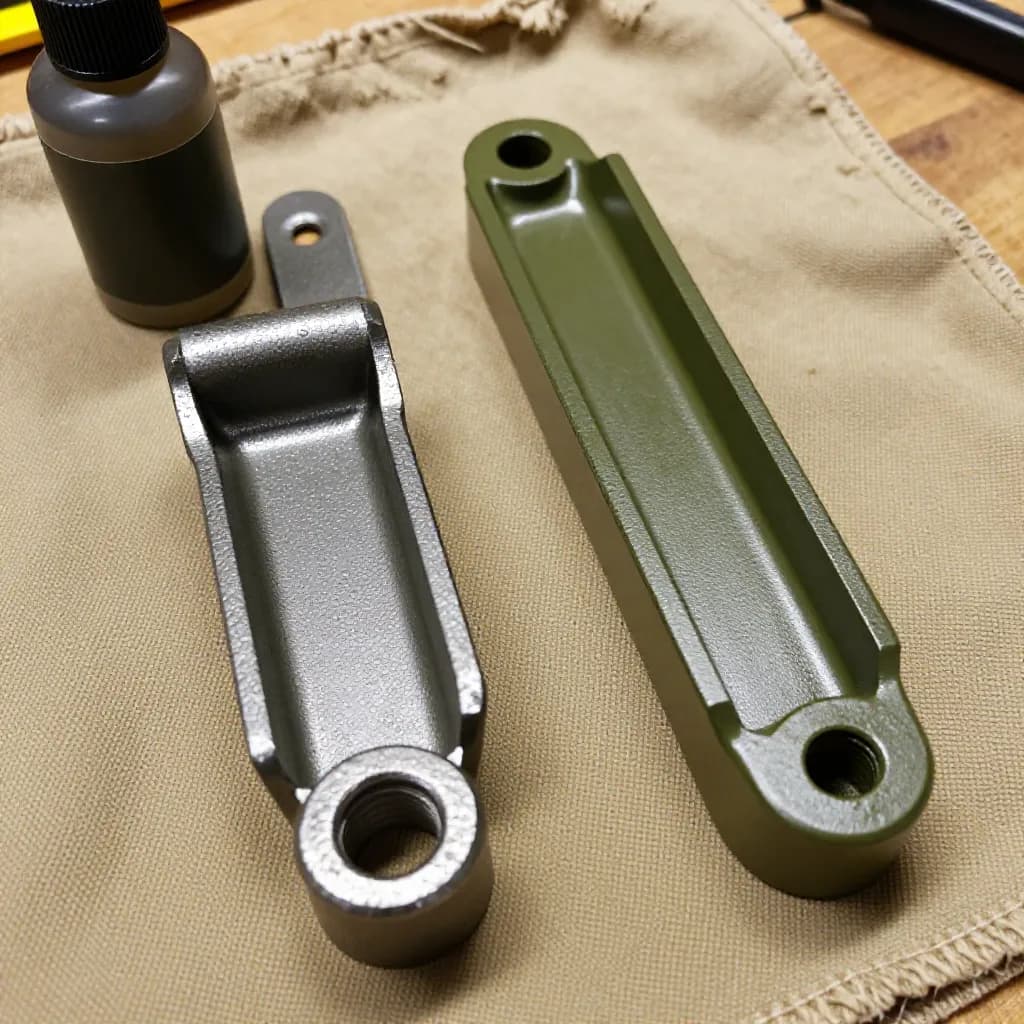
The parkerizing process involves immersing clean steel parts in a hot solution of phosphoric acid and either manganese dioxide or zinc phosphate at temperatures of 88 to 99 degrees Celsius for 5 to 20 minutes. The acid reacts with the steel surface, dissolving a thin layer of iron and depositing a crystalline phosphate coating in its place. Manganese phosphate produces a dark gray to black finish, while zinc phosphate produces a lighter gray-green finish. The resulting coating is porous and must be sealed with oil or preservative to provide effective corrosion protection.
Ready to Start Your Project?
From one-off customs to 15,000-part production runs — get precise pricing in 24 hours.
On This Page
The History and Science of Parkerizing
The parkerized finish became iconic on military weapons including the M1 Garand, M1 Carbine, M14, and M16 series rifles, as well as the M1911 pistol. Its matte, non-reflective surface reduces glare in the field, the porous structure holds oil for lubrication and corrosion protection, and the process is relatively simple and inexpensive to perform at military depot level. These practical advantages made parkerizing the dominant military finish for decades, and it remains in use today on many military and civilian firearms.
How Parkerizing Protects Metal
Parkerizing protects steel through a combination of barrier protection and oil retention. The crystalline phosphate layer itself provides moderate barrier protection against moisture and corrosive agents, but its primary protective function is as an oil reservoir. The porous, crystalline structure of the phosphate coating absorbs and retains oil, creating a continuous oil film on the metal surface that prevents moisture from reaching the underlying steel.
Manganese phosphate coatings are generally considered superior to zinc phosphate for corrosion protection and oil retention. The manganese phosphate crystal structure is finer and more uniform, providing better oil absorption and a more consistent protective barrier. Manganese phosphate also provides better wear resistance and is the preferred parkerizing chemistry for firearms and military applications. Zinc phosphate is more commonly used as a pretreatment for paint and powder coating rather than as a standalone finish.
The corrosion protection provided by parkerizing is moderate — significantly better than bare steel but far below the protection offered by thick-film coatings like powder coating. Oil-sealed manganese phosphate coatings typically provide 48 to 96 hours of salt spray resistance, which is adequate for equipment that receives regular maintenance and oil application but insufficient for applications where the finish must provide long-term protection without maintenance. The coating's effectiveness depends entirely on maintaining the oil seal, which requires regular re-oiling.
Powder Coating's Superior Protection
Powder coating provides a fundamentally different and more robust level of protection than parkerizing. Where parkerizing relies on a thin, porous phosphate layer sealed with oil, powder coating provides a thick, dense, continuous polymer barrier that physically separates the metal from the environment. The 60 to 120 micron powder coating film is impervious to moisture, resistant to chemicals, and does not require oil or any other supplemental treatment to maintain its protective properties.
In salt spray testing, the performance difference is dramatic. Parkerized and oiled surfaces typically show red rust within 48 to 96 hours, while properly applied powder coatings routinely exceed 500 to 1000 hours without corrosion. This represents a performance improvement of roughly ten to twenty times, making powder coating the clearly superior choice for any application where long-term, maintenance-free corrosion protection is required.
Powder coating also provides UV resistance that parkerizing lacks entirely. Parkerized surfaces exposed to sunlight do not degrade in the way that organic coatings can, but they also provide no UV protection to the underlying metal and offer no color stability — the finish simply remains the same matte gray. Powder coating maintains its color, gloss, and protective properties through years of outdoor UV exposure, making it suitable for exterior applications where parkerizing would require constant maintenance to prevent corrosion.
Firearms: Traditional vs Modern Finishes
The firearms industry illustrates the transition from parkerizing to powder coating and other modern finishes. Parkerizing remains popular among military surplus collectors, historical firearm restorers, and shooters who appreciate the traditional matte gray appearance and the way a well-oiled parkerized surface feels in the hand. The finish has a loyal following based on decades of proven military service and the practical advantages of oil retention for firearms that are regularly cleaned and oiled.
However, modern firearms manufacturers increasingly specify powder coating, Cerakote, and other advanced finishes for new production weapons. These modern finishes provide dramatically better corrosion resistance, abrasion resistance, and chemical resistance than parkerizing, with the added benefit of color options for tactical, sporting, and custom applications. Powder coating is particularly popular for AR-15 platform receivers, handguards, and accessories where the thick, durable finish withstands the rigors of field use without the maintenance demands of parkerizing.
The practical advantage of powder coating over parkerizing for firearms is reduced maintenance. A parkerized firearm must be regularly oiled to maintain corrosion protection — if the oil dries out or is washed away by rain or sweat, the bare phosphate coating provides only limited protection. A powder-coated firearm maintains its corrosion protection regardless of oil condition, requiring only basic cleaning for reliable function. For military and law enforcement users who operate in harsh environments with limited maintenance opportunities, this reduced maintenance burden is a significant operational advantage.
Dimensional and Functional Considerations
Parkerizing shares with black oxide the advantage of minimal dimensional change. The phosphate coating is typically 5 to 25 microns thick, which is thin enough to preserve the fit and function of precision firearm components, threaded fasteners, and mechanical assemblies. This dimensional neutrality is one reason parkerizing has remained in use for military weapons where interchangeability of parts between weapons is essential.
Powder coating's 60 to 120 micron film thickness is a significant dimensional addition that must be accounted for in firearm and precision component design. Critical mating surfaces, thread engagement areas, and precision bores typically must be masked during powder coating to prevent interference with function. This masking requirement adds complexity and cost to the powder coating process for firearms and precision components.
However, modern firearm designs increasingly accommodate powder coating thickness in their dimensional specifications. Manufacturers who design for powder coating from the outset can adjust tolerances to account for the coating thickness, eliminating the need for masking on most surfaces. The trend in the firearms industry is toward designing components specifically for modern coating systems rather than retrofitting traditional designs with thicker coatings.
Parkerizing as a Pretreatment for Powder Coating
An important aspect of the parkerizing versus powder coating discussion is that phosphate coatings — the same chemistry used in parkerizing — are widely used as a pretreatment for powder coating. Zinc phosphate and iron phosphate conversion coatings are applied to metal surfaces before powder coating to promote adhesion and enhance corrosion resistance. In this role, the phosphate coating is not a standalone finish but a foundation layer that improves the performance of the powder coating system.
The combination of phosphate pretreatment plus powder coating topcoat provides corrosion protection that exceeds either treatment alone. The phosphate layer provides chemical bonding between the metal substrate and the powder coating, while also providing a secondary barrier against corrosion if the powder coating is damaged. This is why quality powder coating specifications — including Qualicoat, GSB, and AAMA standards — require chemical pretreatment as part of the coating system.
For firearms and military equipment, a manganese phosphate pretreatment followed by a powder coating topcoat provides the best of both worlds — the oil-retaining, anti-galling properties of parkerizing on internal surfaces combined with the robust corrosion and abrasion resistance of powder coating on external surfaces. This combined approach is increasingly used by custom firearms builders and military refurbishment programs that want to maximize the protective performance of the coating system.
Choosing Between Parkerizing and Powder Coating
Choose parkerizing when historical authenticity is important — restoring military surplus firearms, maintaining period-correct appearance on collectible weapons, or matching the original finish specification on vintage equipment. Parkerizing is also appropriate for components that require minimal dimensional change and will receive regular oil maintenance, such as precision mechanical parts in oiled environments.
Choose powder coating when maximum corrosion protection, durability, and low maintenance are priorities. For new firearms, outdoor equipment, industrial components, and any application where the finish must perform without regular oil maintenance, powder coating provides dramatically superior protection. The wide range of available colors and finishes also makes powder coating the choice for custom, tactical, and sporting applications where appearance customization is desired.
For the best overall protection on firearms and military equipment, consider a combined system — manganese phosphate pretreatment on all surfaces for oil retention and anti-galling properties, with powder coating topcoat on external surfaces for maximum corrosion and abrasion resistance. This approach preserves the functional benefits of parkerizing on internal and mating surfaces while providing modern levels of protection on exposed surfaces.
Frequently Asked Questions
Is parkerizing the same as phosphate coating?
Parkerizing is a specific type of phosphate coating — typically manganese phosphate or zinc phosphate applied by immersion in a hot acid solution. The term parkerizing is most commonly used in the firearms and military context, while phosphate coating is the broader industrial term that includes pretreatment applications for paint and powder coating.
How much more corrosion-resistant is powder coating than parkerizing?
Powder coating provides roughly 10-20 times more salt spray resistance than parkerizing. Oil-sealed parkerizing typically provides 48-96 hours of salt spray protection, while powder coating routinely exceeds 500-1000 hours. Powder coating also maintains its protection without oil maintenance.
Can you powder coat over a parkerized surface?
Yes. Phosphate coatings like parkerizing are actually excellent pretreatments for powder coating, promoting adhesion and enhancing corrosion resistance. Many quality powder coating systems use zinc or iron phosphate pretreatment as a standard part of the process. Manganese phosphate pretreatment followed by powder coating provides excellent combined protection.
Why do some people still prefer parkerizing for firearms?
Parkerizing is valued for historical authenticity on military surplus and collectible firearms, its minimal dimensional change on precision components, its oil-retaining properties that aid lubrication, and its traditional matte gray appearance. However, for maximum protection and low maintenance, modern powder coating is the superior choice.
Does parkerizing require maintenance that powder coating does not?
Yes. Parkerizing must be regularly oiled to maintain corrosion protection — the porous phosphate coating relies on absorbed oil as its primary moisture barrier. If the oil dries out, protection is minimal. Powder coating requires no oil or supplemental treatment, maintaining its protective properties indefinitely through its dense polymer film.
Ready to Start Your Project?
From one-off customs to 15,000-part production runs — get precise pricing in 24 hours.