Wheels operate in one of the most demanding environments of any coated component on a vehicle. They are subjected to a unique combination of stresses that would rapidly destroy most standard coatings: extreme temperature cycling from brake heat (100-300°C during normal driving, higher during spirited or track use), constant bombardment by road debris and stone chips, exposure to corrosive brake dust containing iron particles and metallic compounds, chemical attack from road salt, de-icing agents, and aggressive wheel cleaners, and mechanical damage from curb contact and pothole impacts.
Comparison
Powder Coating vs Paint for Wheels: Brake Dust, Curb Rash, and Track Use
Sundial Powder Coating·April 22, 2026·13 min
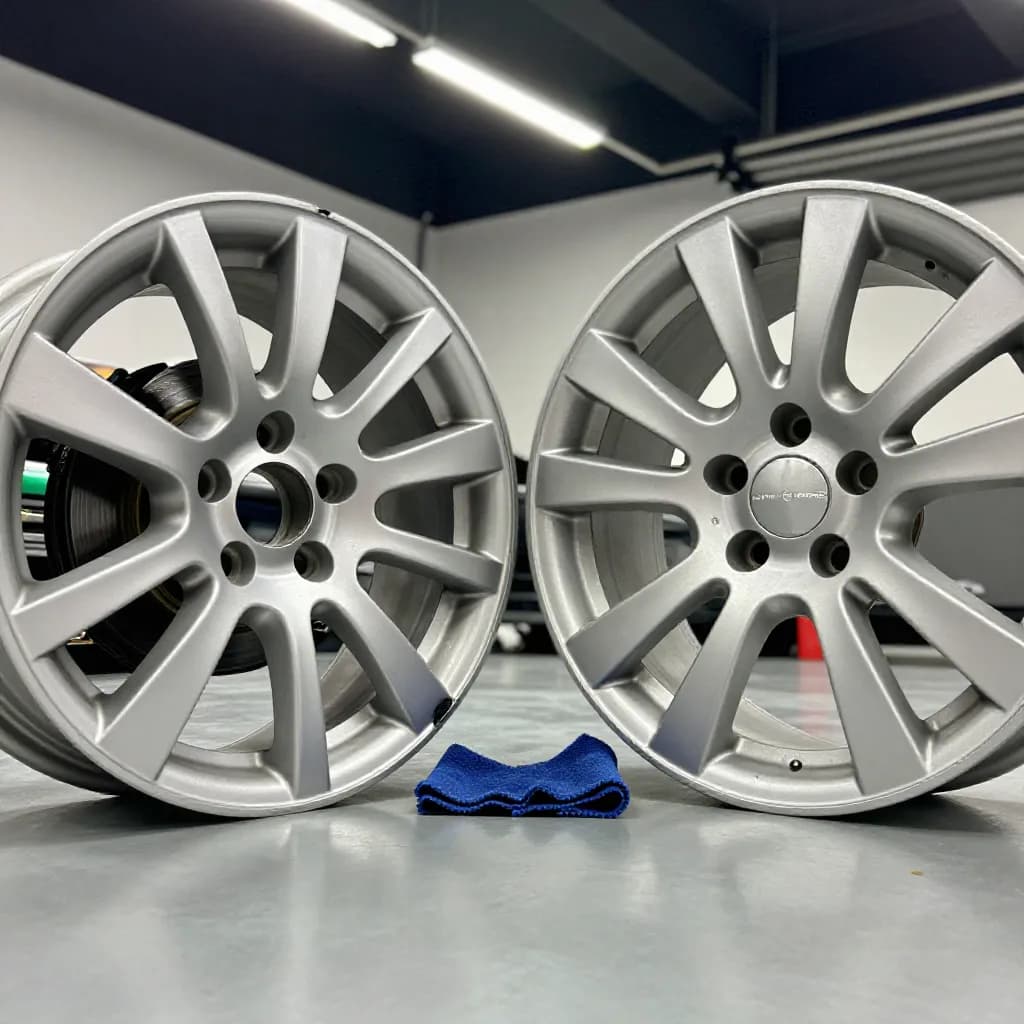
This demanding environment makes wheel finishing a particularly revealing comparison between powder coating and liquid paint. The weaknesses of each technology are exposed more quickly on wheels than on most other applications, and the performance differences become apparent within months rather than years. A wheel finish that survives five years of daily driving in a northern climate with salted roads has proven its durability in one of the toughest real-world tests available.
Ready to Start Your Project?
From one-off customs to 15,000-part production runs — get precise pricing in 24 hours.
On This Page
Why Wheel Finishing Demands More Than Standard Coatings
OEM wheel finishes vary by manufacturer and price point. Economy wheels may receive a simple liquid paint finish — primer, basecoat, and clearcoat — that provides adequate appearance when new but degrades relatively quickly under the stresses described above. Premium OEM wheels increasingly use powder coating as a basecoat or full coating system, sometimes combined with liquid clearcoat for maximum appearance quality. The aftermarket wheel finishing industry is dominated by powder coating, which has become the standard for wheel refinishing and custom finishing due to its superior durability in the wheel environment.
The comparison between powder coating and paint for wheels is not academic — it directly affects how long your wheels look good, how much maintenance they require, and how well they resist the inevitable abuse of daily driving. Understanding the technical differences helps wheel owners make informed decisions about finishing options for new, refinished, or custom wheels.
Brake Dust Resistance: Chemistry Under Attack
Brake dust is one of the most corrosive substances that wheel finishes encounter, and resistance to brake dust is a critical differentiator between powder coating and liquid paint on wheels. Modern semi-metallic and ceramic brake pads generate dust containing iron particles, metallic oxides, carbon fibers, and binding resins. When these particles land on a hot wheel surface, the iron particles can embed in the coating and begin to oxidize, creating the familiar brown-orange staining that plagues wheel owners.
The chemical mechanism of brake dust damage involves iron particles penetrating or bonding to the coating surface, then oxidizing (rusting) in the presence of moisture. The expanding iron oxide creates micro-craters in the coating surface, allowing further contamination and progressive degradation. Acidic brake dust compounds can also chemically attack the coating binder, accelerating degradation. Aggressive acid-based wheel cleaners — while effective at removing brake dust — can further damage coatings that lack adequate chemical resistance.
Powder coating's thicker film (60-120 microns versus 30-50 microns for typical liquid wheel paint) provides a more substantial barrier against brake dust penetration. The dense, crosslinked thermoset film resists embedding of iron particles more effectively than thinner liquid paint films. Additionally, powder coating's superior chemical resistance — particularly epoxy-polyester hybrid and polyester formulations — withstands both the acidic compounds in brake dust and the aggressive chemicals in wheel cleaning products.
Liquid paint finishes on wheels, particularly thin clearcoat layers, are more vulnerable to brake dust damage. The thinner film is more easily penetrated by hot iron particles, and the clearcoat chemistry may be less resistant to the acidic compounds in brake dust. OEM liquid paint wheel finishes often show visible brake dust staining and clearcoat degradation within 2-3 years of use, particularly on front wheels where brake dust exposure is heaviest.
For maximum brake dust resistance, powder-coated wheels should be cleaned regularly (every 1-2 weeks during normal driving) with pH-neutral wheel cleaners to prevent brake dust from bonding to the surface. Iron-removing wheel cleaners (which chemically dissolve iron particles) are safe for quality powder coatings and provide the most effective brake dust removal. The combination of powder coating's durable film and regular cleaning with appropriate products maintains wheel appearance for years.
Curb Rash and Impact Resistance
Curb rash — the scraping and gouging damage that occurs when a wheel contacts a curb during parking — is one of the most common forms of wheel damage, and the coating's ability to resist and survive curb contact varies significantly between powder coating and liquid paint. The physics of curb contact involve both abrasive scraping (the curb grinding against the wheel surface) and impact loading (the sudden force of contact), often combined with the wheel rotating during the scrape.
Powder coating's thicker film provides a meaningful advantage in curb rash resistance. The 60-120 micron coating absorbs more abrasive energy before the substrate is exposed compared to a 30-50 micron liquid paint system. In mild curb contacts — light scrapes at low speed — a powder coating may survive with surface scratching but no substrate exposure, while a thinner liquid paint finish would be scraped through to bare metal. This difference means powder-coated wheels accumulate visible curb damage more slowly than painted wheels under equivalent abuse.
The flexibility and impact resistance of powder coating also contribute to curb rash performance. Polyester powder coatings can absorb impact energy and flex without cracking or delaminating from the substrate. When a powder-coated wheel contacts a curb, the coating may be scratched or abraded at the contact point, but it typically does not crack, chip, or peel away from adjacent undamaged areas. Liquid paint clearcoats, being thinner and sometimes more brittle, can crack and delaminate around the impact zone, causing damage to spread beyond the initial contact area.
For severe curb rash — deep gouges that penetrate through any coating to the aluminum substrate — neither powder coating nor liquid paint provides protection. The damage must be repaired by filling, sanding, and refinishing the affected area. Powder coating has an advantage in repairability: the damaged wheel can be stripped and re-powder-coated to restore it to as-new condition. Liquid paint repairs are also possible but may not match the original finish as precisely, particularly for metallic and multi-coat finishes.
Wheel designs with protective lip profiles, rim guards, or recessed spoke designs can reduce curb rash exposure regardless of the coating type. For owners of wheels with exposed rim edges — particularly large-diameter, low-profile tire setups that are most vulnerable to curb contact — powder coating's thicker, more resilient film provides a worthwhile advantage.
Weight Considerations and Performance Impact
For performance-oriented drivers and track enthusiasts, wheel weight is a critical consideration, and the coating system contributes to total wheel weight. Unsprung weight — the weight of components not supported by the suspension springs, including wheels, tires, brakes, and hubs — directly affects ride quality, handling response, and braking performance. Reducing unsprung weight improves acceleration, braking, and cornering response, making it a priority for track-focused vehicles.
The weight difference between powder coating and liquid paint on a typical alloy wheel is small but measurable. A powder coating at 80 microns average thickness on a standard 18-inch alloy wheel adds approximately 50-100 grams of coating weight, depending on wheel design and surface area. A liquid paint system at 40 microns average thickness adds approximately 25-50 grams. The difference — roughly 25-50 grams per wheel, or 100-200 grams for a set of four — is negligible for street driving but may be considered by competitive racers seeking every possible advantage.
For serious track use, some competitors choose to run bare (uncoated) or minimally coated wheels to minimize weight. Others use thin-film coatings like Cerakote (25 microns) to provide basic protection with minimal weight penalty. However, for the vast majority of enthusiasts — including those who track their cars regularly — the durability and protection advantages of powder coating far outweigh the minimal weight penalty. A powder-coated wheel that maintains its appearance and corrosion protection through years of track use and street driving is more practical than a bare or minimally coated wheel that corrodes and degrades.
The weight discussion should also consider the practical reality that wheel weight is dominated by the wheel structure itself — a forged aluminum wheel may weigh 7-10 kg, and the coating adds less than 1% to that total. Tire selection, wheel design, and material (cast vs forged vs carbon fiber) have far greater impact on unsprung weight than the choice between powder coating and liquid paint. For all but the most weight-obsessed competitors, powder coating's durability advantage makes it the rational choice for wheel finishing.
Track Use: Heat, Chemicals, and Extreme Demands
Track driving subjects wheels to conditions far more extreme than normal street use, and the coating must survive these conditions to maintain both appearance and protection. Brake temperatures during track sessions can reach 500-700°C at the rotor, with caliper temperatures of 200-400°C and wheel temperatures of 100-200°C at the barrel and spoke areas nearest the brakes. These temperatures are within the operating range of standard polyester powder coatings (rated to approximately 150°C continuous) but can approach or exceed their limits during extended track sessions with aggressive braking.
For dedicated track wheels, high-temperature powder coating formulations rated to 200-300°C provide additional thermal margin. These formulations use modified polyester or silicone-polyester hybrid resins that maintain their properties at elevated temperatures. The thicker powder coating film also provides better thermal insulation between the hot brake components and the wheel surface, slightly reducing peak coating temperatures compared to thinner liquid paint systems.
Brake fluid exposure is a concern for track use. DOT 3 and DOT 4 brake fluids are aggressive solvents that can damage many coatings on contact. Brake fluid leaks or spills during pad changes and brake bleeding can contact wheel surfaces, and the coating must resist this exposure without softening, blistering, or delaminating. Powder coatings — particularly epoxy-polyester hybrid formulations — offer good resistance to brake fluid, though prolonged exposure should be avoided. Liquid paint clearcoats are generally more vulnerable to brake fluid damage.
Tire mounting and dismounting — a frequent occurrence for track enthusiasts who swap between street and track tire sets — subjects the wheel bead seat area to mechanical stress from tire mounting machines. Powder coating's thicker, more flexible film resists the scraping and gouging from tire mounting tools better than thinner liquid paint. Proper technique by the tire technician is essential regardless of coating type, but powder coating provides a greater margin for error.
For track enthusiasts who want the best combination of protection and appearance, powder coating with a high-temperature formulation is the optimal wheel finish. The thick, durable film withstands the heat, chemicals, and mechanical abuse of track use while maintaining the aesthetic quality that enthusiasts demand. Liquid paint finishes on track wheels typically show visible degradation — heat discoloration, brake dust staining, and clearcoat failure — within one to two seasons of regular track use.
Wheel Restoration and Refinishing Options
Wheel restoration — returning damaged, corroded, or cosmetically degraded wheels to like-new condition — is a significant market, and the choice between powder coating and liquid paint for refinishing affects both the quality and longevity of the restoration. Powder coating has become the dominant technology for wheel refinishing due to its superior durability, simpler process (single coat versus multi-coat), and the ability to completely strip and recoat wheels to factory-new quality.
The powder coating restoration process typically involves chemical stripping or media blasting to remove the existing finish, inspection and repair of any substrate damage (curb rash filling, crack repair, straightening), pretreatment (chemical cleaning and conversion coating), powder application, and oven curing. The result is a complete, uniform, factory-quality finish that covers all surfaces including the barrel interior, spoke backs, and lug nut recesses. The single-coat process eliminates the inter-coat adhesion issues that can plague multi-coat liquid paint restorations.
Liquid paint restoration follows a similar preparation process but applies primer, basecoat, and clearcoat in separate stages with flash-off time between each. The multi-coat process provides excellent appearance quality — particularly for metallic and multi-tone finishes — but introduces more opportunities for defects (dust contamination, inter-coat adhesion failure, solvent pop) and requires more skilled application technique. Liquid paint restorations can achieve OEM-equivalent appearance quality, which is important for concours-level restorations of classic and collectible vehicles where originality is valued.
For most wheel restoration applications — daily drivers, enthusiast vehicles, and custom builds — powder coating provides the best combination of durability, appearance, and value. The single-coat process is faster and more consistent than multi-coat liquid paint, the thicker film provides better long-term protection, and the wide range of available colors and finishes satisfies most aesthetic requirements.
For concours restorations, OEM-matching refinishes, and wheels with complex multi-tone factory finishes (machined face with painted pockets, for example), liquid paint may be necessary to replicate the original appearance. Some restoration shops offer hybrid approaches — powder coating the base layer for durability, with liquid paint for color-matched topcoats or machined-face effects. This combination captures the durability of powder coating with the appearance precision of liquid paint.
The Verdict: Powder Coating Wins for Wheels
For the vast majority of wheel finishing applications — daily driving, enthusiast use, track days, and custom builds — powder coating is the superior choice over liquid paint. The thicker film provides better resistance to brake dust, curb rash, stone chips, and chemical exposure. The crosslinked thermoset chemistry withstands the temperature cycling, moisture exposure, and mechanical abuse that wheels endure. The single-coat application produces a consistent, durable finish with fewer defect opportunities than multi-coat liquid paint systems.
The performance advantages of powder coating on wheels are not theoretical — they are visible in the real world. Powder-coated wheels maintain their appearance through years of daily driving that would visibly degrade liquid paint finishes. The brake dust staining, clearcoat peeling, and corrosion blistering that commonly affect painted wheels after 3-5 years are rare on properly powder-coated wheels, even after a decade of use.
The practical advantages extend beyond durability. Powder-coated wheels are easier to clean because the dense, smooth film resists dirt and brake dust adhesion. They are easier to maintain because the robust coating tolerates a wider range of cleaning products without damage. And they are easier to restore — when a powder-coated wheel eventually needs refinishing after years of service, it can be stripped and recoated to as-new condition.
Liquid paint retains a role in specific wheel finishing niches: OEM factory finishes where existing paint lines are optimized for liquid application, concours restorations requiring exact OEM appearance matching, and complex multi-tone finishes that combine machined, polished, and painted surfaces. For these specialized applications, liquid paint's thin-film precision and multi-coat capability provide advantages that powder coating cannot fully replicate.
For everyone else — and that includes the vast majority of wheel owners — powder coating delivers the best combination of durability, appearance, maintenance ease, and long-term value. When choosing a finish for new, refinished, or custom wheels, powder coating should be the default choice unless specific circumstances require liquid paint.
Frequently Asked Questions
Is powder coating better than paint for alloy wheels?
Yes, for most applications. Powder coating provides a thicker film (60-120 vs 30-50 microns), better brake dust resistance, superior curb rash durability, and longer service life. Powder-coated wheels typically maintain their appearance for 10+ years versus 3-5 years for liquid paint in demanding conditions.
Does powder coating resist brake dust better than paint?
Yes. Powder coating's thicker, denser film resists brake dust penetration and chemical attack more effectively than thinner liquid paint clearcoats. The crosslinked thermoset chemistry also withstands aggressive wheel cleaners better. Regular cleaning with pH-neutral or iron-removing cleaners maintains powder-coated wheel appearance for years.
Does powder coating add significant weight to wheels?
No. Powder coating adds approximately 50-100 grams per wheel — less than 1% of total wheel weight. The difference versus liquid paint is only 25-50 grams per wheel. This is negligible for street driving and insignificant for all but the most weight-sensitive competitive racing applications.
Can powder-coated wheels handle track use?
Yes. Standard polyester powder coatings handle temperatures up to 150°C, adequate for most track use. High-temperature formulations rated to 200-300°C provide additional margin for aggressive track driving. Powder coating's thick film also resists brake fluid exposure, tire mounting damage, and the heavy brake dust generated during track sessions.
How do you restore powder-coated wheels?
Damaged powder-coated wheels are restored by chemically stripping or media blasting the old finish, repairing any substrate damage, pretreating the bare aluminum, and applying fresh powder coating. The result is a factory-new finish. The process is simpler and more consistent than multi-coat liquid paint restoration.
Ready to Start Your Project?
From one-off customs to 15,000-part production runs — get precise pricing in 24 hours.