Many manufacturers face a fundamental finishing decision: should they outsource powder coating to a specialist applicator, or operate an in-house liquid paint shop? This is not simply a cost comparison — it involves trade-offs across quality, consistency, environmental compliance, operational flexibility, capital investment, and strategic control. The right answer depends on the specific circumstances of the business, and many manufacturers who have operated paint shops for years are re-evaluating this decision as environmental regulations tighten and powder coating technology advances.
Comparison
Powder Coating vs In-House Painting: Outsourcing Coating vs Internal Paint Shop
Sundial Powder Coating·April 22, 2026·12 min
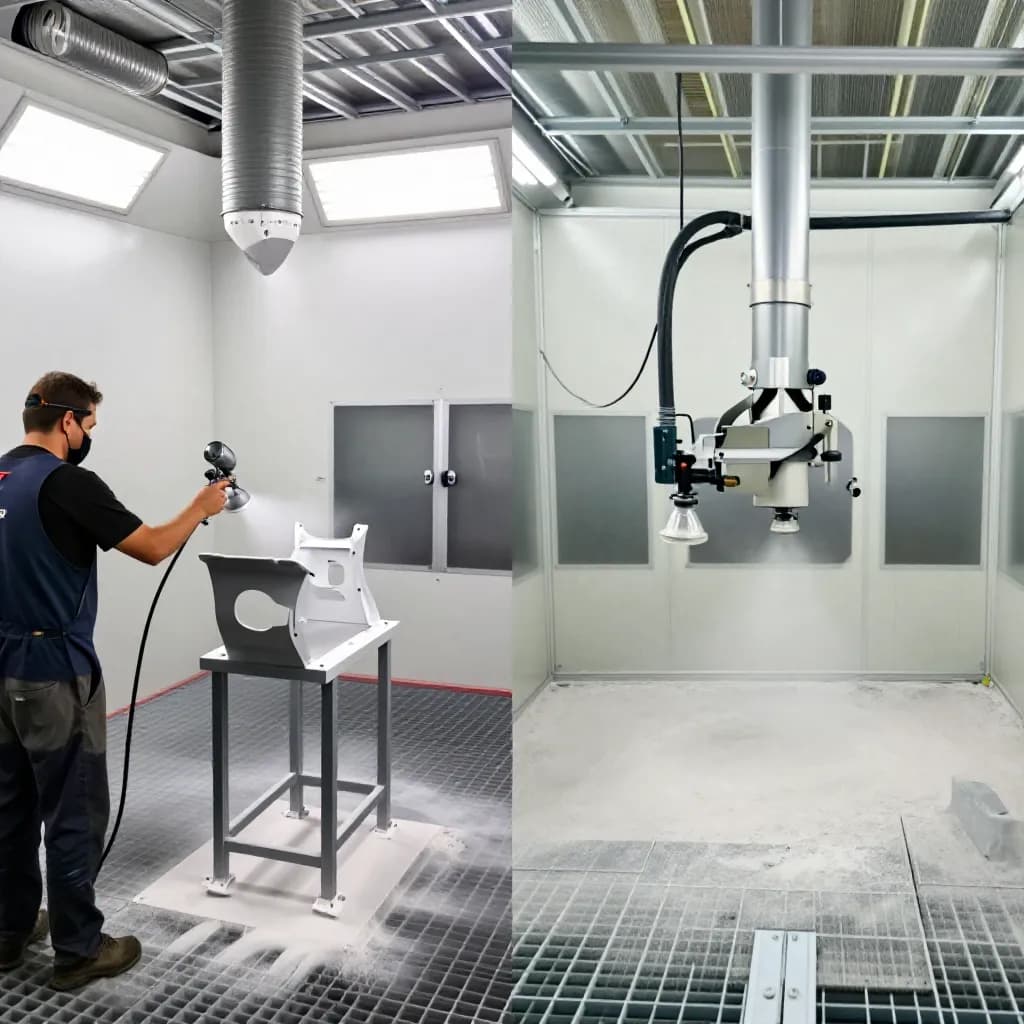
The comparison is not always straightforward because the two options involve fundamentally different technologies. Liquid painting uses solvent-based or water-based paints applied by spray gun, brush, or roller, with curing at ambient temperature or in low-temperature ovens. Powder coating uses electrostatically charged dry powder applied by spray gun and cured in high-temperature ovens. Each technology has inherent advantages and limitations that affect quality, cost, and operational requirements.
Ready to Start Your Project?
From one-off customs to 15,000-part production runs — get precise pricing in 24 hours.
On This Page
The Decision: Outsource Powder Coating or Paint In-House?
This article provides an objective comparison across the factors that matter most to manufacturing decision-makers, helping you evaluate whether outsourced powder coating or an in-house paint shop is the better fit for your operation. We examine quality and consistency, environmental and regulatory compliance, total cost of ownership, operational flexibility, and the practical considerations of transitioning from one approach to the other.
Quality and Consistency Comparison
Powder coating delivers inherently more consistent results than liquid painting for several fundamental reasons. The electrostatic application process deposits powder uniformly across the part surface, and the single-coat application eliminates the inter-coat adhesion issues, solvent entrapment, and layering inconsistencies that can affect multi-coat liquid paint systems. Film thickness is naturally more uniform and typically much greater — 60-120 microns for powder versus 25-50 microns for most liquid paints — providing a more robust protective barrier.
The cured powder coating film is also mechanically superior to most liquid paint films. Powder coatings are fully cross-linked thermoset polymers that offer excellent hardness, scratch resistance, impact resistance, and chemical resistance. Liquid paints, particularly air-dried solvent-based systems, may not achieve the same degree of cross-linking and can remain susceptible to solvent attack, softening at elevated temperatures, and mechanical damage.
Consistency is where the difference is most pronounced. A specialist powder coating operation with automated application equipment, calibrated process controls, and trained operators produces remarkably consistent results from part to part and batch to batch. An in-house paint shop, particularly one using manual spray application, is inherently more variable — film thickness depends on operator technique, paint viscosity varies with temperature and solvent evaporation, and environmental conditions (temperature, humidity, dust) affect the finish quality. Achieving the same level of consistency with liquid paint requires significantly more operator skill, process control, and quality inspection effort.
Environmental Compliance and Regulatory Burden
Environmental compliance is increasingly the decisive factor in the powder coating versus liquid painting comparison. Solvent-based liquid paints contain volatile organic compounds (VOCs) that are released during application and drying, contributing to air pollution and posing health risks to workers. Regulatory limits on VOC emissions have tightened progressively over the past two decades, and compliance requires investment in solvent abatement equipment (thermal oxidizers, carbon adsorption systems, or catalytic converters), emissions monitoring, and regulatory reporting.
Powder coating produces zero VOC emissions because the coating material contains no solvents. This eliminates the need for solvent abatement equipment, simplifies air quality permitting, and removes a significant source of workplace health risk. The environmental advantage extends to waste management — powder overspray is collected and recycled, achieving material utilization rates of 95-98%, while liquid paint overspray is typically captured in water wash or dry filter systems and disposed of as hazardous waste.
The regulatory burden of operating a liquid paint shop extends beyond air emissions. Solvent storage requires fire-rated facilities with spill containment, ventilation, and fire suppression systems. Paint waste is classified as hazardous waste in most jurisdictions, requiring licensed waste carriers, manifested shipments, and documented disposal. Worker exposure monitoring, respiratory protection programs, and health surveillance add further compliance costs. For many manufacturers, the cumulative regulatory burden of operating a liquid paint shop — in terms of both direct costs and management attention — is a compelling reason to transition to outsourced powder coating.
Total Cost of Ownership Analysis
A meaningful cost comparison between outsourced powder coating and in-house painting must consider total cost of ownership rather than just the direct application cost. The direct cost of in-house painting — paint materials, labor, and energy — may appear lower than the per-unit charge from a powder coating supplier, but this comparison ignores the substantial indirect costs of operating a paint shop.
Indirect costs of in-house painting include facility costs (dedicated floor space, ventilation systems, fire suppression, lighting), equipment maintenance and replacement, environmental compliance costs (emissions monitoring, abatement equipment, waste disposal, permits), quality costs (inspection labor, rework, scrap, customer complaints), health and safety costs (PPE, exposure monitoring, health surveillance, training), and management overhead (supervision, scheduling, supplier management for paint and consumables).
Outsourced powder coating converts many of these fixed and semi-fixed costs into a variable per-unit charge. The coating supplier absorbs the capital investment, environmental compliance, staffing, and quality management costs within their pricing. The buyer's costs are limited to the per-unit coating charge, transport and packaging, incoming inspection, and supplier management overhead. For many manufacturers — particularly those with moderate coating volumes, diverse color requirements, or limited facility space — the total cost of outsourced powder coating is lower than the total cost of in-house painting when all factors are included.
Operational Flexibility and Responsiveness
Operational flexibility is one area where in-house painting has a potential advantage over outsourced powder coating. With an in-house paint shop, the manufacturer has direct control over scheduling and can respond immediately to production changes, rush orders, and quality issues. Parts can move from fabrication to painting to assembly without leaving the facility, minimizing lead time and work-in-progress inventory.
However, this flexibility advantage is often overstated. Many in-house paint shops are bottlenecks in the production process — limited by booth capacity, drying time, and operator availability. The flexibility to paint a rush order today may come at the cost of delaying other orders, creating a cascade of scheduling disruptions. And the quality of rush work in a paint shop is often compromised by pressure to skip preparation steps, reduce drying times, or accept marginal finish quality.
Outsourced powder coating introduces a logistics cycle — parts must be transported to the coating supplier and returned — that adds lead time compared to in-house painting. However, a well-managed outsourcing relationship with a reliable supplier can provide predictable, consistent lead times that are easier to plan around than the variable throughput of an in-house paint shop. Many manufacturers find that the apparent flexibility of in-house painting is less valuable in practice than the predictability and consistency of outsourced powder coating.
Durability and Long-Term Performance
The long-term performance of the coating is a critical factor for products that must maintain their appearance and protective function over extended service lives. Powder coating consistently outperforms liquid paint on durability metrics — UV resistance, corrosion protection, scratch resistance, chemical resistance, and overall film integrity over time.
Powder-coated products typically maintain their appearance for 15-25 years in exterior applications, depending on the powder chemistry and exposure conditions. Liquid-painted products in comparable environments may begin showing degradation — fading, chalking, cracking, or peeling — within 5-10 years. This performance gap has direct implications for product warranty costs, customer satisfaction, and brand reputation.
For manufacturers of products with long service lives — building components, outdoor furniture, agricultural equipment, industrial machinery — the superior durability of powder coating reduces warranty claims, extends product life, and supports premium market positioning. The durability advantage also reduces the total lifecycle cost for end users, which can be a significant selling point in markets where lifecycle cost analysis influences purchasing decisions. Even for products with shorter service lives, the superior scratch and chip resistance of powder coating reduces damage during handling, storage, and transport, improving the condition of products at the point of sale.
Making the Transition: From Paint Shop to Powder Coating
For manufacturers considering a transition from in-house painting to outsourced powder coating, the process requires careful planning to avoid disruption to production and customer supply. Start with a pilot project — select a product line or component family that is well-suited to powder coating and transition it first, while maintaining the paint shop for remaining products. This allows you to evaluate the outsourced coating quality, lead time, and cost in practice before committing to a full transition.
During the pilot phase, establish the quality standards, inspection procedures, and supplier management processes that will govern the ongoing relationship. Compare the powder-coated product against the painted equivalent in terms of appearance, performance, and customer acceptance. Gather data on total cost, lead time, and quality metrics to build the business case for broader transition.
The transition timeline should account for several practical considerations. Existing paint inventory must be consumed or disposed of. Paint shop equipment may have residual value that can offset transition costs. Staff currently operating the paint shop will need redeployment or retraining. Customer notification may be required if the change in finishing method affects product specifications or certifications. Environmental permits for the paint shop can be surrendered once the transition is complete, eliminating ongoing compliance costs. Plan the transition in phases, with clear milestones and decision points, to manage risk and maintain production continuity throughout the process.
When In-House Painting Still Makes Sense
Despite the advantages of outsourced powder coating, there are situations where in-house liquid painting remains the better choice. Very large parts that exceed the size capacity of available powder coating ovens — such as large structural steel assemblies, heavy equipment frames, or oversized architectural elements — may be impractical to powder coat and are better served by on-site liquid painting.
Products that require touch-up or repair coating in the field benefit from liquid paint compatibility, as field touch-up of powder coating is difficult and typically requires liquid paint anyway. If your products regularly need field repair, maintaining consistency between factory and field finishes may favor liquid paint for both applications.
Very low volumes or highly variable product mixes may not justify the logistics overhead of outsourced coating. If you coat a handful of parts per week in constantly changing colors and sizes, the simplicity of an in-house spray booth with quick-drying liquid paint may outweigh the quality and durability advantages of powder coating. Similarly, if your products require coating on non-metallic substrates (wood, plastic, composite) that cannot withstand powder coating cure temperatures, liquid paint remains the appropriate technology.
The decision should be based on an honest assessment of your specific requirements, volumes, and capabilities rather than a blanket assumption that one approach is always superior. For many manufacturers, the optimal solution is a combination — outsourced powder coating for the majority of production, with a small in-house paint capability retained for touch-up, prototypes, and items that are impractical to powder coat.
Frequently Asked Questions
Is powder coating always better quality than liquid paint?
Powder coating generally delivers superior film thickness, consistency, durability, and chemical resistance compared to liquid paint. However, liquid paint offers advantages for very thin films, field repair, non-metallic substrates, and certain specialty finishes. The quality comparison depends on the specific application requirements.
How much can I save by switching from in-house painting to outsourced powder coating?
Savings depend on current paint shop costs, coating volumes, and local powder coating market rates. When total cost of ownership is considered — including environmental compliance, waste disposal, quality costs, and management overhead — many manufacturers find savings of 15-30% by transitioning to outsourced powder coating. Conduct a detailed cost analysis for your specific situation.
What happens to my paint shop staff if I outsource coating?
Plan for staff transition as part of the project. Options include redeployment to other manufacturing roles, retraining for quality inspection or supplier management functions, natural attrition timed to the transition schedule, or redundancy with appropriate support. Early communication and fair treatment are essential for maintaining workforce morale.
Can powder coating match any liquid paint color?
Yes, powder coating can match virtually any color reference through custom color formulation. However, some specialty liquid paint effects — such as certain metallic finishes, color-shifting paints, or ultra-high-gloss automotive finishes — may be difficult to replicate exactly in powder. Evaluate physical samples to confirm acceptability before committing to a transition.
How long does it take to transition from painting to powder coating?
A phased transition typically takes three to six months from pilot project to full implementation. Allow time for supplier qualification, sample approval, quality system alignment, staff transition, and customer communication. Rushing the transition risks quality problems and production disruption.
Ready to Start Your Project?
From one-off customs to 15,000-part production runs — get precise pricing in 24 hours.