Powder coating and hot-dip galvanizing are the two most widely used methods for protecting steel from corrosion, but they operate through entirely different mechanisms. Understanding these mechanisms is essential for selecting the right protection strategy — or for deciding when to combine both in a duplex system that delivers performance neither can achieve alone.
Comparison
Powder Coating vs Hot-Dip Galvanizing: Which Protection Is Better?
Sundial Powder Coating·April 22, 2026·13 min
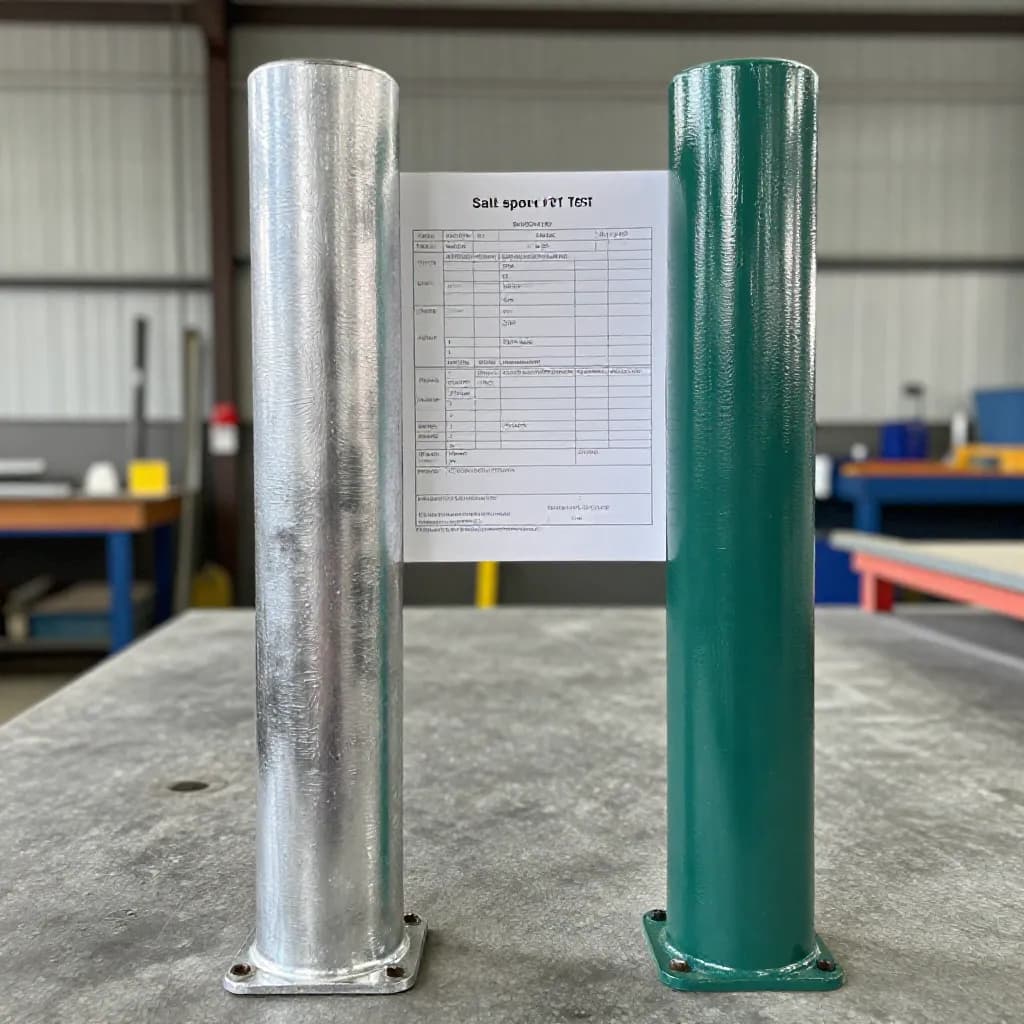
Hot-dip galvanizing involves immersing cleaned steel components in a bath of molten zinc at approximately 450°C. The zinc reacts metallurgically with the steel surface, forming a series of zinc-iron intermetallic alloy layers topped by a layer of pure zinc. This metallurgical bond is far stronger than any mechanical or adhesive bond — the zinc literally alloys with the steel substrate. The resulting coating provides both barrier protection (the zinc physically separates the steel from the environment) and cathodic or sacrificial protection (zinc is more electrochemically active than steel, so it corrodes preferentially, protecting the steel even at scratches, cut edges, and areas of minor damage).
Ready to Start Your Project?
From one-off customs to 15,000-part production runs — get precise pricing in 24 hours.
On This Page
Two Fundamentally Different Protection Strategies
Powder coating protects steel through barrier protection alone. The cured organic film physically isolates the steel from moisture, oxygen, and corrosive agents. As long as the film remains intact, the steel beneath is fully protected. However, if the coating is breached — by impact, scratching, or edge damage — the exposed steel is vulnerable to corrosion because the organic coating provides no sacrificial protection. This is why pretreatment quality is so critical for powder-coated steel: the conversion coating (iron phosphate, zinc phosphate, or modern chrome-free alternatives) must provide corrosion resistance at the coating-metal interface to prevent underfilm corrosion from spreading from any breach point.
This fundamental difference in protection mechanism means that galvanizing and powder coating are not simply interchangeable options. Each has distinct advantages depending on the application environment, aesthetic requirements, expected service life, and maintenance strategy.
Coating Thickness and Physical Properties
Hot-dip galvanizing produces a coating that is typically 45-85 microns thick on structural steel sections, though thickness can vary significantly depending on steel composition, section thickness, and immersion time. Heavier steel sections tend to develop thicker galvanized coatings because they remain at elevated temperature longer during withdrawal from the zinc bath, allowing more zinc-iron alloy growth. Reactive steels — those with silicon and phosphorus contents in certain ranges (the Sandelin effect) — can produce excessively thick, rough, and brittle coatings that may be aesthetically unacceptable.
Powder coating thickness is precisely controllable, typically applied at 60-120 microns for standard applications and up to 200+ microns for heavy-duty industrial or functional coatings. The ability to specify and control film thickness within tight tolerances is a significant advantage for applications where consistent appearance and dimensional accuracy matter. Powder coating film thickness is measured non-destructively using magnetic or eddy-current gauges and is routinely verified as part of quality control processes.
The physical properties of the two coatings differ markedly. Galvanized coatings are metallic — hard, abrasion-resistant, and capable of withstanding significant mechanical handling without damage. However, they are relatively brittle compared to organic coatings and can crack or spall if the substrate is bent or formed after galvanizing. The zinc surface is also susceptible to white rust (zinc hydroxide/carbonate) formation in humid, poorly ventilated storage conditions, which, while not structurally harmful, is aesthetically objectionable.
Powder coatings are organic polymer films that combine hardness with flexibility. A well-formulated polyester powder coating can withstand mandrel bending, reverse impact testing, and cross-hatch adhesion testing without cracking or delamination. This flexibility makes powder coating suitable for components that may experience vibration, thermal cycling, or minor deformation in service. The organic film also provides a smooth, uniform surface that is easy to clean and resistant to dirt accumulation.
Aesthetic Capabilities and Surface Finish
Aesthetics is one of the most decisive factors favoring powder coating over galvanizing for visible applications. Hot-dip galvanizing produces a metallic gray finish that varies from bright and spangled (on conventional zinc baths) to matte gray (on zinc-aluminum or zinc-nickel baths). The appearance is inherently variable — different steel compositions, section thicknesses, and surface conditions produce different galvanized appearances, and achieving a uniform, consistent look across multiple components is challenging. Over time, the bright zinc surface weathers to a dull gray patina as zinc carbonate forms on the surface.
Powder coating offers complete control over color, gloss, and texture. Any color from standard color systems can be matched precisely, and finishes range from mirror-like high gloss to deep matte, from smooth to heavily textured. Metallic, pearlescent, and special-effect finishes are available, as are wood-grain and stone-effect sublimation transfers. This design flexibility makes powder coating the only viable option for applications where specific colors, brand identity, or architectural design intent must be achieved.
For structural steel in buildings, bridges, and infrastructure, the aesthetic difference is particularly significant. Exposed structural steel in commercial interiors, retail environments, and public spaces is increasingly specified with powder coating to achieve specific design outcomes — matte black steelwork in industrial-chic restaurants, bright colors in schools and hospitals, or custom metallic finishes in corporate lobbies. Galvanizing, while excellent for protection, simply cannot deliver these aesthetic outcomes.
There are applications where galvanizing's natural metallic appearance is desirable — agricultural fencing, highway barriers, utility poles, and industrial structures where function takes priority over aesthetics. In these contexts, the self-healing, maintenance-free nature of galvanizing outweighs any aesthetic limitations. But for any application where appearance matters, powder coating is the clear choice.
Corrosion Protection and Service Life
Corrosion protection performance depends heavily on the environment. In mild atmospheric conditions (ISO 9223 corrosivity category C2), hot-dip galvanizing at 85 microns can provide 70-100+ years of service life before the zinc is fully consumed. Even in moderate industrial or urban environments (C3), galvanizing provides 40-70 years of protection. These extraordinary service lives are possible because zinc corrodes at a predictable, slow rate — approximately 1-2 microns per year in C2 environments and 2-4 microns per year in C3 environments — and the zinc-iron alloy layers beneath the pure zinc surface corrode even more slowly.
Powder coating's service life is determined by the integrity of the organic film rather than the consumption rate of a sacrificial metal. In mild to moderate environments, a well-applied powder coating over properly pretreated steel can provide 15-25 years of protection before significant degradation occurs. The primary failure modes are UV-induced chalking and color fade (for exterior applications), moisture permeation leading to underfilm corrosion, and mechanical damage that breaches the coating barrier.
In aggressive environments — coastal (C4), industrial (C4-C5), or immersion conditions — the comparison shifts. Galvanizing's zinc consumption rate increases significantly in high-chloride or high-sulfur-dioxide environments, reducing service life to 15-30 years at C4 and 10-20 years at C5. Powder coating's barrier protection can be highly effective in these environments if the coating remains intact, but any breach allows rapid corrosion of the unprotected steel substrate.
This is precisely why duplex systems — galvanizing plus powder coating — represent the gold standard for maximum corrosion protection. The galvanized layer provides sacrificial protection at any coating breach, while the powder coating provides a thick barrier that dramatically slows the zinc consumption rate. Duplex systems can achieve service lives 1.5 to 2.3 times longer than the sum of the individual coating lives, a synergistic effect recognized by ISO 12944 and other corrosion protection standards.
Duplex Systems: Combining Galvanizing and Powder Coating
Duplex coating systems — hot-dip galvanizing followed by powder coating — combine the strengths of both technologies to deliver corrosion protection that exceeds what either can achieve independently. The synergy arises because the powder coating dramatically reduces the rate at which the underlying zinc is consumed by atmospheric corrosion, while the galvanized layer provides cathodic protection at any point where the powder coating is damaged.
Applying powder coating over galvanized steel requires careful surface preparation. The galvanized surface must be cleaned to remove any zinc oxide, zinc carbonate, or chromate passivation residues that could interfere with adhesion. Sweep blasting with fine abrasive media (typically at low pressure to avoid removing excessive zinc) creates a surface profile that promotes mechanical adhesion. Chemical pretreatment — typically a chrome-free conversion coating designed for zinc substrates — provides additional adhesion promotion and corrosion resistance at the interface.
The powder coating application process for duplex systems is essentially the same as for bare steel, though outgassing can be a concern. Galvanized coatings can contain trapped moisture or gases in the porous zinc-iron alloy layers, and these can escape during the powder curing process, causing pinholes or bubbles in the cured film. To mitigate this, a pre-bake step at the curing temperature (or slightly above) is often performed before powder application to drive off trapped volatiles. Alternatively, outgassing-tolerant powder formulations are available that allow gas to escape before the film fully cures and seals.
Duplex systems are increasingly specified for infrastructure projects — bridges, highway structures, transmission towers, and railway equipment — where maximum service life and minimum maintenance are critical. The additional cost of the duplex system is typically justified by the dramatically extended maintenance-free service life and reduced lifecycle cost. Standards such as ISO 12944-5 and EN ISO 1461 provide guidance on specifying and applying duplex systems for structural steelwork.
Environmental and Process Considerations
The environmental profiles of powder coating and galvanizing differ significantly. Powder coating produces zero VOC emissions and achieves 95-98% material utilization through overspray reclaim. The primary environmental considerations are energy consumption for curing (ovens at 160-200°C) and the management of pretreatment chemicals and rinse water. Modern powder coating lines with closed-loop water treatment systems and energy-efficient ovens have a relatively modest environmental footprint.
Hot-dip galvanizing involves more complex environmental management. The process uses hydrochloric acid for pickling (removing mill scale and rust), flux solutions containing zinc ammonium chloride, and molten zinc at 450°C. Acid pickling generates spent acid and iron-rich sludge requiring disposal or recycling. The zinc bath produces zinc ash (oxidized zinc skimmed from the bath surface) and zinc dross (zinc-iron alloy that settles to the bottom), both of which are recycled. Fume extraction systems capture zinc oxide fumes generated during immersion and withdrawal. While modern galvanizing plants manage these environmental aspects effectively, the process inherently involves more hazardous materials and waste streams than powder coating.
Energy consumption for galvanizing is substantial — maintaining a zinc bath at 450°C requires continuous energy input, and the pickling, fluxing, and drying stages add to the total energy demand. However, galvanizing's extremely long service life means that the energy investment per year of protection can be very favorable compared to coatings that require more frequent renewal.
From a sustainability perspective, both zinc and powder coating materials are compatible with steel recycling at end of life. Zinc is fully recyclable and is recovered during steel recycling in electric arc furnaces. Powder coating residues are destroyed during the steel melting process and do not contaminate the recycled steel. Both technologies therefore support circular economy principles for steel products.
Choosing the Right Protection for Your Application
The choice between powder coating, galvanizing, or a duplex system depends on a matrix of factors including corrosion environment severity, aesthetic requirements, expected service life, maintenance access, and budget constraints. For concealed structural steelwork in mild environments — building frames, mezzanine structures, and industrial racking — galvanizing alone often provides the most cost-effective long-term protection, with service lives measured in decades and zero maintenance requirements.
For visible steelwork where appearance matters — architectural features, furniture, signage, retail fixtures, and consumer products — powder coating is the clear choice. Its unlimited color palette, controlled finish quality, and smooth surface make it the only option that satisfies both protective and aesthetic requirements. Proper pretreatment and quality powder application can deliver 15-25 years of service in moderate environments.
For critical infrastructure in aggressive environments — bridges, marine structures, coastal buildings, chemical plants, and wastewater treatment facilities — duplex systems provide the ultimate protection. The combination of galvanizing's sacrificial protection and powder coating's barrier protection delivers service lives that can exceed 60 years in moderate environments and 30-40 years in aggressive conditions, with minimal maintenance.
For applications where components will be fabricated, welded, or modified after finishing, galvanizing has an advantage: cut edges and weld areas receive cathodic protection from adjacent zinc, whereas powder coating provides no protection at uncoated areas. This makes galvanizing preferred for structural steelwork that will be site-welded or modified during construction.
Ultimately, the best protection strategy considers the full lifecycle — initial cost, maintenance frequency, repair costs, expected service life, and end-of-life recyclability. For many applications, the answer is not powder coating or galvanizing, but powder coating and galvanizing working together in a duplex system that delivers performance neither technology can achieve alone.
Frequently Asked Questions
Can you powder coat over galvanized steel?
Yes, and this combination — called a duplex system — provides superior corrosion protection. The galvanized surface must be properly prepared by sweep blasting and applying a suitable conversion coating. A pre-bake step may be needed to prevent outgassing. Duplex systems can last 1.5 to 2.3 times longer than the sum of individual coating lives.
Which lasts longer, powder coating or galvanizing?
In mild environments, galvanizing typically lasts longer — 70-100+ years versus 15-25 years for powder coating. However, in aggressive coastal or industrial environments, the gap narrows significantly. A duplex system combining both technologies provides the longest service life of all, potentially exceeding 60 years in moderate conditions.
Is galvanizing or powder coating better for outdoor steel?
It depends on whether appearance matters. For concealed or utilitarian steel, galvanizing provides excellent long-term protection with zero maintenance. For visible steel where color and finish quality are important, powder coating is necessary. For maximum protection in harsh environments, a duplex system combining both is the best option.
Does galvanizing provide better corrosion protection than powder coating?
Galvanizing provides sacrificial (cathodic) protection that continues working even when the coating is scratched or damaged — an advantage powder coating cannot match. However, powder coating provides a thicker barrier film that slows overall corrosion rates. The two mechanisms are complementary, which is why duplex systems outperform either technology alone.
Why does powder coating over galvanizing sometimes bubble?
Bubbling occurs due to outgassing — trapped moisture or gases in the porous galvanized layer escape during powder curing, creating pinholes or blisters. This is prevented by pre-baking the galvanized parts at curing temperature before powder application, or by using outgassing-tolerant powder formulations designed for galvanized substrates.
Ready to Start Your Project?
From one-off customs to 15,000-part production runs — get precise pricing in 24 hours.