E-coating — also known as electrocoating, electrodeposition coating, or electrophoretic deposition (EPD) — is a wet coating process in which electrically charged paint particles suspended in a water-based solution are deposited onto a conductive substrate by applying an electrical potential. The workpiece is immersed in a tank containing the e-coat bath, and a DC voltage (typically 200-400 volts) is applied between the workpiece and counter-electrodes in the tank. The charged paint particles migrate through the solution and deposit uniformly onto all conductive surfaces of the workpiece, including internal cavities, recesses, and complex geometries that are difficult to reach with spray-applied coatings.
Comparison
Powder Coating vs E-Coating (Electrocoating): Automotive and Industrial Guide
Sundial Powder Coating·April 22, 2026·13 min
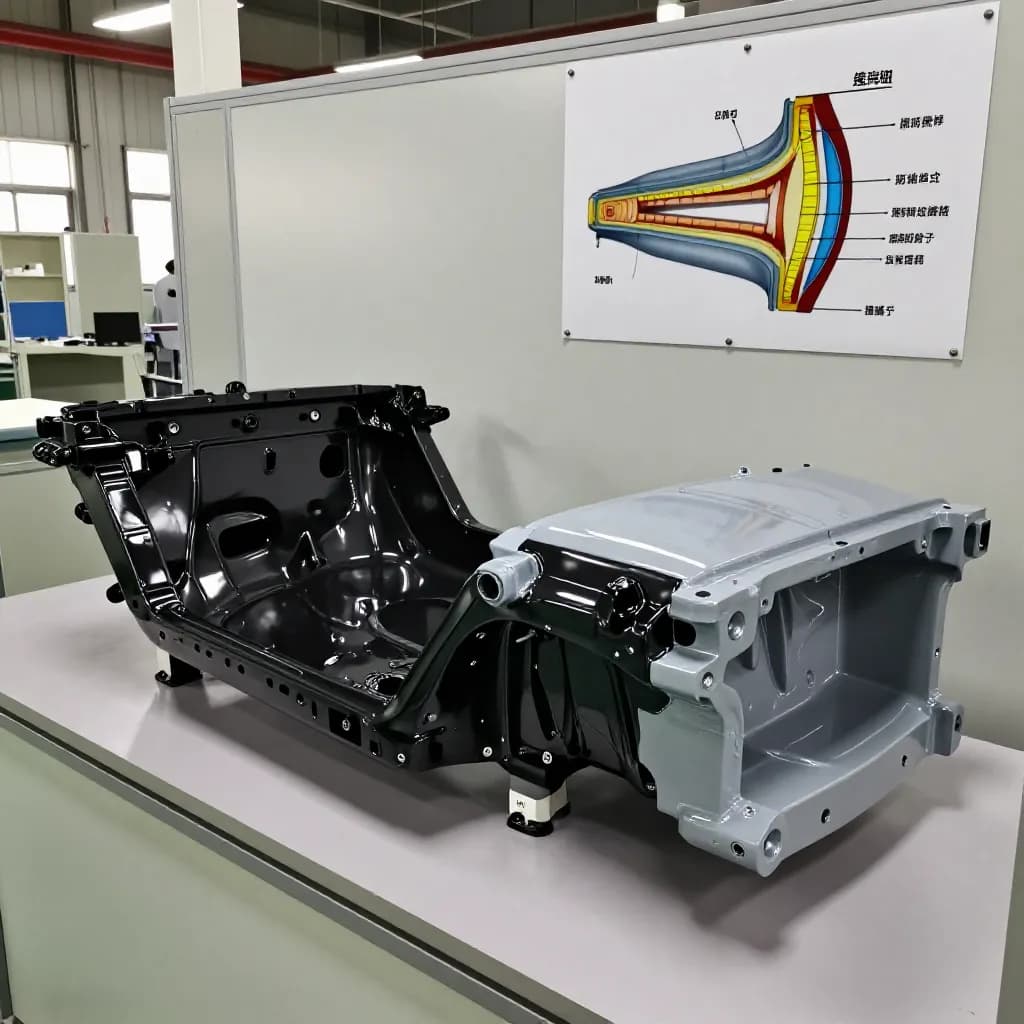
The two main types of e-coating are anodic (where the workpiece is the anode) and cathodic (where the workpiece is the cathode). Cathodic e-coating (CED) dominates modern automotive and industrial applications because it provides superior corrosion protection — the cathodic reaction at the workpiece surface does not dissolve the substrate metal, unlike anodic e-coating where metal dissolution can occur. Cathodic epoxy e-coats are the standard automotive primer, applied to virtually every car body produced worldwide.
Ready to Start Your Project?
From one-off customs to 15,000-part production runs — get precise pricing in 24 hours.
On This Page
What Is E-Coating and How Does It Differ from Powder Coating?
Powder coating operates through a completely different mechanism. Dry powder particles are electrostatically charged and sprayed onto a grounded workpiece, adhering through electrostatic attraction. The part is then oven-cured to melt, flow, and crosslink the powder into a continuous film. Unlike e-coating, powder coating does not require immersion in a liquid bath, does not use water as a carrier, and deposits coating through air rather than through a liquid medium.
The fundamental difference in deposition mechanism gives each technology distinct advantages. E-coating's immersion process provides unmatched coverage uniformity on complex three-dimensional parts. Powder coating's spray application provides greater film thickness, broader color and finish options, and simpler process chemistry. Understanding these differences is key to selecting the right technology — or the right combination — for any given application.
Coverage Uniformity and the Faraday Cage Challenge
Coverage uniformity on complex geometries is e-coating's defining advantage and the primary reason it dominates automotive body priming. When a car body is immersed in the e-coat tank, the electrical field drives paint particles to every conductive surface — exterior panels, interior box sections, door hems, roof pillars, floor pans, and the insides of structural members. The self-limiting nature of the deposition process ensures uniform thickness: as the insulating paint film builds up on a surface, the electrical resistance increases, redirecting current and paint deposition to areas with thinner or no coating. This self-leveling behavior produces remarkably uniform film thickness across the entire part, typically within ±2-3 microns of the target.
Powder coating faces significant challenges with complex geometries due to the Faraday cage effect. Electrostatic field lines concentrate on external surfaces, edges, and protrusions while avoiding recesses, internal corners, and enclosed cavities. Deep channels, box sections, and back-to-back flanges receive little or no powder deposition from conventional corona-charging guns. Tribo-charging guns improve penetration into recesses because they do not generate the ionic cloud that causes back-ionization, but they still cannot match e-coating's ability to coat fully enclosed internal surfaces.
For automotive body structures — which contain hundreds of box sections, hem flanges, and internal cavities that must be protected against corrosion — e-coating is the only practical technology for achieving complete coverage in a single process step. No spray-applied coating, whether powder or liquid, can reach all the internal surfaces of a modern unibody car structure.
However, for parts with moderate geometric complexity — flat panels, simple enclosures, tubular structures, and open profiles — powder coating achieves excellent coverage uniformity with proper gun positioning, reciprocator programming, and booth design. For these geometries, powder coating's greater film thickness (60-120 microns versus 15-35 microns for e-coat) provides superior barrier protection, and the Faraday cage effect is manageable with standard application techniques.
Film Thickness, Chemistry, and Performance Properties
E-coating and powder coating differ significantly in achievable film thickness and the performance properties that result. E-coat films are typically 15-35 microns thick — thin enough to serve as a primer but insufficient for standalone protection in most exterior applications. The self-limiting deposition mechanism that ensures uniformity also limits maximum thickness: as the film builds, its electrical resistance eventually prevents further deposition regardless of immersion time or voltage. Achieving thicker e-coat films requires higher voltages, which increase the risk of film rupture and defects.
Powder coating achieves 60-120 microns in a single application — three to eight times the thickness of e-coat. This greater thickness provides substantially better barrier protection against moisture permeation, UV radiation, chemical exposure, and mechanical damage. For applications requiring a single-coat finish with both protection and aesthetics, powder coating's film build is a decisive advantage.
The chemistry of e-coats and powder coatings also differs. Automotive cathodic e-coats are predominantly epoxy-based, providing excellent adhesion, corrosion resistance, and chemical resistance but limited UV stability. Exposed to sunlight, epoxy e-coats chalk and degrade rapidly, which is why they are always topcoated in automotive applications. Powder coatings are available in a wide range of chemistries — polyester, superdurable polyester, epoxy, hybrid, polyurethane, and fluoropolymer — with polyester and superdurable polyester formulations providing excellent UV resistance for exterior applications.
In automotive manufacturing, e-coat and powder coating are increasingly used together in a complementary system. The e-coat provides the primer layer with complete coverage of internal structures, and powder coating provides the topcoat with color, gloss, UV resistance, and additional barrier protection. This combination is used for automotive wheels, underbody components, and increasingly for body panels as powder-on-primer technology advances. BMW, for example, has pioneered powder clearcoat application over liquid basecoat on e-coated car bodies, demonstrating the compatibility and synergy of these technologies.
Throughput, Automation, and Production Scale
Both e-coating and powder coating are highly automatable processes suited to high-volume production, but their throughput characteristics and optimal production scales differ. E-coating is inherently a high-volume, continuous-flow process. The immersion tank, which may contain 100,000-500,000 liters of e-coat bath for automotive applications, represents a massive capital investment that is only economical at high production volumes. Automotive e-coat lines typically process 30-60 car bodies per hour, with each body spending 2-4 minutes immersed in the tank followed by extensive rinsing and oven curing at 170-180°C for 20-30 minutes.
The e-coat bath requires continuous monitoring and maintenance — pH, conductivity, solids content, pigment-to-binder ratio, and bath temperature must be controlled within tight tolerances. Ultrafiltration systems continuously remove excess ions and maintain bath chemistry. The complexity of bath management requires dedicated technical staff and sophisticated process control systems, adding to operating costs but ensuring consistent quality at high volumes.
Powder coating lines are more scalable and flexible. They can range from simple batch operations with a manual spray booth and batch oven (suitable for job shops processing dozens of parts per day) to fully automated conveyorized lines with multi-gun robotic application and continuous ovens (processing thousands of parts per hour). This scalability makes powder coating accessible to a much wider range of manufacturers, from small custom coaters to large OEMs.
Color change is another significant differentiator. E-coating is essentially a single-color process — changing the color of an e-coat bath is impractical due to the enormous volume of material involved. Most e-coat lines run a single color (typically gray or black primer) continuously. Powder coating lines can change colors relatively quickly — a well-designed quick-color-change booth can switch colors in 5-15 minutes, and dedicated booths for high-volume colors eliminate change time entirely. This flexibility makes powder coating far more suitable for applications requiring multiple colors or frequent color changes.
For manufacturers processing high volumes of a single primer color on complex parts, e-coating is the optimal choice. For manufacturers requiring color variety, moderate to high volumes, and the flexibility to handle different part sizes and geometries, powder coating is more versatile and cost-effective.
Environmental Profile and Waste Management
Both e-coating and powder coating offer significant environmental advantages over conventional solvent-based liquid painting, but their environmental profiles differ in important ways. E-coating uses water as the primary carrier, with organic co-solvents typically comprising only 1-3% of the bath by weight. VOC emissions from e-coating are very low — typically 10-30 grams per liter of applied coating, compared to 300-600 grams per liter for conventional solvent-based paints. Modern e-coat formulations have pushed VOC content even lower, with some achieving less than 10 g/L.
Powder coating produces zero VOC emissions because it contains no solvents whatsoever — the coating is applied as a 100% solids dry powder. This gives powder coating a clear environmental advantage over e-coating in terms of air emissions. Powder coating also achieves 95-98% material utilization through overspray reclaim, compared to e-coating's material efficiency of approximately 95-99% (the high efficiency is achieved because undeposited paint remains in the bath for subsequent use, with losses limited to dragout and ultrafiltrate waste).
Wastewater management is a more significant concern for e-coating. The process generates rinse water containing paint solids, co-solvents, and dissolved ions that must be treated before discharge. Ultrafiltration permeate is used for rinsing to minimize water consumption, but the system still produces waste streams requiring treatment. E-coat bath maintenance generates spent ultrafiltrate, anolyte (in cathodic systems), and periodic bath dumps that require disposal. Powder coating pretreatment generates wastewater as well, but the volumes are typically lower and the chemistry simpler than e-coat waste streams.
Energy consumption is substantial for both processes. E-coating requires energy for bath heating and circulation, ultrafiltration, rinsing, and oven curing. Powder coating requires energy for pretreatment, dry-off, and curing ovens. On a per-part basis, energy consumption depends heavily on part size, line speed, and oven efficiency, making direct comparison difficult without specific production parameters. Both technologies have benefited from advances in oven design, heat recovery, and process optimization that have reduced energy consumption per unit of coated surface area.
Automotive Applications: The E-Coat and Powder Coat Partnership
The automotive industry provides the clearest example of how e-coating and powder coating work together as complementary technologies rather than competitors. In modern automotive manufacturing, the coating process for a car body typically follows a multi-layer sequence: pretreatment (zinc phosphate or modern thin-film alternatives), cathodic e-coat primer, primer surfacer, basecoat, and clearcoat. E-coating provides the critical first barrier layer, depositing a uniform 18-25 micron epoxy primer on every surface of the body structure including internal cavities that no spray process can reach.
Powder coating has made significant inroads in automotive applications beyond body priming. Automotive wheels are one of the largest powder coating markets, with most alloy wheels receiving an e-coat primer followed by a powder basecoat and powder or liquid clearcoat. The combination provides excellent corrosion protection (the e-coat covers internal barrel surfaces and lug nut recesses) with the aesthetic quality and durability that wheel applications demand. Powder-coated wheels offer superior resistance to brake dust, road salt, and curb damage compared to liquid-only coating systems.
Underbody components — subframes, suspension arms, engine cradles, and structural brackets — are increasingly powder coated over e-coat primer. The thick powder film (80-120 microns) provides robust protection against stone chipping, road debris, and salt spray in the harsh underbody environment. Some manufacturers apply powder coating directly to pretreated steel for underbody components, eliminating the e-coat step for parts where complete internal coverage is less critical.
The frontier of automotive powder coating is body panel topcoating. BMW's powder clearcoat technology, applied over liquid basecoat on e-coated bodies, demonstrates that powder coating can achieve the appearance quality required for Class A automotive surfaces. As powder coating technology continues to advance in flow, leveling, and thin-film application, its role in automotive body finishing is expected to expand, potentially replacing liquid primer surfacer and clearcoat layers in future coating architectures.
Choosing Between E-Coating and Powder Coating
The choice between e-coating and powder coating — or the decision to use both — depends on part geometry, production volume, performance requirements, and aesthetic needs. E-coating is the right choice when complete coverage of complex internal geometries is essential, when thin-film uniformity is critical, and when production volumes justify the capital investment in immersion tank systems. Automotive body structures, complex welded assemblies, and parts with enclosed cavities are ideal e-coating candidates.
Powder coating is the right choice when color variety, thick-film protection, aesthetic quality, and production flexibility are priorities. Parts with moderate geometric complexity, exterior-exposed surfaces requiring UV resistance, and applications where a single-coat finish must provide both protection and appearance are ideal powder coating candidates. The lower capital investment and greater scalability of powder coating lines make them accessible to a wider range of manufacturers and production volumes.
For many industrial applications, the optimal approach combines both technologies. E-coat provides the primer layer with complete coverage and excellent adhesion, while powder coating provides the topcoat with color, gloss, UV resistance, and additional barrier protection. This two-coat system delivers performance that neither technology can achieve alone — the complete internal coverage of e-coat with the thick-film protection and aesthetic quality of powder coating.
The trend in industrial finishing is toward greater integration of e-coating and powder coating in complementary systems. Advances in powder coating technology — including thin-film powders, improved Faraday cage penetration, and low-temperature cure formulations — are expanding the range of applications where powder coating can serve as both primer and topcoat. Simultaneously, advances in e-coat chemistry — including lead-free and tin-free formulations, improved throwing power, and lower cure temperatures — are making e-coating more environmentally friendly and energy-efficient. Together, these technologies provide the finishing industry with a powerful toolkit for meeting the most demanding protection and appearance requirements.
Frequently Asked Questions
What is the main advantage of e-coating over powder coating?
E-coating's main advantage is its ability to coat complex internal geometries uniformly. Because the part is immersed in the coating bath, paint deposits on every conductive surface including enclosed cavities, box sections, and recesses that spray-applied powder coating cannot reach. This makes e-coating essential for automotive body structures and complex welded assemblies.
Can powder coating replace e-coating as a primer?
For parts with moderate geometric complexity, powder coating can serve as an effective primer or single-coat finish. However, for parts with enclosed internal cavities and complex box sections — like automotive body structures — e-coating remains necessary because powder coating cannot reach fully enclosed internal surfaces through electrostatic spray application.
Is e-coating or powder coating thicker?
Powder coating is significantly thicker — typically 60-120 microns versus 15-35 microns for e-coating. This greater thickness gives powder coating superior barrier protection, impact resistance, and UV durability. E-coating's thinner film is designed to serve as a primer layer rather than a standalone finish.
Do automotive manufacturers use both e-coating and powder coating?
Yes, extensively. Most automotive wheels receive e-coat primer plus powder topcoat. Underbody components increasingly use powder over e-coat. BMW has pioneered powder clearcoat on car bodies. The two technologies are complementary — e-coat provides complete internal coverage while powder coating provides thick-film topcoat protection and aesthetics.
Which produces fewer VOC emissions, e-coating or powder coating?
Powder coating produces zero VOC emissions because it contains no solvents. E-coating produces very low VOC emissions (typically 10-30 g/L) because it uses water as the primary carrier with minimal organic co-solvents. Both are far cleaner than conventional solvent-based liquid painting, but powder coating has the edge on air emissions.
Ready to Start Your Project?
From one-off customs to 15,000-part production runs — get precise pricing in 24 hours.