Ceramic coatings and powder coatings are both used to protect metal surfaces, but they are fundamentally different materials designed for different performance envelopes. The term ceramic coating encompasses several distinct technologies — from thin-film nano-ceramic coatings used in automotive detailing to thick-film ceramic-metallic coatings applied by thermal spray for extreme heat and wear applications. Understanding which type of ceramic coating is being compared to powder coating is essential for a meaningful evaluation.
Comparison
Powder Coating vs Ceramic Coating: Heat Resistance and Performance Guide
Sundial Powder Coating·April 22, 2026·13 min
Thin-film ceramic coatings, often marketed for automotive paint protection, are typically silicon dioxide (SiO₂) or silicon carbide (SiC) based formulations applied in layers of 1-5 microns. These nano-ceramic coatings create a hydrophobic, chemically resistant surface layer that protects the underlying finish from UV damage, chemical etching, and minor scratching. They are not structural coatings — they are surface treatments applied over existing paint or powder coating to enhance durability and ease of cleaning.
Ready to Start Your Project?
From one-off customs to 15,000-part production runs — get precise pricing in 24 hours.
On This Page
Understanding Ceramic and Powder Coating Technologies
Thick-film ceramic coatings — including plasma-sprayed alumina (Al₂O₃), chromia (Cr₂O₃), zirconia (ZrO₂), and ceramic-metallic composites (cermets) — are high-performance coatings applied at 50-500+ microns for extreme temperature, wear, and corrosion applications. These coatings can withstand continuous temperatures of 500-1,600°C depending on composition, far exceeding the thermal limits of any organic powder coating.
Powder coatings are organic polymer films — polyester, epoxy, hybrid, polyurethane, or fluoropolymer — that cure at 160-200°C and have maximum continuous service temperatures of 80-150°C for standard formulations, with specialty high-temperature silicone powder coatings rated to 500-600°C. Powder coatings excel in color variety, impact resistance, barrier protection, and cost-effectiveness for applications within their thermal operating range. The comparison between ceramic and powder coating is therefore not about which is universally better, but about which is appropriate for the specific temperature, wear, and performance requirements of the application.
Heat Resistance: Where Ceramic Coatings Excel
Heat resistance is the primary domain where ceramic coatings dramatically outperform powder coatings. Standard polyester powder coatings begin to degrade at continuous temperatures above 120-150°C — the organic polymer chains break down, causing discoloration, chalking, loss of adhesion, and eventual coating failure. Even high-temperature silicone powder coatings, which can withstand 500-600°C, cannot match the thermal capabilities of true ceramic coatings.
Plasma-sprayed zirconia-based thermal barrier coatings (TBCs) are used in gas turbine engines and can withstand surface temperatures exceeding 1,200°C while protecting the underlying metal substrate. Yttria-stabilized zirconia (YSZ), the most common TBC material, has a thermal conductivity of only 2.0-2.3 W/m·K — roughly one-tenth that of the nickel superalloy substrates it protects — making it an effective thermal insulator as well as a heat-resistant surface.
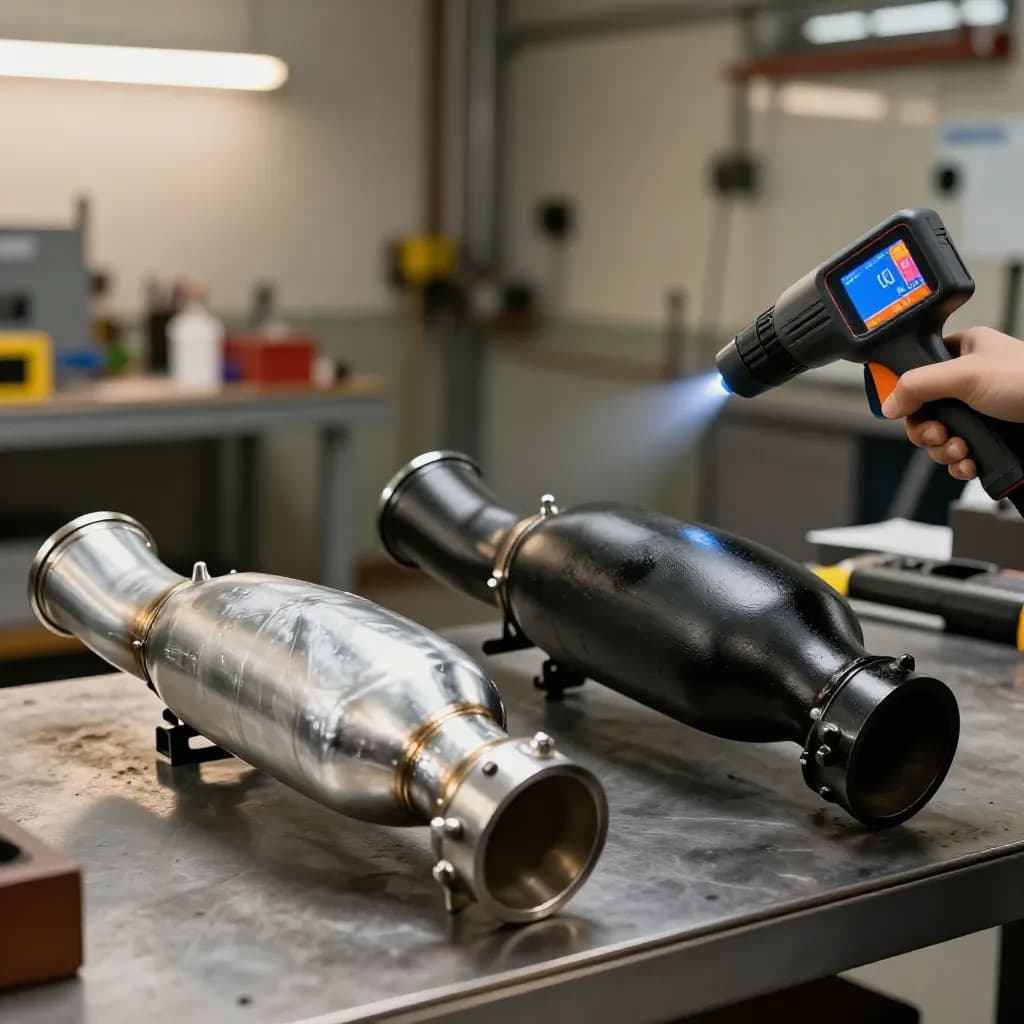
For automotive exhaust systems, ceramic coatings based on alumina, zirconia, or proprietary ceramic-metallic formulations are applied to headers, downpipes, turbo housings, and exhaust manifolds. These coatings serve dual purposes: they protect the metal substrate from oxidation and corrosion at exhaust gas temperatures of 400-900°C, and they reduce radiant heat transfer to surrounding components, lowering under-hood temperatures. Ceramic-coated exhaust headers can reduce surface temperatures by 30-50% compared to uncoated headers, protecting adjacent wiring, hoses, and plastic components.
Powder coating has no role in these extreme-temperature applications. However, for exhaust tips, decorative heat shields, and components that operate below 300°C, high-temperature powder coatings provide an attractive alternative to ceramic coatings, offering color options and surface finishes that ceramic coatings cannot match. The key is matching the coating technology to the actual operating temperature of the specific component.
Hardness, Wear Resistance, and Surface Properties
Ceramic coatings offer exceptional hardness and wear resistance that far exceeds what organic powder coatings can achieve. Plasma-sprayed alumina (Al₂O₃) coatings achieve hardness values of 1,000-1,400 HV (Vickers), while chromia (Cr₂O₃) coatings reach 1,200-1,800 HV. These values are comparable to or exceeding the hardness of hardened tool steel and make ceramic coatings the standard choice for industrial wear surfaces — pump shafts, cylinder liners, textile machinery components, and paper mill rolls where abrasive wear would rapidly destroy organic coatings.
Nano-ceramic coatings applied for automotive paint protection achieve hardness ratings of 9H on the pencil hardness scale — the maximum rating — providing excellent scratch resistance for vehicle surfaces. However, these thin-film coatings (1-5 microns) provide surface hardness only; they do not offer the bulk wear resistance of thick-film thermal spray ceramics.
Powder coatings typically achieve pencil hardness values of 2H-4H, which provides adequate scratch resistance for most decorative and general industrial applications but is insufficient for surfaces subject to abrasive wear, sliding contact, or erosive particle impingement. Where powder coating excels over ceramic coatings is in impact resistance and flexibility. The organic polymer matrix of a powder coating can absorb impact energy and flex with the substrate without cracking — properties that brittle ceramic coatings lack. A powder-coated surface can withstand a direct impact that would crack and spall a ceramic coating.
This difference in mechanical behavior means that ceramic coatings are preferred for applications dominated by abrasive wear, erosion, and high-temperature oxidation, while powder coatings are preferred for applications where impact resistance, flexibility, and aesthetic quality are the primary requirements. For many real-world applications — automotive wheels, architectural panels, consumer products, furniture — the moderate hardness of powder coating is more than adequate, and its superior impact resistance and aesthetic versatility make it the better overall choice.
Automotive Applications: Engine Bay and Beyond
The automotive sector provides a clear illustration of how ceramic and powder coatings serve different roles based on thermal and mechanical demands. Under the hood, ceramic coatings dominate high-temperature applications. Exhaust manifolds, turbocharger housings, downpipes, and catalytic converter heat shields operate at temperatures that would destroy any organic coating. Ceramic thermal barrier coatings on these components reduce heat radiation, protect against oxidation, and can improve exhaust gas velocity by maintaining higher gas temperatures within the exhaust system.
Brake calipers represent an interesting crossover application. Standard brake calipers reach temperatures of 150-300°C during normal driving and can exceed 500°C during aggressive track use. For street-driven vehicles, high-temperature powder coatings rated to 200-300°C provide excellent protection with the color variety that enthusiasts demand — red, yellow, blue, and custom colors that ceramic coatings cannot easily achieve. For dedicated track vehicles and high-performance applications where caliper temperatures regularly exceed 300°C, ceramic coatings are the more appropriate choice despite their limited color options.
Valve covers, intake manifolds, and engine accessories that operate at moderate temperatures (80-150°C) are ideal powder coating candidates. These components benefit from powder coating's color options, smooth finish, and chemical resistance to oil, coolant, and cleaning solvents. The engine bay of a show car or restored classic is typically powder coated rather than ceramic coated because aesthetics and color matching are priorities, and operating temperatures are within powder coating's capability.
Wheels are firmly in powder coating territory. Operating temperatures rarely exceed 100-150°C even during spirited driving, and the requirements for color accuracy, gloss consistency, impact resistance, and chemical resistance to brake dust and road salt align perfectly with powder coating's strengths. Ceramic nano-coatings are sometimes applied over powder-coated wheels as a sacrificial protective layer to ease cleaning and maintain appearance, demonstrating how the two technologies can work together rather than competing.
Application Methods and Process Differences
The application methods for ceramic and powder coatings differ substantially, affecting cost, accessibility, and quality control. Thick-film ceramic coatings are applied using thermal spray processes — plasma spray, high-velocity oxy-fuel (HVOF), detonation gun, or flame spray — that require specialized equipment, trained operators, and controlled environments. Plasma spray systems operate at temperatures of 10,000-15,000°C, melting ceramic powder particles and propelling them at high velocity onto the substrate where they flatten, solidify, and build up a coating layer by layer.
The thermal spray process requires careful surface preparation — typically grit blasting to Sa 2.5 or Sa 3 cleanliness with a surface profile of 50-100 microns Ra — to achieve adequate mechanical bonding. The bond between a thermal spray ceramic coating and the substrate is primarily mechanical (interlocking of splat particles with the roughened surface), unlike the chemical crosslinking bond of a cured powder coating. Bond strengths for plasma-sprayed ceramics typically range from 15-40 MPa, depending on the material system and application parameters.
Nano-ceramic coatings for automotive applications are applied by hand or spray gun in a much simpler process — surface decontamination, paint correction if needed, and application of the ceramic coating in thin layers that cure at ambient temperature or with infrared assistance. While simpler than thermal spray, proper application still requires surface preparation expertise and controlled conditions to achieve optimal results.
Powder coating application is well-established, highly automated, and accessible to a wide range of manufacturers. The electrostatic spray process is straightforward — parts are pretreated, powder is applied with corona or tribo-charging guns, and parts are cured in a convection or infrared oven. The process is clean, efficient, and produces consistent results with standard quality control procedures. The lower barrier to entry for powder coating — in terms of equipment cost, operator training, and process complexity — makes it the more accessible and cost-effective technology for the vast majority of surface finishing applications.
Durability and Longevity in Real-World Conditions
Real-world durability depends on matching the coating technology to the actual service conditions. In their respective optimal operating ranges, both ceramic and powder coatings deliver excellent longevity. Thermal barrier coatings in gas turbines operate for thousands of hours at temperatures exceeding 1,000°C — a testament to ceramic coating durability in extreme thermal environments. Ceramic-coated automotive exhaust components can last the life of the vehicle in applications where uncoated or painted components would fail within months.
Powder coatings demonstrate exceptional durability within their thermal operating range. Architectural powder coatings certified to Qualicoat Class 2 or AAMA 2605 standards maintain color and gloss for 20-25+ years of exterior exposure. Automotive powder coatings on wheels and underbody components withstand years of exposure to brake dust, road salt, stone chipping, and UV radiation. Industrial powder coatings on agricultural equipment, construction machinery, and outdoor furniture provide 10-20 years of protection in demanding environments.
UV resistance is an area where powder coating has a clear advantage over most ceramic coatings. Polyester and superdurable polyester powder coatings are specifically formulated for UV stability, maintaining color and gloss through years of direct sunlight exposure. Ceramic coatings, being inorganic, do not degrade under UV exposure themselves, but they offer limited color options and their appearance can change as surface porosity accumulates dirt and contaminants over time.
Chemical resistance varies by formulation for both technologies. Ceramic coatings are inherently resistant to most chemicals, solvents, and acids due to their inorganic composition. Powder coatings offer good chemical resistance that varies with chemistry — epoxy powder coatings provide excellent chemical and solvent resistance but poor UV stability, while polyester powder coatings offer excellent UV resistance with moderate chemical resistance. Hybrid and specialty formulations can be tailored to specific chemical exposure requirements. For most real-world applications outside extreme thermal environments, powder coating's combination of UV resistance, chemical resistance, impact resistance, and aesthetic quality makes it the more versatile and practical choice.
When to Choose Ceramic vs Powder Coating
The decision between ceramic and powder coating should be driven by the specific thermal, mechanical, and aesthetic requirements of the application rather than a general preference for one technology over the other. Choose ceramic coating when the application involves continuous operating temperatures above 200°C, when extreme wear resistance is required, or when thermal barrier properties are needed to protect adjacent components or improve system efficiency. Exhaust systems, turbocharger components, industrial furnace parts, and high-wear industrial surfaces are clear ceramic coating candidates.
Choose powder coating when the application requires color variety, aesthetic quality, impact resistance, UV durability, and cost-effective protection within normal temperature ranges (up to 150°C for standard formulations, up to 300°C for high-temperature variants). Automotive wheels, architectural panels, consumer products, furniture, appliances, and general industrial equipment are ideal powder coating applications. The vast majority of metal finishing applications fall within powder coating's performance envelope.
Consider combining both technologies when the application has zones with different thermal and aesthetic requirements. A motorcycle exhaust system might use ceramic coating on the header pipes (operating at 400-700°C) and powder coating on the muffler body and heat shields (operating below 200°C), achieving optimal protection and appearance for each zone. Similarly, an engine bay might feature ceramic-coated exhaust manifolds alongside powder-coated valve covers, intake manifolds, and accessories.
For automotive enthusiasts considering ceramic nano-coatings for paint protection, these coatings are best understood as a complement to powder coating rather than an alternative. Applying a nano-ceramic coating over a powder-coated surface adds hydrophobic properties, enhanced scratch resistance, and easier cleaning without replacing the underlying powder coating's protective and aesthetic functions. The two technologies work together to deliver a surface that is both beautiful and exceptionally easy to maintain.
Frequently Asked Questions
Can powder coating withstand exhaust temperatures?
Standard powder coatings cannot — they degrade above 150°C. High-temperature silicone powder coatings can withstand 500-600°C but offer limited color options. For exhaust manifolds and headers operating at 400-900°C, ceramic coatings are necessary. Exhaust tips and components below 300°C can use high-temperature powder coatings.
Is ceramic coating harder than powder coating?
Yes, significantly. Thermal spray ceramic coatings achieve 1,000-1,800 HV hardness, while powder coatings typically reach 2H-4H pencil hardness (roughly 10-20 HV). However, powder coating offers superior impact resistance and flexibility — it absorbs impacts that would crack brittle ceramic coatings.
Can you apply ceramic coating over powder coating?
Yes, nano-ceramic coatings can be applied over cured powder coating to add hydrophobic properties, enhanced scratch resistance, and easier cleaning. This combination is popular for automotive wheels and painted surfaces. Thick-film thermal spray ceramics are not applied over powder coating — they require bare metal substrates.
Which is better for brake calipers, ceramic or powder coating?
For street vehicles where calipers reach 150-300°C, high-temperature powder coating provides excellent protection with full color options. For track vehicles where calipers regularly exceed 300-500°C, ceramic coating is more appropriate despite limited color choices. The operating temperature of your specific application determines the right choice.
Is ceramic coating more expensive than powder coating?
Generally yes, especially for thick-film thermal spray ceramics which require specialized equipment and skilled operators. Nano-ceramic coatings for automotive applications vary widely but are typically applied as an additional protective layer rather than a replacement for powder coating. Powder coating is significantly more cost-effective for applications within its temperature range.
Ready to Start Your Project?
From one-off customs to 15,000-part production runs — get precise pricing in 24 hours.