The urban heat island (UHI) effect — the phenomenon where urban areas are significantly warmer than surrounding rural areas — is one of the most well-documented consequences of urbanization. Cities can be 2-8°C warmer than adjacent rural areas during summer, with the temperature differential most pronounced at night when heat stored in buildings, roads, and infrastructure is released. This elevated temperature increases energy consumption for cooling, degrades air quality through accelerated ozone formation, increases heat-related illness and mortality, and reduces the livability of urban environments.
Environmental
Powder Coating and the Urban Heat Island Effect: Cool Roof Coatings, Solar Reflectance, and Energy Savings
Sundial Powder Coating·April 22, 2026·12 min
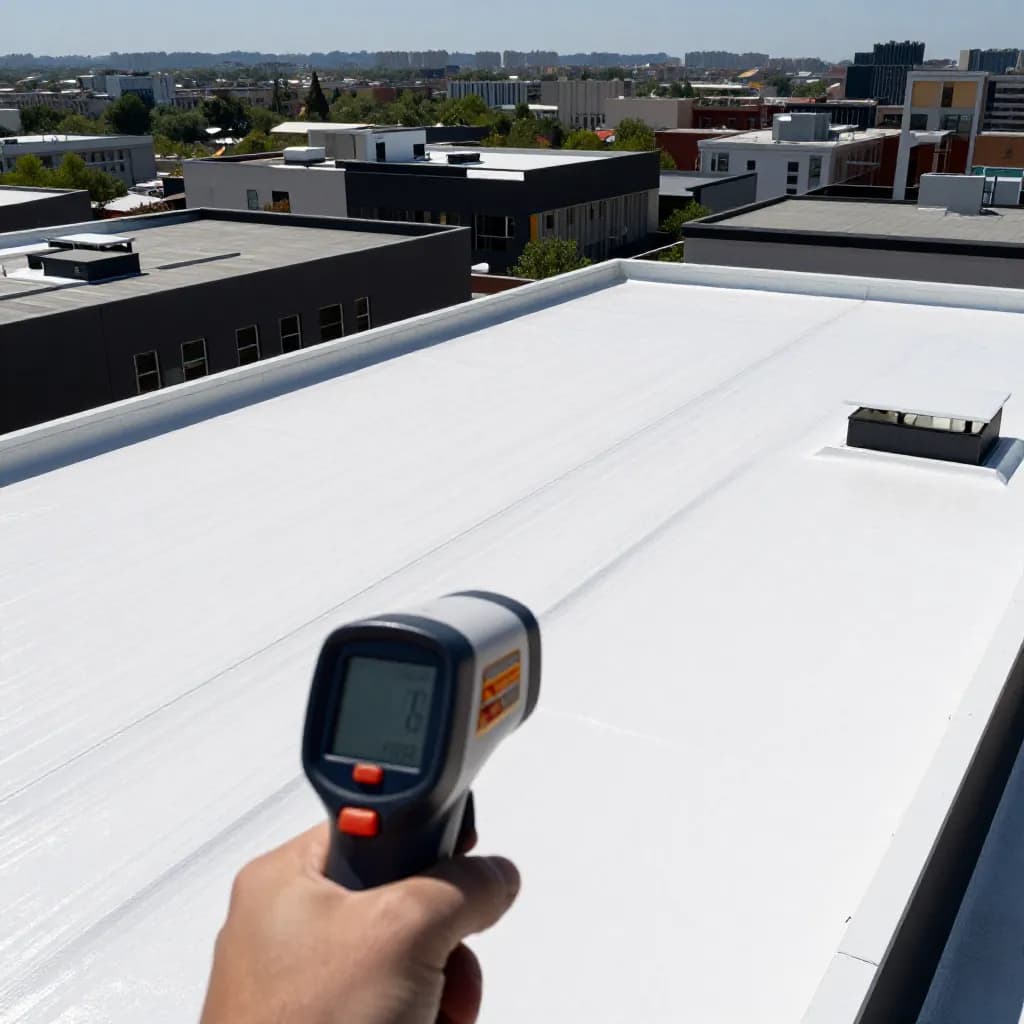
The primary cause of the UHI effect is the replacement of natural vegetation and soil with dark, heat-absorbing surfaces — asphalt roads, dark roofing materials, and building facades. These surfaces absorb 70-95% of incoming solar radiation and convert it to heat, which is stored in the thermal mass of the built environment and released slowly over the following hours. The canyon geometry of urban streets traps this heat between buildings, reducing convective cooling and creating localized hot spots.
Ready to Start Your Project?
From one-off customs to 15,000-part production runs — get precise pricing in 24 hours.
On This Page
Understanding the Urban Heat Island Effect
Powder-coated building surfaces — roofs, facades, and infrastructure — represent a significant portion of the urban surface area that contributes to or mitigates the UHI effect. The solar reflectance and thermal emittance properties of the powder coating directly determine whether a coated surface absorbs and stores solar heat (contributing to UHI) or reflects solar radiation and emits absorbed heat efficiently (mitigating UHI).
Cool coating technology — powder coatings specifically formulated with high solar reflectance and high thermal emittance — offers a practical, cost-effective strategy for reducing the UHI effect at the building scale. When deployed across a significant fraction of urban building surfaces, cool coatings can measurably reduce ambient temperatures, lower peak electricity demand, and improve urban livability.
Solar Reflectance and Total Solar Reflectance
Solar reflectance — the fraction of incoming solar radiation that is reflected by a surface — is the primary property that determines a coating's contribution to or mitigation of the UHI effect. Solar radiation reaching the Earth's surface spans wavelengths from 300 nm (ultraviolet) to 2,500 nm (near-infrared), with approximately 5% in the UV range, 43% in the visible range (400-700 nm), and 52% in the near-infrared (NIR) range (700-2,500 nm).
Total solar reflectance (TSR) — also called solar reflectance index when combined with thermal emittance — measures the fraction of total solar energy reflected across the entire solar spectrum. A surface with TSR of 0.70 reflects 70% of incoming solar energy and absorbs only 30%. Conventional white powder coatings achieve TSR values of 0.70-0.85, while conventional dark coatings may have TSR values as low as 0.05-0.10.
The key insight of cool coating technology is that the near-infrared portion of the solar spectrum — which carries 52% of the solar energy but is invisible to the human eye — can be reflected independently of the visible color. Infrared-reflective (IR-reflective) pigments are designed to reflect NIR radiation while absorbing or reflecting visible light to produce the desired color appearance. This means a dark-colored cool coating can reflect 30-40% of total solar energy (compared to 5-10% for a conventional dark coating) while appearing visually identical.
The practical impact of TSR on surface temperature is substantial. On a clear summer day with 1,000 W/m² solar irradiance, a conventional dark roof coating (TSR 0.05) reaches a surface temperature of approximately 80-90°C, while a cool dark coating (TSR 0.35) reaches only 55-65°C, and a white cool coating (TSR 0.80) stays at 35-45°C. These temperature differences translate directly to reduced heat transfer into the building and lower cooling energy consumption.
Thermal Emittance and Radiative Cooling
Thermal emittance — the ability of a surface to radiate absorbed heat as infrared radiation — is the second critical property for cool coatings. A surface with high thermal emittance efficiently radiates absorbed solar heat back to the sky, reducing the amount of heat stored in the building and released into the urban environment.
Thermal emittance is measured on a scale of 0 to 1, where 1 represents a perfect blackbody radiator. Most non-metallic surfaces, including powder coatings, have thermal emittance values of 0.85-0.95 — inherently high values that enable efficient radiative cooling. Bare metal surfaces, by contrast, have much lower thermal emittance (0.05-0.25 for polished aluminum), which is why uncoated metal roofs can remain hot even when they have moderate solar reflectance.
The combination of high solar reflectance and high thermal emittance produces the maximum cooling effect. A surface that reflects most incoming solar radiation and efficiently radiates any absorbed heat achieves the lowest possible surface temperature — potentially below ambient air temperature during nighttime radiative cooling conditions. This combined performance is quantified by the Solar Reflectance Index (SRI), which normalizes the effects of both properties into a single value on a scale where a standard black surface (TSR 0.05, emittance 0.90) has SRI 0 and a standard white surface (TSR 0.80, emittance 0.90) has SRI 100.
Powder coatings are inherently well-suited for cool coating applications because their organic polymer matrix provides high thermal emittance (typically 0.88-0.92) regardless of color. This means that the primary formulation challenge for cool powder coatings is maximizing solar reflectance through pigment selection, while the thermal emittance is naturally provided by the coating chemistry.
Radiative cooling technology — coatings designed to emit thermal radiation in the atmospheric transparency window (8-13 microns wavelength) — represents an advanced extension of cool coating principles. These coatings can achieve sub-ambient surface temperatures even in direct sunlight by radiating heat directly to the cold sky through the atmosphere's infrared-transparent window. While still emerging for powder coating applications, radiative cooling technology has demonstrated surface temperature reductions of 5-10°C below ambient in laboratory and field testing.
Cool Roof and Cool Wall Powder Coating Standards
Several standards and rating programs define performance requirements and testing methods for cool coatings, providing a framework for specification and verification of cool powder coating performance.
The Cool Roof Rating Council (CRRC) in the United States maintains a rated products directory of roofing materials with independently tested solar reflectance and thermal emittance values. CRRC ratings include both initial values (tested on new products) and aged values (tested after 3 years of weathering exposure), recognizing that solar reflectance can decrease over time due to soiling and weathering. Cool powder coatings listed in the CRRC directory provide verified performance data for specification purposes.
ENERGY STAR roof products requirements (US EPA) define minimum solar reflectance values for cool roofing: initial reflectance of 0.25 minimum for steep-slope roofs and 0.65 minimum for low-slope roofs, with aged reflectance requirements of 0.15 and 0.50 respectively. Cool powder coatings that meet ENERGY STAR requirements qualify for energy efficiency incentives and contribute to green building certification credits.
Title 24 of the California Building Energy Efficiency Standards mandates cool roof requirements for new construction and re-roofing in California's climate zones. The requirements specify minimum aged solar reflectance and thermal emittance values that vary by climate zone and building type. Cool powder coatings that meet Title 24 requirements are essential for compliance in California's large construction market.
LEED (Leadership in Energy and Environmental Design) awards credits for cool roof and cool wall surfaces that reduce the UHI effect. LEED v4.1 Sustainable Sites credit SS Heat Island Reduction requires that 75% of roof and non-roof hardscape surfaces meet minimum SRI values (SRI 82 for low-slope roofs, SRI 39 for steep-slope roofs, SRI 29 for walls). Cool powder coatings with appropriate SRI values contribute directly to this credit.
European standards for cool coatings are less developed than US standards but are evolving. EN 1062-7 defines methods for measuring solar reflectance of exterior coatings, and several European green building certification systems (BREEAM, DGNB) include credits for cool surface materials. The European Cool Roofs Council (ECRC) is developing a European cool roof rating system analogous to the US CRRC.
Energy Savings and Economic Benefits
The energy savings from cool powder coatings are well-documented through both modeling studies and field measurements. The magnitude of savings depends on climate zone, building type, insulation level, HVAC system efficiency, and the fraction of building surface area covered by cool coatings.
For commercial buildings in hot climates (cooling-dominated), cool roof coatings can reduce annual cooling energy consumption by 10-30%. A meta-analysis of cool roof studies found average cooling energy savings of 20% for buildings with cool roofs compared to conventional dark roofs. For buildings with cool wall coatings in addition to cool roofs, total cooling energy savings can reach 25-40% in hot climates.
Peak electricity demand reduction is an equally important benefit. Cool coatings reduce the maximum cooling load during the hottest hours of the day, when electricity demand peaks and grid stress is highest. Studies have shown peak demand reductions of 10-15% for individual buildings with cool roofs, and modeling of city-wide cool roof adoption projects peak demand reductions of 5-10% at the utility scale — potentially avoiding the need for new power generation capacity.
The heating penalty — increased heating energy consumption in winter due to reduced solar heat gain through cool surfaces — is a consideration in heating-dominated climates. However, studies consistently show that the cooling energy savings in summer outweigh the heating penalty in winter for most climate zones, with net energy savings positive for all locations with more than approximately 1,000 cooling degree days annually. In hot climates, the heating penalty is negligible.
The economic payback period for cool powder coatings depends on the incremental cost compared to conventional coatings and the value of energy savings. For new construction, the incremental cost of specifying cool powder coatings instead of conventional formulations is minimal — typically less than 5-10% of the coating material cost — because the primary cost difference is in the IR-reflective pigments. Given the energy savings, the payback period for the incremental cost is typically 1-3 years in hot climates, making cool coatings one of the most cost-effective energy efficiency measures available.
Non-energy benefits — reduced HVAC equipment sizing, extended roof membrane life (due to lower thermal cycling), improved occupant comfort, and reduced urban air pollution — provide additional economic value that is not captured in simple energy payback calculations.
IR-Reflective Pigment Technology for Cool Powder Coatings
Infrared-reflective pigments are the enabling technology for cool powder coatings in colors other than white. These specialized pigments are designed to reflect near-infrared solar radiation (700-2,500 nm) while absorbing or reflecting visible light to produce the desired color appearance. The result is a coating that looks like a conventional color but reflects significantly more total solar energy.
The physics of IR-reflective pigments relies on the electronic band structure of inorganic metal oxide compounds. By engineering the composition and crystal structure of the pigment, manufacturers can create materials that absorb specific visible wavelengths (producing color) while reflecting the broader NIR spectrum. For example, an IR-reflective black pigment based on mixed metal oxide chemistry absorbs visible light (appearing black) but reflects 40-50% of NIR radiation, compared to less than 5% for conventional carbon black.
The TSR improvement from IR-reflective pigments varies by color. Dark colors show the largest improvement because conventional dark pigments absorb heavily across both visible and NIR spectra, while IR-reflective alternatives maintain visible absorption but dramatically increase NIR reflectance. A conventional dark brown coating might have TSR of 0.08, while an IR-reflective dark brown achieves TSR of 0.30-0.35 — a four-fold improvement. Light colors show smaller absolute improvements because conventional light pigments already reflect significant NIR radiation.
Formulating cool powder coatings requires attention to the entire pigment system, not just the primary color pigment. Extender pigments, matting agents, and other additives can absorb NIR radiation and reduce the overall TSR of the coating. Selecting NIR-transparent or NIR-reflective versions of all pigment and filler components maximizes the cool coating performance.
The durability of IR-reflective pigments under UV exposure and weathering is critical for maintaining cool coating performance over the building's service life. Inorganic IR-reflective pigments based on metal oxide chemistry are inherently UV-stable and maintain their reflective properties over decades of exposure. This stability ensures that the energy savings from cool coatings persist throughout the coating's service life, unlike some organic-based cool coating technologies that may lose reflectance as pigments degrade.
Urban Planning and Cool Coating Deployment Strategies
The UHI mitigation potential of cool coatings is maximized when deployment is coordinated at the urban planning level rather than implemented building by building. Strategic deployment of cool coatings across a city can achieve measurable reductions in ambient temperature, air pollution, and heat-related health impacts.
Urban climate modeling studies have demonstrated that city-wide adoption of cool roofs and cool walls can reduce peak ambient temperatures by 0.5-2.0°C, depending on the fraction of urban surface area converted to cool surfaces and the local climate. A 1°C reduction in peak urban temperature reduces peak electricity demand by approximately 2-4% and reduces ground-level ozone concentrations by 5-10% — significant public health and economic benefits.
Targeted deployment in UHI hotspots — dense commercial districts, industrial zones, and areas with limited green space — provides the greatest temperature reduction per unit of cool surface area deployed. Urban heat mapping using satellite thermal imagery or ground-based sensor networks can identify these hotspots and prioritize cool coating deployment for maximum impact.
Cool coating mandates and incentive programs are being adopted by cities worldwide. Los Angeles, New York, and other US cities have implemented cool roof requirements for new construction and major renovations. European cities including Paris, Athens, and Milan are developing cool surface strategies as part of their climate adaptation plans. These regulatory and incentive frameworks create market demand for cool powder coatings and drive innovation in IR-reflective pigment technology.
The integration of cool coatings with other UHI mitigation strategies — urban tree planting, green roofs, permeable pavements, and urban water features — creates synergistic cooling effects that exceed the sum of individual measures. Cool powder coatings on building facades complement street-level greening by reducing the radiant heat load on pedestrians and vegetation, creating a more comfortable and biologically productive urban environment.
Lifecycle assessment of cool coating deployment should account for both the direct energy savings at the building level and the indirect benefits at the urban scale — reduced ambient temperature, lower peak electricity demand, improved air quality, and reduced heat-related health impacts. When these broader benefits are included, the economic case for cool coating deployment is substantially stronger than building-level energy savings alone would suggest.
Future Developments in Cool Powder Coating Technology
Cool powder coating technology continues to advance through improvements in pigment science, coating formulation, and application of emerging materials concepts.
Next-generation IR-reflective pigments with higher NIR reflectance and broader color gamut are in development. Current IR-reflective pigments achieve TSR improvements of 0.15-0.30 over conventional pigments; next-generation materials target improvements of 0.30-0.45, which would enable dark-colored coatings to approach the cool performance of current medium-toned formulations.
Photonic crystal and metamaterial approaches to solar reflectance offer the potential for coatings that selectively reflect specific solar wavelengths with near-perfect efficiency. These engineered structures — which can be incorporated into powder coating formulations as micro-scale additives — could achieve TSR values of 0.50-0.60 for dark colors, approaching the theoretical maximum for non-white surfaces.
Daytime radiative cooling powder coatings — which emit thermal radiation in the atmospheric transparency window to achieve sub-ambient surface temperatures — are transitioning from laboratory demonstrations to commercial development. These coatings combine high solar reflectance with engineered thermal emission spectra that maximize radiative heat loss to the cold sky. Field demonstrations have achieved surface temperatures 5-10°C below ambient air temperature in direct sunlight — a remarkable performance that could transform building energy management in hot climates.
Self-cleaning cool coatings that maintain high solar reflectance over time by preventing soiling are being developed using photocatalytic TiO2 and superhydrophilic surface technologies. Soiling — the accumulation of dirt, biological growth, and atmospheric deposits — is the primary cause of solar reflectance degradation in service, and self-cleaning properties can maintain initial reflectance values for extended periods, maximizing the long-term energy savings from cool coatings.
Smart thermochromic cool coatings that automatically adjust their solar reflectance in response to temperature represent the frontier of cool coating technology. These coatings would have low reflectance in winter (absorbing solar heat for beneficial warming) and high reflectance in summer (reflecting solar heat to reduce cooling loads), providing optimal thermal management year-round without mechanical systems or external energy input.
Frequently Asked Questions
What is a cool powder coating?
A cool powder coating is formulated with high total solar reflectance (TSR) and high thermal emittance to reflect solar radiation and efficiently radiate absorbed heat. IR-reflective pigments enable dark colors to achieve TSR of 0.30-0.40 (vs. 0.05-0.10 for conventional dark coatings) while maintaining the desired visible color appearance.
How much energy do cool powder coatings save?
Cool roof coatings reduce annual cooling energy by 10-30% for commercial buildings in hot climates, with peak demand reductions of 10-15%. Combined cool roof and wall coatings can achieve 25-40% cooling energy savings. The payback period for the incremental cost of cool coatings is typically 1-3 years in hot climates.
What standards apply to cool powder coatings?
CRRC (Cool Roof Rating Council) provides independently tested ratings. ENERGY STAR defines minimum reflectance values. California Title 24 mandates cool roofs by climate zone. LEED v4.1 awards credits for surfaces meeting minimum SRI values (SRI 82 for low-slope roofs, SRI 39 for steep-slope, SRI 29 for walls).
Can dark-colored powder coatings be cool coatings?
Yes. IR-reflective pigments reflect near-infrared solar radiation (52% of solar energy) while maintaining the desired visible color. A dark brown cool coating achieves TSR of 0.30-0.35 vs. 0.08 for conventional dark brown — reducing surface temperature by 15-25°C while appearing visually identical.
How much can cool coatings reduce urban temperatures?
Urban climate modeling shows that city-wide cool roof and wall adoption can reduce peak ambient temperatures by 0.5-2.0°C. A 1°C reduction lowers peak electricity demand by 2-4% and ground-level ozone by 5-10%. Targeted deployment in UHI hotspots provides the greatest temperature reduction per unit area.
Do cool coatings increase heating costs in winter?
There is a small heating penalty from reduced solar heat gain in winter, but studies consistently show net energy savings are positive for locations with more than approximately 1,000 cooling degree days annually. In hot climates, the heating penalty is negligible. The cooling savings in summer significantly outweigh winter heating increases in most climate zones.
Ready to Start Your Project?
From one-off customs to 15,000-part production runs — get precise pricing in 24 hours.