Film thickness measurement is the most fundamental and frequently performed quality control test in powder coating operations. The thickness of the cured powder coating directly determines its protective performance, appearance, and compliance with customer specifications. Too thin, and the coating fails to provide adequate corrosion protection, UV resistance, or mechanical durability. Too thick, and the coating wastes material, may develop appearance defects (orange peel, sag), and can exhibit reduced flexibility and impact resistance.
Technical
Powder Coating Thickness Gauge Selection: Magnetic Induction, Eddy Current, and Dual-Mode Instruments
Sundial Powder Coating·April 23, 2026·13 min
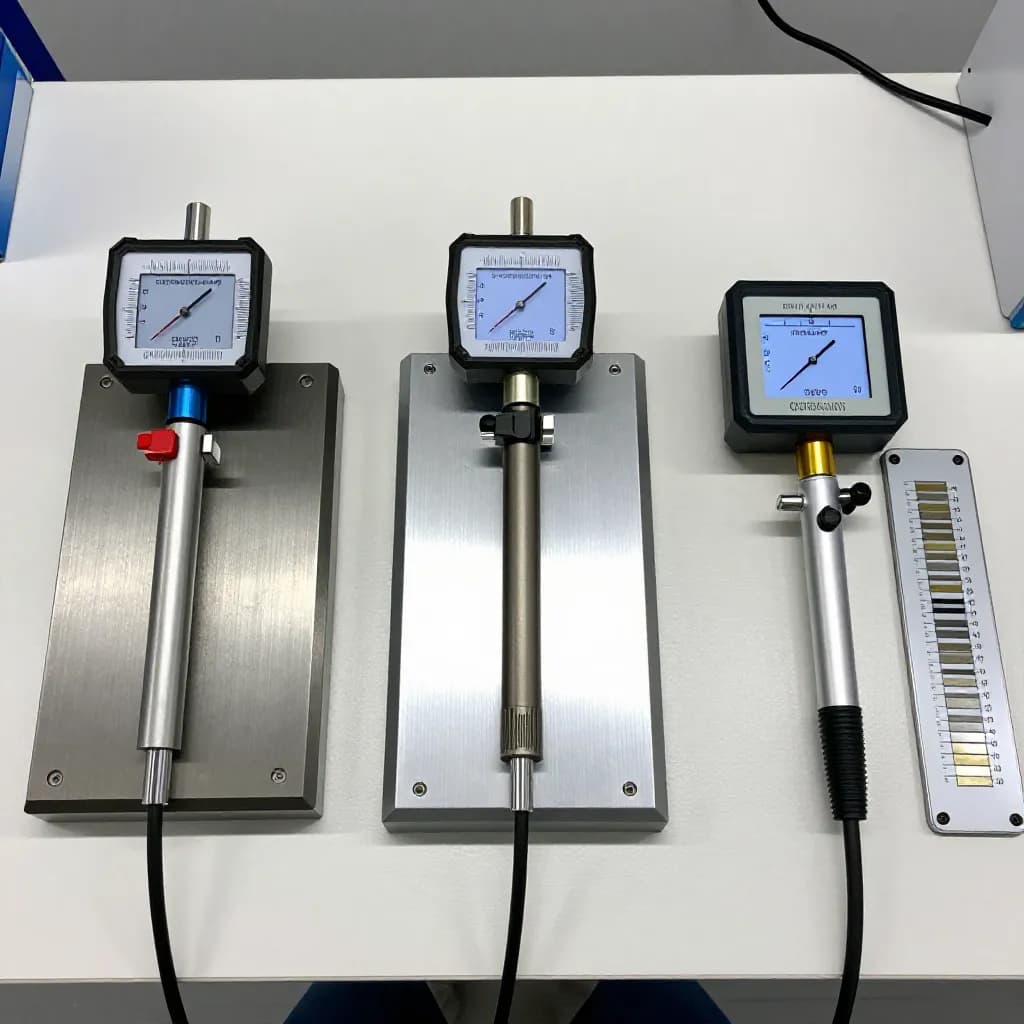
Dry film thickness (DFT) measurement on cured powder coatings is performed using non-destructive electromagnetic gauges that measure the distance between the gauge probe and the metal substrate beneath the coating. These gauges are portable, battery-powered instruments that provide instant readings with accuracy of ±1–3% of the measured value. They are used at every stage of the coating process — from incoming quality verification of pre-coated components to in-process monitoring during production to final inspection before shipment.
Ready to Start Your Project?
From one-off customs to 15,000-part production runs — get precise pricing in 24 hours.
On This Page
Film Thickness Measurement: The Essential Quality Control Tool
The two electromagnetic measurement principles used for coating thickness measurement are magnetic induction (for coatings on ferromagnetic substrates) and eddy current (for coatings on non-ferromagnetic conductive substrates). Understanding the physics, capabilities, and limitations of each principle is essential for selecting the right gauge and obtaining accurate, reliable measurements. The governing standard for coating thickness measurement is ASTM D7091 (Standard Practice for Nondestructive Measurement of Dry Film Thickness of Nonmagnetic Coatings Applied to Ferrous Metals and Nonmagnetic Coatings Applied to Non-Ferrous Metals), which defines the measurement methods, calibration procedures, and accuracy requirements.
Magnetic Induction: Measuring on Steel Substrates
Magnetic induction gauges measure the thickness of non-magnetic coatings (including all powder coatings) on ferromagnetic substrates — primarily carbon steel, low-alloy steel, and ferritic stainless steel. The measurement principle is based on the relationship between the magnetic flux density at the probe tip and the distance between the probe and the ferromagnetic substrate. As the coating thickness increases, the probe is farther from the substrate, and the magnetic flux density decreases in a predictable, calibratable manner.
The probe contains a permanent magnet or an electromagnet that generates a magnetic field, and a sensor (Hall effect sensor or induction coil) that measures the field strength. The gauge electronics convert the sensor signal to a thickness reading using a calibration curve that relates field strength to distance. Modern magnetic induction gauges achieve accuracy of ±1–2 microns or ±1–2% of the reading (whichever is greater) over the range of 0–1,500 microns, which covers the full range of powder coating thicknesses.
Magnetic induction measurements are affected by several factors that must be understood and controlled for accurate results. Substrate thickness affects the reading if the substrate is thinner than the critical thickness — typically 0.5 mm for most gauges. Below this thickness, the magnetic field penetrates through the substrate, reducing the apparent field strength and producing erroneously high readings. Substrate curvature affects the probe-to-substrate geometry, requiring calibration on a curved reference surface for accurate measurement on curved parts. Surface roughness of the substrate creates an air gap beneath the coating that is included in the thickness reading — on heavily blasted surfaces, this can add 10–25 microns to the apparent coating thickness.
Eddy Current: Measuring on Aluminum and Non-Ferrous Substrates
Eddy current gauges measure the thickness of non-conductive coatings (including all powder coatings) on non-ferromagnetic conductive substrates — primarily aluminum, copper, brass, zinc, and austenitic stainless steel. The measurement principle uses a high-frequency alternating current in the probe coil to generate an alternating magnetic field. When the probe is placed on a conductive substrate, this field induces eddy currents in the substrate surface. The eddy currents generate their own magnetic field that opposes the probe field, and the magnitude of this opposition depends on the distance between the probe and the substrate — i.e., the coating thickness.
The probe electronics measure the impedance change in the probe coil caused by the eddy current interaction and convert it to a thickness reading. Modern eddy current gauges achieve accuracy of ±1–3 microns or ±1–3% of the reading over the range of 0–1,500 microns. Eddy current measurements are generally slightly less precise than magnetic induction measurements on equivalent coating thicknesses, due to the more complex electromagnetic interaction and greater sensitivity to substrate conductivity variations.
Eddy current measurements are affected by substrate conductivity — different aluminum alloys have different conductivities, and the gauge must be calibrated on the specific alloy being measured for maximum accuracy. Substrate thickness must exceed the critical thickness (typically 0.3–0.5 mm for aluminum) to avoid measurement errors. Temperature affects both the substrate conductivity and the probe electronics — most gauges include temperature compensation, but extreme temperatures (below 0°C or above 50°C) may require special calibration. Edge effects occur when measuring within 5–10 mm of a part edge, where the eddy current pattern is distorted by the proximity of the edge, producing unreliable readings.
Dual-Mode Gauges and Automatic Substrate Recognition
Dual-mode gauges combine both magnetic induction and eddy current measurement capabilities in a single instrument, automatically detecting the substrate type and selecting the appropriate measurement principle. This capability is essential for operations that coat both steel and aluminum parts, eliminating the need for separate gauges and the risk of using the wrong measurement principle on a given substrate.
Automatic substrate recognition works by briefly energizing both the magnetic induction and eddy current circuits when the probe contacts the surface. The gauge electronics analyze the response from both circuits to determine whether the substrate is ferromagnetic (magnetic induction response) or non-ferromagnetic conductive (eddy current response) and automatically selects the correct measurement mode. The substrate type is typically displayed on the gauge screen (Fe for ferromagnetic, NFe for non-ferromagnetic) along with the thickness reading.
Modern dual-mode gauges offer additional features that enhance measurement productivity and data management. Built-in statistics calculate mean, standard deviation, minimum, maximum, and coefficient of variation for a batch of readings. Data storage allows thousands of readings to be stored in the gauge memory, organized by batch, part number, or measurement location. Wireless connectivity (Bluetooth or USB) enables transfer of measurement data to computers, tablets, or cloud-based quality management systems for analysis, reporting, and archival. Some gauges include measurement location mapping — the ability to define a grid of measurement points on a part template and record readings at each point, producing a thickness map that visualizes coating distribution across the part surface.
Calibration Procedures and Reference Standards
Accurate thickness measurement requires proper calibration of the gauge using certified reference standards. Calibration establishes the relationship between the gauge sensor signal and the actual coating thickness, compensating for variations in probe characteristics, substrate properties, and environmental conditions.
Calibration standards consist of two components: a substrate reference (a flat plate of the same material and similar thickness as the production substrate) and thickness reference foils (thin plastic or metal foils of known, certified thickness). The calibration procedure involves placing the foils on the substrate reference and adjusting the gauge to read the certified foil thickness. ASTM D7091 recommends calibrating at a minimum of two points — zero (probe directly on the substrate reference with no foil) and one point near the expected coating thickness.
For maximum accuracy, calibration should be performed on a substrate reference that matches the production substrate in material, thickness, curvature, and surface roughness. Calibrating on a smooth, flat reference plate and then measuring on a rough, curved production part introduces systematic errors. Many gauge manufacturers offer curved reference blocks and roughened reference plates for calibration on non-flat or rough substrates.
Calibration verification should be performed at the start of each measurement session, after every 25–50 readings, and whenever the gauge is dropped or subjected to temperature changes. Verification involves measuring a known reference standard and confirming that the reading is within the gauge's specified accuracy. If the verification reading is outside tolerance, the gauge must be recalibrated before continuing measurements. Reference foils and substrate standards should be traceable to national metrology standards (NIST in the US, PTB in Germany) and should be recertified annually or when physical damage is suspected.
Measurement Technique and Common Errors
Proper measurement technique is essential for obtaining accurate, repeatable thickness readings. The most common source of measurement error is not the gauge itself but the operator's technique — how the probe is positioned, how many readings are taken, and where on the part the measurements are made.
Probe positioning requires the probe to be perpendicular to the part surface and pressed firmly against the coating with consistent pressure. Tilting the probe changes the effective distance between the sensor and the substrate, producing erroneous readings — typically higher than actual thickness. On curved surfaces, the probe must be oriented along the radius of curvature (perpendicular to the tangent) for accurate measurement. Spring-loaded probes that maintain consistent contact pressure reduce operator-induced variability.
The number of readings per measurement location affects the reliability of the result. A single reading at a point may not be representative due to local coating thickness variation, surface roughness effects, or random measurement noise. ASTM D7091 recommends taking a minimum of three readings at each measurement location and reporting the average. For critical applications, five or more readings per location provide greater statistical confidence.
Measurement location selection is equally important. Readings should be taken at defined locations that represent the critical surfaces of the part — areas where minimum thickness is required for performance, areas where maximum thickness is limited for appearance or fit, and areas where thickness variation is expected (edges, recesses, flat surfaces). A documented measurement plan that specifies the number and location of readings for each part type ensures consistent, comparable measurements across operators, shifts, and production runs. Common measurement errors to avoid include: measuring on edges (readings are unreliable within 5–10 mm of edges), measuring on rough welds (surface irregularity causes erratic readings), measuring on hot parts (temperature affects gauge accuracy), and measuring through multiple coating layers without accounting for the total system thickness.
Advanced Measurement Technologies and In-Line Systems
Beyond handheld gauges, advanced measurement technologies are available for specialized powder coating applications. Non-contact measurement systems use laser triangulation, optical coherence tomography (OCT), or terahertz imaging to measure coating thickness without touching the surface. These technologies are used for in-line measurement on continuous coating lines (coil coating, pipe coating) where contact measurement is impractical due to line speed or part temperature.
In-line thickness measurement systems integrate sensors into the coating line to provide real-time thickness data during production. Sensors are positioned after the spray booth (measuring uncured powder) or after the cure oven (measuring cured coating) and provide continuous feedback to the spray system controller. When integrated with automatic spray systems, in-line measurement enables closed-loop thickness control — the system automatically adjusts powder flow rate, gun voltage, or gun-to-part distance to maintain the target thickness as part geometry or powder characteristics vary.
Uncured powder thickness measurement presents unique challenges because the powder layer is fragile and easily disturbed by contact. Non-contact ultrasonic sensors and capacitive sensors can measure uncured powder thickness without touching the surface, providing early feedback that allows corrections before the powder is cured. The correlation between uncured and cured thickness must be established for each powder type, as the powder compacts and flows during cure, typically reducing in thickness by 30–50% from the uncured state.
For quality documentation and traceability, modern measurement systems integrate with manufacturing execution systems (MES) and enterprise resource planning (ERP) systems, automatically recording thickness data against part serial numbers, production orders, and customer specifications. This digital quality record provides complete traceability from raw material to finished product and supports compliance with quality management standards such as ISO 9001 and IATF 16949.
Frequently Asked Questions
What type of thickness gauge do I need for powder coating on steel?
For steel substrates, you need a magnetic induction gauge. For aluminum, you need an eddy current gauge. A dual-mode gauge that automatically detects the substrate type and selects the correct measurement principle is the most versatile choice for operations that coat both steel and aluminum.
How accurate are powder coating thickness gauges?
Modern handheld gauges achieve accuracy of ±1–3 microns or ±1–3% of the reading, whichever is greater. This accuracy is sufficient for all standard powder coating specifications. Proper calibration on reference standards matching the production substrate is essential for achieving this accuracy.
How often should a thickness gauge be calibrated?
Calibration should be verified at the start of each measurement session, after every 25–50 readings, and after any physical shock or temperature change. Full recalibration is performed when verification readings fall outside the gauge's specified accuracy. Reference standards should be recertified annually.
Why do thickness readings vary on rough or blasted surfaces?
Surface roughness creates an air gap between the coating and the substrate that is included in the thickness reading. On heavily blasted surfaces, this can add 10–25 microns to the apparent coating thickness. Calibrating the gauge on a reference with similar roughness compensates for this effect.
How many thickness readings should be taken per part?
ASTM D7091 recommends a minimum of three readings at each measurement location, reporting the average. For critical applications, five or more readings per location provide greater statistical confidence. Measurement locations should be defined in a documented plan covering critical surfaces, edges, and recesses.
Ready to Start Your Project?
From one-off customs to 15,000-part production runs — get precise pricing in 24 hours.