Independent laboratory testing provides objective, third-party verification of powder coating performance that is essential for quality assurance, specification compliance, dispute resolution, and failure analysis. While coating applicators and powder manufacturers conduct their own quality testing, independent testing adds a layer of impartiality that carries greater weight in commercial and legal contexts.
Technical
Powder Coating Testing Laboratory Guide: Methods, Commissioning, and Interpreting Results
Sundial Powder Coating·April 22, 2026·13 min
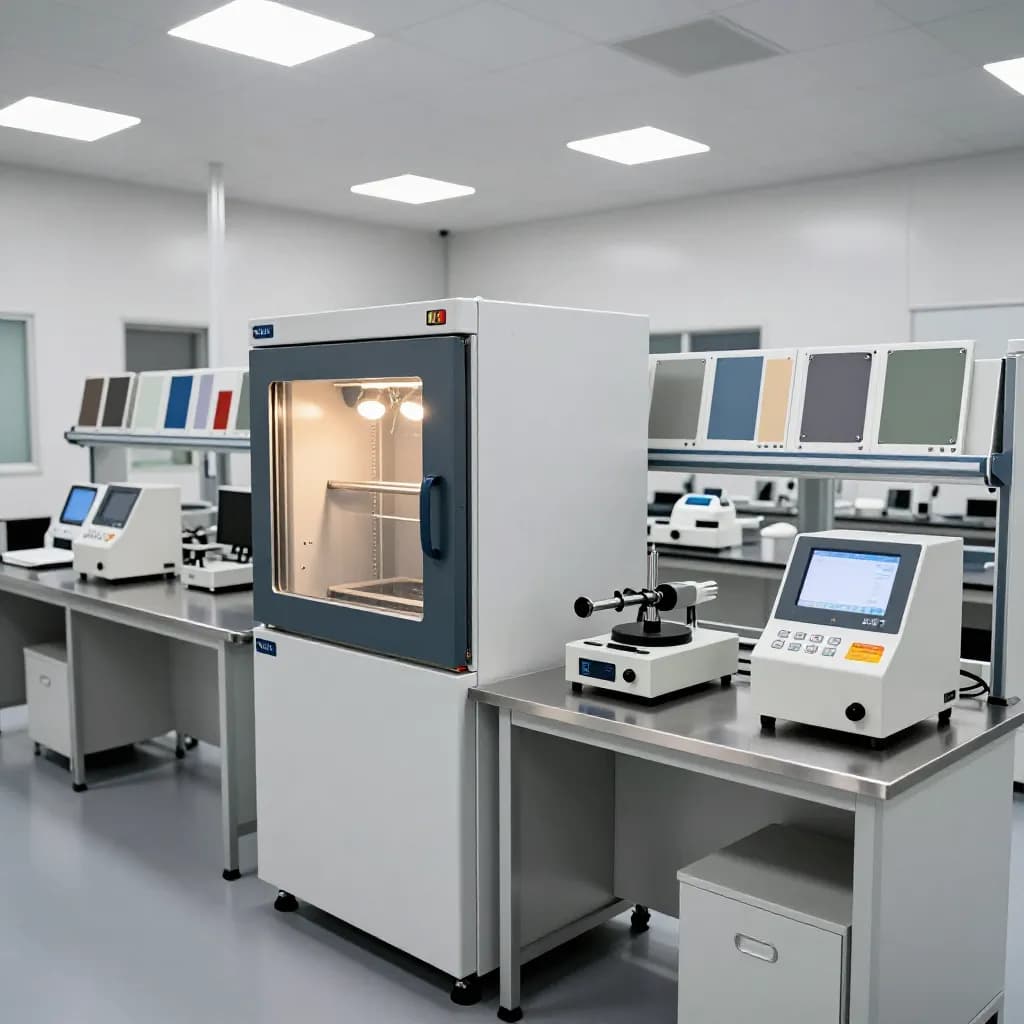
There are several situations where independent testing is particularly valuable. During supplier qualification, independent test results verify that a new coating supplier can meet your performance specification without relying solely on the supplier's own data. For specification development, laboratory testing establishes the baseline performance of different coating systems, helping you set realistic and appropriate requirements. In dispute resolution, independent test results provide objective evidence that both parties can rely on when coating quality is contested. For failure analysis, a testing laboratory can diagnose the root cause of a coating failure using techniques and equipment that most coating applicators do not have in-house.
Ready to Start Your Project?
From one-off customs to 15,000-part production runs — get precise pricing in 24 hours.
On This Page
The Role of Independent Testing in Powder Coating Quality
This guide covers the major test methods used for powder coating evaluation, explains how to commission testing from an independent laboratory, and provides guidance on interpreting test results in the context of coating specification and quality management.
Mechanical Property Tests
Mechanical property tests evaluate the physical characteristics of the cured coating film — its hardness, flexibility, adhesion, and resistance to impact and abrasion. These tests are fundamental to coating quality assessment and are included in virtually every coating specification.
Adhesion testing measures the bond strength between the coating and the substrate. The cross-cut test (ISO 2409 / ASTM D3359) is the most common method — a grid pattern is cut through the coating to the substrate using a multi-blade cutting tool, adhesive tape is applied and removed, and the amount of coating detached is assessed against a classification scale (0 to 5, where 0 is no detachment and 5 is greater than 65% detachment). For more quantitative results, the pull-off adhesion test (ISO 4624 / ASTM D4541) uses a dolly bonded to the coating surface and measures the tensile force required to detach the coating, expressed in megapascals.
Hardness testing assesses the coating's resistance to indentation and scratching. The pencil hardness test (ISO 15184 / ASTM D3363) determines the hardest pencil grade that does not scratch the coating surface, providing a simple comparative measure. The Buchholz indentation test (ISO 2815) measures the depth of indentation under a defined load, providing a more quantitative hardness value. Impact resistance testing (ISO 6272 / ASTM D2794) drops a weighted indenter onto the coated surface from increasing heights to determine the maximum impact energy the coating can absorb without cracking or delaminating, tested in both direct (impact on coated face) and reverse (impact on uncoated face) orientations.
Corrosion Resistance Tests
Corrosion resistance testing evaluates the coating system's ability to protect the substrate from corrosive attack. These tests are critical for coatings intended for outdoor exposure, marine environments, industrial atmospheres, or any application where moisture and chemical exposure are expected.
The neutral salt spray test (ISO 9227 / ASTM B117) is the most widely used accelerated corrosion test. Test panels are placed in a sealed cabinet and exposed to a continuous fog of 5% sodium chloride solution at 35°C. The test duration depends on the specification — typical requirements range from 500 hours for moderate-duty applications to 1,000-2,000 hours for demanding exterior applications and up to 3,000 hours or more for marine and heavy industrial environments. After exposure, panels are evaluated for blistering (ISO 4628-2), rusting (ISO 4628-3), cracking (ISO 4628-4), and creep from a scribed line (ISO 4628-8).
While salt spray testing is universally used, it has well-known limitations as a predictor of real-world corrosion performance. The continuous salt fog exposure does not replicate the wet-dry cycling, UV exposure, temperature variation, and atmospheric pollutants that coatings experience in actual service. Cyclic corrosion tests — such as ISO 11997 or various automotive cyclic test protocols — provide a more realistic simulation by alternating between salt spray, humidity, drying, and UV exposure phases. For critical applications, consider specifying cyclic corrosion testing in addition to or instead of neutral salt spray testing.
Weathering and UV Resistance Tests
Weathering tests evaluate the coating's resistance to degradation from ultraviolet radiation, moisture, and temperature cycling — the primary causes of outdoor coating deterioration. These tests are essential for exterior architectural coatings, outdoor furniture, automotive components, and any product exposed to sunlight and weather.
Accelerated weathering tests use laboratory equipment that simulates the effects of outdoor exposure in a compressed timeframe. The most common methods use fluorescent UV lamps (ISO 16474-3 / ASTM G154) or xenon arc lamps (ISO 16474-2 / ASTM G155) to provide UV radiation, combined with moisture cycles (condensation or water spray) and temperature cycling. Xenon arc testing is generally considered more representative of natural sunlight because the xenon lamp spectrum more closely matches the solar spectrum, while fluorescent UV testing is faster and less expensive.
Test results are evaluated by measuring changes in color (Delta E), gloss retention (percentage of original gloss), chalking (development of a powdery surface layer), cracking, blistering, and film erosion after defined exposure periods. Qualicoat and GSB specifications define specific accelerated weathering test durations and acceptance criteria for each performance class. AAMA specifications use natural Florida weathering exposure (one, five, or ten years) as the primary performance benchmark, supplemented by accelerated testing.
Natural weathering exposure — mounting test panels on outdoor exposure racks in locations with known climatic conditions — provides the most realistic performance data but requires years of exposure time. South Florida (for UV and humidity), Arizona (for UV and heat), and coastal locations (for salt exposure) are the most commonly used natural weathering sites. For critical architectural applications, natural weathering data from the powder manufacturer provides valuable evidence of long-term performance that accelerated tests can only approximate.
How to Commission Independent Testing
Commissioning testing from an independent laboratory requires clear communication of your requirements to ensure that the testing is performed correctly and the results are meaningful. Start by identifying a laboratory that is accredited for the specific tests you need — look for ISO 17025 accreditation, which confirms that the laboratory operates a quality management system for testing and calibration and has demonstrated technical competence in the specific test methods.
When submitting samples for testing, provide the laboratory with complete information: the test methods required (referenced by standard number), the test conditions (duration, temperature, reagent concentration, UV source type), the acceptance criteria (so the laboratory can report pass/fail as well as measured values), the number of test specimens required, and any special instructions for sample preparation or conditioning.
Prepare test specimens according to the requirements of each test method. Most coating tests require flat test panels of specified dimensions and substrate material, coated under the same conditions as production parts. If you are testing production parts rather than test panels, discuss the specimen requirements with the laboratory — some tests require flat surfaces, specific dimensions, or particular orientations that may not be achievable on actual production parts. Label all specimens clearly with unique identifiers that link them to your internal records.
Request a formal test report that includes the test method reference, test conditions, specimen identification, measured results, and pass/fail assessment against your specified criteria. The report should be issued on the laboratory's letterhead with the accreditation mark and the signature of the responsible technical person. Retain test reports as part of your quality records for the duration specified in your quality management system.
Interpreting Test Results and Making Quality Decisions
Test results are only valuable if they are correctly interpreted in the context of the coating specification and the intended application. A test result that meets the specification requirement is straightforward — the coating passes. But borderline results, unexpected failures, and results that seem inconsistent with field performance require more nuanced interpretation.
When a test result falls just outside the specification limit, consider the measurement uncertainty of the test method. All test methods have inherent variability, and a result that is marginally outside the limit may be within the measurement uncertainty of the method. ISO 17025-accredited laboratories report measurement uncertainty with their results, allowing you to assess whether a borderline result represents a genuine failure or falls within the range of normal measurement variation.
For corrosion and weathering tests, understand the relationship between accelerated test results and real-world performance. Accelerated tests compress years of exposure into weeks or months, but the correlation between accelerated test hours and years of field service is not linear or universal — it depends on the specific test method, the coating system, and the actual service environment. Use accelerated test results as comparative tools (comparing one coating system against another) and as specification compliance checks, but do not extrapolate them directly to predict specific field service life.
When test results indicate a failure, investigate the root cause before taking corrective action. A coating that fails adhesion testing may have a pretreatment problem, a cure problem, or a contamination issue — each requiring a different corrective action. A coating that fails salt spray testing may have inadequate film thickness, poor edge coverage, or an inappropriate powder chemistry for the exposure conditions. The test result identifies the symptom; root cause analysis identifies the cure.
Building an In-House Testing Capability
While independent laboratory testing is essential for formal quality verification and dispute resolution, many coating operations benefit from in-house testing capability for routine quality control and process monitoring. The level of in-house testing capability depends on the volume and criticality of the coating work and the quality requirements of the customer base.
Basic in-house testing equipment for a powder coating operation includes a calibrated film thickness gauge (magnetic induction for steel, eddy current for aluminum), a cross-cut adhesion test kit, a pencil hardness test kit, a gloss meter, and a calibrated thermometer or oven data logger for cure verification. This basic kit enables routine quality checks on every batch and provides early warning of process deviations before they result in significant quality problems.
Intermediate capability adds a spectrophotometer for instrumental color measurement, an impact tester, a cupping tester, and a salt spray cabinet for accelerated corrosion testing. This level of capability supports more rigorous quality control, enables in-house verification of specification compliance, and reduces dependence on external laboratories for routine testing.
Advanced capability — including weathering test equipment, advanced corrosion test chambers, and surface analysis instruments — is typically justified only for large coating operations, powder manufacturers, or organizations with research and development functions. For most coating applicators, a combination of basic to intermediate in-house capability supplemented by independent laboratory testing for formal verification and specialized analysis provides the most cost-effective quality assurance approach. Regardless of the level of in-house capability, ensure that all test equipment is calibrated according to documented schedules and that test procedures follow the referenced standard methods.
Frequently Asked Questions
What is the most important test for powder coating quality?
Adhesion testing is arguably the most fundamental test because without adequate adhesion, all other coating properties are irrelevant. Film thickness measurement is the most frequently performed test because it is non-destructive and provides immediate feedback on the coating process. The most important test for your application depends on the service environment and performance requirements.
How do I find an accredited testing laboratory for powder coating?
Search the database of your national accreditation body (UKAS in the UK, DAkkS in Germany, A2LA or NVLAP in the US) for laboratories accredited to ISO 17025 for the specific test methods you need. Industry associations such as Qualicoat and PCI can also recommend approved testing laboratories.
How many hours of salt spray testing should I specify?
Salt spray hours depend on the service environment: 500 hours for mild interior applications, 1,000 hours for moderate exterior exposure, 1,500-2,000 hours for demanding exterior or industrial environments, and 2,000-3,000+ hours for marine or severe coastal exposure. Reference the applicable quality standard (Qualicoat, GSB, AAMA) for specific requirements.
What does Delta E mean in color testing?
Delta E (ΔE) is a numerical measure of the difference between two colors in the CIE L*a*b* color space. A Delta E of 1.0 is generally considered the threshold of perceptibility for a trained observer. Values below 1.0 are typically acceptable for commercial applications; values above 2.0 are usually noticeable to most observers.
Can accelerated weathering tests predict actual outdoor performance?
Accelerated weathering tests provide comparative data and specification compliance verification, but they cannot precisely predict years of outdoor service life. The correlation between accelerated test hours and field performance depends on the test method, coating system, and actual service conditions. Use accelerated tests alongside natural weathering data and field experience for the most reliable performance assessment.
Ready to Start Your Project?
From one-off customs to 15,000-part production runs — get precise pricing in 24 hours.