Powder coating structural steel — I-beams, H-sections, channels, angles, hollow sections, and plate girders — presents challenges of scale, logistics, and process engineering that distinguish it from coating smaller fabricated components. Structural steel members can weigh several tonnes, span 12-18 meters in length, and have complex cross-sections with internal surfaces, bolt holes, and welded connections that all require coating coverage. The sheer size and weight of these components demand specialized handling equipment, large-format blast rooms and coating booths, and high-capacity cure ovens that represent significant capital investment.
Technical
Powder Coating Structural Steel: Large-Format Coating, Blast Cleaning, and Infrastructure Applications
Sundial Powder Coating·April 22, 2026·14 min
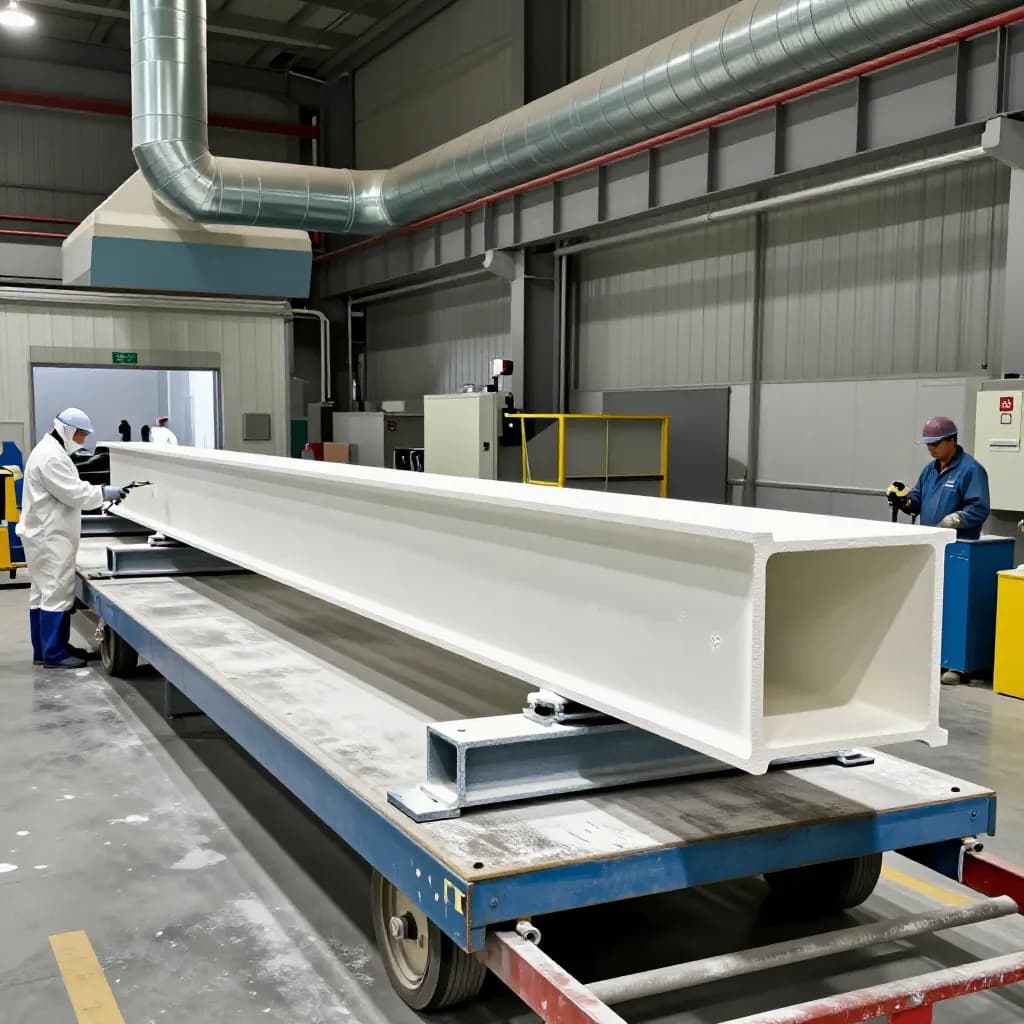
Despite these challenges, powder coating structural steel is growing rapidly as an alternative to traditional liquid paint systems for bridges, buildings, stadiums, railway infrastructure, and industrial structures. The drivers are familiar — zero VOC emissions, high material efficiency, superior film build in a single coat, and excellent long-term durability — but the scale of environmental benefit is proportionally larger for structural steel because the volumes of coating material consumed are enormous. A single bridge project may require coating thousands of square meters of steel surface, and the difference between 30% transfer efficiency (typical for liquid spray) and 95% efficiency (typical for powder with reclaim) translates to tonnes of material saved and waste eliminated.
Ready to Start Your Project?
From one-off customs to 15,000-part production runs — get precise pricing in 24 hours.
On This Page
Structural Steel: Scale and Complexity
The structural steel coating market has historically been dominated by liquid paint systems — alkyd, epoxy, polyurethane, and zinc-rich primers — applied by airless spray in fabrication shops or on-site. Powder coating's entry into this market has been enabled by the development of large-format coating equipment, high-performance powder primer systems, and industry standards that recognize powder coating as an equivalent or superior alternative to liquid paint for structural steel protection.
Blast Cleaning to SA 2.5: The Foundation of Performance
Surface preparation is the single most important factor determining the long-term performance of any coating system on structural steel, and blast cleaning to SA 2.5 (near-white metal) per ISO 8501-1 is the minimum standard for high-performance powder coating applications. SA 2.5 requires that at least 95% of the surface is free of all visible mill scale, rust, paint, and foreign matter, with only slight staining permitted in the form of spots or stripes. This level of cleanliness ensures that the coating bonds directly to clean steel rather than to loosely adherent corrosion products or mill scale that will eventually detach and cause coating failure.
Abrasive blast cleaning of structural steel is performed using centrifugal wheel blast machines (for automated processing of standard sections) or compressed air blast equipment (for manual processing of fabricated assemblies). Steel grit (G25-G40) is the standard abrasive, producing an angular surface profile of 50-100 micrometers that provides excellent mechanical keying for the coating. The profile depth should be matched to the coating system thickness — a general guideline is that the profile should be 25-33% of the total dry film thickness of the first coat.
Mill scale — the blue-black iron oxide layer that forms on hot-rolled steel during manufacturing — is the primary contaminant that blast cleaning must remove. Mill scale is cathodic to the underlying steel, meaning that any break in the mill scale creates a galvanic cell that accelerates corrosion of the exposed steel. Even small areas of residual mill scale beneath a coating will eventually cause blistering and corrosion. This is why SA 2.5 rather than SA 2 (thorough blast cleaning, which allows up to 33% residual staining) is specified for high-performance structural steel coating — the additional cleaning effort to achieve SA 2.5 pays dividends in coating longevity.
Primer Systems for Structural Steel
Structural steel coating systems typically employ a primer-plus-topcoat approach, with the primer providing corrosion protection and adhesion at the steel surface and the topcoat providing UV resistance, color, and aesthetic durability. Zinc-rich epoxy primers are the gold standard for structural steel corrosion protection, containing 70-85% metallic zinc in the dry film. The zinc particles provide galvanic (sacrificial) protection to the steel substrate — if the coating is damaged and steel is exposed, the zinc corrodes preferentially, protecting the steel from rusting.
Zinc-rich powder primers are applied at 50-75 micrometers and cured before the topcoat is applied. The high zinc content creates a porous, rough primer surface that provides excellent mechanical keying for the topcoat. However, the porosity also means that zinc-rich primers alone do not provide adequate barrier protection — they must be topcoated to achieve their full corrosion protection potential. The combination of galvanic protection from the zinc primer and barrier protection from the topcoat creates a synergistic system that outperforms either component alone.
Epoxy primers without zinc provide barrier-only protection and are used where galvanic protection is not required or where the service environment is less demanding. Standard epoxy primers at 50-80 micrometers offer excellent adhesion, chemical resistance, and moisture barrier properties. For the most demanding applications — marine, offshore, and heavy industrial environments classified as C4 or C5 per ISO 12944 — a three-coat system of zinc-rich epoxy primer, epoxy intermediate coat, and polyester topcoat provides maximum protection with expected service life exceeding 25 years. The intermediate epoxy coat (50-80 micrometers) adds barrier thickness and bridges any porosity in the zinc-rich primer, while the polyester topcoat (60-80 micrometers) provides UV resistance and color retention.
Large-Format Coating Equipment and Logistics
Coating structural steel requires equipment scaled to handle the size and weight of the components. Blast rooms for structural steel are typically 15-25 meters long, 5-8 meters wide, and 4-6 meters high, equipped with overhead cranes or rail-mounted trolleys for moving heavy sections through the blast zone. Automated blast machines using centrifugal wheels can process standard sections (I-beams, channels, angles) at throughput rates of 20-50 m²/hour, while manual blast operators handle fabricated assemblies and areas that automated equipment cannot reach.
Powder coating booths for structural steel are similarly large-scale, with booth dimensions matching or exceeding the blast room. Reciprocating automatic guns mounted on vertical masts coat the external surfaces of sections as they pass through the booth on a conveyor or trolley system, while manual operators coat internal surfaces, bolt holes, and complex connection details. Powder reclaim systems must handle the high volumes of overspray generated by large-surface-area components — cyclone separators with cartridge filter afterfilters are standard, with reclaim efficiency of 95-98%.
Cure ovens for structural steel are the most capital-intensive component of the coating line. Batch ovens measuring 15-20 meters long, 4-6 meters wide, and 3-5 meters high are typical, with gas-fired convection heating systems capable of raising the oven temperature to 200-220°C. The thermal mass of structural steel sections is enormous — a single I-beam may weigh 500-2000 kg — and the oven must deliver sufficient heat energy to bring the entire section to cure temperature within a reasonable time. Oven soak times of 30-60 minutes at temperature are common for heavy sections, compared to 10-15 minutes for light fabrications. Energy consumption is a significant operating cost, and oven insulation, heat recovery systems, and optimized loading patterns are important for economic viability.
Bridge and Infrastructure Applications
Bridge steelwork represents one of the most demanding applications for powder-coated structural steel, combining severe environmental exposure (C4-C5 corrosive environments per ISO 12944), long design life requirements (75-120 years for modern bridges), and the practical impossibility of complete recoating once the bridge is in service. The coating system must provide decades of maintenance-free protection, with only localized touch-up of damage areas required during the bridge's service life.
Powder coating systems for bridge steelwork typically follow the three-coat specification: zinc-rich epoxy primer (60-80 micrometers), epoxy intermediate coat (60-80 micrometers), and polyester topcoat (60-80 micrometers), for a total system thickness of 180-240 micrometers. This system provides both galvanic and barrier protection, with the zinc primer protecting against corrosion at any points of coating damage, the epoxy intermediate providing chemical and moisture resistance, and the polyester topcoat providing UV stability and color retention. Salt spray resistance of 2000-4000 hours and cyclic corrosion resistance exceeding 4000 hours are typical qualification requirements.
Railway infrastructure — station canopies, footbridges, signal gantries, and platform furniture — is another growing market for powder-coated structural steel. Railway specifications emphasize fire safety (powder-coated steel achieves A1-A2 Euroclass fire ratings), vandal resistance (powder coatings resist graffiti better than liquid paints and can be formulated with anti-graffiti properties), and long maintenance intervals (railway infrastructure is difficult and expensive to access for maintenance). The combination of fire safety, durability, and low maintenance makes powder coating increasingly specified by railway authorities as the preferred finish for new and refurbished steel infrastructure.
Weld Area Treatment and Connection Details
Welded connections on structural steel require specific attention during both surface preparation and coating application. Weld spatter — the small droplets of molten metal that adhere to the steel surface adjacent to welds — must be removed before blast cleaning because spatter particles are loosely attached and will detach in service, taking the coating with them. Mechanical removal using chipping hammers, grinders, or scrapers is standard practice, followed by blast cleaning to achieve SA 2.5 on both the weld and the surrounding base metal.
Weld profiles affect coating coverage and durability. Convex weld beads with smooth, regular profiles are easier to coat uniformly than concave or irregular welds with undercut, porosity, or sharp transitions. Weld quality standards such as ISO 5817 define acceptable weld profiles for different quality levels, and structural steel intended for high-performance coating should be welded to at least quality level C (intermediate) to ensure that the weld profile does not compromise coating performance. Weld toes — the transition between the weld bead and the base metal — are stress concentration points where coating thickness tends to be reduced due to the sharp angle change. Grinding weld toes to a smooth radius improves both coating coverage and fatigue performance of the welded joint.
Bolted connections present masking and access challenges. Bolt holes must be kept clear of coating to ensure proper bolt fit and load transfer, requiring masking plugs or tape during coating. Faying surfaces (the contact surfaces between bolted members) may need to be left uncoated or coated with a specific friction-qualified coating to maintain the slip resistance required for friction-type bolted connections. High-strength friction grip (HSFG) bolt connections require a defined coefficient of friction at the faying surface, and standard powder coatings may not meet this requirement. Inorganic zinc silicate or metallized zinc coatings are sometimes specified for faying surfaces because they provide both corrosion protection and adequate friction coefficient.
Standards and Specification Framework
The specification framework for powder-coated structural steel draws from several international standards. ISO 12944 (Corrosion protection of steel structures by protective paint systems) provides the overarching classification of corrosive environments (C1-C5 and CX for immersion) and defines durability ranges (Low: 2-5 years, Medium: 5-15 years, High: 15-25 years, Very High: more than 25 years). While ISO 12944 was originally written for liquid paint systems, its environmental classification and testing requirements are equally applicable to powder coating systems.
EN 15773 (Powder organic coated galvanized and sherardized steel products) and the Qualisteelcoat quality label specifically address powder coating of steel structures, defining pretreatment requirements, coating system specifications, and quality control procedures. Qualisteelcoat certification is increasingly required by European infrastructure authorities as evidence of applicator capability and process quality.
National standards and specifications supplement the international framework. In the UK, the Highways England specification for bridge painting (formerly BD 35) defines coating systems for highway structures. In Germany, the ZTV-ING (Additional Technical Contractual Conditions for Engineering Structures) specifies coating requirements for bridges and tunnels. In North America, SSPC (Society for Protective Coatings) standards define surface preparation grades (SSPC-SP 10 equivalent to SA 2.5) and coating application requirements. Each national authority may have specific requirements for powder coating qualification, including accelerated corrosion testing, outdoor exposure testing, and applicator certification that must be met before powder coating is accepted as an alternative to traditional liquid paint systems.
Frequently Asked Questions
Can structural steel beams be powder coated?
Yes, structural steel beams and sections are increasingly powder coated for bridges, buildings, stadiums, and railway infrastructure. Large-format blast rooms, coating booths, and cure ovens (15-25 meters long) handle sections up to 18 meters. Multi-coat systems with zinc-rich primers provide corrosion protection exceeding 25 years in demanding environments.
What blast standard is required for structural steel coating?
SA 2.5 (near-white metal) per ISO 8501-1 is the minimum standard, requiring 95%+ of the surface to be free of mill scale, rust, and contaminants. Steel grit (G25-G40) produces a 50-100 micrometer surface profile. SA 2.5 is essential because residual mill scale creates galvanic cells that accelerate corrosion beneath the coating.
What coating system is used for powder-coated bridges?
The standard three-coat system consists of zinc-rich epoxy primer (60-80 micrometers), epoxy intermediate coat (60-80 micrometers), and polyester topcoat (60-80 micrometers), totaling 180-240 micrometers. This provides galvanic protection from zinc, barrier protection from epoxy, and UV resistance from polyester, with salt spray resistance of 2000-4000 hours.
How long does it take to cure heavy structural steel sections?
Heavy structural steel sections (500-2000 kg) require 30-60 minutes at cure temperature due to their enormous thermal mass. The cure oven must deliver sufficient heat energy to bring the entire section to 180-200°C throughout. Oven soak times are significantly longer than the 10-15 minutes typical for light fabrications.
How are bolted connections handled when powder coating structural steel?
Bolt holes are masked with plugs or tape to maintain proper fit. Faying surfaces for friction-type connections may need specific friction-qualified coatings or may be left uncoated, as standard powder coatings may not provide the required slip coefficient. High-strength friction grip connections require validated friction values at the faying surface.
Ready to Start Your Project?
From one-off customs to 15,000-part production runs — get precise pricing in 24 hours.