Stone effect powder coating brings the visual character of natural stone to aluminum and steel surfaces, enabling architects and designers to achieve the appearance of granite, marble, sandstone, and other natural stones on lightweight metal substrates. This technology opens design possibilities that would be impractical or impossible with actual stone, including curved surfaces, thin profiles, and large-span panels that natural stone cannot achieve due to its weight and structural limitations.
Design
Powder Coating Stone Effect Finishes: Granite, Marble, Sandstone Effects for Architectural Cladding
Sundial Powder Coating·April 22, 2026·11 min
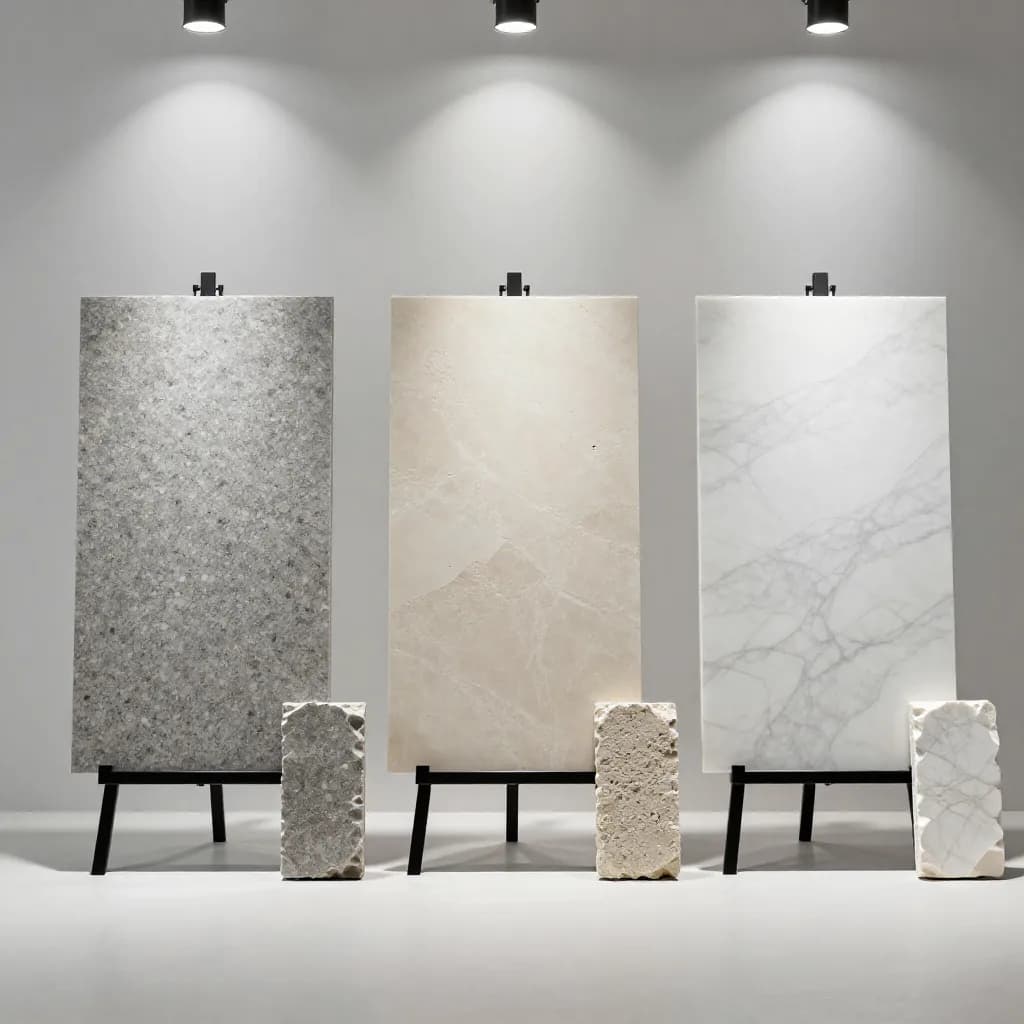
The appeal of stone effect finishes extends beyond simple material imitation. Natural stone carries associations of permanence, quality, and connection to the earth that resonate deeply in architectural design. Stone effect powder coatings allow these associations to be applied to modern building systems that offer superior structural performance, lighter weight, and greater design flexibility than traditional stone construction. The result is architecture that communicates the solidity and prestige of stone while benefiting from the engineering advantages of metal framing and cladding systems.
Ready to Start Your Project?
From one-off customs to 15,000-part production runs — get precise pricing in 24 hours.
On This Page
Stone Effect Powder Coating: Natural Aesthetics on Metal Substrates
Stone effect powder coatings are achieved through several technologies, including multi-color powder blends, sublimation transfer, and specialized textured formulations. Each technology produces a different type of stone effect, from the speckled, granular appearance of granite to the veined, flowing patterns of marble. Understanding these technologies and their capabilities is essential for specifying stone effects that meet both aesthetic and performance expectations.
Granite Effect: Multi-Tone Speckled Finishes
Granite effect powder coatings replicate the characteristic speckled, multi-toned appearance of natural granite stone. These finishes combine multiple colored particles within a single coating to create the random, organic pattern of mineral crystals that defines granite's visual character.
The most common technology for granite effects is multi-color powder blending, where two or more differently colored powder particles are mixed together and applied simultaneously. During curing, the different colored particles flow and merge partially, creating a speckled pattern where individual color spots remain visible within the overall composition. The size, distribution, and color contrast of the spots can be controlled through the particle size ratio and blending proportions.
Granite effects are available in a wide range of color combinations reflecting the natural diversity of granite stone. Light granite effects in combinations of white, grey, and black replicate the appearance of popular architectural granites such as Bianco Sardo or Silver Grey. Warm granite effects incorporating beige, brown, and cream tones replicate stones like Giallo Veneziano or Rosa Porrino. Dark granite effects in combinations of black, dark grey, and subtle metallic flecks replicate stones like Absolute Black or Nero Impala.
The texture of granite effect powder coatings adds to their realism. Most granite effect formulations produce a slightly rough, granular surface texture that mimics the feel of honed or flamed granite. This texture also provides practical benefits, including excellent dirt-hiding capability, resistance to fingerprints and handling marks, and reduced visibility of minor surface damage.
Granite effect finishes are particularly popular for architectural cladding panels, column covers, and facade elements where the appearance of stone is desired on lightweight aluminum substrates. They are also widely used for interior applications including elevator interiors, reception desk cladding, and wall panel systems where the visual weight and permanence of stone enhances the design intent.
Marble Effect: Veined and Flowing Patterns
Marble effect powder coatings replicate the distinctive veined, flowing patterns that make natural marble one of the most prized decorative stones. Unlike the speckled pattern of granite effects, marble effects require continuous, flowing lines of contrasting color that sweep across the surface in organic, non-repeating patterns.
Achieving convincing marble effects in powder coating is more technically challenging than granite effects because the veined pattern cannot be created through simple powder blending. Instead, marble effects typically use sublimation transfer technology, where a printed film carrying the marble pattern is transferred onto the powder-coated surface using heat and vacuum pressure. This process allows for highly detailed, photorealistic marble patterns that closely replicate specific marble varieties.
Popular marble effects include Carrara marble, with its white background and subtle grey veining, which is the most widely specified marble effect for architectural and interior applications. Calacatta marble effects feature bolder, more dramatic veining in gold and grey tones on a white background. Emperador marble effects replicate the rich brown tones and cream veining of this popular Spanish stone. Nero Marquina effects capture the dramatic contrast of white veining on a black background.
The realism of sublimation marble effects has reached a level where they can be remarkably convincing, particularly on flat or gently curved surfaces viewed at normal architectural distances. The limitation of sublimation technology is that the pattern is two-dimensional, so it lacks the depth and translucency that characterize real marble when viewed at close range or in certain lighting conditions.
For applications where maximum realism is required, combining a marble sublimation pattern with a high-gloss or semi-gloss base coat enhances the depth and luminosity of the effect, more closely approximating the polished surface of real marble. Matte base coats create a honed marble appearance that is equally convincing and increasingly popular in contemporary design.
Sandstone and Natural Stone Effects
Sandstone effect powder coatings replicate the warm, textured appearance of natural sandstone, creating finishes that evoke the character of traditional stone buildings and natural rock formations. These effects are particularly popular in regions where sandstone is a traditional building material, allowing modern metal-clad buildings to reference the local architectural vernacular.
Sandstone effects are typically achieved through textured powder formulations that combine warm earth-toned colors with a granular surface texture. The texture is critical to the realism of sandstone effects because natural sandstone has a distinctly rough, grainy surface that is as much a tactile experience as a visual one. Textured powder coatings can replicate this granular quality effectively, creating surfaces that both look and feel like natural sandstone.
The color palette for sandstone effects draws from the natural range of sandstone colors, including warm buff and cream tones replicating Bath stone or Cotswold stone, golden yellows replicating York stone, warm pinks replicating red sandstone, and cool greys replicating grey sandstone varieties. Multi-tone formulations that incorporate subtle color variation within the surface enhance the realism by replicating the natural banding and color variation found in sedimentary stone.
Limestone effects offer a smoother, more uniform alternative to sandstone, replicating the fine-grained, consistent appearance of architectural limestone. These effects use finer textures and more subtle color variation than sandstone effects, creating a refined, elegant stone appearance suited to formal architectural contexts.
Slate effect powder coatings replicate the layered, textured appearance of natural slate, with dark grey, blue-grey, or green-grey tones and a directional texture that mimics the natural cleavage planes of slate stone. Slate effects are popular for contemporary architectural applications where a dark, textured stone appearance is desired.
For all natural stone effects, the texture profile is as important as the color in achieving a convincing result. Specifiers should evaluate physical samples not only visually but also tactilely, assessing whether the surface texture convincingly replicates the feel of the intended stone type.
Architectural Cladding Applications for Stone Effects
Stone effect powder coating has become a significant specification choice for architectural cladding systems, offering the visual character of natural stone on lightweight aluminum panels that are easier to install, more structurally efficient, and more cost-effective than actual stone cladding.
Rainscreen cladding panels in stone effect finishes are the most common architectural application. These panels, typically fabricated from aluminum sheet or aluminum composite material, are coated with stone effect powder finishes and installed on a ventilated rainscreen system. The result is a facade that appears to be clad in natural stone but weighs a fraction of actual stone cladding and can be installed much more quickly.
Column covers and pilaster cladding in stone effect finishes allow structural steel or concrete columns to be clad with the appearance of stone. This application is particularly common in commercial lobbies, retail environments, and hospitality spaces where the visual weight and prestige of stone columns enhances the interior design without the structural implications of actual stone.
Soffit and canopy panels in stone effect finishes extend the stone aesthetic to overhead surfaces that would be impractical to clad in real stone due to weight constraints. Stone effect aluminum soffits create a seamless visual transition from stone-clad walls to overhead surfaces, maintaining the material consistency that contributes to a convincing stone aesthetic.
The design flexibility of stone effect powder coating on metal substrates enables forms and geometries that natural stone cannot achieve. Curved panels, perforated screens, folded profiles, and thin-section elements can all receive stone effect finishes, allowing architects to combine the visual language of stone with contemporary formal expression.
For cladding applications, the durability of the stone effect finish must match the expected service life of the cladding system. Super-durable polyester base coats with Qualicoat Class 2 or AAMA 2605 certification provide the necessary long-term performance. For sublimation-based stone effects, Qualideco certification ensures pattern stability under weathering.
Multi-Tone Techniques for Realistic Stone Effects
The realism of stone effect powder coatings depends largely on the multi-tone techniques used to create the natural color variation that characterizes real stone. Single-color finishes, no matter how well-chosen, cannot replicate the visual complexity of natural stone, which derives its character from the interaction of multiple mineral colors, grain patterns, and surface textures.
Powder-on-powder techniques involve applying two or more powder coats in sequence, with each layer partially visible through the others. This creates depth and color variation that mimics the layered structure of sedimentary stones. The technique requires careful control of film thickness and coverage to achieve the desired balance between the different color layers.
Dry-blend multi-color powders combine differently colored powder particles in a single application. The particles flow and merge partially during curing, creating a speckled or mottled pattern. The color distribution can be controlled through particle size ratios and blending proportions, allowing the creation of fine-grained granite effects, coarse aggregate effects, or subtle color variation depending on the formulation.
Sublimation transfer provides the most detailed and realistic stone patterns, capable of replicating the specific veining of marble, the banding of sandstone, or the fossil inclusions of limestone with photographic accuracy. The limitation is that sublimation works best on flat or gently curved surfaces and may not wrap effectively around complex three-dimensional geometries.
Manual artistic techniques, where skilled applicators create deliberate color variation through controlled application of multiple powder colors, can produce unique, one-of-a-kind stone effects. This approach is labor-intensive and difficult to reproduce consistently, but it can achieve a level of natural randomness and authenticity that automated processes cannot match. Manual techniques are most appropriate for feature elements and small-scale applications where each piece is treated as an individual work.
Combining techniques can produce the most convincing results. For example, a textured base coat providing the granular surface character of sandstone, followed by a sublimation transfer adding color banding and variation, creates a multi-layered effect that approaches the visual and tactile complexity of real stone.
Specifying Stone Effect Powder Coating for Projects
Stone effect powder coating specification requires defining the stone type, color palette, texture profile, pattern character, and performance standard. The following guidelines ensure that the specified finish achieves the intended stone aesthetic while meeting durability requirements.
Identify the specific stone being referenced. Rather than specifying simply granite effect or marble effect, provide the name of the specific stone variety being replicated, such as Carrara marble, Silver Grey granite, or Bath stone sandstone. If possible, provide a physical sample of the actual stone for the powder manufacturer to reference during formulation development.
Define the color palette and variation range. Natural stone exhibits color variation between pieces and even within a single piece. Specify whether the stone effect should replicate this natural variation or achieve a more uniform, consistent appearance. Some projects benefit from controlled variation that creates a natural, authentic look, while others require consistency for a cleaner, more contemporary aesthetic.
Specify the texture profile. The surface texture is critical to the realism of stone effects and varies significantly between stone types. Polished marble requires a smooth, high-gloss surface. Honed limestone needs a smooth, matte surface. Flamed granite demands a rough, granular texture. Evaluate physical samples for both visual and tactile accuracy.
Define the pattern scale and repeat. For sublimation-based stone effects, the pattern is printed on a film that has a finite repeat length. Specify the minimum acceptable repeat length to avoid obvious pattern repetition on large facade surfaces. Longer repeat lengths create a more natural, non-repeating appearance but may increase cost.
Reference the appropriate performance standard. For exterior cladding applications, specify super-durable polyester with Qualicoat Class 2 or AAMA 2605 certification. For sublimation-based effects, add Qualideco certification. For interior applications, standard polyester provides adequate performance.
Request large-format sample panels for evaluation. Stone effects should be assessed on panels of at least 300mm by 300mm, and preferably larger, to evaluate the pattern scale, color variation, and overall visual impact at a representative size. Small sample chips cannot convey the character of stone effects at architectural scale.
Frequently Asked Questions
How is stone effect powder coating achieved?
Stone effects use several technologies: multi-color powder blends create granite-like speckled patterns, sublimation transfer produces detailed marble veining and sandstone banding, and textured formulations add the granular surface character of natural stone. Combining techniques produces the most realistic results.
How realistic do stone effect powder coatings look?
Modern stone effects are highly convincing at normal architectural viewing distances. Granite effects with multi-tone speckled patterns and appropriate texture are particularly realistic. Marble effects achieved through sublimation transfer can closely replicate specific marble varieties. Close-range inspection may reveal the absence of natural stone depth and translucency.
Can stone effect powder coating be used on exterior facades?
Yes, stone effect finishes are widely used for architectural cladding, rainscreen panels, and facade elements. Specify super-durable polyester base coats with Qualicoat Class 2 or AAMA 2605 certification for exterior durability. For sublimation-based effects, Qualideco certification ensures pattern stability under weathering.
What stone types can be replicated in powder coating?
Virtually any stone type can be replicated, including granite in various color combinations, marble varieties such as Carrara and Calacatta, sandstone in buff, golden, and pink tones, limestone, slate, and travertine. Custom matching to specific stone samples is available from specialist manufacturers.
Is stone effect powder coating lighter than real stone cladding?
Significantly lighter. Stone effect powder-coated aluminum panels weigh a fraction of equivalent natural stone cladding, reducing structural requirements, simplifying installation, and enabling stone aesthetics on buildings where actual stone would be impractical due to weight constraints.
Ready to Start Your Project?
From one-off customs to 15,000-part production runs — get precise pricing in 24 hours.