Spring steel and wire products present a distinct set of challenges for powder coating that differ fundamentally from flat sheet metal or fabricated components. Wire products — fencing, shelving, dishwasher racks, refrigerator shelves, shopping carts, and industrial wire forms — are characterized by small cross-sections (typically 1-8 mm diameter), high surface-area-to-mass ratios, complex three-dimensional geometries with numerous intersections and contact points, and the need for uniform coating coverage on all surfaces including the underside of horizontal wire runs.
Technical
Powder Coating Spring Steel and Wire Products: Fluidized Bed, Thin Wire Challenges, and Nylon Coatings
Sundial Powder Coating·April 22, 2026·13 min
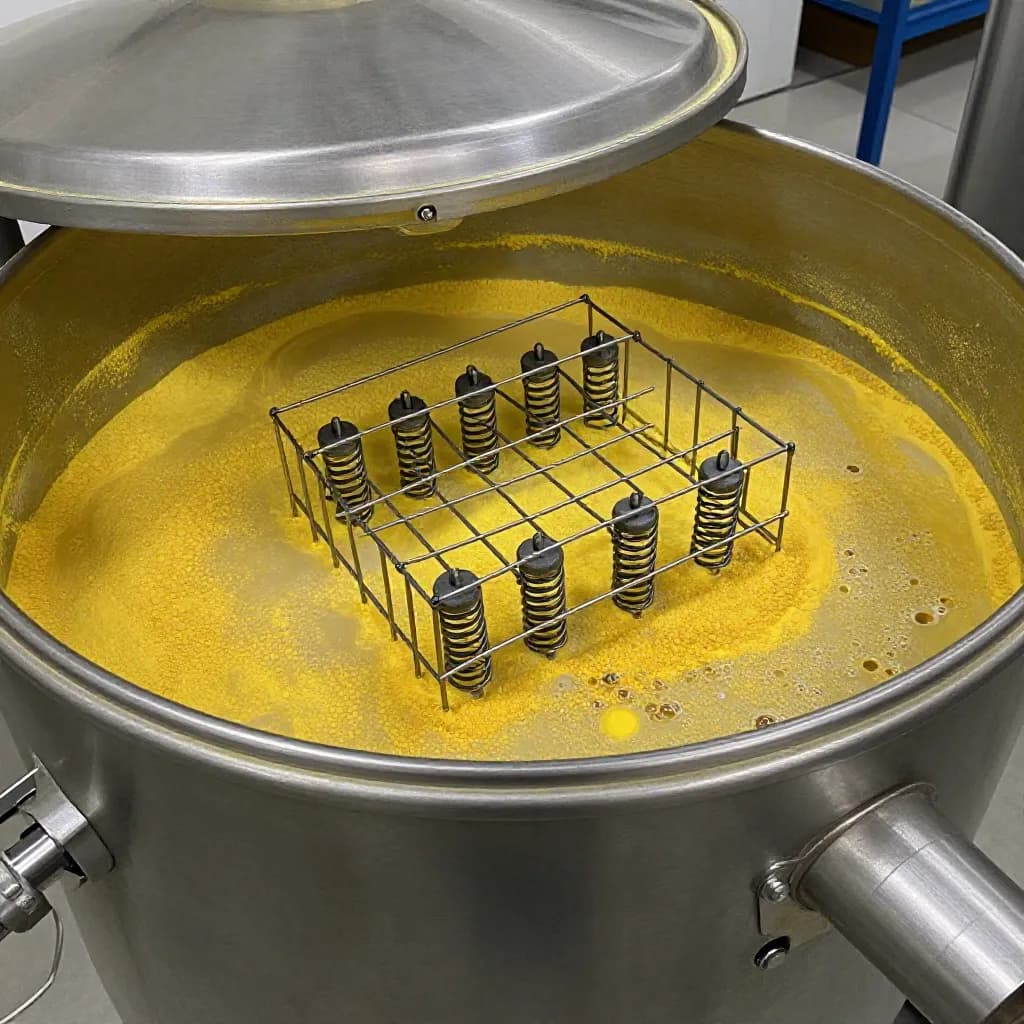
Spring steel components — compression springs, extension springs, torsion springs, leaf springs, and wire forms used in automotive, industrial, and consumer applications — add the requirement that the coating must not significantly alter the spring's mechanical properties. The coating must be flexible enough to withstand the repeated deflection cycles that springs experience in service without cracking, delaminating, or fatiguing. It must also be thin enough to maintain dimensional tolerances — a spring designed to fit within a specific housing cannot accommodate a thick coating that increases its outside diameter.
Ready to Start Your Project?
From one-off customs to 15,000-part production runs — get precise pricing in 24 hours.
On This Page
Spring Steel and Wire: Unique Coating Substrates
The coating methods used for wire and spring products differ from conventional electrostatic spray application. Fluidized bed coating, electrostatic fluidized bed coating, and specialized electrostatic spray techniques are the primary methods, each suited to different product types, production volumes, and coating thickness requirements. The choice of coating material also differs — thermoplastic powders such as nylon (polyamide), polyethylene, and PVC are widely used for wire products, in addition to the thermoset polyester and epoxy powders that dominate metal fabrication coating.
Fluidized Bed Coating: Process and Applications
Fluidized bed coating is the oldest and most established powder coating method, predating electrostatic spray by several decades. The process involves heating the workpiece to a temperature above the powder's melting point, then immersing it in a tank of powder that is fluidized (suspended in air) by compressed air flowing through a porous membrane at the bottom of the tank. The hot metal surface melts the powder particles on contact, building up a continuous coating layer whose thickness is controlled by the metal temperature, immersion time, and powder characteristics.
The fluidized bed process is particularly well-suited to wire products and springs because it coats all surfaces simultaneously and uniformly, regardless of geometry. Unlike electrostatic spray, which relies on line-of-sight access and electrostatic field lines that can be disrupted by complex geometries, fluidized bed coating deposits powder on every surface that contacts the fluidized powder cloud — including the inside of coils, the underside of wire intersections, and recessed areas that electrostatic spray cannot reach. This complete coverage is essential for corrosion protection of wire products that will be exposed to moisture, chemicals, or food contact.
Typical fluidized bed coating parameters for wire products involve preheating the part to 250-350°C (depending on the powder type and desired film thickness), immersing in the fluidized bed for 2-10 seconds, withdrawing, and allowing the coating to fuse and smooth during a brief post-heat or ambient cooling period. Film thickness is typically 200-500 micrometers — significantly thicker than electrostatic spray coatings — providing robust barrier protection and a smooth, rounded coating profile on wire intersections and edges. The thick film build is advantageous for wire products because it provides substantial corrosion protection and a comfortable, non-abrasive surface for consumer products like dishwasher racks and refrigerator shelves.
Nylon and Thermoplastic Powder Coatings for Wire
Nylon (polyamide) powder coatings are the dominant coating material for wire products in food contact, consumer appliance, and industrial applications. Nylon 11 and Nylon 12 are the most commonly used grades, offering excellent chemical resistance, abrasion resistance, flexibility, and FDA compliance for food contact applications. Nylon coatings applied by fluidized bed at 200-400 micrometers provide a tough, resilient barrier that withstands the mechanical abuse, chemical exposure, and thermal cycling that wire products experience in service.
Nylon 11 (derived from castor oil, making it partially bio-based) offers superior chemical resistance and lower moisture absorption than Nylon 12, making it preferred for dishwasher racks, food processing equipment, and chemical-resistant applications. Nylon 12 provides slightly better dimensional stability and lower moisture absorption in humid environments. Both grades are available in a full range of colors and can be formulated with antimicrobial additives for food service and healthcare applications.
Polyethylene powder coatings — both low-density (LDPE) and high-density (HDPE) — are used for wire products requiring maximum chemical resistance at lower cost than nylon. Polyethylene provides excellent resistance to acids, alkalis, and solvents, making it suitable for chemical processing equipment, laboratory racks, and industrial wire baskets. PVC (polyvinyl chloride) plastisol coatings, applied by dip coating rather than fluidized bed, are used for tool handles, fence posts, and industrial wire products where cost is the primary driver. Thermoplastic polyester (PET) coatings offer a balance of chemical resistance, UV stability, and mechanical properties for outdoor wire products such as garden furniture and fencing.
Thin Wire Challenges and Solutions
Coating thin wire — below 3 mm diameter — presents specific challenges related to thermal mass, coating thickness control, and handling. Thin wire has very low thermal mass, meaning it heats up and cools down extremely rapidly. In fluidized bed coating, a thin wire preheated to 300°C may cool below the powder's melting point within seconds of immersion, limiting the coating thickness that can be achieved in a single dip. Conversely, the rapid heating rate means that thin wire can reach excessive temperatures quickly in a preheat oven, risking metallurgical changes in spring steel (tempering or annealing) that alter the spring's mechanical properties.
For spring steel wire, the preheat temperature must be carefully controlled to avoid exceeding the steel's tempering temperature. Carbon spring steel tempered at 300-400°C will lose hardness and spring force if reheated above its original tempering temperature. Stainless spring steel (302, 304, 17-7PH) is less sensitive but can still experience property changes at elevated temperatures. The preheat temperature for fluidized bed coating should be validated against the specific spring steel grade and temper condition to ensure that mechanical properties are not degraded. In practice, this often limits the preheat temperature to 250-300°C for carbon spring steel, which in turn limits the achievable coating thickness per dip.
Handling thin wire products during the coating process requires fixtures and conveyors designed to support the wire without creating uncoated contact points. Wire products are typically hung from hooks or placed on carriers that contact the product at non-critical points — areas that will be hidden in assembly or that are not exposed to the service environment. For continuous wire coating (fence wire, cable, and wire rope), the wire is fed continuously through a preheat zone, fluidized bed or electrostatic spray zone, and post-heat/cooling zone at speeds of 5-30 meters per minute. Tension control is critical to prevent wire distortion during heating, and the coating zone must be long enough to achieve the required film build at the line speed.
Electrostatic Spray for Wire and Spring Products
While fluidized bed coating dominates thick-film applications on wire products, electrostatic spray is used when thinner coatings (40-100 micrometers) are required or when the product geometry is better suited to spray application. Thermoset polyester and epoxy-polyester powders applied by electrostatic spray provide decorative and protective finishes on wire shelving, display racks, wire baskets, and spring components where the thick build of fluidized bed coating is unnecessary or undesirable.
The Faraday cage effect is a significant challenge when spraying wire products because the open, three-dimensional geometry of wire forms creates numerous recesses and intersections where electrostatic field lines cannot penetrate effectively. The back side of wire runs, the inside of coil springs, and the intersection points where wires cross or are welded together are all prone to thin or missing coating. Tribo-charging guns improve penetration compared to corona guns, and manual touch-up of critical areas may be necessary for products with complex geometries.
Electrostatic fluidized bed (EFB) coating offers a hybrid approach that combines elements of both fluidized bed and electrostatic spray. In EFB, the powder in the fluidized bed is electrostatically charged by corona electrodes embedded in the fluidized bed or positioned above it. The charged powder cloud rises above the bed and deposits on grounded parts positioned above or passed through the charged cloud. EFB can coat parts at ambient temperature (unlike conventional fluidized bed, which requires preheating), producing film thicknesses of 50-250 micrometers — intermediate between electrostatic spray and conventional fluidized bed. This makes EFB suitable for wire products that need thicker coatings than spray can efficiently provide but thinner than conventional fluidized bed produces.
Fence, Rack, and Industrial Wire Applications
Chain-link fence fabric, welded wire mesh panels, and ornamental iron fence components represent a major market for powder-coated wire products. These products require corrosion protection for 15-25 years of outdoor exposure, resistance to UV degradation, and mechanical toughness to withstand handling, installation, and service impacts. The coating must also resist soil contact corrosion for fence posts and bottom rails that are partially buried.
Polyester powder coating applied by electrostatic spray at 60-100 micrometers is the standard finish for ornamental fence panels and components, providing color options, UV resistance, and corrosion protection. For chain-link fence fabric, continuous coating processes apply polyester or PVC coatings to the wire before it is woven into fabric. The coated wire passes through a fluidized bed or electrostatic spray zone at speeds of 10-30 meters per minute, with film thickness controlled by line speed, powder delivery rate, and wire temperature. Zinc-coated (galvanized) wire with a polymer topcoat provides a duplex system with both galvanic and barrier protection for maximum service life.
Dishwasher racks and refrigerator shelves are high-volume consumer applications that demand food-safe coatings with excellent chemical resistance, thermal cycling tolerance, and aesthetic durability. Nylon 11 or Nylon 12 applied by fluidized bed at 250-400 micrometers is the industry standard, providing FDA-compliant food contact surfaces that withstand thousands of dishwasher cycles (exposure to 60-75°C water, alkaline detergent, and mechanical loading) without cracking, peeling, or discoloring. The thick nylon coating also provides a cushioning effect that protects dishes and glassware from chipping. Quality control for dishwasher rack coatings includes adhesion testing after thermal cycling (1000+ cycles between 20°C and 75°C), chemical resistance testing with dishwasher detergent solutions, and flexibility testing to verify that the coating withstands rack loading and unloading without cracking.
Hydrogen Embrittlement and Spring Steel Considerations
Hydrogen embrittlement is a critical concern when processing high-strength spring steel through acid-based pretreatment or electroplating processes prior to powder coating. Hydrogen atoms generated during acid pickling or electroplating can diffuse into the steel microstructure, concentrating at grain boundaries and stress concentration points. In high-strength steels (above approximately 1000 MPa tensile strength), this absorbed hydrogen can cause delayed brittle fracture — sudden, catastrophic failure under sustained load that may occur hours, days, or weeks after processing.
Spring steels commonly used in automotive and industrial applications — including SAE 1070-1095 carbon steel, 5160 chrome-vanadium, 9260 silicon-manganese, and 302/304 stainless — can be susceptible to hydrogen embrittlement when hardened to high strength levels. The risk is greatest for springs that operate under sustained tensile stress, such as extension springs and torsion springs. Compression springs, which operate under compressive stress, are less susceptible but not immune.
Prevention of hydrogen embrittlement in spring steel coating operations requires avoiding or minimizing acid exposure during pretreatment. Mechanical pretreatment (grit blasting or shot blasting) is preferred over acid pickling for high-strength spring steel. If acid cleaning is necessary, the exposure time should be minimized, inhibited acid solutions should be used, and a post-cleaning bake at 190-220°C for 4-24 hours (per ASTM F519 or equivalent) should be performed within 4 hours of acid exposure to drive absorbed hydrogen out of the steel before it can cause damage. The powder coating cure cycle at 180-200°C provides some hydrogen relief but may not be sufficient for heavily embrittled parts. Quality control should include hydrogen embrittlement testing per ASTM F519 on representative samples from each production batch of high-strength spring components.
Frequently Asked Questions
What is fluidized bed powder coating?
Fluidized bed coating involves preheating the part to 250-350°C and immersing it in a tank of powder suspended in air. The hot surface melts powder on contact, building a 200-500 micrometer coating in 2-10 seconds. It coats all surfaces uniformly regardless of geometry, making it ideal for wire products, springs, and complex shapes that electrostatic spray cannot reach effectively.
Why is nylon used for dishwasher rack coatings?
Nylon 11 and Nylon 12 provide excellent chemical resistance to dishwasher detergents, FDA compliance for food contact, flexibility to withstand rack loading cycles, and thermal cycling tolerance (thousands of cycles between 20°C and 75°C). Applied at 250-400 micrometers by fluidized bed, the thick coating also cushions dishes and glassware against chipping.
Can powder coating damage spring steel properties?
Yes, if the preheat or cure temperature exceeds the steel's original tempering temperature, it can reduce hardness and spring force. Carbon spring steel tempered at 300-400°C is most at risk. Preheat temperatures must be validated against the specific steel grade and temper. Acid pretreatment can also cause hydrogen embrittlement in high-strength springs, requiring mechanical pretreatment or post-baking.
How do you coat the inside of coil springs?
Fluidized bed coating is the most effective method because the fluidized powder cloud penetrates inside the coil and coats all surfaces uniformly. Electrostatic spray cannot effectively reach the inside of tightly wound coils due to the Faraday cage effect. For open-coil springs, electrostatic fluidized bed (EFB) coating provides an intermediate option with better penetration than spray.
What causes hydrogen embrittlement in spring steel coating?
Hydrogen atoms generated during acid pickling or electroplating diffuse into the steel, concentrating at grain boundaries. In high-strength steels (above 1000 MPa), this causes delayed brittle fracture under sustained load. Prevention requires mechanical pretreatment instead of acid pickling, or post-acid baking at 190-220°C for 4-24 hours within 4 hours of acid exposure.
Ready to Start Your Project?
From one-off customs to 15,000-part production runs — get precise pricing in 24 hours.