Sheet metal fabrications — enclosures, cabinets, brackets, panels, housings, guards, and covers produced from flat sheet steel or aluminum by cutting, bending, punching, and welding — represent the highest-volume product category in the powder coating industry. These components are found in virtually every sector: electrical and electronic enclosures, HVAC equipment, office and industrial furniture, agricultural machinery, medical equipment, vending machines, ATMs, and countless other applications. The combination of sheet metal's versatility and economy with powder coating's durability and environmental advantages makes this pairing the default for industrial and commercial metal products.
Technical
Powder Coating Sheet Metal Fabrications: Weld Prep, Edge Coverage, and Design for Coating
Sundial Powder Coating·April 22, 2026·14 min
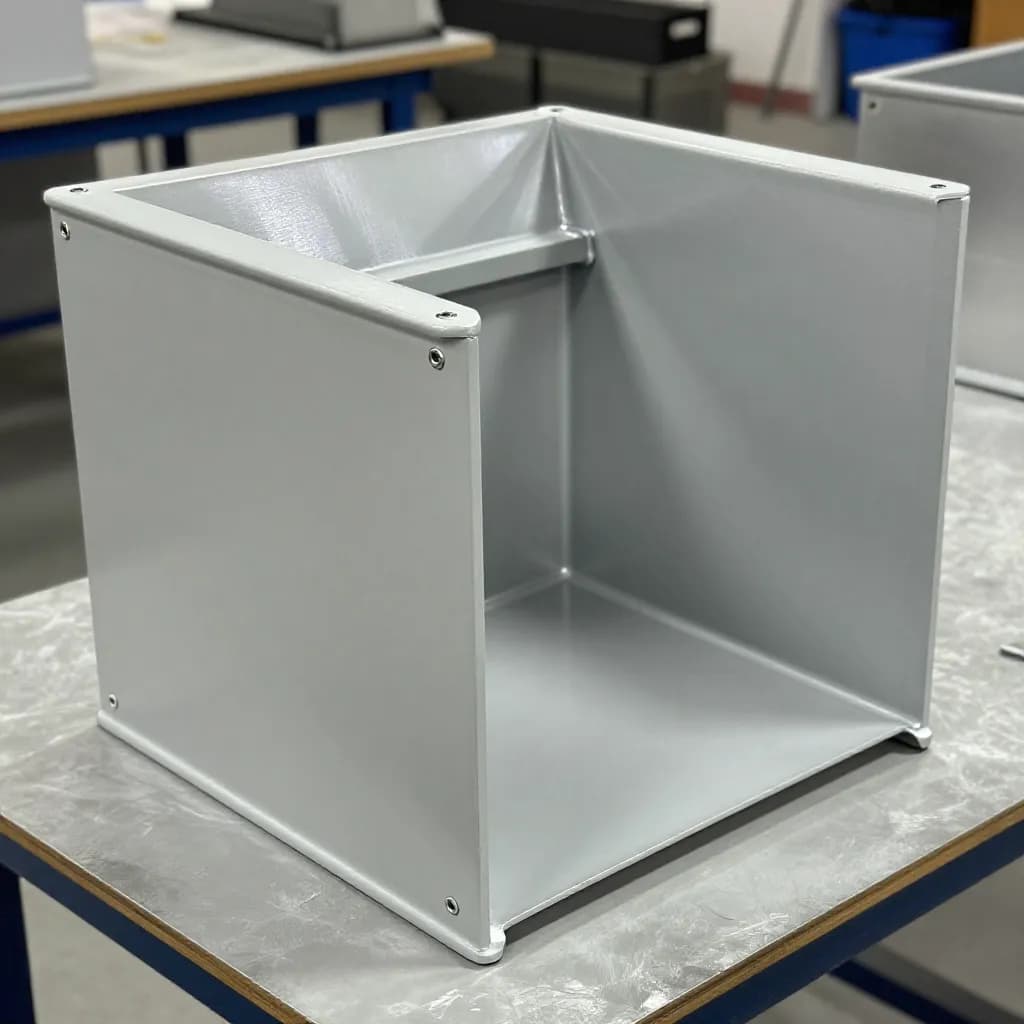
Despite the familiarity of sheet metal as a coating substrate, achieving consistently high-quality powder coatings on fabricated sheet metal requires attention to design details, fabrication practices, and surface preparation that are frequently overlooked. The most common coating defects on sheet metal fabrications — thin edges, weld-related defects, poor coverage in recesses, and corrosion at cut edges — are almost always traceable to upstream design or fabrication decisions rather than to the coating process itself. A well-designed, well-fabricated sheet metal part is straightforward to coat; a poorly designed part with sharp edges, rough welds, and trapped volumes will produce coating defects regardless of how skilled the coating applicator is.
Ready to Start Your Project?
From one-off customs to 15,000-part production runs — get precise pricing in 24 hours.
On This Page
Sheet Metal Fabrications: The Bread and Butter of Powder Coating
This reality has driven the development of 'design for coating' guidelines that integrate coating requirements into the product design and fabrication process from the earliest stages. By considering coating performance during design — specifying edge radii, weld quality, drainage holes, and hanging points — designers can dramatically improve coating quality while reducing rework and rejection rates.
The Sharp Edge Problem: Why Edges Fail First
Sharp edges are the single most common cause of premature coating failure on sheet metal fabrications. When powder coating melts and flows during the cure cycle, surface tension draws the liquid coating away from sharp edges toward flat surfaces — a phenomenon known as edge pull-back or edge recession. The result is a coating that is 30-60% thinner at edges than on adjacent flat surfaces. Since edges are also the points most exposed to mechanical damage, moisture ingress, and corrosion initiation, this combination of thin coating and high exposure makes edges the weakest link in the coating system.
The physics of edge pull-back are straightforward. Surface tension in the molten powder creates a force that minimizes the surface area of the liquid film. On a flat surface, this force produces a uniform film. At a sharp edge (radius less than 0.3 mm), the high curvature creates a strong surface tension gradient that pulls the liquid coating away from the edge toward the lower-curvature flat surface on either side. The sharper the edge, the stronger the pull-back force and the thinner the resulting coating. Laser-cut and sheared edges, which can have radii approaching zero, experience the most severe pull-back.
The solution is to eliminate sharp edges through design specification and fabrication practice. A minimum edge radius of 0.5 mm (achieved by deburring, tumbling, or specifying a radius on the drawing) reduces edge pull-back to acceptable levels for most applications. For high-corrosion environments, a minimum radius of 1.0 mm is recommended. Qualicoat and other quality standards require minimum edge radii and include edge film thickness in their quality control protocols. Powder formulations with enhanced edge coverage — typically containing flow modifiers that increase the viscosity of the molten powder, reducing the surface tension-driven flow away from edges — can also improve edge performance, though they cannot fully compensate for extremely sharp edges.
Weld Preparation for Powder Coating
Weld quality has a direct and significant impact on powder coating quality. Welds that are acceptable for structural purposes may be completely unacceptable for coating purposes — a weld that provides adequate strength but has spatter, undercut, porosity, or irregular profile will produce coating defects that compromise both appearance and corrosion protection. The coating applicator cannot fix weld defects; they must be addressed during fabrication.
Weld spatter is the most common weld-related coating defect. Spatter particles are loosely attached to the surface and will eventually detach in service, taking the coating with them and exposing bare steel to corrosion. All weld spatter must be removed before coating — by grinding, chipping, or anti-spatter treatment during welding. Anti-spatter sprays or pastes applied to the base metal adjacent to the weld before welding prevent spatter adhesion and allow easy removal after welding. MIG (GMAW) welding produces more spatter than TIG (GTAW) welding, and optimizing MIG welding parameters (wire feed speed, voltage, shielding gas composition) can significantly reduce spatter generation.
Weld porosity — gas pockets trapped in the weld metal — causes outgassing during the powder cure cycle, producing pinholes and craters in the coating over the weld area. Porosity is caused by contaminated base metal (oil, rust, moisture), inadequate shielding gas coverage, or incorrect welding parameters. Clean base metal, proper joint fit-up, adequate gas flow, and optimized welding parameters minimize porosity. For critical coating applications, weld quality should meet ISO 5817 quality level B (stringent), which limits porosity, undercut, and profile irregularity to levels that are compatible with high-quality powder coating. Post-weld grinding to smooth the weld profile and remove surface irregularities further improves coating quality over weld areas.
Design for Coating: Drainage, Access, and Hanging
Designing sheet metal fabrications for optimal powder coating performance requires consideration of several factors that are not always obvious to designers unfamiliar with the coating process. Drainage is one of the most important — any enclosed or semi-enclosed volume in the fabrication will trap pretreatment chemicals, rinse water, and air during the coating process. Trapped liquids cause staining, blistering, and corrosion, while trapped air prevents powder from reaching internal surfaces and causes outgassing during cure.
Drainage holes should be provided in all enclosed sections, positioned at the lowest point when the part is in its coating orientation (which may differ from its installed orientation). A minimum hole diameter of 8-10 mm is recommended to allow free drainage of viscous pretreatment chemicals. For box sections and tubular members, holes at both ends allow air to escape from one end while liquid drains from the other. The drainage holes can be plugged after coating if they are not acceptable in the finished product, though many designers incorporate them into the product design as ventilation or cable access openings.
Hanging point design is another critical consideration. Every powder-coated part must be suspended from a conveyor or rack during pretreatment, coating, and cure, and the hanging point creates an uncoated contact area where the hook or fixture touches the part. Designers should specify hanging points in non-critical areas — hidden surfaces, assembly interfaces, or areas that will be covered by other components. Hanging holes (6-8 mm diameter) in non-visible locations provide consistent, reliable hanging points that minimize contact marks. The hanging orientation should be considered during design — parts should hang in an orientation that allows pretreatment chemicals to drain freely, powder to reach all critical surfaces, and the cured coating to flow and level without runs or sags.
Recessed Areas, Faraday Cages, and Internal Surfaces
Sheet metal fabrications frequently include recessed features — channels, pockets, flanges, and internal corners — that create Faraday cage effects during electrostatic powder application. The electrostatic field lines that guide charged powder particles toward the grounded workpiece wrap around external surfaces but cannot penetrate into recesses, leaving internal surfaces with thin or absent coating. The severity of the Faraday cage effect depends on the depth-to-width ratio of the recess — shallow, wide recesses are relatively easy to coat, while deep, narrow channels are extremely difficult.
Design strategies to minimize Faraday cage effects include increasing the opening width of recesses relative to their depth, radiusing internal corners (minimum 3-5 mm radius) to improve powder flow and electrostatic field penetration, and avoiding deep blind pockets where possible. When deep recesses are functionally necessary, providing access holes or slots in the back wall allows powder to be sprayed from multiple angles, improving coverage.
Application strategies for recessed areas include using tribo-charging guns (which produce a more uniform electrostatic field than corona guns and avoid back-ionization in confined spaces), reducing electrostatic voltage to minimize the Faraday cage effect (at the cost of reduced deposition efficiency on flat surfaces), and using manual touch-up guns to apply additional powder to recessed areas before the part enters the cure oven. Some advanced automatic coating systems use programmable gun arrays that adjust voltage, powder flow, and gun position based on the part geometry, optimizing coverage for both flat surfaces and recessed areas in a single pass. For parts with severe Faraday cage challenges, a two-pass coating approach — first pass at low voltage for recesses, second pass at standard voltage for flat surfaces — can achieve uniform coverage throughout.
Material Selection and Gauge Considerations
The choice of sheet metal material and gauge affects both the coating process and the finished product performance. Cold-rolled steel (CRS) is the most common substrate for powder-coated fabrications, offering a smooth, clean surface that accepts pretreatment and coating readily. Hot-rolled steel (HRS) has a rougher surface with mill scale that must be removed by blast cleaning or heavy acid pickling before coating — the additional preparation cost makes HRS less economical for coating despite its lower material cost. Galvanized steel (both hot-dip and electrogalvanized) provides built-in corrosion protection but introduces zinc outgassing concerns as discussed in the galvanized steel article.
Sheet gauge (thickness) affects the thermal behavior of the part during cure. Thin-gauge sheet (0.5-1.0 mm) heats up rapidly in the cure oven, reaching cure temperature in minutes. This rapid heating can cause the powder to melt and flow before the entire part reaches a uniform temperature, potentially creating runs on vertical surfaces and thin spots on horizontal surfaces. Thicker gauge sheet (2.0-4.0 mm and above) heats more slowly and uniformly but requires longer oven dwell times to reach cure temperature throughout.
Parts with mixed gauge thicknesses — common in fabrications where structural members are thicker than cosmetic panels — present a cure optimization challenge. The thin sections reach cure temperature first and may over-cure while the thick sections are still ramping. Oven programming with controlled ramp rates and extended soak times at cure temperature helps equalize the cure across different thicknesses. Alternatively, designing the fabrication so that thick and thin sections can be coated and cured separately, then assembled after coating, eliminates the mixed-gauge cure problem at the cost of additional assembly operations.
Quality Standards and Inspection Protocols
Quality control for powder-coated sheet metal fabrications follows established international standards, with the specific requirements depending on the application and end-use environment. Film thickness measurement per ISO 2178 (magnetic method for steel) or ISO 2360 (eddy current method for aluminum) is the most fundamental quality check, performed at multiple points on each part including flat surfaces, edges, corners, and recessed areas. Minimum film thickness requirements vary by application — 60 micrometers for standard interior use, 80 micrometers for exterior industrial, and 100+ micrometers for heavy-duty corrosion protection.
Adhesion testing per ISO 2409 (cross-hatch) is performed on production parts or test panels processed alongside production. Classification 0 (no detachment) is the target for all applications, with classification 1 (less than 5% detachment) acceptable for some interior applications. Pull-off adhesion testing per ISO 4624 provides quantitative data, with values above 5 MPa considered acceptable. Adhesion testing should be performed both on flat surfaces and over weld areas, as weld-related adhesion failures are a common defect mode.
Visual inspection under controlled lighting identifies surface defects including orange peel, pinholes, craters, runs, sags, color variation, and contamination. Inspection lighting should include both direct overhead illumination and raking light at a low angle, which reveals surface texture defects that are invisible under direct light. For high-quality decorative applications, inspection criteria may include gloss measurement per ISO 2813, color measurement per ISO 11664, and surface roughness assessment. Corrosion resistance testing per ISO 9227 (salt spray) is performed on test panels at defined intervals — typically weekly or monthly — to verify ongoing process capability. The test duration and acceptance criteria depend on the application specification, ranging from 240 hours for interior applications to 1000+ hours for demanding exterior environments.
Frequently Asked Questions
Why does powder coating fail at edges on sheet metal?
Surface tension in the molten powder during cure pulls the liquid coating away from sharp edges toward flat surfaces, reducing edge film thickness by 30-60%. This edge pull-back makes edges the weakest point for corrosion. The solution is specifying minimum edge radii of 0.5 mm (1.0 mm for high-corrosion environments) through deburring, tumbling, or design specification.
How should welds be prepared for powder coating?
Remove all weld spatter by grinding or use anti-spatter treatment during welding. Grind weld profiles smooth to eliminate undercut and sharp transitions. Weld quality should meet ISO 5817 level B to minimize porosity that causes outgassing. TIG welding produces cleaner welds than MIG for coating-critical applications. Clean base metal before welding to prevent porosity.
What drainage holes are needed for powder coating?
All enclosed sections need drainage holes at the lowest point (in coating orientation) with minimum 8-10 mm diameter. Box sections need holes at both ends for air escape and liquid drainage. Without drainage, trapped pretreatment chemicals cause staining and blistering, trapped air prevents powder coverage, and trapped moisture causes outgassing during cure.
What is the minimum edge radius for powder coating?
A minimum edge radius of 0.5 mm is recommended for standard applications, achieved by deburring, tumbling, or design specification. For high-corrosion environments (C4-C5 per ISO 12944), a minimum radius of 1.0 mm is recommended. Laser-cut and sheared edges with near-zero radius experience the most severe coating pull-back and should always be deburred.
How do you coat recessed areas on sheet metal fabrications?
Use tribo-charging guns for better penetration into recesses, reduce electrostatic voltage to minimize the Faraday cage effect, and use manual touch-up for critical areas. Design strategies include increasing recess opening width, radiusing internal corners (3-5 mm minimum), and providing access holes in back walls. Two-pass coating (low voltage for recesses, standard for flats) can achieve uniform coverage.
Ready to Start Your Project?
From one-off customs to 15,000-part production runs — get precise pricing in 24 hours.